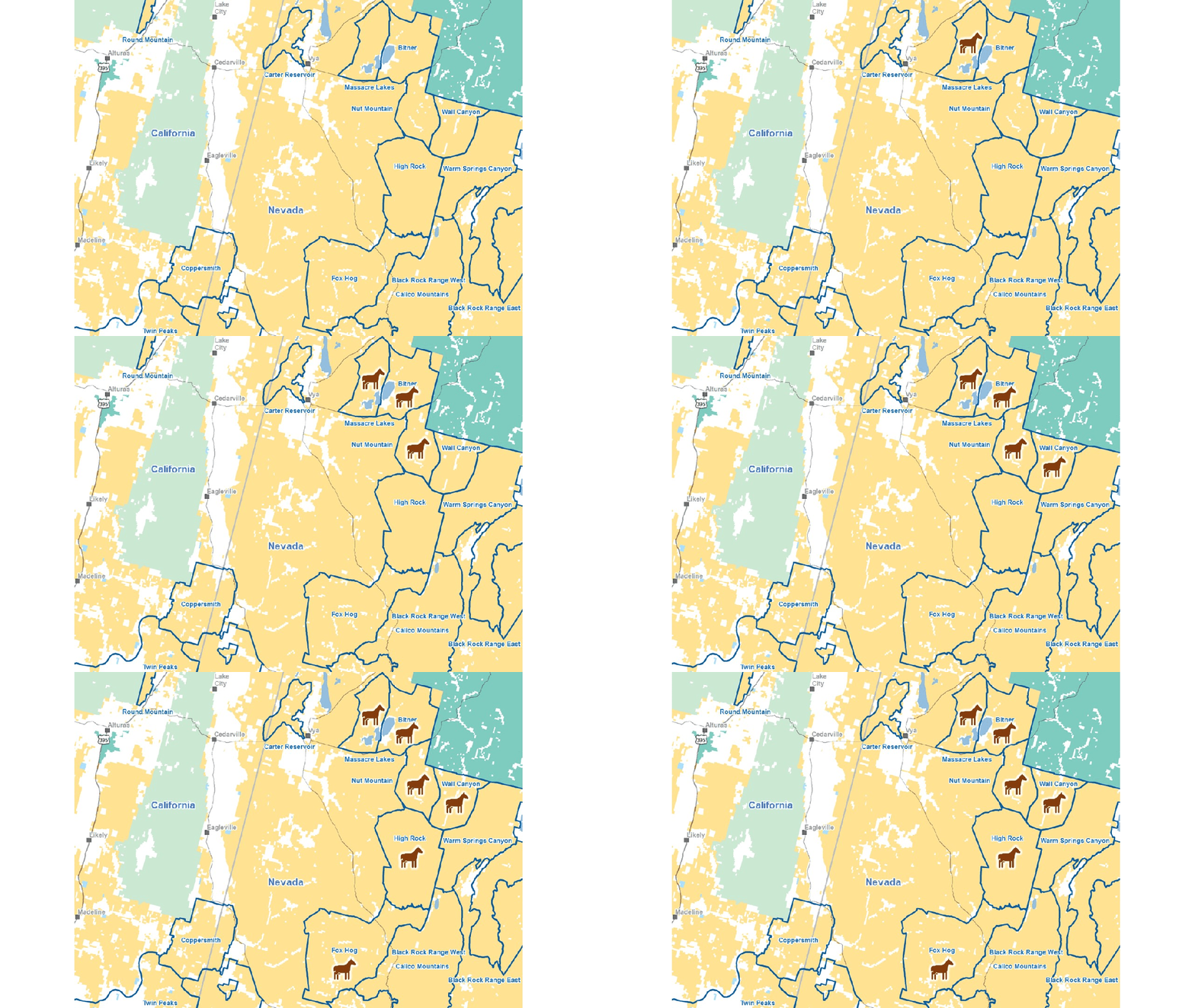
Delamar Roundup Day 8

The incident began on December 6.  Gather stats through December 13:

  • Horses captured: 325
  • Goal: 414
  • Returned: 0
  • Deaths: 15
  • Shipped: 224

Helicopters were grounded on Day 7 due to weather.

One horse was put down on Day 6 and three on Day 8 due to pre-existing conditions, bringing the death rate to 4.6%.

Foals accounted for 15.1% of the horses gathered.  Roughly 51% of captured adults were males and 49% were females.

Body condition scores are not known.

The number of horses shipped is 248 according to the gather page.  No shipments were reported on Day 8.

The number of unaccounted-for animals is 325 – 0 – 15 – 224 = 86.

RELATED: Delamar Roundup Day 5.

Delamar Roundup Day 5

The incident began on December 6.  Gather stats through December 10:

  • Horses captured: 265
  • Goal: 414
  • Returned: 0
  • Deaths: 11
  • Shipped: 137

Three horses were put down on Day 4 and one on Day 5 due to pre-existing conditions, bringing the death rate to 4.2%.

Foals accounted for 14.7% of the horses gathered.  Roughly 49% of captured adults were males and 51% were females.

Body condition scores are not known.

The number of horses shipped is 161 according to the gather page.  No shipments were reported on Day 4.

The number of unaccounted-for animals as of Day 5 is 117.

RELATED: Delamar Roundup Day 3.

Confusion Roundup Day 11

The incident began on November 29.  Gather stats through December 9:

  • Horses gathered: 303
  • Goal: 500
  • Returned: 1
  • Deaths: 5
  • Shipped: 265

Helicopters were grounded on Day 10 and no deaths were reported on Days 10 and 11.

Foals accounted for 24% of the horses gathered.  Roughly 40% of the captured adults were males and 60% were females.

The cumulative total is 304, according to the gather page.  The discrepancy is probably in the November 30 figures.

Body condition scores on Day 11 ranged from three to five.

The number of unaccounted-for animals is 32.  The contractor may be holding them on site.

The collared mare taken to Swasey may have been part of a research project.  GPS radios are in use at the Frisco HMA, probably elsewhere.

RELATED: Confusion Roundup Day 9.

New Desatoya Gather Plan Available for Review

BLM announced today the beginning of a 30-day comment period on a draft EA for wild horse management actions over the next ten years.

The Proposed Action (Alternative 1) features roundups, contraceptives, IUDs and sex ratio skewing.

The HMA covers 161,678 acres in central Nevada and has an AML of 180, for a stocking rate of 1.1 horses per thousand acres.  The map in Figure 1-1 shows the gather area, denoted by a red boundary.  The HMA has been shaded yellow.

Desatoya Gather Plan Map

The HMA intersects four grazing allotments.  The horses allowed by plan receive 2,160 AUMs per year, compared to 9,608 AUMs per year for livestock, according to data in Table 3-2 of the EA.

Comments will be accepted through January 9.

Delamar Roundup Day 3

The incident began December 6.  Gather stats through December 8:

  • Horses captured: 135
  • Goal: 414
  • Returned: 0
  • Deaths: 7
  • Shipped: 84

A horse died on Day 2 due to injuries related to the roundup but no details were given.

Three horses were put down on Day 2 and two on Day 3 due to pre-existing conditions but no details were provided.  “TBD.”  The death rate is now over five percent.

Foals accounted for 18.5% of the horses gathered.  Roughly 49% of captured adults were males and 51% were females.

Body condition scores are not known.

The number of unaccounted-for animals is 44, as of today.  The contractor may be holding them on site.

RELATED: Delamar Roundup Underway.

Pancake Wild Horses Get Short End of Stick

The Pancake HMA, largest of the four areas in the Pancake Complex, covers 855,000 acres and has an AML of 493, according to Table 1 of the Draft EA for wild horse management actions therein.

The horses allowed by plan require 493 × 12 = 5,916 AUMs per year and the stocking rate allowed by plan is 493 ÷ 855,000 × 1,000 = 0.6 wild horses per thousand acres.

As noted earlier, fractional stocking rates may indicate large amounts of forage diverted to privately owned livestock.

The HMA intersects six allotments.  Table 3 in the EA provides grazing seasons, livestock types and permitted AUMs.  Although cattle and sheep are allowed in the area, the following calculations are based on cow/calf pairs only, for a direct comparison to wild horses.  The resource requirements of cow/calf pairs and wild horses are said to be equivalent.

The map in Appendix I of the EA (page 78 in the pdf) does not show the allotment boundaries relative to those of the horse areas.

Table 3 does not provide the allotment sizes so those were sourced from the Allotment Master in the Rangeland Administration System.  Five of them are administered by the Bristlecone Field Office and one is managed by the Mount Lewis Field Office.

A footnote in Table 3 says one of the Duckwater pastures has been closed to grazing since 2000 and that may explain why the permitted AUMs in the table are less than those in the RAS report.  The impact on grazing land inside the HMA is not known, but the total calculated acreage exceeds the size of the HMA, suggesting that it’s 100% subject to permitted grazing.

A map like that in Appendix V of the Caliente EA (page 81 in the pdf) would be a nice addition to the Pancake EA, if you’d like to submit that as a comment.

Pancake HMA Calcs-1

The Duckwater permittees would have to place 1,556 cow/calf pairs inside the allotment to graze off 18,667 AUMs in twelve months (18,667 ÷ 12).  The stocking rate would be 1.9 cow/calf pairs per thousand acres (1,556 ÷ 807,662 × 1,000).

The forage available to livestock on the Duckwater allotment inside the HMA is 1 × 18,667 = 18,667 AUMs per year.  The forage available to livestock on the Six Mile allotment inside the HMA is .96 × 1,209 = 1,161 AUMs per year, assuming the resource is evenly distributed across the parcel.

The total estimated forage available to livestock inside the HMA is 23,662 AUMs per year.

The Six Mile permittee would have to place 97 cow/calf pairs inside the HMA to consume 1,161 AUMs in twelve months (1,161 ÷ 12).  The total estimated number of cow/calf pairs inside the HMA is 2,371, with a weighted average grazing season of ten months per year (23,662 ÷ 2,371).

The estimated stocking rate allowed by plan inside the HMA is 2,371 ÷ 855,000 × 1,000 = 2.8 cow/calf pairs per thousand acres.

These figures are compared in the following charts.

Pancake HMA Charts-1

The HMA—an area set aside for wild horses—is managed primarily for livestock.  Cattle receive four times as much forage as the horses with a stocking rate that’s five times higher.

If the current population of horses, thought to be around 1,829 according to Table 1 in the EA, is destroying their habitat at a stocking rate of 2.1 animals per thousand acres, what do you suppose is happening when cattle are turned out a rate of 2.8 cow/calf pairs per thousand acres?

The forage assigned to livestock would support an additional 1,972 wild horses for a true AML of 2,465, which exceeds the current population by a comfortable margin.

There is no need for a roundup and no need for a fertility control program.

Unfortunately, those will be the primary enforcement methods until the management framework changes.  The ranchers prefer roundups while the advocacy groups push for contraceptives.  Nobody’s sticking up for the horses.

RELATED: Initial Thoughts on Pancake Gather Plan, Pancakes and Pie Charts!

Confusion Roundup Day 9

The incident began November 29.  Gather stats through December 7:

  • Horses captured: 270
  • Goal: 500
  • Returned: 1
  • Deaths: 5
  • Shipped: 226

No deaths were reported on Days 8 and 9.

Foals accounted for 24% of the total since Day 1.  Of the captured adults, 40% were males and 60% were females.

The number of horses captured is 271, according to the gather page.  The discrepancy is probably in the November 30 figures.

Body condition scores on Days 8 and 9 were mostly threes and fours.

The number of unaccounted-for animals is 38.  The contractor may be holding them on site.

One mare was collared and returned to the Swasey HMA.  The date when that occurred is not known.  Was it the horse taken to Delta on November 30?

RELATED: Confusion Roundup Day 7.

Confusion Roundup Day 7

The incident began November 29.  Gather stats through December 5:

  • Horses captured: 230
  • Goal: 500
  • Returned: 0
  • Deaths: 5
  • Shipped: 202

Two horses were put down today due to poor body condition.  Although attributed to pre-existing conditions, they’d likely be alive if the roundup didn’t happen.

Foals accounted for 24% of the total.

Of the captured adults, 38% were males and 62% were females.  Do those percentages look like they came from a herd that’s 50% males and 50% females?

The number of horses captured is 231, according to the gather page.  The discrepancy is probably in the November 30 figures.

Body condition scores since the last report were mostly threes and fours.

The number of unaccounted-for animals is 23.  The contractor may be holding them on site.

No horses have shipped to Delta since November 30.

RELATED: Confusion Roundup Day 5.

Who’s Grazing the Delamar and Meadow Valley Allotments?

The roundup will be coordinated by the Caliente Field Office, Ely District, according to the news release.  Over 400 wild horses will be removed from two HAs—part of the Caliente Complex—due to insufficient food and water.

Curiously, these wastelands can support thousands of privately owned cattle at fire-sale prices.  Who benefits from this arrangement?

Map 1 in the Final EA for wild horse management actions in the Complex shows the layout (page 5 in the pdf).  The Delamar Mountains and Meadow Valley Mountains HAs, targets of the roundup, are on the west side.

The map in Appendix V, page 81, shows the allotments.  In this section of the map, Delamar, in light green, intersects four allotments and Meadow Valley, in pink, intersects two.

Delamar and Meadow Valley Allotments

Table 3.2, page 41, provides livestock types, grazing seasons and permitted AUMs.  Note that some of the allotments are in use twelve months per year.

Go to the Rangeland Administration System and right-click on Allotment Master to open the report in a new tab.

  • State: Nevada
  • Office: Caliente
  • Allotment: Oak Springs

Click Apply to run the report.  You can download the results as a pdf file.

The allotment covers 195,049 acres with 9,268 active AUMs, which would support 772 cow/calf pairs over a 12 month grazing season.  Or, if you prefer, 772 wild horses.

The permittee is Delamar Valley Cattle, a producer of range-fed beef.

Go back to the top of the page, uncheck Oak Springs, check Delamar and hit Apply.

The allotment covers 203,000 acres and has 5,558 active AUMs, according to the report.  Same permittee as Oak Springs.  The forage would support 463 cow/calf pairs over a 12 month grazing season, equivalent to 463 wild horses.

You can run through the same steps to look up the other allotments.

The stated reason for the roundup—lack of food—is not consistent with these findings.

The horses are robbing forage from the public-lands ranchers, and they’re not supposed to be there according to the resource management plan (AMLs are zero), so send in the helicopters.

RELATED: Delamar Mountains Emergency Roundup Starts This Weekend.

Confusion Roundup Day 5

The incident began November 29.  Gather stats through December 3:

  • Horses captured: 207
  • Goal: 500
  • Returned: 0
  • Deaths: 3
  • Shipped: 160

One horse died on Day 4 due to a broken neck (related to roundup) and another was put down due to emaciation (pre-existing condition).

Foals accounted for 24% of the total.  Of the captured adults, 37% were males and 63% were females.

The number of horses captured is 208 according to the gather page.  The discrepancy is probably in the November 30 figures.

Body condition scores were mostly threes and fours.

The number of unaccounted-for animals is 44.  The contractor may be holding them on site, with some, perhaps, destined for sterilization.

All horses shipped to Axtell since the last report.

RELATED: Confusion Roundup Day 3.