Wild Horses Found Dead in Southeast Utah

The remains of 16 animals have been discovered on an unnamed grazing allotment between the towns of Bluff and Montezuma Creek, according to a news release posted yesterday by Advocates for Wild Equines.

The horses may have crossed the San Juan River onto BLM land from the Navajo reservation or migrated there from canyons and forests to the west, where wild horses have been spotted.

The Western Watersheds map shows three allotments on the north side of the river between Bluff and Montezuma Creek.

Montezuma Creek Horse Shooting Map 10-20-22

The Allotment Master Report puts all three in the Improve category and the map indicates all AUMs have been assigned to cattle.

There are no HMAs or WHTs in this part of the state.

Many More Wild Horses Lost to Advocates Than Alpine Shooters

A report by KPNX News of Phoenix indicates 25 horses confirmed dead with 25 missing and presumed dead.

That’s fifty wild horses that should be in the forest but aren’t.

To the west, at the Salt River, the losses are higher but nobody complains.

The woman interviewed for the story, ringleader of the Salt River Wild Horse Darting Group, denies life to an estimated 80 wild horses every year with the Montana Solution.

That’s eighty wild horses that should be there but aren’t.  Every year.

To the north, on the Virginia Range, the losses are far greater.

Advocates with the Campaign Against America’s Wild Horses deny life to an estimated 600 wild horses every year with their safe, proven and reversible darting program.

That’s 600 wild horses that should be there but aren’t.  Every year.

The same thing is happening at Onaqui, Sand Wash Basin, McCullough Peaks, Pine Nut Mountains, Piceance, Little Book Cliffs, Spring Creek Basin and Pryor Mountains.

Who’s the greater threat to wild horses?  The advocates or the shooters?

RELATED: Alpine Reward Jumps to $35,000.

Bold Prediction for HR 9154

Ten days have passed since the bill was introduced but the text has not been published, so a little speculation is in order.

Consider this example from the North Lander Complex in Wyoming:

A. Forage allocations before HR 9154, neglecting wildlife:

  • Horses – 11.5%
  • Livestock – 88.5%

B. Forage allocations after HR 9154:

  • Horses – 11.5%
  • Livestock – 88.5%

Conclusion: The bill is of no use to America’s wild horses.

The problem is resource management.

RELATED: Status of HR 9154?

Allocating Resources 05-08-21

Alpine Reward Jumps to $35,000

A report by KPHO News of Phoenix does not indicate who pledged the additional funds.

Previously, the payout was $25,000.

The advocates are still upset that others are getting rid of the horses when they had offered earlier this year to do the same thing.

The incident must not interfere with the removal of wild horses by the Forest Service according to a representative of the Center for Biological Diversity, the group that instigated the roundup of the Jumping Mouse horses in March.

RELATED: Forest Service Confirms Facts as More Alpine Horses Found Dead.

UPDATE: Added video.

Mesa Verde Wild Horses Arrive at Mustang Camp

A report by KOB News of Albuquerque indicates they’re now in the hands of trainers who can’t accomplish anything without bags of alfalfa cubes over their shoulders.

The executive director said of one animal “The biggest problem with this horse is not getting it to come to you, it’s getting it to go away.”

Who could have predicted that?

RELATED: First Wild Horse Band Removed from Mesa Verde National Park.

UPDATE: Added video.

New YouTube Video Doing Well?

Less than two minutes long, it received 100 views in less than 12 hours.

Most videos on the channel don’t reach 50, ever.

New Video 100 Views 10-17-22

The film touches on the safe, proven and reversible fertility control program authorized by the Nevada Department of Agriculture and carried out by the Campaign Against America’s Wild Horses.

Despised by the bureaucrats, ranchers and advocates, Western Horse Watchers brings you the truth about wild horses, resource mismanagement and the Love Triangle on America’s public lands.

RELATED: Beneficiary of Virginia Range Darting Program Revealed.

Getting Rid of Wild Horses 03-18-22

Forest Service Confirms Facts as More Alpine Horses Found Dead

Wildlife activists say at least 25 horses have been killed inside the Apache-Sitgreaves National Forests, with 25 missing as of yesterday, according to a report published this morning by The Washington Post.

The article includes a photo of a dead foal provided by Alpine Wild Horse Advocates, an offshoot of the Salt River Wild Horse Darting Group, an affiliate of the Campaign Against America’s Wild Horses.

Simone Netherlands, ringleader, said the horses should be protected from killing and harassment but not from her and her army of nitwits: “They should be … managed through humane fertility control in the field, which is not only more humane but also more cost effective and more efficient in reducing the population in the long run.”

Protect Wild Horses from Advocates 08-29-21

Wildlife activists, indeed.

RELATED: Roadmap for Saving the Alpine Wild Horses?

Beneficiary of Virginia Range Darting Program Revealed

Trailcams have been picking up more cattle than horses in the last few months, mostly at night, but these images are unmistakable.

“As you start reducing the amount of available space and forage, then you need to manage the numbers to fit what’s available for the horses,” according to Tracy Wilson, ranching advocate and field marshal for the Campaign Against America’s Wild Horses.

Cattle on Virginia Range 08-18-22

Montgomery Pass Wild Horses Migrating Westward?

A report posted this morning by the San Francisco Chronicle indicates they’re taking up residence near Mono Lake, noting that in other western states, the herds have toppled pristine lands, commandeered forage for livestock and pose hazards to humans.

The story is no different here.

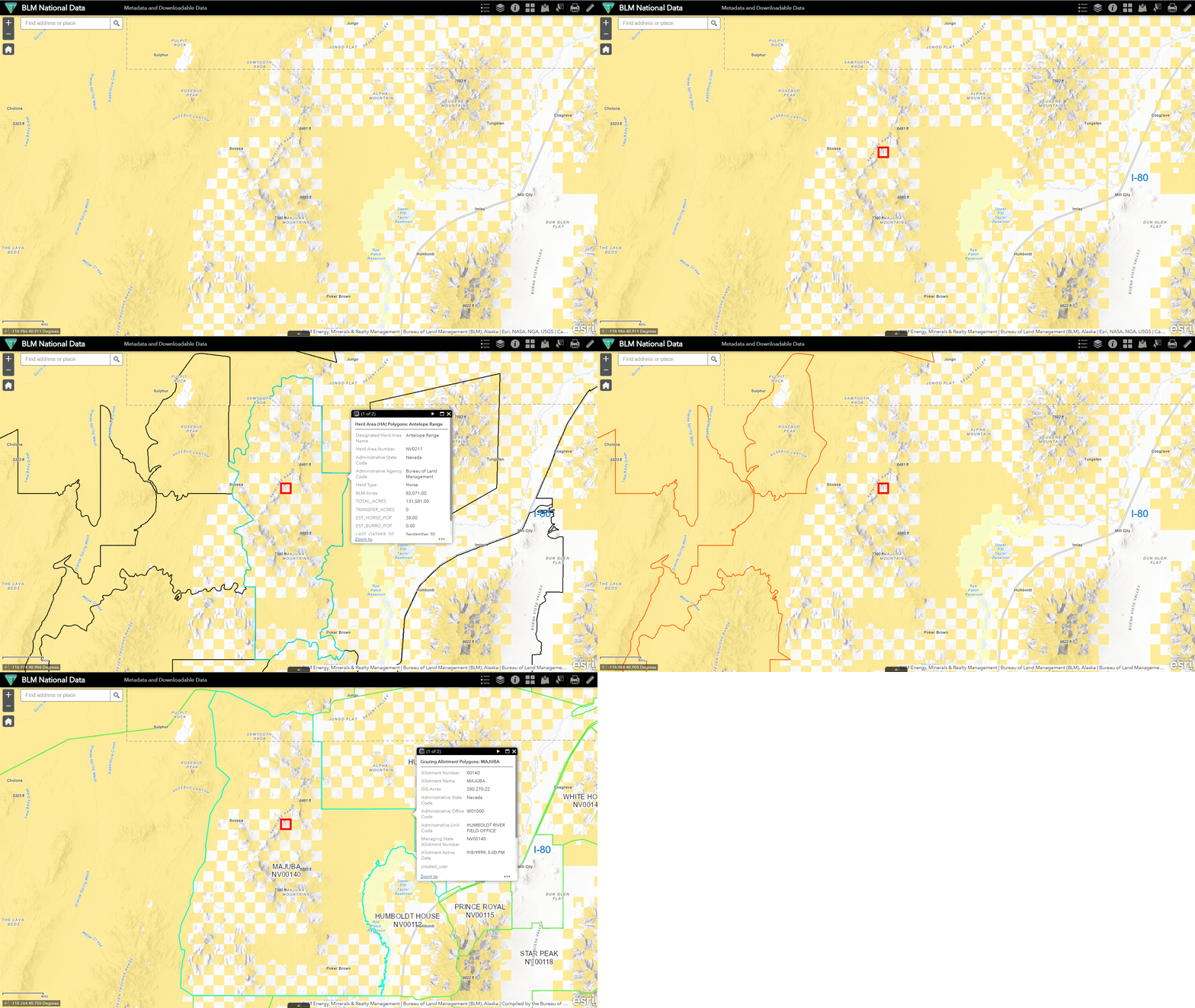
Their origin is thought to be the Montgomery Pass WHT/HMA.

The Western Watersheds map shows the arrangement.

Montgomery Pass Herd Migration 10-14-22

The photos show few if any foals.

The bad news is that advocates with the Campaign Against America’s Wild Horses are already eyeing the animals.

A representative stated “They have the same status as the bald eagle.  The fact that we would round them up with helicopters is just inhumane.”

The implication, of course, is that they’re ready to sink their claws into the herd and ruin it with the Montana Solution.

Foal-Free Friday, Fitting the Herds to the Resources Edition

In the September 15 story by KUNR Radio about the Virginia Range darting program, Tracy Wilson, Nevada State Director for the Campaign Against America’s Wild Horses, told the reporter that “As you start reducing the amount of available space and forage, then you need to manage the numbers to fit what’s available for the horses.”

The statement reflects their defeatist mentality and desire to please the bureaucrats and ranchers at the expense of America’s wild horses.

What if the government assigns 84% of their food on public lands to privately owned livestock?

“You need to manage the numbers to fit what’s available for the horses.”

They are failures and frauds.  Don’t give them a penny.

RELATED: Foal-Free Friday, Safe, Proven and Reversible Edition.

Virginia Range Darting Program 10-13-22

Sustainability of Currituck Wild Horses Questioned

The topic was discussed at the September 19 meeting of the county commissioners according to a report posted today by The Coastland Times.

One of the commissioners claimed that only six mares were fertile but the herd manager stated in a subsequent interview that 19 out of 53 mares (36%) were producing.

The percentages of males and females in the herd were not given.

The story indicated that a contraceptive process several years ago—sorry, a safe, proven and reversible fertility control program—ended up making several mares sterile.

The article also indicated that the filly put down by the advocates last month contracted swamp cancer.

RELATED: Currituck Filly Dies.

Report Stresses Observation of Roundups, Not Cessation

We’re not going to push back against the public-lands ranchers, and we don’t care if they receive the lion’s share of the resources, we just want the horses treated humanely as they’re forced off their lawful homes and into government feedlots.

How does that help America’s wild horses?

The news release on EIN shows that you can develop a large following, and hold your audience spellbound, teaching them everything that is wrong.

PSA 12-12-19

Alpine Shooters Knew What They Were Doing?

The advocates reported that the horses were shot in the abdomen, face and between the eyes, according to the story by KPHO News.

Shots to the abdomen may have occurred from longer range, to make the animals approachable, with kill shots applied at short distance.

Where do you find expertise in killing wild horses by gunshot?  At wild horse roundups, where it is often associated with pre-existing conditions.

The method was sanctioned by PIM 2021-007, Euthanasia of Wild Horses and Burros Related to Acts of Mercy, Health or Safety.

From paragraph VI.2 in Attachment 1:

A properly placed gunshot to the brain of an animal that is calm and still, or humanely restrained, instantly produces an unconscious state followed quickly by a painless and humane death.  This method of euthanizing wild horses and burros requires only minimal handling and restraint; and when performed on the range, drug residues that may poison wildlife are not a concern.  Only qualified and experienced persons skilled in the safe handling and use of firearms and trained by a veterinarian will perform the procedure.  The optimal placement of a gunshot is from the front of the animal, perpendicular to the skull at a point one inch above the intersection of two imaginary lines drawn like an “X” from the eyes to the base of the ears.  Typically, when euthanizing a wild horse or burro in this manner with a handgun, the animal will be approached to within five-to-six feet and the gun will be held within a few inches or up to two-to-three feet from the animal.

Euthanasia by Gunshot 10-10-22This information is not limited to government contractors or the agencies that hire them.  The image above was found at thinklikeahorse.org.

RELATED: Searching for Motives in Alpine Wild Horse Shootings.

Searching for Motives in Alpine Wild Horse Shootings

The story by FOX10 News in Phoenix indicated that the dead animals were found near Forest Road 25 in the Alpine and Springerville Ranger Districts.

The Western Watersheds map shows Road #25 in the PS Allotment, about 15 miles southwest of Alpine and near the area where the Jumping Mouse horses were trapped earlier this year.

Forest Road 25 Map 10-09-22

The area is not just known for its grazing potential, but is home to some of the best elk and mule deer habitat in Arizona.

The Annual Operating Instructions for PS indicate two pastures, with grazing seasons ending in just a few days.

RELATED: Advocates Outraged by Alpine Wild Horse Shootings?

Pokegama Legal Action to Be Tossed Out?

The case, brought by the Vermont Law and Graduate School’s Environmental Advocacy Clinic on behalf of Wild Horse Fire Brigade, seeks to halt the removal of wild horses from private property within and adjacent to the HMA in southern Oregon, according to a news release dated October 8.

Plaintiffs allege that the BLM has violated the WHB Act and/or NEPA and have asked the Court to issue a temporary restraining order stopping the roundup.

The incident started on September 26.  To date, three horses have been captured.

If free-roaming horses or burros stray from public lands onto privately owned land, the owners of such land may inform the nearest Federal marshall or agent of the Secretary, who shall arrange to have the animals removed, per §1334 of 16 USC 30.

The BLM issued a CX and DR for the action two years ago.  The map on page 5 of the pdf shows much of the land inside the HMA is privately owned.

Is Oregon a fence-out state?

The CX was the only document posted to the project folder in ePlanning.

The aim of the Wild Horse Fire Brigade is to move wild horses from areas where they’re not wanted (by public-lands ranchers) to remote wilderness areas not particularly suited to livestock grazing.

“Horses are significantly more ecologically appropriate in wilderness areas over ruminant livestock like cattle, sheep, and goats,” according to its founder.

Achievement of that end would constitute victory for the ranchers in their long-held goal of purging wild horses from western rangelands.

McKinney Fire 08-08-22