Livestock Grazing on Forest Service Lands

The BLM sells about 12 million AUMs annually on 155 million acres.  At current prices, the government receives about $16 million per year, a small offset to the cost of the WHB program, which is operated mostly for the benefit of the public-lands ranchers.

A summary of grazing activity on Forest Service lands in 2016, the most recent year for which the agency has published data, shows sales of about seven million AUMs annually on 102 million acres, for an income of roughly $9 million per year at current prices.

In total, privately owned livestock receive 19 million AUMs per year on about 250 million acres of public lands, allowing for some overlap in jurisdictions.

The ranchers would have to place 3.2 million cow/calf pairs on those lands to consume 19 million AUMs in a six month grazing season, for a stocking rate of 12.8 cow/calf pairs per thousand acres.

At current herd sizes, wild horses and burros are consuming about one million AUMs per year on slightly more than ten percent of the land.

The current stocking rate is less than four animals per thousand acres.

The target rate is one animal per thousand acres, suggesting that resource availability and productivity improve dramatically when areas are designated for livestock.
Storey County Commissioners Oppose Autonomous Zone

Commissioners voted yesterday against the idea, according to a report posted this morning by The Nevada Independent, an online news service based in Las Vegas.

The “Smart City,” to be built on 67,000 acres owned by Blockchains LLC, would include up to 15,000 dwelling units and would almost certainly necessitate the downsizing of the wild horse herds that currently inhabit the area, beyond what the PZP zealots are trying to accomplish.

RELATED: Storey County Autonomous Zone in the News.

Another One on the Way?

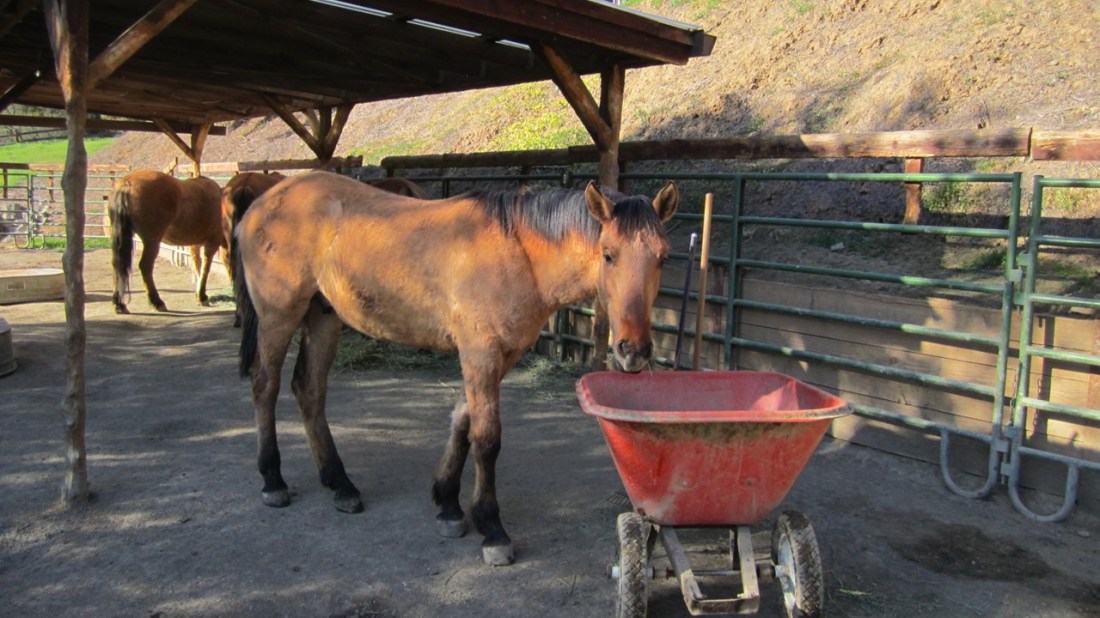
The colt was eleven months old yesterday.  He was born last year on April 1.

Mares supposedly go back into heat shortly after birth so let’s say she was bred on April 10.  Adding 340 days to that means she’d be due on March 16—two weeks from today.

She’s behind the colt in the photo, but does she look like she’s two weeks out?  Nope, not even close.  Is the stud still in the corral?  Yep.

After the colt was born the mare told the stud, by numerous kicks, that she didn’t want anything to do with him.  For the first six weeks, she ruled the roost with an iron fist.

So maybe they only get pregnant when they want to get pregnant?

RELATED: Thoughts on New Colt.

Colt at Eleven Months 03-01-21

Fixing the Ranching Problem in the Western U.S.

Many permittees own land and appurtenances known as a ‘base property.’  Grazing privileges on public lands are usually tied to base properties, which may include other assets such as water rights.

Where do livestock go during the off season?  Where would they go if AUMs on public lands had to be curtailed because of a fire or drought?  Back to the base property and/or rented pastures, where the ranchers would have to pay market rates to feed them.

The 4M Ranch, a sponsor of the Meeker Mustang Makeover and probable beneficiary of wild horses thus adopted, has almost 12,000 acres of deeded lands which, presumably, secure its grazing privileges on 125,000 acres of BLM and Forest Service lands.

Hay production on the ranch, about 1,200 tons annually, would support 240 cow/calf pairs, assuming they consume five tons per year per pair (25 to 30 pounds per day).

Forage on the deeded acres would support another 100 cow/calf pairs, assuming a stocking rate of eight pairs per thousand acres.

Additional food can be imported (at going rates) if a larger number of animals is desired.  No more dependence on government, no more slurping at the public trough.

Yes, it’s a radical idea—confining them to their own property.  Nobody has ever been expected to do that.

RELATED: Sponsor of Meeker Mustang Makeover or Beneficiary?.

Quick Note on Overpopulation

It does not mean the carrying capacity of the land has been exceeded, not even close.

It means more horses than allowed by plan, too many resources lost to animals that bring in no economic return.

The resources are there.  In most cases there are no ‘excess’ horses.  There is no basis for a roundup or fertility control program.  Most of the ‘advocacy’ groups are clueless.

The problem is resource management—the plans—which typically allocate four to five times as much food to privately owned livestock as they do to wild horses, on lands identified for the horses.

Thriving Ecological Balance-3

Sponsor of Meeker Mustang Makeover or Beneficiary?

One of the event’s sponsors is 4M Ranch.

The Operator Information report in RAS, for the State of Colorado, Northwest District, White River Field Office, gives an address in Meeker, along with authorization numbers 0505793 and 0505794.

The Allotment Information report ties the authorization numbers to the River and Little Toms Draw allotments.

The Allotment Master report puts Little Toms in the Improve category and River in the Custodial category (condition unknown).  Western Horse Watchers is unable to explain how it qualifies for Custodial.

The principal of 4M Ranch is Craig Macnab, according to a Bizapedia report.

A 1985 announcement in The New York Times suggests that he’s married to Deirdre Macnab, the woman who said that genetic viability of wild horses is threatened by increasing herd sizes.

A 2016 report by the Rio Blanco Herald Times says the ranch was purchased in 2015 for $9.5 million.  It covers 11,870 deeded acres and has grazing preference on more than 125,000 acres of BLM and Forest Service land.  The allotment master report accounts for only a small fraction of the total acreage.

The ranch has 800 acres of hay meadows and supports up to 1,000 cow/calf pairs, for a stocking rate of eight cow/calf pairs per thousand acres.  The aimed-at stocking rate across all HMAs is one wild horse per thousand acres.

To say that the Macnabs have only a passing interest in wild horses would be a gross understatement.

RELATED: Meeker Mustang Makeover Seeks Trainers and Adopters.

Extra Grain Storage

What’s the point of buying enough hay to last four weeks when you can only store enough grain for two weeks?

A 31-gallon metal trash can holds up to three 50-pound bags and they’re great for dispensing daily rations.  Rodents will bore into the plastic ones.

An eight-foot round end tank will hold up to twelve sacks.  Cover it with plywood or similar material to keep pests away.

At current prices, you’ll be paying about $100 per AUM to feed your horses—unless you have grazing privileges on public lands, in which case you’ll pay $1.35 per AUM.

Grain Storage 03-01-21

Meeker Mustang Makeover Seeks Trainers and Adopters

If you want to help the local ecosystem and reduce inbreeding associated with “rising populations” of wild horses, then you need to get involved with the Meeker Mustang Makeover.  Yep, genetic diversity is compromised by overpopulation, according to a spokesperson interviewed for a story by The Daily Sentinel of Grand Junction, CO.

A disclaimer says the event is not associated with, sponsored or endorsed by the Mustang Heritage Foundation, Extreme Mustang Makeover, Mustang Madness, Mustang Mania or the Wild to Mild TIP Challenge.  It is an independent, volunteer run entity that is unaffiliated with any other mustang event, organization, or association.

Organizers include ranchers, horse trainers, conservationists and historians concerned about the growing populations of mustangs in western Rio Blanco.

Holy Grail of Wild Horse World Already Found?

The fossil record suggests that horses evolved in North America and nobody disputes that they were brought to the New World by Spanish explorers around 500 years ago.

But was the disembarkation a reintroduction or a supplementation?

The official storyline says it was a reintroduction.

A summary of comments on a new management plan for the Big Summit WHT includes a reprint of an article by Craig Downer on the subject, beginning on page 49 of the pdf.

At the top of page 53 is a remark about the discovery near Winnemucca Lake in Nevada that was mentioned in the Holy Grail post.  The evidence contradicted the wild horse narrative and “appear[s] to have vanished under suspect circumstances,” according to Mr. Downer.

RELATED: Wild vs. Feral: Are America’s Horses a Re-Introduced Species?

‘Perseverance’ Tests Martian Soil

Multiple samples failed to meet standards for rangeland health so the Designated Area was immediately placed into the Improve category.  No major problems are expected, however, as there are many such areas in the western U.S., even where horses have been zeroed out.

Peserverance Tests Soil 02-27-21

A spokesman for the Bureau of Livestock on Mars said an RMP and EIS are in the works but they will not be put out for public review because grazing is “too important” for the red planet’s fledgling economy.

He went on to say that retraining cattle ranchers for other roles, such as solar techs, would be “darn near impossible.”

The spacecraft carried the historic first doses of PZP to the surface, so the ranchers can get out in front of the horse problem before it even gets started.  Clipboards and darting rifles will be delivered in a subsequent mission.

RELATED: ‘Perseverance’ on Mars, Stakes Claim for Public-Lands Ranchers.

Gather Schedule Updated

The list was updated yesterday, with the Sand Wash roundup currently in progress.

Six burros were removed from the Lake Pleasant HMA in a nuisance gather on February 2, according to the schedule, but Western Horse Watchers was unable to find an announcement on BLM’s main news page.

Next up is nuisance gather in the Piceance-East Douglas HMA (may have already started) and a planned gather in the Black Mountain HMA, home of the Oatman burros.

Onaqui Mountain is on the list for July, with Beatys Butte in August.

More information at the WHB gather page.

Comments Invited on Piper Mountain Range Improvements

The project involves water systems in two grazing allotments that intersect the Piper Mountain HMA near Deep Springs, CA, according to a BLM news release issued today.

Comments will be accepted through March 29.

Piper Mountain HMA Allotments

The EA says the current burro population is zero and horses are very seldom seen.

The management plan for Piper Mountain allows 17 horses and 82 burros on 96,261 acres, for an equivalent stocking rate of 0.6 wild horses per thousand acres.

Horses can be found in the Fish Lake Valley HMA, according to the EA, where an estimated 120 animals live.  See page 30 in the Nevada wild horse maps.

The Allotment Master report shows most of the allotments in the Maintain category.

‘Perseverance’ on Mars, Stakes Claim for Public-Lands Ranchers

In a first-of-its-kind mission, an American spacecraft has designated a large swath of the Martian surface for livestock grazing, before any horses can escape or be turned loose by explorers from Earth.

Peseverence Rover 02-26-21

The vehicle touched down in an area known as Ubiquitous Valley, aptly named for a practice that’s devoured hundreds of millions of acres in the western U.S.

Animal Exports to Mexico

A story by WKRN News of Nashville, TN regarding a horse rescue included a link for daily livestock exports from Texas to Mexico.

The most recent report, dated February 23, shows 1,992 horses shipped to slaughter year to date.

The largest category is beef cattle.

The site offers reports on other export channels to Mexico.  Type ‘exports’ in the Search Publications field and hit Enter.

Livestock Exports Search 02-25-21

UPDATE: A weekly summary is also available.

Contraceptives Are Better Than Ovariectomies?

Two ‘advocacy’ groups have asked DOI nominee Deb Haaland to stop the sterilization of mares from the Confusion HMA, according to a news release in Horse Nation, while concurring with her vision of ‘humane management’ of wild horse herds—code words for PZP fertility control.

Managing HMAs and WHTs primarily for livestock must be an acceptable practice to these people, perhaps the preferred practice.  Instead of pushing back against the ranchers, they push back against the horses.

Regulations Override Statutes?

Allowing four permittees to utilize most of the resources in the Piceance-East Douglas HMA does not conform to the mandates of 16 USC 30, an act of Congress, according to comment #69 in the appendices of the EA for resource enforcement actions therein.

Western Horse Watchers refers to the practice as ‘managing primarily for livestock.’

In response, the government stated that the ‘principally but not necessarily exclusively’ language of the statute applies only to areas known as Wild Horse Ranges, not to HMAs in general, pointing to 43 CFR 4710.3-2, a rule created by the unelected bureaucracy.

Areas that no longer qualify as HMAs are managed almost exclusively for livestock.

These are the defining issues of the wild horse world.

Can regulations override statutes?  Is the government trying to sidestep the law in favor of a special interest?  Where is the consent of the governed?

RELATED: Statutes and Regulations, Piceance Decision Record Signed.