They were released on February 4 and 5 after receiving a second dose of GonaCon Equine, according to a BLM news release.
RELATED: Nevada WHR Mares Waiting for Second Jab.

Western Horse Watchers Association
Exposing the Hypocrisy, Lies and Incompetence of the Wild Horse Advocates
They were released on February 4 and 5 after receiving a second dose of GonaCon Equine, according to a BLM news release.
RELATED: Nevada WHR Mares Waiting for Second Jab.
Stop the roundups but not the removals. Treat the symptoms, not the causes.
Alternative 1 in the Final EA for resource enforcement actions in the HMA states that the BLM will gather and remove excess horses within and around the HMA to low AML as expeditiously as feasible through one or more gathers, suppress population growth using PZP-22 and equip the horses with GPS tracking units.
Alternative 2 is the same as Alternative 1 with the exception that the released mares would be treated with GonaCon Equine instead of PZP.
The decision was to implement Alternatives 1 and 2. The goal is to get the herd down to low AML and keep it there with fertility control.
The total authorized forage inside the HMA, neglecting wildlife, is 13,256 AUMs per year, as discussed previously.
At the low end of the AML, the 165 horses allowed by plan will receive 1,980 AUMs per year, about 15% of the forage in the HMA, sometimes referred to as ‘their food.’
If the vaccines are successful, forage assigned to the horses, corresponding to the difference between the low and high end of AML, could be shifted informally to the ranchers by extending the grazing season and/or allowing a higher stocking rate.
Curiously, the HMA has a Herd Management Area Plan (HMAP), which ratifies these lopsided resource allocations.
RELATED: SHOCKER: Sulphur Permittee Supports Wild Horse Roundup.

The writer holds all of the active AUMs in the Fairview Allotment, 73% of which is in the HMA. It’s in the Improve category and accounts for about 30% of the forage assigned to livestock in that area.

Western Horse Watchers was unable to find any remarks from drilling and mining companies in the comments for the project.
In comment 8, the Campaign Against America’s Wild Horses opposes the roundup, while demanding in comment 16 that the BLM get rid of them with humane, reversible and vaccine-based fertility control, including PZP-22.
RELATED: Sulphur Allotment Confusion.
On the Maryland side of Assateague Island with td adventures.
Table 3.1 in the Final EA for resource enforcement actions shows nine allotments that intersect the HMA, with one out of service.
The map supplied with other supporting documents shows eight.
The Western Watersheds map, reproduced below, shows ten.

Bennion Spring, listed in the table, does not appear on the project map. Buckhorn and Jackson Wash, which appear on the map, are not listed in the table. North and South Pine Valley, which are listed in the table, are not shown on the map.
A BLM representative said Table 3.1 is correct and explained the differences as follows:
Stateline, Hamlin and Fairview are administered by the Fillmore Field Office and the others are managed by the Cedar City Field Office.
Allotment Master reports for the legacy arrangement [Fillmore | Cedar City] yielded the following data. The percentage of Jackson Wash inside the HMA is based on an eyeball estimate from the WW map. The other percentages were taken from Table 3.1.
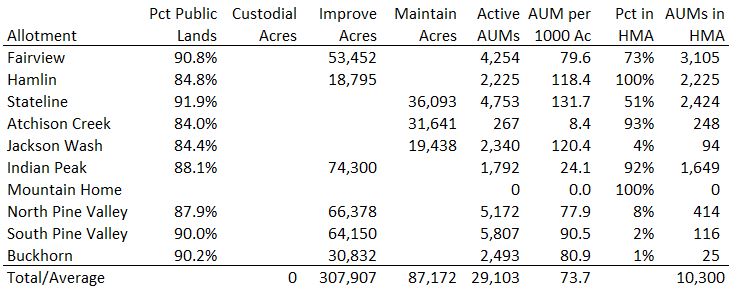
Approximately 78% of the public acres in the allotments are in the Improve category, with the balance in Maintain.
The estimated forage assigned to livestock is 10,300 AUMs per year. The allocation based on the data in Table 3.1 is 10,256 AUMs per year.
The 250 horses allowed by plan receive 3,000 AUMs per year.
If you thought the HMA was managed primarily for livestock, you’d be right.
A roundup is set begin this week.
RELATED: Sulphur Roundup Announced.
The price of alfalfa-grass hay yesterday was unchanged from January, $25 per bale with a 20 bale minimum. But it’s still up 32% in the past six months.
The single-bale price was $26.
The price of a 50-pound sack of Purina Equine Senior has jumped from $26.49 in July to $30.99 yesterday, a 17% increase.
A 50-pound sack of Purina rice bran pellets has gone from $19.62 to $22.93, also a 17% increase.
The price of hay, which represents the majority of a horse’s diet, adopted or otherwise, works out to about $125 per AUM. With the new AIP guidelines, you’ll be paying the freight for at least a year before you receive the $1,000 incentive.
RELATED: Price of Hay Still Going Up.
The incident began on January 11. Gather stats through February 5:
One horse was put down on Day 24 and another died on Day 26. The death rate is 0.9%.
The cumulative total includes 714 stallions, 777 mares and 192 foals.
Youngsters represented 11.4% of the horses captured, consistent with a herd growth rate of six to seven percent per year, assuming a five percent death rate. A growth rate of 20% per year is often used by land managers to predict herd sizes.
Of the adults, 47.9% were stallions and 52.1% were mares.
Body condition scores were not reported.
The location of the trap site within the Complex was not provided.

Day 26 ended with 110 unaccounted-for animals.
With an average daily take of 65, the capture goal should be achieved in another week.
The number of horses removed to date is 1,679. Mares returned to the Complex will be treated with fertility control of unspecified type.
Other statistics:
RELATED: Pancake Roundup Day 23.
Buy a calendar from the advocates, as advertised in the current edition of Horse Tales.
RELATED: How Many Wild Horses Can the Pine Nut HA Support?
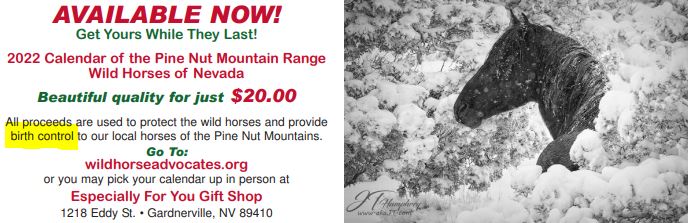
The advocates are trying to convince you that they care about wild horses, by protesting the BLM’s resource enforcement goals for FY 2022, while they’re getting rid of as many as possible with PZP.
The Virginia Range darting program, sponsored by the Campaign Against America’s Wild Horses, is equivalent to five Desatoya roundups every year.
Similar programs are taking root in other areas.
In most cases, helicopters effect large changes in herd sizes over a few days or a few weeks, with the advocates protecting the ranchers after the fact in a mopping up role.
But on the Virginia Range, the advocates have been given authority for the entire operation, with goals to be achieved over a much longer timeframe, mostly by attrition.
What about accountability to the public? Western Horse Watchers has not seen any reports on deaths or injuries attributable to the field work, changes in herd behavior due to the increased presence of humans in their habitat, or trends in the sex ratios and death rates of the bands.
We don’t even know the final population target.
RELATED: Can Darting Programs Compete with Helicopter Roundups?
Up until a few days ago, if you searched Google for “wild horse” or “wild horses,” Wild Horse Education would appear at or near the top of page 1.
Now, following the Pancake lawsuit, the site has disappeared from those results.
Interesting how that works.
The column begins on page 8 of the January edition.
In typical fashion, the executive director of the Campaign Against America’s Wild Horses feigns outrage at the government’s FY 2022 resource enforcement goals, which will take 19,000 wild horses and burros off the range, while praising the fertility control programs in Colorado and Utah that make sure the herds never bounce back.
The ranchers couldn’t have asked for a better stooge.
RELATED: Criticize Livestock, Dart Horses.
How can the AML represent the number of wild horses an area can support, as stated in the news release for the Cedar Mountain resource enforcement plan, when the BLM authorizes privately owned livestock equivalent to 4X AML in the same area?
The True AML would be 5X AML.
RELATED: Rule of Thumb for AMLs.
The resources have already been apportioned. The project will decide how to enforce them.
Starting today, interested persons can identify issues, suggest alternatives and provide data that could be useful in preparing an environmental assessment that supports the decision-making process.
The proposed action will likely include, among other things, removal of wild horses to the low end of AML and one or more fertility control methods.
Comments must be submitted March 5, according to the news release.
The HMA covers 411,636 acres west of Salt Lake City. The 390 horses allowed by plan require 4,680 AUMs per year.
The stocking rate allowed by plan is 0.9 horses per thousand acres.
The current population is thought to be around 790, excluding foals.

The HMA intersects four allotments according to the Western Watersheds map and appears to be 100% subject to permitted grazing.
The amount of forage assigned to livestock inside the HMA is not known.
The proposed roundup would occur no sooner than the fall of 2022. The removal goal would be at least 600.
RELATED: New Resource Enforcement Plan for Cedar Mountain HMA?
Another reader responds to the January 27 column in the Reno Gazette Journal about the importance of roundups, only this time in the Sierra Nevada Ally, a nonprofit news organization based in Carson City.
RELATED: Criticize Livestock, Dart Horses.
The case was handled by the De Castroverde Law Group, which specializes in the areas of personal injury, criminal defense and immigration law, according to an article posted yesterday by Nevada Business.
RELATED: Pancake Judge Appointed by Barack Obama.
The new rules won’t keep more wild horses on the range but may keep more of them in off-range holding.
The rising cost of feed is another deterrent.
Changes to the incentive were authorized under a categorial exclusion.
Described as a “marketing tool” in the CX, the AIP is now subject to the policies and procedures of IM 2022-014.
The feedlot, sometimes referred to as a concentrated animal feeding operation (CAFO), covers 160 acres northeast of Fallon, NV and has a capacity of 3,200 wild horses and burros, according to the Determination of NEPA Adequacy signed on November 15.
The expansion will add 238 acres on three adjacent parcels owned by the contractor, increasing the capacity to 7,600 wild horses and burros.
Map 2 in the DNA shows the arrangement.
The project was not announced at the BLM news site.
With six more week of winter on the way, livestock operators, eager to access the AUMs on your public lands, especially in areas set aside for wild horses and burros, may have to wait a bit longer until conditions improve.
One thing they won’t have to face this year is the rising cost of feed.
The advocates, allies of the bureaucrats and ranchers, look to the new year with guarded optimism, knowing that Congress has provided funding for the Montana Solution, which protects livestock, not the horses and burros.
A BLM Natural Resource Specialist told the county Public Lands Council on Tuesday that the horses are very astute and the sound of loading the dart can make them run, according to a report by ETV News.
The agent said the drug can be effective for five years, suggesting that they are using GonaCon Equine.
The story did not indicate if any advocates had offered to help with the field work.
The Sinbad and Muddy Creek HMAs are in Emery County and both are 100% subject to permitted grazing, as shown on the Western Watersheds map.
 Western Horse Watchers Association