
Roundups, Emergencies and Escalating Problems

Emergencies occur suddenly and require immediate action, according to Section 2.22 of BLM Handbook 4720 for removal of excess wild horses and burros from public lands.

Earthquakes and wildfires occur suddenly, droughts do not.

Section 2.21 defines escalating problems as conditions that deteriorate over time.

They are indicated by a decline in the amount of food or water available for wild horses and burros, which results in negative impacts to animal condition and rangeland health.  These situations are normally associated with drought or animal numbers in excess of AML, can be detected in advance, and are managed through the normal gather planning (NEPA) process.

Further, these types of problems should be managed within the individual BLM State gather targets, to the extent possible, per 2.21.C.  If you have to pull horses out of HMA X because of drought, you’ll need to forego the planned removal at HMA Y.

The roundups announced on August 2 were in addition to those already on the schedule.

The next step would be to check the news releases for NEPA citations.  If found, there was an attempt to comply with the statute, so those roundups, and the circumstances that led to them, probably didn’t qualify as emergencies.
RELATED: Are Emergency Roundups Really Emergencies?

Are Emergency Roundups Really Emergencies?

According to Section 2.3.1 in the National Environmental Policy Handbook, actions that must be taken immediately to protect public health and safety or important resources qualify as emergency.

Examples include

  • Cleanup of a hazardous materials spill
  • Wildland fire suppression activities related to ongoing wildland fires
  • Stabilization actions following wildland fires or other disasters

Actions not immediately needed to protect public health and safety or important resources must undergo normal NEPA procedures.  In some cases, alternative arrangements may be available to comply with NEPA.

RELATED: More Emergency Roundups in the Works.

Sand Wash Roundup Day 7

The incident began on September 1.  Gather stats through September 7:

  • Type: Emergency
  • Method: Helicopter
  • Horses captured: 501, up from 329 on Day 5
  • Average daily take: 71.6
  • Capture goal: 783
  • Removal goal: 733
  • Returned: 1, no change from Day 5
  • Deaths: 1, no change from Day 5
  • Shipped: 370, up from 190 on Day 5

The death rate has dropped to 0.2%.

The breakdown between stallions, mares and foals captured on Day 5 was added to the gather page.

Foals represented 13.2% of the horses gathered.  Of the adults, 41.4% were male and 58.6% were female.

The low percentage of foals may be due to the darting program.  The gap between males and females may indicate the sex ratio of the herd is not 1:1 (50/50).

This pattern—more mares captured than studs—has appeared in every wild horse roundup this summer since Onaqui.

Body condition scores were not reported.

Day 7 ended with 129 unaccounted-for animals.

Other statistics:

  • AML: 362
  • Forage assigned to horses: 4,344 AUMs per year
  • Pre-gather population: 896
  • Forage liberated to date: 6,000 AUMs per year
  • Water liberated to date: 5,000 gallons per day
  • Forage assigned to livestock: 16,827 AUMs per year (estimated)
  • Horses displaced from HMA by livestock: 1,402 (2.8% of off-range holding)
  • True AML: 1,764

RELATED: Sand Wash Roundup Day 5.

Another Devil’s Garden Roundup Starts Next Week

The Forest Service will gather and remove 600 wild horses from the Devil’s Garden Plateau WHT, beginning on September 15, according to an announcement posted today.  The incident marks the fourth year in a row that helicopters have pushed them off their home range in favor of privately owned livestock.

Last year, 506 animals were removed.

The operation will be open to limited public observation.

The AML is 402 and the pre-gather population is thought to be 1,962.

The destination of captured animals was not stated in the news release but they will probably be taken to the Double Devil Corrals and BLM’s off range holding facility at Litchfield.

A link to the gather stats and daily reports was not provided.

Stone Cabin Roundup Day 6

The incident began on September 1.  Gather stats through September 6:

  • Type: Emergency
  • Method: Bait
  • Horses captured: 122, up from 45 on Day 3
  • Average daily take: 20.3
  • Capture goal: 450
  • Removal goal: 450
  • Returned: 0
  • Deaths: 3, up from 1 on Day 3
  • Shipped: 43

No horses were caught on Day 5.

One horse was put down on Day 4 due to a broken neck.  Another was put down on Day 6 because of colic.

Foals represented 14.8% of the horses gathered.  Of the adults, 43.3% were male and 56.7% were female.

Body condition scores were not reported.

Day 6 ended with 76 unaccounted-for animals.

Other statistics:

  • AML: 364
  • Forage assigned to horses: 4,368 AUMs per year
  • Pre-gather population: 1,037
  • Forage liberated to date: 1,464 AUMs per year
  • Water liberated to date: 1,220 gallons per day
  • Forage assigned to livestock: Unknown
  • Horses displaced from HMA by livestock: Unknown
  • True AML: Unknown

RELATED: Stone Cabin Roundup Day 3.

Horses Clash with Livestock at Wild Horse Mesa

As in other parts of the west, ponds are drying up in this southern Colorado community but that hasn’t discouraged the woman who’s been protecting the herd for 17 years.

She’s been hauling water to fill a pond and is now thinking about drilling a well.

But some disagree with the plan, as explained in this report by the Santa Fe New Mexican, posted yesterday.

The herd is not federally protected, according to the story.

RELATED: Wild Horse Mesa Confirmed.

Indictment on Lesser Charges

This critique, appearing in today’s edition of the Pagosa Daily Post, points to some of the wrongdoing in the wild horse world but leaves out the big enchilada—public-lands ranching and the lopsided resource allocations associated therewith.

Why?  The author is a rancher, as noted in the audio segment posted with this episode of Line on Agriculture by the Ag Information Network of the West.

Not mentioned in the critique is the author’s desire to move wild horses from areas where they’re not wanted (by public-lands ranchers) to remote wilderness areas (not particularly suited to livestock grazing).

What about that automatic darting machine that’s being upgraded with facial recognition?  Hard to believe, but it’s being developed by a rancher.

Black Mountain Roundup, Part 2, Day 175

The incident began on March 9, a resource enforcement action that follows a wild burro removal in 2020Gather stats through August 30:

  • Type: Planned
  • Method: Bait
  • Burros captured: 450, up from 369 on Day 156
  • Average daily take: 2.6
  • Capture goal: 500
  • Removal goal: 500
  • Returned: 0
  • Deaths: 0
  • Shipped: 368, up from 306 on Day 156

Foals represented 14.7% of the burros gathered.  Of the adults, 58.6% were male and 41.4% were female.

To date, 225 jacks and 159 jennies have been captured.  The observed percentages of males and females cannot be explained by a simple random process centered at 50% males / 50% females, with n = 384 adults.  The sex of the foals was not given.

The expected range of variation can be found with basic statistical formulas.

Day 175 ended with 82 unaccounted-for burros.

Other statistics:

  • AML: 478
  • Pre-gather population: Unknown
  • Forage liberated to date: 2,700 AUMs per year
  • Water liberated to date: 2,250 gallons per day
  • Forge assigned to livestock: 7,333 AUMs per year (estimated)
  • Burros displaced from HMA by livestock: 1,222
  • True AML: 1,700

RELATED: Black Mountain Roundup, Part 2, Day 156.

Planet Ranch Nuisance Roundup Begins, Ends, No News Release

The incident started on August 14 and ended on August 27, with 184 burros captured and 184 shipped, according to figures at the gather page.

Western Horse Watchers was unable to find an announcement at the BLM news site.

The method of capture was bait.  The capture and removal goals were 160.

The operation was prompted by complaints from a landowner about wild burros that had ventured onto private property within the Havasu HMA.

Foals accounted for 13% of the animals captured.  Of the adults, 57.5% were male and 42.5% were female.

The burros were taken to the off-range corrals in Florence, AZ.

Planet Ranch, previously an alfalfa farm, is now a conservation area managed by the Arizona Game and Fish Department.

A roundup occurred in the area last year.

Chronic Overpopulation and Strained Resources?

This article about rescue and adoption in The Daily Sentinel of Grand Junction isn’t a human-interest story or a horse-interest story.  It’s a setup.

When two mustangs reunite, would they remember

  • Hunger and thirst?
  • Heat and mud?
  • Suffering and death?

The story begins on Navajo land but shifts to “all the wild horses roaming millions of acres without enough food or water” and the need for their management.

It’s all downhill from there.

A competitive shooter and PZP darter trains other firearms aficionados to shoot mares with contraceptive darts to reduce the number of foals born every season.

Many still starve and die of thirst, according to the writer, but these heroes are doing their part to get rid of them, along with the helicopters, while shielding the public-lands ranchers from the effects of a temporary change in the weather.

Sand Wash Roundup Day 5

The incident began on September 1.  Gather stats through September 5:

  • Type: Emergency
  • Method: Helicopter
  • Horses captured: 329, up from 81 on Day 3
  • Average daily take: 65.8
  • Capture goal: 783
  • Removal goal: 733
  • Returned: 1
  • Deaths: 1, up from 0 on Day 3
  • Shipped: 190, up from 64 on Day 3

One horse was put down on Day 4 due to a pre-existing condition.  The death rate is now 0.3%.

The breakdown between stallions, mares and foals was not given on Day 5, only the total number of horses captured.

Foals represented 11.6% of the horses gathered through Day 4.  Of the adults, 47.5% were male and 52.5% were female.  The low percentage of foals may be due to the darting program.

Body condition scores were not reported.

Day 5 ended with 137 unaccounted-for animals.

Other statistics:

  • AML: 362
  • Forage assigned to horses: 4,344 AUMs per year
  • Pre-gather population: 896
  • Forage liberated to date: 3,936 AUMs per year
  • Water liberated to date: 3,280 gallons per day
  • Forage assigned to livestock: 16,827 AUMs per year (estimated)
  • Horses displaced from HMA by livestock: 1,402 (2.8% of off-range holding)
  • True AML: 1,764

RELATED: Sand Wash Roundup Day 3.

Stone Cabin Roundup Day 3

The incident began on September 1.  Gather stats through September 3:

  • Type: Emergency
  • Method: Bait
  • Horses captured: 45
  • Average daily take: 15.0
  • Capture goal: 450
  • Removal goal: 450
  • Returned: 0
  • Deaths: 1
  • Shipped: 0

No horses were caught on Day 2.

One horse was put down due to an injury sustained in the roundup on Day 3.

Foals represented 20.0% of the horses gathered.  Of the adults, 58.3% were male and 41.7% were female.

Body condition scores were not reported.

Day 3 ended with 44 unaccounted-for animals.

Other statistics:

  • AML: 364
  • Forage assigned to horses: 4,368 AUMs per year
  • Pre-gather population: 1,037
  • Forage liberated to date: 540 AUMs per year
  • Water liberated to date: 450 gallons per day
  • Forage assigned to livestock: Unknown
  • Horses displaced from HMA by livestock: Unknown
  • True AML: Unknown

RELATED: Stone Cabin Roundup in Progress.

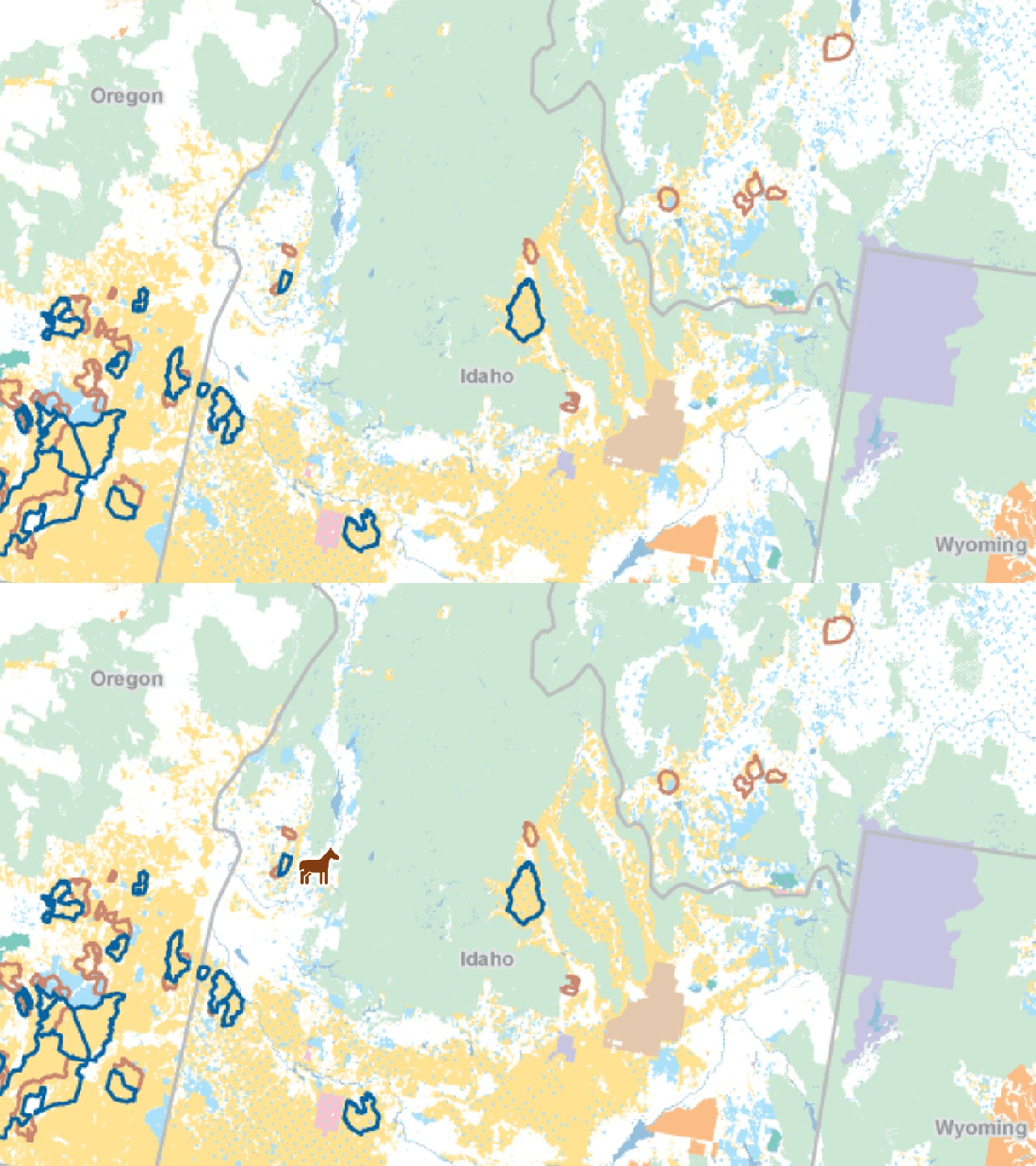
Four Mile Roundup Starts Next Week

The incident will begin on September 14, according to the news release.  The rationale is too many animals, not inadequate food and water.

Helicopters will push the horses into the traps and the operation will be open to public observation.

The capture goal is 189 and the removal goal is 173.  Mares returned to the HMA will be treated with GonaCon.

The HMA covers 18,800 acres in western Idaho and has an AML of 60.  The aimed-at stocking rate is 3.2 wild horses per thousand acres.  The target rate across all HMAs is one wild horse per thousand acres.

The pre-gather population of 210 includes 150 horses not allowed by plan, sometimes referred to as ‘excess animals.’

Four Mile HMA Map 09-05-21

Section 3.4.1 in the 2020 Final EA for resource enforcement actions states that the HMA is fully fenced and encompasses three of the ten pastures in the Willow Ridge Allotment, but does not disclose the AUMs assigned to livestock in those pastures.

Table 4 shows the grazing schedule and Map 1 in Appendix A shows the arrangement.

The Allotment Master report puts Willow Ridge in the Improve category.

The EA was posted with other project documents in ePlanning.

Captured animals will be taken to the off-range corrals in Boise.

Gather stats and daily reports will be posted to this page.

McGregor Grazing Land Up for Bids Again

On September 17, BLM will auction cattle-only grazing units on withdrawn lands in the McGregor Range, between Alamogordo, NM and El Paso, TX, according to a news release issued yesterday.

Results, if published, will provide data on current market values for livestock forage.

Two years ago, some of the parcels fetched $43 per AUM.

The United States shall receive fair market value for the use of public lands and their resources, as specified in §1701(a)(9) of FLPMA, unless otherwise provided by statute.

The fee paid by public-lands ranchers, $1.35 per AUM, falls short of that requirement, and is locked in by §1905 of the Public Rangelands Improvement Act, 43 USC 37.

Emergency Roundup Roundup

Snapshot of activity as of September 4:

West Douglas HA

  • Start date – July 26
  • Status – Complete

Paisley Desert HMA

  • Start date – August 1
  • Status – No announcement

Antelope Complex

  • Start date – August 2
  • Status – Complete

Conger HMA

  • Start date – August 11
  • Status – Complete

Flanigan HMA

  • Start date – August 12
  • Status – No activity reported

Stone Cabin HMA

Stinkingwater HMA

  • Start date – August 15
  • Status – Complete

Palomino Buttes HMA

  • Start date – August 30
  • Status – Complete

Sand Wash Basin HMA

Barren Valley Complex

  • Start date – September 8
  • Status – Pending

Emergency roundups are marked ‘E’ in the latest schedule, ‘P’ is for planned.

RELATED: More Emergency Roundups in the Works.