Lying for the Cause?

The views expressed in this commentary are those of its author and not necessarily those of Western Horse Watchers.

If the government assigns 84% of the forage in HMAs to privately owned livestock, the number of wild horses displaced thereby would be 141,750, enough to empty all of the off-range corrals and long-term pastures almost three times over.

The True AML, the number of horses the HMAs could support if they were managed principally for horses, would be 168,750, to be achieved by ending public-lands ranching in those areas.  A similar assessment for WHTs would likely drive the number higher.

The current population of 86,000 is well within this range.

Show your work:

Current AML = 27,000 (horses and burros but assume all horses)

Available land = 27,000,000 acres

Current stocking rate = 27,000 ÷ 27,000,000 × 1,000 = 1 wild horse per thousand acres

Forage demand = 27,000 × 12 = 324,000 AUMs per year

Total authorized forage in HMAs = 324,000 ÷ (1 – .84) = 2,025,000 AUMs per year

Forage assigned to livestock in HMAs = 2,025,000 × .84 = 1,701,000 AUMs per year

Horses displaced by livestock = 1,701,000 ÷ 12 = 141,750

True AML = 27,000 + 141,750 = 168,750

New stocking rate = 168,750 ÷ 27,000,000 × 1,000 = 6.25 horses per thousand acres

Land ratio at new AML = 1,000 ÷ 6.25 = 160 acres per horse

New Management Paradigm for Wild Horses

You can see it in the news release for horses returned to Sand Wash Basin: Government gets rid of most of them and the advocates make sure they never come back, leaving the ranchers as the primary—if not principal—consumer of resources in the HMA.

The rate at which the new way of thinking can spread to other wild horse areas will be limited only by the number of kool-aid drinkers that can be recruited and trained on the use of darting rifles.

RELATED: Sand Wash Basin Aftermath.

Park County Commissioners to Approve New Resource Plan?

An article posted yesterday by the Cody Enterprise says it’s up for a vote on September 20 but, as of today, an agenda for the meeting does not appear on their web site.

The plan documents the county’s position on wild horses and burros:

  • Oppose the introduction or reintroduction of wild horses or burros on federal and state lands within the County
  • Support herd management plans that prevent habitat degradation and native wildlife displacement, using all available agency tools
  • Oppose any establishment, enlargement, or expansion of wild horse and burro HMAs and Herd Areas and be involved in discussions regarding any proposed enlargement or expansion of such boundaries or areas
  • Encourage public education programs that inform the public at large about domestic livestock, wild/feral horse and burros, wildlife management needs, and balancing the impacts and the needs to maintain healthy ecosystems

The chairman, taking a utilitarian approach, said the quality and health of local herds was much better under the purview of local ranchers and cowboys.  “We had good stock, we don’t have that anymore.”

Horses deemed useful were adopted, the rest went to slaughter.

An advocate interviewed for the story sided with the ranchers, stressing the importance of—you guessed it—fertility control and proper management of the adoption program.

As for the allotments, just make sure the permitted amount of cows are on the land and they are off when they are supposed to be.

RELATED: Wild vs Feral Debate at Park County Commissioners Meeting.

UPDATE: Agenda for September 20 meeting now available.

Four Mile Roundup Over

Another 27 horses were captured today, according to the gather page, bringing the total to 215.  One death was reported, with 214 shipped.

The capture goal was 189 and the removal goal was 173.  Plans for returning horses to the HMA were not included.

Foals represented 22.8% of the horses captured.  Of the adults, 47% were males and 53% were females.

Body condition scores were not provided.

The pre-gather population was thought to be 210.  Genetic viability will certainly be a problem if only 16 horses are released.

RELATED: Four Mile Roundup Starts Next Week.

Barren Valley Roundup Day 7

The incident began on September 8.  Gather stats through September 14:

  • Type: Emergency
  • Method: Helicopter
  • Horses captured: 491, up from 316 on Day 5
  • Average daily take: 70.1
  • Capture goal: 1,900
  • Removal goal: 1,900
  • Returned: 0
  • Deaths: 6, no change from Day 5
  • Shipped: 379, up from 270 on Day 5

The death rate decreased from 1.9% to 1.2%.

Foals represented 21.2% of the horses gathered.  Of the adults, 47.3% were male and 52.7% were female.

Body condition scores on Days 6 and 7 ranged from three to four.

Three HMAs are involved in the roundup.

Day 7 ended with 106 unaccounted-for animals.

Other statistics:

  • AML: 892 (total for three HMAs)
  • Forage assigned to horses: 10,704 AUMs per year
  • Pre-gather population: 2,500
  • Forage liberated to date: 5,892 AUMs per year
  • Water liberated to date: 4,910 gallons per day
  • Forage assigned to livestock: 27,011 AUMs per year (estimated)
  • Horses displaced from Complex by livestock: 2,258 (4.5% of off-range holding)
  • True AML: 3,150

RELATED: Barren Valley Roundup Day 5.

Park Service Drops Assateague Speed Limits After Loss of Mare

The change follows a hit-and-run collision in July that killed the mare and injured her foal according to a story posted yesterday by Delmarva Now, an online news service of the Salisbury Daily Times.

Until 2016, when the darting program was stopped, the PZP zealots were getting rid of many more horses than motorists.  This is true today wherever they ply their trade.

The herd continued to decline until this year, when it produced a 7.8% birth rate, slightly larger than the death rate.

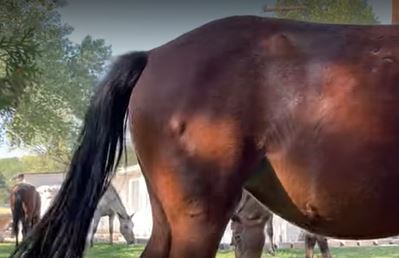
VR Darting Injury 09-15-21

The advocates, undeterred by the facts, continue to push this snake oil on our wild horses, with benefits accruing to the public-lands ranchers.

RELATED: Assateague Foal Loses Mom in Vehicle Collision.

Sand Wash Basin Aftermath

It’s a classic example of wild horse mismanagement, with benefits accruing to the public-lands ranchers.

First, you assign four times more forage to livestock than the horses.

Next, you get rid of 80% of the horses.

Then, you return a few dozen, a token gesture, with mares inhibited by contraceptives.

The advocates, realizing that the best way to protect wild horses is to not have them, double down on their fertility control program.

If everything goes according to plan, there will be no more roundups—because there will be no new horses—and the ranchers will be the primary consumer of resources in the HMA for many years to come.

RELATED: Sand Wash Advocate Says There Are Too Many Horses.

Who Will Look After the Nokotas When Frank Is Gone?

Brother Leo died unexpectedly three years ago and now some are wondering what will happen to the herd when Frank passes on, according to a story appearing in today’s edition of the Grand Forks Herald.

There are currently abut 300 head in his care, thought to be descendants of Sitting Bull’s horses.

Their predecessors were removed from Theodore Roosevelt National Park in the 1980s and 1990s.  The horses you see in the park today are not related.

Insiders are looking for a benefactor to secure the horses’ future when the time comes.

RELATED: New Film About Nokota Horses in the Works.