South Steens Roundup Ends

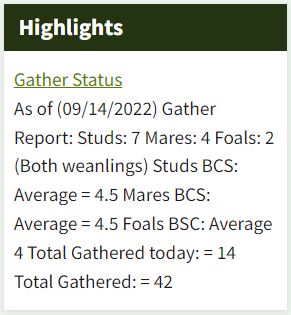
The incident concluded yesterday, according to a statement at the gather page, with 753 horses captured, 732 shipped and 22 dead.

The number of horses processed exceeded the number of horses captured by one.

The death rate was 2.9%.

The capture total included 281 stallions, 326 mares and 146 foals.

Youngsters represented 19.4% of the animals gathered.

Of the adults, 46.3% were male and 53.7% were female.

The capture goal was 500 but was increased after three days to 750.

Up to 25 mares treated with fertility control may be returned to the HMA at a later date.

RELATED: South Steens Roundup Set for Next Month.

Readers Respond to “Romance Versus Reality” Diatribe

The original piece, billed as a special to the Herald Times, ran on August 25.

Western Horse Watchers did not comment at the time as it was clearly an ode to the bureaucrats, ranchers and wild horse charlatans of the Piceance HMA, target of a roundup in July.

Today the paper published three responses, two in opposition, one in support.

The August 25 column was written by Kathleen Kelley, formerly a contract lobbyist and now co-owner of Sullivan Kelley Farms in Meeker, a cow-calf and livestock forage operation according to a 2018 letter to the paper by husband Reed Kelley.

Apparently, Mrs. Kelley is trying to establish herself with the ranching community and supporters thereof, perhaps with political and/or professional aspirations.

Knock yourself out, honey.

One of the letters was written by Scott Beckstead, a proponent of on-range management with the Montana Solution, evident in his reference to “our cherished wild equines.”

For Your Cherished Ants and Roaches 08-30-22

Foal-Free Friday, Fighting Crime on the Virginia Range

The advocates care far more about their standing with the bureaucrats and ranchers than they do about the horses.

They’re trying to convince them that the Montana Solution is a viable alternative to helicopter roundups.

They want to be leaders in the wild horse removal business and the Virginia Range has become their proving ground.

Crime in the Wild Horse World 05-26-22

Breeding has to be stopped and the advocates are on the case, led by four individuals that have administered over 1,000 doses of the pesticide each.

Predators take out the foals that slip through.

By the end of 2023, five years into the program, the herd will be toast.

RELATED: Foal-Free Friday, Barren Mares and Paragliders Edition.

Virginia Range Foal 05-08-22

Prelude to Foal-Free Friday

Tomorrow’s episode was written early this morning but a story by KUNR Radio, just out, validates remarks about the Campaign Against America’s Wild Horses and how it’s using the Virginia Range as a proving ground for the Montana Solution.

Tracy Wilson, Nevada State Director for CAAWH, told the writer her group is trying to prove there is a better way to get rid of wild horses and to show they can do it.

“As you start reducing the amount of available space and forage, then you need to manage the numbers to fit what’s available for the horses,” Wilson said.  “So, we want a healthy range, we want a healthy horse population.”

Funny, that’s what the bureaucrats say, as they whittle away at the land designated for wild horses and shift more and more of the resources to the public-lands ranchers.

File under: Charlatans.

No Leads in Shootings of Jakes Valley Horses?

The reward for information has grown from $5,000 to $10,000, according to a BLM news release, thanks to a pledge from the Campaign Against America’s Wild Horses.

Don’t be fooled by the gesture.  Next to the federal government, nobody, including shooters, is getting rid of more wild horses than they are.

RELATED: Information Sought in Killing of Jakes Valley Horses.

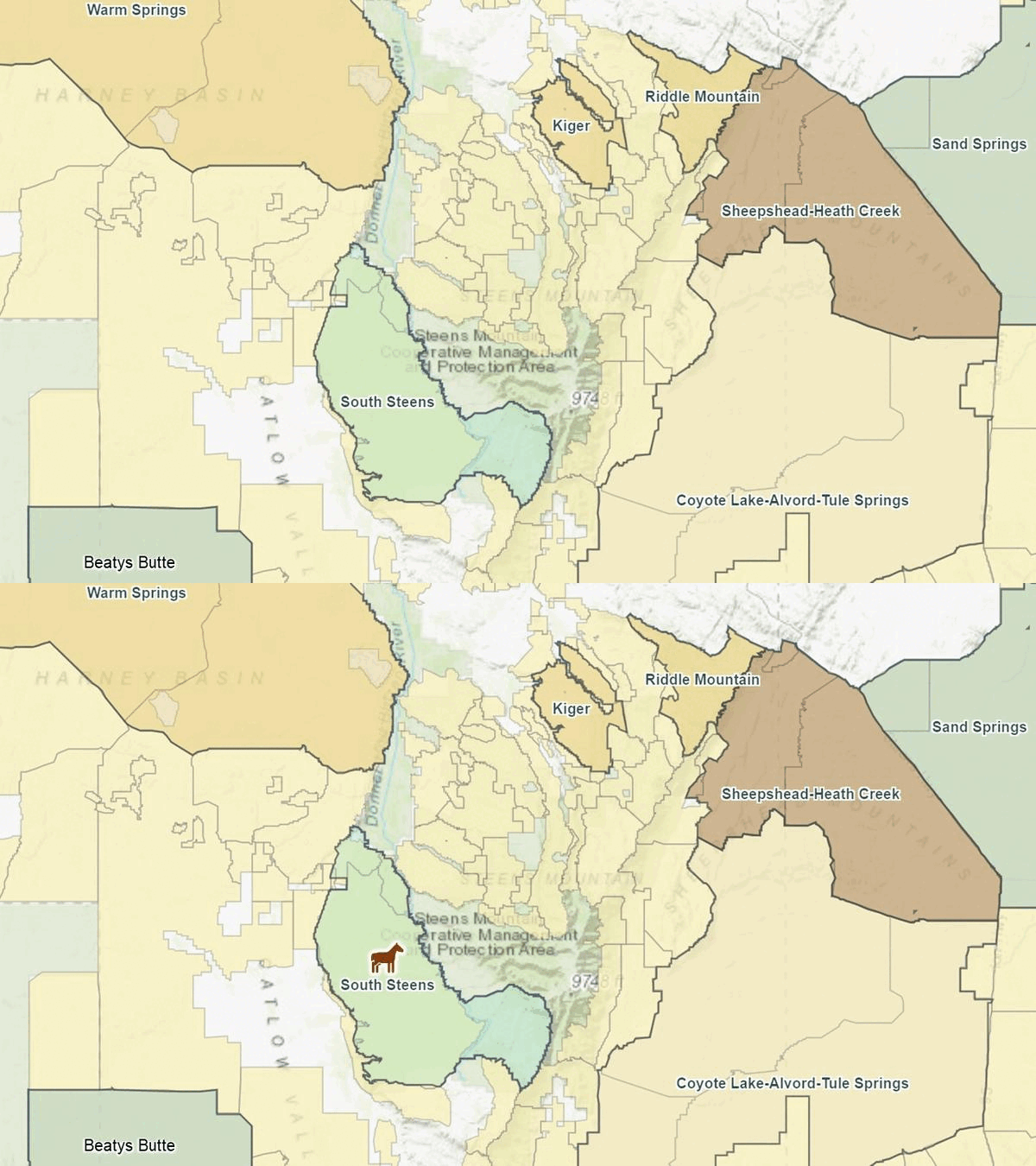
South Steens Roundup, Day 5

The incident began on September 10.  Gather stats through September 14:

  • Target: Horses
  • Type: Planned
  • Method: Helicopter
  • Category: Cruel and costly
  • Captured: 628, up from 525 on Day 3
  • Average daily take: 125.6
  • Capture goal: 500, increased to 750 on Day 3
  • Removal goal: 450, increase not reported
  • Returned: None
  • Deaths: 16, up from 7 on Day 3
  • Shipped: 579, up from 476 on Day 3

The figures above are based on the daily reports, not the totals posted by the BLM.

Nine horses were put down on Day 4 due to pre-existing conditions.

The death rate has increased from 1.3% to 2.5%.

The capture total includes 234 stallions, 274 mares and 120 foals.

Youngsters represented 19.1% of the animals gathered.

Of the adults, 46.1% were male and 53.9% were female.

The herd can’t be growing at a rate of 20% per year with a birth rate of 19% per year.

A better estimate would be 14% per year, assuming a death rate of 5% per year.

Body condition scores were not provided.

The location of the trap site was not disclosed.

The HMA and surrounding lands are subject to permitted grazing.

South Steens HMA Map 08-17-22

Day 5 ended with 33 unaccounted-for animals.

Mares treated with fertility control may be returned to the area at a later date.

Other statistics:

  • Horses allowed by plan (AML): 304
  • Forage assigned to horses: 3,648 AUMs per year
  • Pre-gather population: 1,370
  • Forage liberated to date: 7,536 AUMs per year
  • Water liberated to date: 6,280 gallons per day
  • Forage assigned to livestock: 10,299 AUMs per year (estimated)
  • Horses displaced from HMA by permitted grazing: 858
  • True AML: 1,162
  • Stocking rate at new AML: 8.6 horses per thousand acres
  • Horses displaced from HMA by drilling and mining: Ask the advocates

RELATED: South Steens Roundup, Day 3.

Calico Roundup, Day 5

The incident began on September 10.  Gather stats through September 14:

  • Target: Horses
  • Type: Planned
  • Method: Helicopter
  • Category: Cruel and costly
  • Captured: 258, up from 235 on Day 3
  • Average daily take: 51.6
  • Capture goal: 1,076
  • Removal goal: 1,036
  • Returned: None
  • Deaths: 7, up from 5 on Day 3
  • Shipped: 251, up from 133 on Day 3

The figures above are based on the daily reports, not the totals posted by the BLM.

No animals were taken on Day 5 and no explanantion was given.  Operations may have moved to another HMA.

The number of horses shipped on Day 3 was changed from 90 to 81.

Two stallions were euthanized on Day 4 for non-life-threatening conditions.

The death rate is 2.7%.

The capture total includes 99 stallions, 117 mares and 42 foals.

Youngsters represented 16.3% of the animals gathered.

Of the adults, 45.8% were male and 54.2% were female.

The herd can’t be growing at a rate of 20% per year with a birth rate of 16% per year.

A better estimate would be 11% per year, assuming a death rate of 5% per year.

Body condition scores were not provided.

The location of the trap site was not disclosed.

The HMAs and surrounding lands are subject to permitted grazing.

Calico Complex Map 09-07-22

Day 5 ended with no unaccounted-for animals.

Mares treated with fertility control may be returned to the area at a later date.

Other statistics:

  • Horses allowed by plan (AML): 952
  • Forage assigned to horses: 11,424 AUMs per year
  • Pre-gather population: 1,593
  • Forage liberated to date: 3,096 AUMs per year
  • Water liberated to date: 2,580 gallons per day
  • Forage assigned to livestock: Unknown
  • Horses displaced from Complex by permitted grazing: Unknown
  • True AML: Unknown
  • Stocking rate at new AML: Unknown
  • Horses displaced from Complex by drilling and mining: Ask the advocates

RELATED: Calico Roundup, Day 3.

BLM, Media Feed Public Steady Diet of Disinformation

A BLM spokesman told The Grand Island Independent in a story about wild horse adoption at Husker Harvest Days that the herds are growing at a rate of 20% per year.

The article also indicated that climate change has reduced the carrying capacity of the land.

Anybody who reads these pages knows that birth rates of 25%, needed for growth rates of 20%, are rarely seen in roundup data.

For example, the blitzkrieg at South Steens, which took wild horses off the range at an average rate of 175 per day, yielded 19% foals in 525 horses captured.

The operation was so productive that the BLM decided to extend it by 50%.

Followers of this blog also know that permitted grazing has sharply reduced the carrying capacity of public lands, not man-made climate change, which is a hoax.

True AMLs often exceed current AMLs by a factor of four of five because the horses receive just fifteen to twenty percent of the authorized forage, neglecting wildlife.

Wild vs Feral: You Can’t Reason with an Idealogue

Refer to this opinion piece dated September 11 by Rod Miller, columnist for Cowboy State Daily, a reader response dated September 13 by Ross MacPhee of the American Museum of Natural History and this angry retort dated September 13 by Miller.

Why would Miller care about “horses that are munching our public grass?”

His bio says he was raised on the ID Ranch north of Rawlins, WY and has spent half his adult life working on and managing ranches in the West.

South Steens Roundup, Day 3

The incident began on September 10.  Gather stats through September 12:

  • Target: Horses
  • Type: Planned
  • Method: Helicopter
  • Category: Cruel and costly
  • Captured: 525, up from 225 on Day 1
  • Average daily take: 175.0
  • Capture goal: 500
  • Removal goal: 450
  • Returned: None
  • Deaths: 7, up from zero on Day 1
  • Shipped: 476 up from 175 on Day 1

The capture goal has been reached.

The figures above are based on the daily reports, not the totals posted by the BLM.

Five horses were put down on Day 2 due to pre-existing conditions, followed by two more on Day 3.

The death rate is 1.3%.

The capture total includes 194 stallions, 231 mares and 100 foals.

Youngsters represented 19.0% of the animals gathered.

Of the adults, 45.6% were male and 54.4% were female.

The herd can’t be growing at a rate of 20% per year with a birth rate of 19% per year.

A better estimate would be 14% per year, assuming a death rate of 5% per year.

Body condition scores were not provided.

The location of the trap site was not disclosed.

The HMA and surrounding lands are subject to permitted grazing.

South Steens HMA Map 08-17-22

Day 3 ended with 42 unaccounted-for animals.

Mares treated with fertility control may be returned to the area at a later date.

Other statistics:

  • Horses allowed by plan (AML): 304
  • Forage assigned to horses: 3,648 AUMs per year
  • Pre-gather population: 1,370
  • Forage liberated to date: 6,300 AUMs per year
  • Water liberated to date: 5,250 gallons per day
  • Forage assigned to livestock: 10,299 AUMs per year (estimated)
  • Horses displaced from HMA by permitted grazing: 858
  • True AML: 1,162
  • Stocking rate at new AML: 8.6 horses per thousand acres
  • Horses displaced from HMA by drilling and mining: Ask the advocates

RELATED: South Steens Roundup Begins.

Calico Roundup, Day 3

The incident began on September 10.  Gather stats through September 12:

  • Target: Horses
  • Type: Planned
  • Method: Helicopter
  • Category: Cruel and costly
  • Captured: 235, up from 85 on Day 1
  • Average daily take: 78.3
  • Capture goal: 1,076
  • Removal goal: 1,036
  • Returned: None
  • Deaths: 5, up from 2 on Day 1
  • Shipped: 133, up from 43 on Day 1

The figures above are based on the daily reports, not the totals posted by the BLM.

The figures for Day 1 were updated to include 43 horses shipped.

Three females were euthanized on Day 2 for non-life-threatening conditions.

The death rate is 2.1%.

The capture total includes 90 stallions, 105 mares and 40 foals.

Youngsters represented 17.0% of the animals gathered.

Of the adults, 46.2% were male and 53.8% were female.

The herd can’t be growing at a rate of 20% per year with a birth rate of 17% per year.

A better estimate would be 12% per year, assuming a death rate of 5% per year.

Body condition scores were not provided.

The location of the trap site was not disclosed.

The HMAs and surrounding lands are subject to permitted grazing.

Calico Complex Map 09-07-22

Day 3 ended with 97 unaccounted-for animals.

Mares treated with fertility control may be returned to the area at a later date.

Other statistics:

  • Horses allowed by plan (AML): 952
  • Forage assigned to horses: 11,424 AUMs per year
  • Pre-gather population: 1,593
  • Forage liberated to date: 2,820 AUMs per year
  • Water liberated to date: 2,350 gallons per day
  • Forage assigned to livestock: Unknown
  • Horses displaced from Complex by permitted grazing: Unknown
  • True AML: Unknown
  • Stocking rate at new AML: Unknown
  • Horses displaced from Complex by drilling and mining: Ask the advocates

RELATED: Calico Roundup in Progress.

McCullough Fundraiser Benefits Ranchers Not Horses

The event will be held on September 17 at the Cody Holiday Inn according to an article posted yesterday by the Cody Enterprise.

The advocates at FOAL protect the horses from removal by getting rid of them with PZP.

FOAL Mixing PZP 01-18-22

A representative interviewed for the story said “The [darting] program keeps the herd at a sustainable level to minimize the need for roundups that are costly and also disrupt the family units and social structure within the herd,” exactly what they’re doing!

Livestock in the HMA receive 3.6 times more forage than the horses.

The BLM collects an estimated $8,230 per year in grazing fees from ranching activity inside the HMA while it spends $927,100 per year to care for the 508 wild horses displaced thereby.

That’s what the advocates are trying to protect.

RELATED: Youngsters Hard to Find at FOAL.

Cedar Mountain Pest Removal Starts This Week

The incident will begin on September 17, according to a BLM news release.

Helicopters will force the horses into the traps and operations will be open to public observation, starting on Day 3.

Gather activity on Days 1 and 2 will occur in the Dugway Proving Ground, a military facility not accessible by the public.

The September 7 schedule indicates capture and removal goals of 700 and 400.

The HMA covers 211,592 acres in western Utah, including 204,674 public acres.

The 390 horses allowed by plan require 4,680 AUMs per year.

The stocking rate allowed by plan is 1.9 wild horses per thousand public acres, higher than the target rate across all HMAs of one wild horse per thousand acres.

The pre-gather population is thought to be 920.

Cedar Mountain HMA Map 01-29-22

The HMA intersects four grazing allotments.  Livestock receive over three times more forage than the horses, as explained previously.

The BLM spends 113 times more to care for wild horses displaced from public lands by permitted grazing than it collects in fees from ranching activity inside the HMAs, as discussed yesterday.

Captured animals will be taken to the off-range corrals in Axtell.

Gather stats and daily reports will be posted to this page.

RELATED: Cedar Mountain Added to 2022 Roundup Schedule.

Chemehuevi Roundup, Day 30

The incident began on August 11 and does not appear in the latest schedule.

As of September 9, 194 burros have been trapped, 194 have been shipped and none have died, according to figures at the gather page.

The daily reports provide totals only.

The capture and removal goals are 275 each.

The cumulative total includes 92 jacks, 70 jennies and 32 foals.

Youngsters represented 16.5% of the animals gathered.

Of the adults, 56.8% were male and 43.2% were female.

The herd can’t be growing at rate of 20% per year with a birth rate of 17%.

The location of the trap site was not specified.

Day 30 ended with no unaccounted-for animals.

RELATED: Chemehuevi Roundup, Day 23.