More Angst at TRNP

Good grief.  The original wild horse herd has been gone for over twenty years.

The horses you see today were put there by the Park Service, as an exhibit.

With the Park Service threatening to remove them, the advocates are fighting back.

When their comrades try to eradicate other herds with the Montana Solution, there’s not even a whimper.

Have you seen a film by Deb Carson and Jamie Baldanza calling attention to the Virginia Range mustangs?

RELATED: Wailing and Gnashing of Teeth at TRNP?

Pile Burning This Week on the Virginia Range?

The December 20 news release said the BLM would burn piles of branches near Jackson Ranch in Genoa, NV and Geiger Grade in the Virginia City Highlands when enough precipitation has fallen to prevent the fires from spreading beyond the pile areas and road conditions allow safe access.

The forecast for Virginia City, slightly to the south, shows rain and snow most of the week, perhaps too much to get anything to burn.

Virginia City Forecast 12-26-22

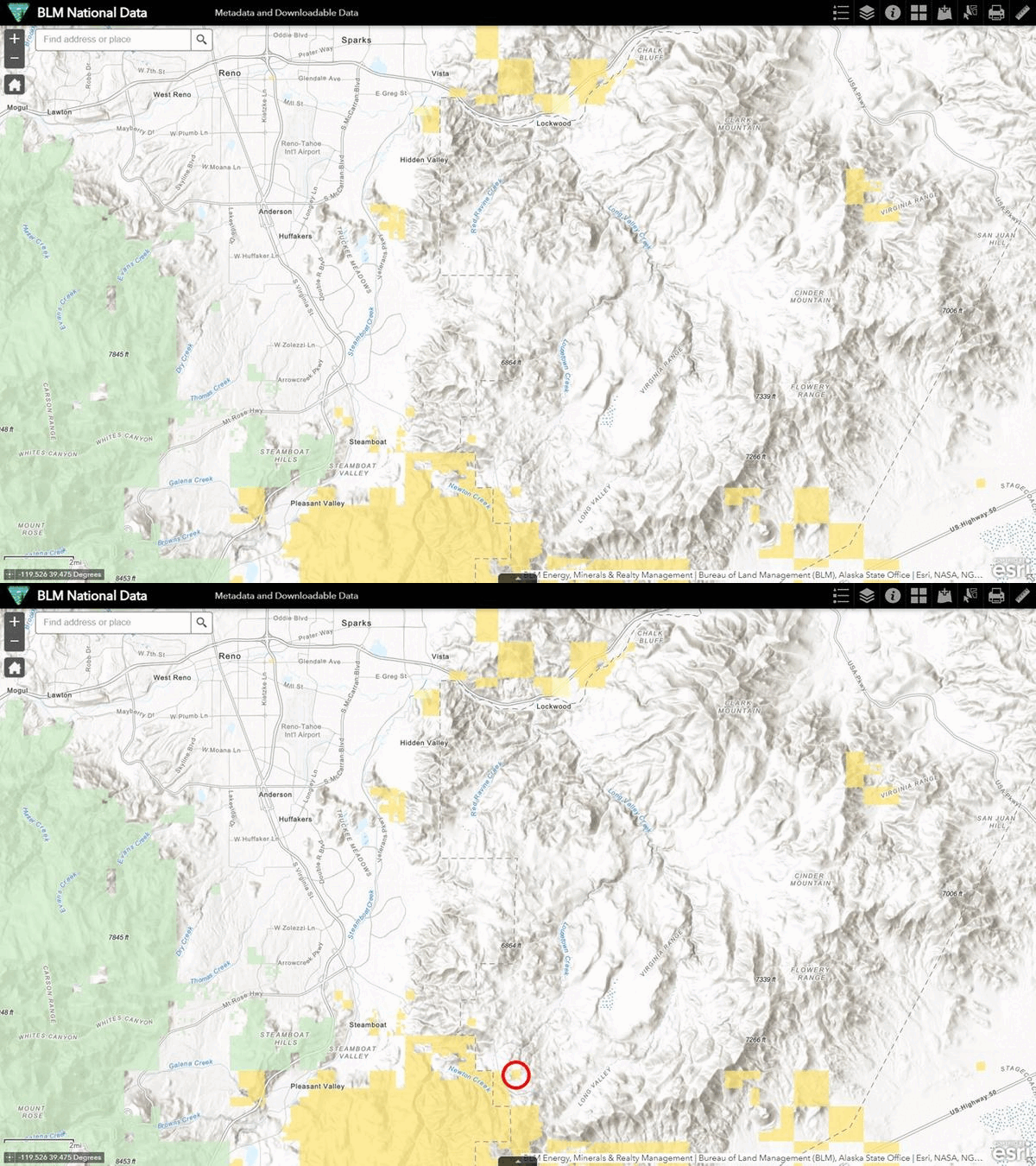
Most of the land in the Virginia Range is privately owned, denoted by white in this map from the National Data Viewer, but the BLM does control some acreage, denoted by tan.

Western Horse Watchers suspects the burns in the Highlands will occur on a 44-acre parcel surrounded by private lots, as shown in Storey County parcel map 03-18.

Pile Burning on Virginia Range 12-26-22

The announcement said the trees, probably pinyon pines and junipers, were thinned to reduce high severity wildfire and increase growth and vigor of the remaining trees.

Western Horse Watchers knows what you’re thinking: They sound like the advocates!

“If we get rid of them, they can stay.”

Speaking of the advocates, they have been pummeling the Virginia Range mares with their favorite pesticide for four years, and many are now at risk of sterility.

They do this not because they care about the horses but because they’re desperate for the approval of the bureaucrats and ranchers.

They are not having second thoughts about what they are doing.

Why are you still giving them money?

RELATED: Virginia Range Crimefighting Update for December.

How to Help the Bordo Atravesado Wild Horses

During the comment period for the draft EA, several advocates urged the BLM to reduce livestock grazing inside the HMA and/or shift livestock AUMs back to the horses, apparently unaware they were dealing with a resource enforcement action, or, if you prefer, a livestock protection plan, not an amendment to the land-use plan.

This is like asking a highway patrol officer to change the speed limit.  He doesn’t write them, he doesn’t review them, he enforces them.

Fortunately, the answer is in Appendix G of the Decision Packet.

“Changes to livestock grazing cannot be made through a wild horse and burro gather decision or through 4710.5(a), and are only possible if the BLM first revises the land-use plans to allocate livestock forage to wild horses and to eliminate or reduce livestock grazing.”

That would be the Socorro Resource Management Plan.

RELATED: Bordo Atravesado Decision Signed But Not Announced.

Wailing and Gnashing of Teeth at TRNP?

“And then everyone will look back at the tragedy of these horses being gone and why didn’t anyone try to save them?”

There is much consternation about the possible removal of wild horses from Theodore Roosevelt National Park, including this opinion piece dated December 23 in INFORUM, a news service based in Fargo, ND.

The horses you see today were put there by the Park Service.

The original herd, thought to be descended from Sitting Bull’s horses, is gone, thanks to the Park Service.

Some were rescued by Leo Kuntz and moved to his ranch near Linton.

He called them Nokotas.

The story unfolds in Nakota Heart, a 60-minute film you can watch on YouTube.

RELATED: Horses and Cattle to Be Removed from TRNP?

FY 2023 Omnibus Going Through Enrollment Process

That’s the current status according to a story posted this morning by The Hill.

Enrollment is an administrative step that verifies the accuracy of bill texts, confirms House and Senate actions and prepares the measure for delivery to the President.

A bill must pass both chambers in identical form before it can be printed and sent to the President.

As for the Omnibus, you know it’s bad for the country because liberals support it.

Similarly, you know an idea is bad for wild horses if the advocates endorse it.

RELATED: FY 2023 Omnibus Not Signed, Stopgap Measure Extended.

Sand Wash Advocates 01-17-22

Comparing the HAs and HMAs

From the National Data Viewer.  Forest Service not included.

Areas identified for wild horses and burros (HAs) in black.

Areas managed for wild horses and burros (HMAs) in orange.

Nullification is the process by which the administration and the unelected bureaucracy ignore laws they don’t agree with.

That’s what’s happening at the southern border and in the wild horse world.

Click on image to open in new tab.

RELATED: Resource Management in Pictures.

Comparing the HAs and HMAs 12-24-22

FY 2023 Omnibus Not Signed, Stopgap Measure Extended

A bill originally introduced as the Department of State, Foreign Operations and Related Programs Appropriations Act of 2022 was modified and rebranded as the Further Additional Continuing Appropriations and Extensions Act of 2023 and signed into law today according to a White House news release.

The Act provides temporary funding for the federal government through December 30.

The announcement did not indicate why the signing of the omnibus was delayed.

RELATED: FY 2023 Omnibus Clears House and Senate.

Bordo Atravesado Decision Signed But Not Announced

The Final EA, DR and FONSI were combined into one document and posted to the project folder on October 31.  The move was not announced at the BLM news site.

The Decision Record, signed on October 26, authorizes Alternative A, the Proposed Action, which calls for the removal of 190 excess wild horses in and around the HMA and the application of population control measures over a ten-year period.

The area is subject to permitted grazing and the new enforcement plan will ensure that the ranchers get their due.

RELATED: Bordo Atravesado Enforcement Plan Announced.

Bordo Atravesado HMA Map 07-31-22

FY 2023 Omnibus Clears House and Senate

The news release includes links to the full bill, division summaries and explanatory statements.

Despite last-minute amendments, the FY 2023 budget for the wild horse and burro program remains at $147,888,000.

The measure will likely be signed today by the one-horse pony, avoiding a government shutdown.  A White House statement confirms that.

RELATED: Committee Releases Overview of FY 2023 Omnibus.

Wild Horse Fire Brigade Serves Ranchers, Not Wild Horses

Imagine completing 198 laps in a 200-lap race and running out of gas.

This news release about the Wild Horse Fire Brigade, written by its creator and leading proponent, plays the course well but chokes on the back nine in the final round.

Roundups and stockpiling of captured animals are costly, as the author notes, and they represent irresponsible use of the taxpayer’s money and the public lands.

The 768,000 AUMs per year needed to support the 64,000 animals in off-range holding are readily available in their lawful homes, at a loss of $1 million per year in grazing fees but with savings of $70 million per year in holding costs.

Who wouldn’t jump on that?  The bureaucrats, ranchers and their political allies.

These figures were not mentioned in the announcement.

Fertility control and on-range management are euphemisms for chemical sterilization of mares with vaccines that cause illness instead of preventing it.  Spot on.

Wild horses and burros were to be protected from capture, branding, harassment and death, and their land was to be managed principally for them, yet we see everything that was prohibited in the 1971 Act.  Correct, the Act no longer affords the protections sought by Velma!

In case you haven’t been keeping score, we’re ahead 3-2 in the top of the eighth.

Keeping wild horses in areas where they are in conflict with commercial interests guarantees they will remain targets of those interests, resulting in the highly flawed and costly management concepts previously cited.

Oh crap, bases loaded.

Is there a solution to the problem?

Yes, the Natural Wildfire Abatement and Forest Protection Plan, also known as the Wild Horse Fire Brigade.

Move the horses to remote wilderness areas not particularly suited for livestock grazing, or anything else.

Using just 20 million acres of these vast water and forage-rich areas, up to 100,000 wild horses could be relocated as family bands, at the rate of one horse per 200 acres (five horses per thousand acres), ending the conflicts with commercial interests.

Dang, the other team just drove in two runs.

Where would the family bands come from?  Not from the off-range corrals and long-term pastures.

Why resolve the conflicts by getting rid of the horses?  That’s what the advocates do.

The same result could be achieved by confining the ranchers to their base properties in a year-round off season, while expecting them to pay the going rate to feed their animals.

This would be in line with the original statute.

Game saved with one out remaining.

RELATED: ‘Wild Horse Fire Brigade’ Means Victory for Permittees.

Foal-Free Friday, Christmas Wish Edition

Advocates with the Salt River Wild Horse Darting Group, an affiliate of the Campaign Against America’s Wild Horses, believe every wild horse herd should have a humane management program like theirs.

SRWHDG Christmas Wish 12-21-22

That means they want every herd cut down to size (with the Montana Solution).

Western Horse Watchers knows what you’re thinking: They sound like the bureaucrats and ranchers!

That’s because they’re in bed with the bureaucrats and ranchers.

Let’s take a look at what they’re offering:

  • Barren mares
  • Confused stallions
  • Shrinking herds
  • Injuries and infections
  • Abnormal sex ratios
  • Increasing death rates
  • Massive human involvement
  • Disruption of natural order
  • Acclimation to people
  • Sterility

Whenever you see a reference to cruel and costly roundups, humane management, keep them wild and free, or help us protect our cherished/beloved/innocent wild horses, you know you’re being swindled.

Don’t give them a penny.

RELATED: Foal-Free Friday, Don’t Let Them Near the Horses Edition.

Working Together for a Horse-Free Future 12-21-22

RTF Applauds FY 2023 Budget Increase for WHB Program

Contrary to the Division G summary issued by the Senate, the organization’s president claims in today’s news release that the higher level of funding marks a new direction for wild horse and burro management.

Like most advocacy groups, Return to Freedom is known for its unwavering support of safe, proven and reversible fertility control—which doesn’t exist—as an alternative to capture and removal.

Resource allocations and management priorities are never questioned.

RELATED: BLM Shuns Montana Solution?

Thriving Ecological Balance-3

Impact of FY 2023 Omnibus on Wild Horses and Burros?

Like the House news release, the December 20 announcement by the Senate appropriations committee included links to the full bill, division summaries and explanatory statements.

However, the Division G summary puts a different spin on the authorization for the wild horse and burro program.

“The wild horse and burro program is provided $148 million to accelerate removals from degraded and drought-plagued areas, to house horses off-range, and to jumpstart a fertility control program to reduce the future horse population.”

The emphasis is on removals, off-range holding and on-range management (as the advocates like to describe it).

Research was not mentioned.

The new roundup schedule does not reflect these priorities.

Not yet, anyway.

RELATED: Committee Releases Overview of FY 2023 Omnibus.