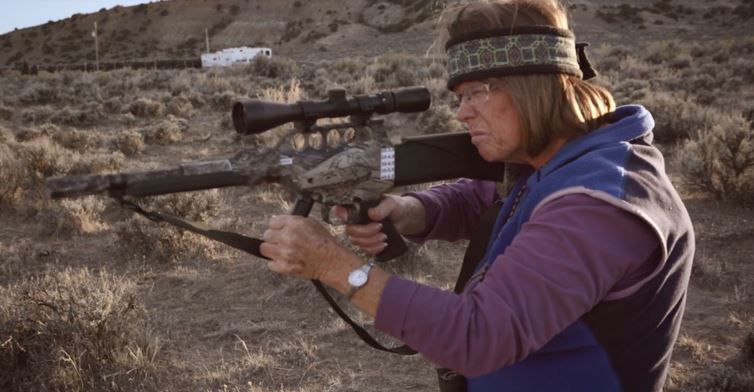
On the Salt River with Mark Storto.
May be disturbing to viewers wearing “Stay Wild” caps.

Western Horse Watchers Association
Exposing the Hypocrisy, Lies and Incompetence of the Wild Horse Advocates
On the range
The BLM off-range corrals at Hines don’t have room for horses removed from the WHT, according to a story posted yesterday by The Bulletin of Bend, OR, so the Forest Service will build one at the former headquarters of the Crooked River National Grassland.
The facility will have a capacity of 35 animals and is expected to cost $3 million.
The NEPA review will likely consist of a categorical exclusion, which minimizes public involvement and avoids an environmental assessment.
The article said that feed costs are expected to be $7 per horse per day, which means the government will collect $16.20 per year in grazing fees from ranching activity inside the WHT, while it spends $2,555 per year to care for every wild horse displaced thereby,
Would you say that’s a wise use of the public lands?
The WHT lies mostly within the Reservoir Allotment, which has been designated for privately owned sheep.
RELATED: Big Summit Roundup Delayed Until Fall.

The incident will begin on or about December 1, according to a BLM news release.
A roundup last year took 46 horses off the HMA.
Horses will be drawn into the traps with bait and operations will not be open to public observation.
The capture goal is 50 and the removal goal is 25.
The HMA covers 437,120 acres in southern Oregon and the 250 horses allowed by plan require 3,000 AUMs per year.
The stocking rate allowed by plan is 0.6 wild horses per thousand acres, compared to a target rate of one wild horse per thousand acres across all HMAs.
The current population is thought to be 463.
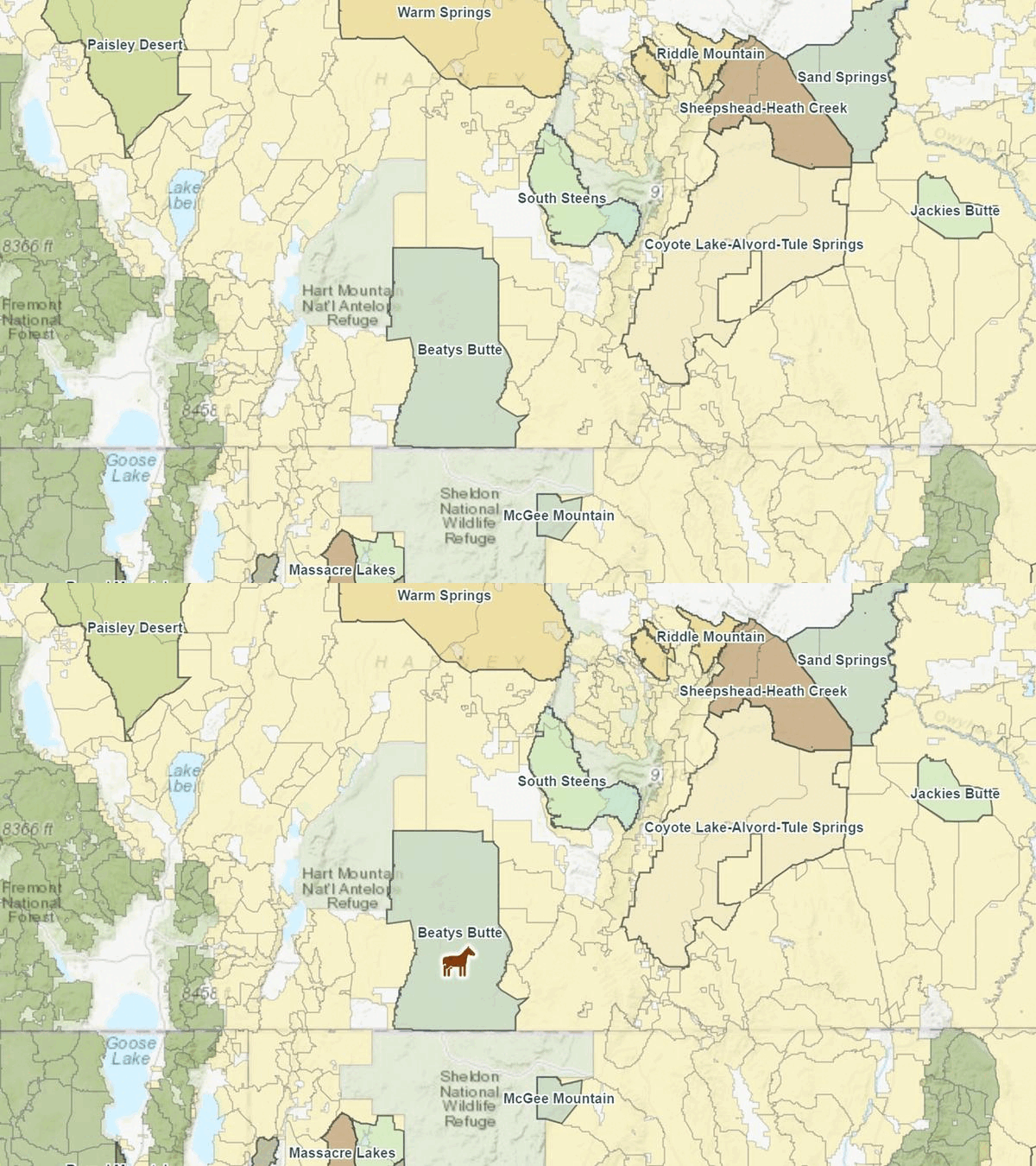
The allotment lies within the Beaty Butte Common Allotment, which offers 26,121 AUMs per year on 506,985 public acres, or 51.5 AUMs per year per thousand acres.
That resource would support 4.3 wild horses per thousand acres.
The stocking rate at the True AML would be 0.6 + 4.3 = 4.9 wild horses per thousand acres, eight times higher than the government allows!
You don’t have a wild horse problem, you have a resource management problem.
Don’t ask the advocates to explain it, they are clueless.
Captured animals will be taken to the off-range corrals in Hines.
A link to the gather stats and daily reports was not provided.
The FY23 roundup schedule has not been posted to the customary location.
A story dated November 16 by Fox News includes a photo from the early days of the roundup when gather activity took place at the Dugway Proving Ground.
The gather page does not mention the capture of a domesticated horse.
The operation gave ranchers unfettered access to cheap feed on America’s public lands.
The wild horse and burro program has been a drag on the grazing program for 50 years.
RELATED: Escaped Trail Horse Captured in Cedar Mountain Roundup?
The decision earlier this year by the Corolla Wild Horse Fund to stop darting the Currituck mares, due to an aging population and questions about the long-term effects of PZP on their reproductive systems, shows that one group, at least, may be rejecting the propaganda of the big-name advocacy groups.
Did they cut ties completely?
Doesn’t look like it. Their herd management page, which describes the darting program, still has links to other organizations, including two of the signatories to the ill-advised Path Forward, and American Wild Horse Preservation, which many know today as the Campaign Against America’s Wild Horses.
Volunteers with CAAWH have been pummeling the Virginia Range mares with their favorite pesticide for four years and some may be nearing sterility. All in a day’s work for the monster in Davis.
They treat their cherished horses the way you treat your cherished ants and roaches.
As for the Path Forward, the advocates have picked through the plan and pulled out the best part—the Montana Solution—which they now claim is the path forward for America’s wild horses.
RELATED: Foal-Free Friday, Choosing Your Own Poison Edition.

A BLM news release dated November 15 describes the hand-thinning of pinyon pine and juniper trees on 539 acres of the public lands in the Kern Mountains, about 50 miles northeast of Ely, NV.
Workers lop the targeted trees and scatter the debris across the treatment area.
Non-targeted species, brush, grasses and forbs are not impacted, according to the announcement.
The effort is part of the Kern Mountains Landscape Restoration Project that will treat up to 12,580 acres of a 15,725-acre project area over several years.
A news release dated December 14 said the trees displace shrubs, grasses and forbs important for wildlife and removing them, combined with seed application, increases food for such animals while reducing the potential for hazardous crown fires.

The Western Watersheds map shows the area is covered by grazing allotments.
The remarks about wildlife may be a cover story for a concerted effort to boost forage production and further enrich the public-lands ranchers, with taxpayers footing the bill.
The ranchers pay five cents on the dollar for the resource, compared to market rates, and fifty percent of grazing receipts, or $10 million, whichever is greater, is plowed back into the program every year in the form of range improvements. But it’s not enough.
The nearest HMAs are Triple B, Antelope and Confusion.
They don’t like helicopters.
Can’t stand the wild horse shooters.
They’re not thrilled with motorists, tourists and campers.
Don’t care much for the hunters either.
They hate drillers and miners, even though they’re not much of a threat to wild horses.
Why? They want to dominate the wild horse removal business, so their ranching allies can dominate America’s public lands.
They, and they alone, shall get rid of the horses with safe, proven and reversible fertility control, as explained by the writer of this op-ed in the Arizona Daily Sun.
File under: Charlatans.
Thirty five mares will be returned to the HMA on November 16, according to a BLM news release.
The announcement said they were treated with a fertility control drug but did not specify the type.
The gather page said they would receive GonaCon Equine, which may act as a sterilant with a single dose.
The advocates generally oppose the use of the substance but they strongly support the Montana Solution, which can achieve the same results in as little as five doses (primer plus four boosters).
Mares thus treated, no longer able to conceive, are described as “self-boosting.”
RELATED: Twin Peaks Roundup Ends.
The Animal Industry reports presented at the quarterly Board of Agriculture meetings include updates from the Campaign Against America’s Wild Horses on its safe, proven and reversible fertility control program.

Here are some figures from the past year:
The herd appears to be shrinking, as advertised.
The advocates are doing what they do best—getting rid of wild horses—but will they win the approval of the bureaucrats and ranchers?
The June report said they pumped 1,255 rounds of their favorite pesticide into the herd in FY22.
An aerial survey put the population at 3,567 according to the September report but did not indicate if the area inspected coincided with the area hunted by the advocates.
The same report indicated that five vehicle collisions with horses have occurred to date, compared to 27 in 2021 and 46 in 2020.
RELATED: Virginia Range Darting Program a Model for Herd Management?
On the Salt River with Mark Storto.
The incident occurred last year east of Rawlins and the HMAs affected by the Rock Springs RMP amendments, when the group tried to access public lands interspersed among private parcels of roughly the same size.
Owners of the private areas consider it unneighborly for outsiders to hopscotch through their land by crossing from one public section to another at the corners where they meet, according to a story dated November 10 by The Wall Street Journal.
“Their land” taken to mean all of it.
The case involved the use of a fence ladder to effect the crossing, shown in an August 23 report by WyoFile.
Apparently, at one of the corners, the landowner, or an agent thereof, drove T-posts into the ground and wrapped them in chains to prevent anyone from crossing at that point.
Note the marker between the posts at the bottom of the photo in the WyoFile article.
Here is an example from the Virginia Range. Lands in this area are privately owned.

The private parcels in Wyoming are owned by Elk Mountain Ranch, indicated by the signs in the WyoFile image.
Elk Mountain Ranch is owned by Iron Bar Holdings, which is controlled by North Carolina pharmaceuticals magnate Fredric Eshelman.
The four men were acquitted of criminal trespass charges in state court earlier this year, but Iron Bar has since filed a civil trespassing complaint against them, which will be heard in federal court in 2023.
The map provided by WSJ suggests the ranch occupies the same space as the Home Ranch Allotment, which can be found in the Western Watersheds map.

Turns out that Iron Bar holds all of the active AUMs in the allotment, making Eshelman a public-lands rancher!
This explains the remark about “their land” above.
Elk Mountain is probably the base property that secures grazing preference on the public parcels.
The allotment is in the Custodial category, probably because most of the acreage and forage are associated with non-BLM lands.
As for the BLM resources, the allotment offers 585 AUMs per year on 7,152 public acres, or 81.8 AUMs per year per thousand acres, enough to support 6.8 wild horses per thousand acres on a twelve-month grazing season.
The BLM maintains that public lands in the western U.S. can only support one wild horse per thousand acres.
The agency also maintains that corner crossings in the Checkerboard or elsewhere are not considered legal public access.
Parachuting might be an option.
Western Horse Watchers does not know if hunters can use fence ladders to haul their trophies out of such areas.
You can order one at Bonfire. Seven days remaining.
Caps, the best way to signal your support for the Montana Solution, are not available.
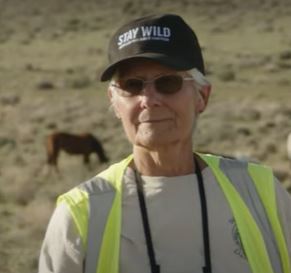
You may need a diploma from the Billings School of PZP Darting to get one.
RELATED: Do “Stay Wild” Caps Absolve the Advocates from Wrongdoing?
The advocates, eager to dominate the wild horse removal business, generally don’t support the use of GonaCon Equine, which may act as a sterilant.
As noted by the Wild Beauty Foundation, the product can be irreversible, sterilize wild horses completely and has been proven to shrivel the ovaries of wild mares.
The Montana Solution, favored by most of the advocates, including the Campaign Against America’s Wild Horses, its affiliates and offshoots, accomplishes the same thing in as little as four years, but these charlatans have invested so much in its promotion they’ll never admit their errors.

You only have to look at Assateague Island, where the pesticide was applied for over twenty years, to see the destruction.
The advocates are now trying to ruin the herds on the Virginia Range and Salt River, among others.
Meanwhile, the search for a better poison goes on.
These “vaccines” don’t prevent illness, they cause it, and are probably more harmful in the long run than the “cruel and costly” helicopter roundups they seek to replace.
RELATED: Foal-Free Friday, Anathema to the Advocates Edition.
The original solicitation was withdrawn due to unspecified protests, according to today’s news release.
A new request has been posted.
This is a great opportunity for the advocates to advance their anti-horse agenda, build lasting relationships with former adversaries and embrace their heretofore cruel and costly helicopter roundups.
Proposals can be submitted through November 30.
RELATED: Proposals Sought to Catch, Treat, Release Wild Horses and Burros.
If you’re trying to sell the Montana Solution, win the approval of the bureaucrats and ranchers, and dominate the wild horse removal industry, are you going to tell your donors that areas identified for wild horses can support many more animals than the government allows?
RELATED: The Carrying Capacity Puzzle.

The BLM sells about 12 million AUMs to livestock operators on 155 million acres of public lands in the western U.S. every year.

That resource would support one million wild horses on a twelve-month grazing season, for an equivalent stocking rate of 6.5 wild horses per thousand acres.
The Virginia Range was carrying ten wild horses per thousand acres before the advocates got involved.
Land designated for wild horses, a subset of the acreage above, can only support one wild horse per thousand acres, according to the official narrative (27,000 animals on 27 million acres).
Why the difference?
The management plans assign most of the forage to privately owned livestock.
By how much are the horses being cheated?
The forage assigned to livestock is the missing piece in the carrying capacity puzzle.
Carrying capacity = Horses allowed by plan + Horses displaced by livestock
The number of horses displaced from their lawful homes by permitted grazing is
6.5 × 27,000,000 ÷ 1,000 = 175,500
The True AML, the number of wild horses the land could support if it was managed principally for them, is
27,000 + 175,500 = 202,500
The figure based on the land originally identified for wild horses, around 53 million acres, is
(1.0 + 6.5) × 53,000,000 ÷ 1,000 = 397,500
This is enough to empty all of the off-range corrals and long-term pastures six times over!
You don’t have a wild horse problem on America’s public lands, you have a resource management problem.
Who’s doing the cheating?
The bureaucrats, of course, with the cooperation of the ranchers and advocates.
Concerns about the rising costs of the wild horse and burro program are bullcrap.
More and more horses will be taken off the range and the costs will go wherever they need to go to protect the grazing program and the public-lands ranchers.
RELATED: Livestock Outnumber Horses and Burros on Public Lands?

Refer to this news release on EIN. Includes a link to a letter contradicting their belief that equine slaughter is a humane form of euthanasia.
Cattle and sheep are not, and never were part of the North American ecosystem.
The thriving ecological balance of the original statute referred to the relationship between wild horses and wildlife, not privately owned livestock.

Fifty mares treated with GonaCon Equine will be returned to the HMA on November 14, along with twelve stallions, according to today’s news release.
The event will be open to public observation.
Smaller herd sizes and lower birth rates keep the resource scales tipped in favor of the public-lands ranchers for longer periods of time.
The advocates have unmatched expertise in that regard.
RELATED: Cedar Mountain Roundup Over.

 Western Horse Watchers Association