Resource Management at McCullough Peaks HMA

As noted yesterday, the 140 horses allowed by plan require 1,680 AUMs per year.

Livestock receive an average of 56.7 AUMs per year per thousand public acres on the six allotments that overlap the HMA.

The HMA covers 113,938 public acres so the forage assigned to livestock in the area managed for horses is 56.7 × 113,938 ÷ 1,000 = 6,460 AUMs per year.

If you allow 200 AUMs per year for wildlife, the resource management pie chart would look like this:

McCullough Peaks Resource Management 01-14-23

The AML is small relative to the available resources because the HMA is managed primarily for livestock, contrary to the original statute.

The forage allocations will be enforced over a ten-year period by thinning the herd with bait traps and stifling its growth with fertility control.

The process is just getting started.

It’s not what Velma intended but it’s what the bureaucrats, ranchers and advocates intend.

RELATED: The Carrying Capacity Puzzle.

How Many Wild Horses Can McCullough Peaks Support?

The HMA overlaps six allotments, as shown in this map from the National Data Viewer.

Although Peaks 1064 and Red Point extend beyond the HMA boundary, the forage assigned to livestock inside the HMA is easy to estimate on a per-acre basis.

The HMA covers 120,412 total acres, including 113,938 public acres, according to the BLM HMA Report, and the 140 horses allowed by plan require 1,680 AUMs per year.

The stocking rate allowed by plan is 1.2 wild horses per thousand public acres.

Click on image to open in new tab.

McCullough Allotment Map 01-13-23

The Allotment Master Report from RAS provides management status, acreage and active AUMs.

McCullough Allotment Calcs 01-13-23

All of the allotments are in the Improve category.

The weighted average forage availability across the six parcels is 56.7 AUMs per year per thousand public acres, enough to support 4.7 wild horses per thousand public acres.

The number of wild horses displaced from their lawful home by permitted grazing is 4.7 × 113,938 ÷ 1,000 = 535, putting the True AML at 675, to be achieved by confining the ranchers to their base properties in a year-long off-season.

The BLM spends around $1 million per year to care for the 535 refugees in short-term holding, while it collects about $9,000 per year in grazing fees from ranching activity inside the HMA.

Would you say that’s a wise use of the public lands?

The current population is thought to be 179, well within the carrying capacity of the HMA.

Given that the advocates are trying to suppress the herd with their favorite pesticide, they are voices for the bureaucrats and ranchers, not the horses.

RELATED: What the McCullough Advocates Are Trying to Protect.

Burros Lost at Axtell?

Western Horse Watchers is unable to corroborate the story by Deseret News with reports from the BLM.

Unlike the incident at Cañon City, the agency has not acknowledged the loss at its news site or the Utah HMA page.

The reporter’s source was the self-serving Campaign Against America’s Wild Horses, whose representatives used the deaths to justify their ruinous darting programs.

In cases like these, you have to wonder if the reporter contacted CAAWH through the course of her research or if CAAWH approached her as an outlet for its propaganda.

Scoping Begins for McCullough Peaks Livestock Protection Plan

Your mission, should you decide to accept it, is to help the bureaucrats eliminate unauthorized native species (excess horses) in favor of authorized non-native species (livestock), under the guise of a thriving natural ecological balance.

Volunteers with FOAL are experts in this regard.

Suggestions that benefit the horses are outside the scope of the project.

Comments will be accepted through February 7, according to a BLM news release.

RELATED: Bait Traps Coming to McCullough Peaks HMA?

McCullough Peaks HMA Map 10-26-22

Purpose of Three Fingers and Jackies Butte Pest Control Plan?

As in other areas, the goal is to eliminate unauthorized native species (excess horses) in favor of authorized non-native species (lifestock).

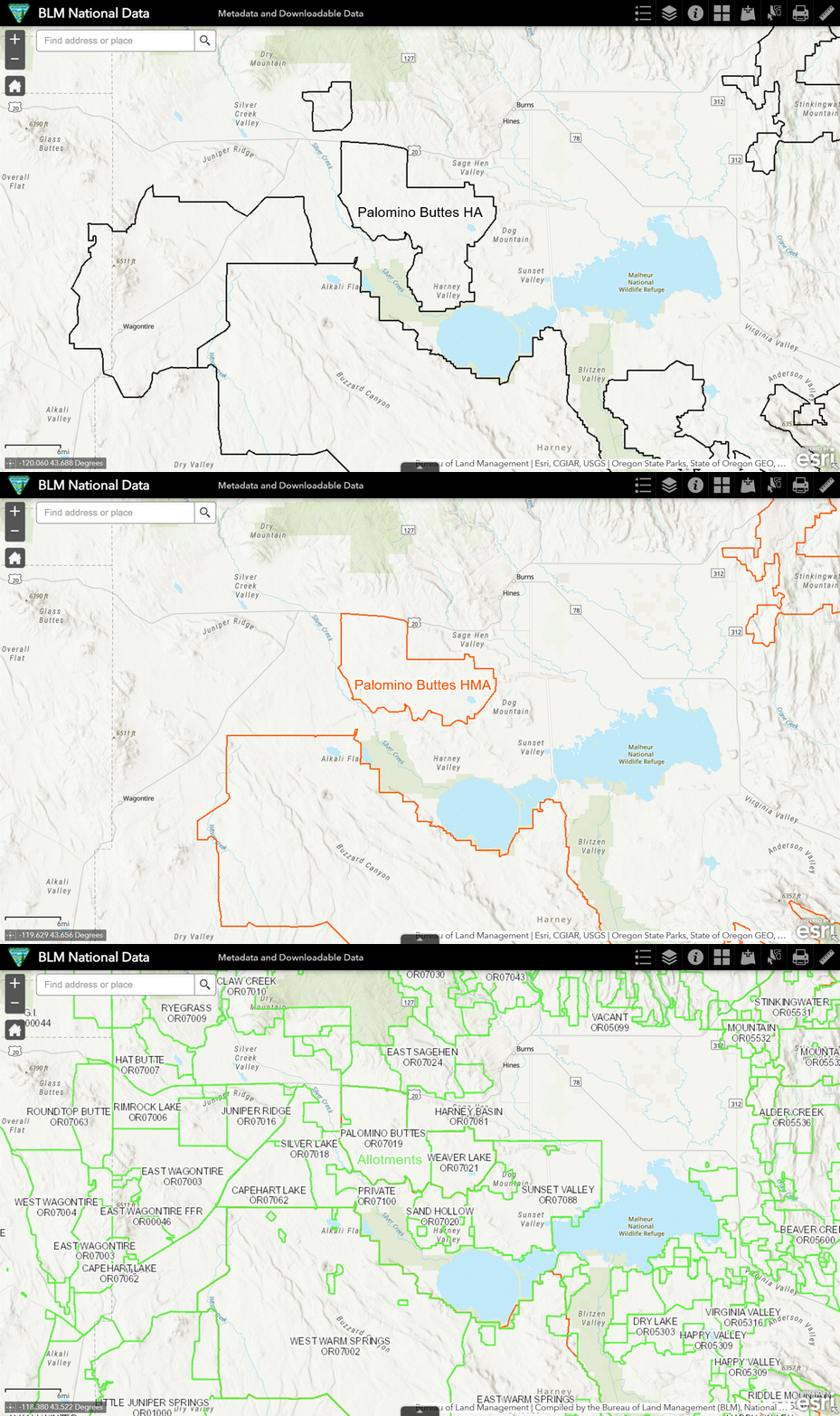
In this map from the National Data Viewer, areas of critical environmental concern are marked in gray, HAs are black, HMAs are orange and grazing allotments are green.

The two HMAs are in eastern Oregon near the Idaho state line.

Click on image to open in new tab.

RELATED: Decision Pending for Malheur County Pest Control Plan?

Three Fingers and Jackies Butte Allotments 01-06-23

Foal-Free Friday, Everything’s Going According to Plan Edition

Many more horses will be lost to the Virginia Range darting program, now moving into its fifth year, than harsh winter conditions.

With few if any new foals hitting the ground, the death rate is going up as the average age of the herd increases.

Many of the mares are now at risk of sterility.

Advocates with the Campaign Against America’s Wild Horses and bureaucrats with the Nevada Department of Agriculture are responsible for the destruction.

RELATED: Foal-Free Friday, Auld Lang Syne Edition.

Decision Pending for Malheur County Pest Control Plan?

A story by the Malheur Enterprise of Vale, OR indicates the BLM will publish a ten-year plan later this month but does not specify the target HMA(s).

You must subscribe for details.

Western Horse Watchers suspects it’s Three Fingers and Jackies Butte.

No documents have been posted to the project folder since May 6.

RELATED: Draft EA for Three Fingers and Jackies Butte Out for Review.

Wild Horse Management Trends in Northern Wyoming

From the National Data Viewer.

Areas of Critical Environmental Concern are shown in gray.

Areas identified for wild horses are shown in black.

Areas managed for wild horses are shown in orange.  McCullough Peaks is east of Cody, Fifteenmile is southeast.

Areas managed for livestock are shown in green, an indication of what the McCullough advocates are trying to protect with their ruinous darting program.

While ACECs may be an impediment to management of wild horses, they don’t appear to be a major obstacle to permitted grazing.

Although horses are often blamed for poor rangeland health, most of the BLM land in this map, denoted by tan, is horse free.

RELATED: Wild Horse Management Trends in Southwestern Wyoming.

Wild Horse Management Trends in Northern Wyoming 01-03-22

Online Scoping Meeting Next Week for TRNP Livestock Plan

The meeting will be held on January 12, starting at 6:00 PM Mountain time.

The meeting notice includes a link to join.

Comments on the scoping newsletter will be accepted through January 31.

Three management options have been identified and the Park Service has designated Alternative C as the Proposed Action – Phased Reduction of Herds to No Livestock.

RELATED: More Angst at TRNP.

Wild Horse Management Trends in Southwestern Wyoming

From the National Data Viewer.

First, the HAs in black, areas identified for wild horses.

Next, in orange, the HMAs, areas managed for wild horses.  A subset of the HAs with roughly half of the land now designated for other purposes.

Finally, the grazing allotments in green.  The principal use of America’s public lands.

Areas unfit for wild horses are almost always suitable for livestock production, as if there was no dietary overlap.

Under the Rock Springs RMP Amendments, two more HMAs will be closed and a third will be downsized, continuing a trend that puts ranching interests far above those of wild horses.

RELATED: Caliente Complex in Pictures.

Rock Springs HAs and HMAs 01-01-23

What Happened to the Pine Nut Mountains AUMs?

From the National Data Viewer.

First, the HA in black, just east of Carson City, an area identified for wild horses.

Next, the HMA, in orange, an area managed for wild horses, much smaller than the HA.

Finally, the grazing allotments, in green, an indication of what the Pine Nut advocates and their overlords at the Campaign Against America’s Wild Horses are trying to protect.

RELATED: Population Explosion Coming to Carson Valley?

What Happened to Pine Nut AUMs 01-01-23

Colorado Grazing Project Offers Hope for Wild Horses

The Proposed Action, Alternative B, would reissue 24 grazing permits on 36 allotments with updated terms and conditions to protect the Colorado hookless cactus and DeBeque phacelia, according to the scoping document.

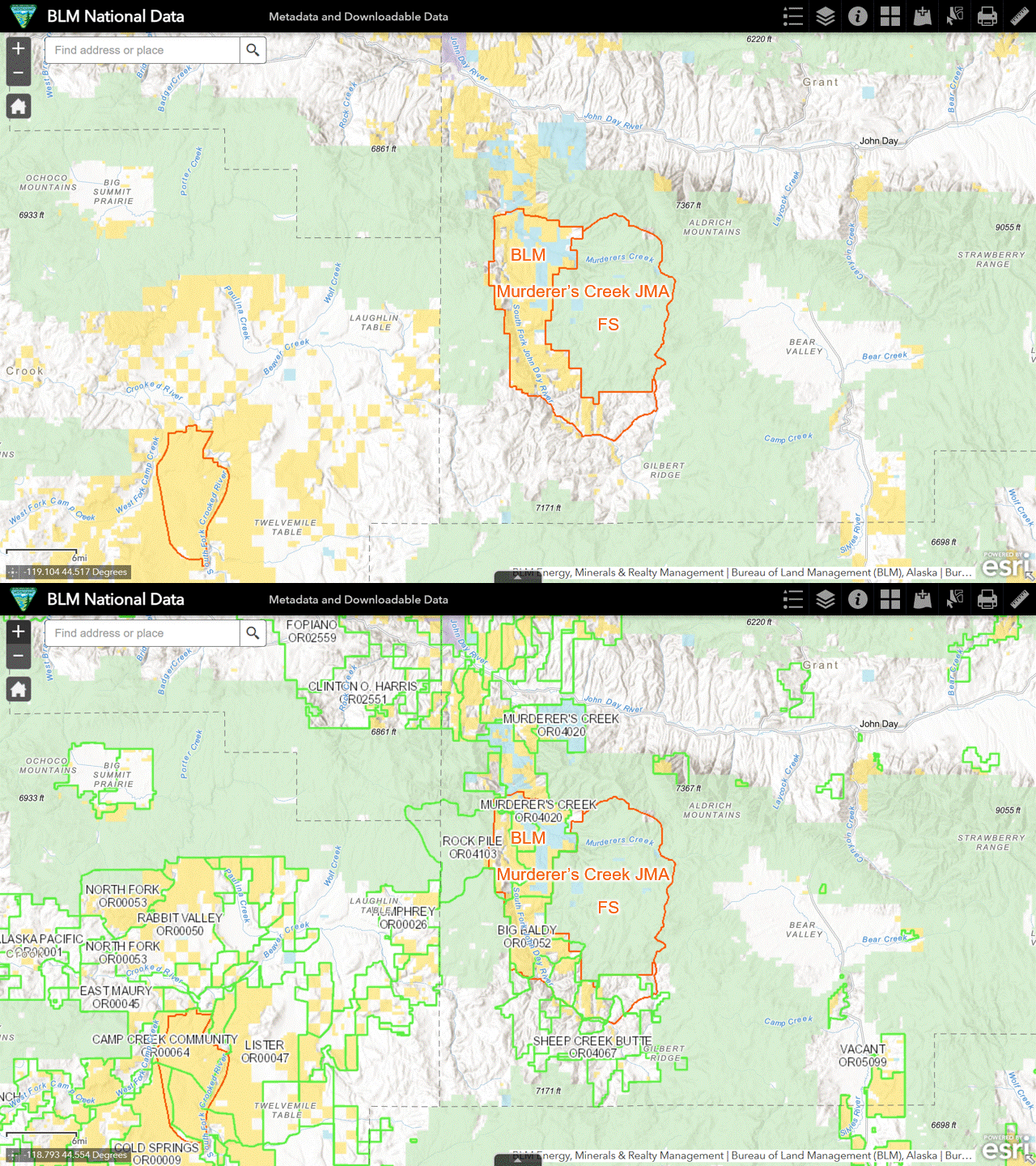
The allotments and the affected species are shown in Figure 2.

Not shown in the map is the Little Book Cliffs WHR, which is west of and adjacent to Red Rock.  Click on image to open in new tab.

Figure 2 Colorado Scoping Document 12-31-22

Although comments will be accepted through January 10, Western Horse Watchers was unable to find the “Participate Now” button mentioned in the “How to Get Involved” section of the project.

Of interest to the wild horse world is Alternative C, the No Grazing option.

Under this alternative, public lands within the allotments would be devoted to a public purpose that precludes livestock grazing.  The grazing permits would be canceled on the 36 allotments, and use of the allotments by livestock would be discontinued.

The permittees would be given two years’ prior notification before their grazing permit and grazing preference were canceled as specified in 43 CFR 4110.4-2.

Further, no livestock grazing would be authorized after the termination date unless a new environmental analysis is completed which determines that livestock grazing could be authorized on all or some portion of the area.

Any private acreage within the allotments or private lands in close proximity to the allotments could continue to be grazed at landowners’ discretion.  However, landowners would be required to keep their livestock off BLM-administered public lands and additional fencing may be needed to prevent livestock from trespassing on said lands.

Livestock-related range improvements would be abandoned and/or removed and reclaimed where there is no clear benefit to other programs.

In short, confine the ranchers to their base properties in a year-round off season and let them pay market rates to feed their animals.

This is a much better option for our wild horses than the Wild Horse Fire Brigade.

RELATED: Wild Horse Fire Brigade Serves Ranchers, Not Wild Horses.

Ringleader Admits Her Group Is Getting Rid of Salt River Horses!

“Through our humane fertility control program, we make sure the population is reducing without ever removing one horse.”

Yep, we’re protecting them from removal by getting rid of them with PZP.

You won’t see one foal in the video.  How can that possibly bode well for the horses?

RELATED: Words Have Different Meanings in the Wild Horse World.

Foal-Free Friday, Auld Lang Syne Edition

The year saw some of the stupidest ideas yet from the advocates.

In the legislative arena, three bills come to mind:

All three died in committee, thankfully.  But they speak volumes about those who supported them.

Regarding their important work, the advocates came up with these profound ideas:

  • If we get rid of them, they can stay
  • We’re protecting them from removal by getting rid of them with PZP
  • If we don’t get rid of them, the BLM will
  • We’re changing the way wild horse herds are managed, not their land
  • We have a better way (to get rid of wild horses)
  • You have to manage the numbers to fit what’s available for the horses

It’s getting harder and harder to distinguish them from the tools of their trade.

Give them the boot in 2023.

RELATED: Foal-Free Friday, Christmas Wish Edition.

Students Learn About Darting 10-26-22

Alpine Horses Killed Because People Saw Harm They Caused?

That’s a possibility according to Bob Vahle, biologist and Region 1 Director for the Arizona Wildlife Federation, a hunting advocacy group.

Vahle told a reporter for Arizona PBS in a story posted today that the horses are competing with native wildlife.

“They may be competing with a permittee’s livestock … you think everybody loves horses, but I kind of take it in this situation, they’re looking at them as having impacts on habitat, impacts on the wildlife that they may like or impacts on maybe a rancher’s livelihood.”

So in those cases it’s okay to shoot them?

Contrary to what you read in the article, horses appear in the North American fossil record, cattle and sheep do not.

A spokesman for the Forest Servive said the best way to prevent future shootings is to get rid of them, the same approach used by the advocates to stop roundups.

He indicated that adverse impacts to the forest are due to unauthorized non-native species, not authorized non-native species, suggesting that the real issue is not wild vs feral, but who’s robbing forage from whom.

Curiously, the writer noted that “Horses present during the passage of the Wild Horse and Burro Act are protected, but those that arrived after that or were born out there are considered unauthorized livestock and aren’t protected.”

RELATED: Alpine Roundup Continues as More Horses Found Dead.