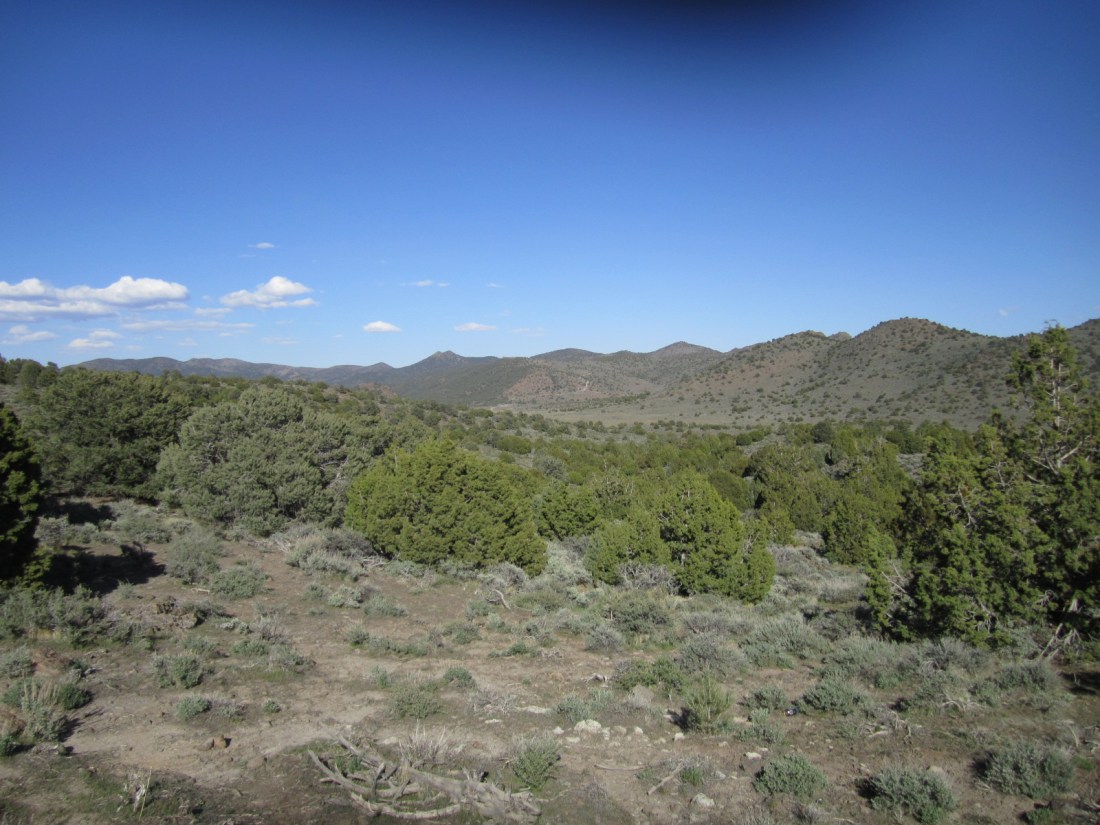
On Paynes Prairie State Park with Rambling Tim.
Category: Range
On the range
Salt Wells Horses Get Short End of Stick
The Tier 1 analysis in Appendix A of the draft EIS for the Rock Springs RMP amendment provides data for current conditions on the Salt Wells Creek HMA.
The numbers were copied into a spreadsheet to see if the current management plan favors privately owned livestock over wild horses and if so by how much.
The EIS did not provide allotment sizes, grazing seasons, and livestock types within the HMA. The grazing season on some of the allotments is three months, according to Section 3.10 of the EIS, and on others it’s four to six months, so an average grazing season of four months was assumed.

Forage requirements and stocking rates for livestock were computed for cow/calf pairs, whose resource requirements are said to be equivalent to those of wild horses, allowing a side-by-side comparison. The grazing permits may allow other animals.
Key indicators are presented in the following charts.

The HMA is already managed primarily for livestock—the horses are just a blip on the radar screen. It will be zeroed out in the revised RMP, but who will notice?
The big-name ‘advocacy’ groups, unfazed by these results, will demand more contraceptives for wild horses, because they are allies of the public-lands ranchers.
Don’t give them a penny.
RELATED: Divide Basin Horses Get Short End of Stick.

Divide Basin Horses Get Short End of Stick
The Tier 1 analysis in Appendix A of the draft EIS for the Rock Springs RMP amendment provides data for current conditions on the Divide Basin HMA.
Those numbers were copied into a spreadsheet to see how wild horses are managed relative to other mandated users of public lands.
The EIS did not provide allotment sizes, grazing seasons, and animal types within the HMA. The grazing season on some of the allotments is three months and on others it’s four to six months, according to Section 3.10 of the EIS, so an average grazing season of four months was assumed.

Management indicators for the other mandated users were computed on the basis of cow/calf pairs, whose resource requirements are equivalent to those of wild horses, allowing a side-by-side comparison.
The results are presented in the following charts.

The indicators show that the HMA has not been managed principally for wild horses, as required by paragraph 1332(c) of the statute.
The horses have a smaller footprint and environmental impact compared to livestock, but the RMP amendment will eliminate them under the preferred alternative.
“Hey WHW, what about CFR 4710.3-2? The government doesn’t have to manage HMAs principally for wild horses unless it chooses to do so.”
Good question.
Can a federal regulation trump a duly enacted statute? That would be a substantive comment on the EIS, although it might pertain more to the Adobe Town HMA, which will be downsized in the revised RMP but not wiped out.
RELATED: Adobe Town Horses Get Short End of Stick.

Eagle Roundup Day 23
Cumulative totals through 02-07-20, per the BLM roundup page for the Eagle Complex:
- 1,209 animals gathered
- 14 deaths (1.2%)
- 546 studs (45.3%)
- 658 mares (54.7%)
- 5 new foals (2019 foals counted as adults)
The proportion of mares, many of whom are now heavily pregnant, continues to be assignably higher than the proportion of studs, based on statistical limits where n = 1,204 and p-bar = .50.
The thriving ecological balance is now only 391 wild horses away (1,700 horses to be gathered − 100 to be returned − 1,209).

RELATED: Eagle Roundup Day 21, Eagle Wild Horses Get Short End of Stick.
Adobe Town Horses Get Short End of Stick
The three-tier analysis in Appendix A of the draft EIS for the Rock Springs RMP amendment provides data for current conditions on the affected HMAs (listed as Alternative A, No Action). For more information on the three-tier method, go to Appendix 3 in the WHB Management Handbook.
Tier 1 data for the Adobe Town HMA were copied into a spreadsheet so key indicators of wild horse management could be compared to those of livestock. The HMA is to be managed principally for wild horses per paragraph 1332(c) of the statute, but do the numbers reflect that?
The EIS did not provide the allotment sizes, grazing seasons, and animal types within the HMA. The absence of those figures would be a substantive comment on the EIS.
Indicators for livestock were computed on the basis of cow/calf pairs, as their resource requirements are equivalent to those of wild horses, allowing a direct comparison.

The grazing season on some of the Adobe Town allotments is three months and on others it’s four to six months, according to Section 3.10 of the EIS, so an average grazing season of four months was assumed.
The indicators for horses and livestock are compared in the following charts.

If the ranchers place their animals on pastures within the allotments, the day-to-day stocking rates would be higher than shown above. If they didn’t rotate pastures the land would be ruined in a season. More rape and pillage sold as environmental stewardship.
Most of the allotments in the planning area are operated under grazing strategies incorporating rest, seasonal rotations, deferment, and prescribed use levels that provide for adequate plant recovery time to enhance rangeland health.
The HMA is not managed principally for wild horses. Horses have a smaller footprint and environmental impact than livestock, but the RMP amendment will reduce their numbers appreciably under the preferred alternative.
The RMP update is not about keeping the horses off private lands, it’s about giving the ranchers unfettered access to public lands that surround their private parcels.
Moreover, the BLM is not a hapless victim of a rogue court that’s trying to shove the rancher-friendly consent decree down their throats. The ranchers could have been ordered off the public lands, making them bear the costs of keeping their property private, not the horses and not the taxpayers.
RELATED: Rock Springs EIS Posted, Is Wyoming a Fence-Out State?
What Is the Minimum Herd Size for Wild Horses?
According to Section 4.4.6.3 of the WHB Management Handbook, a minimum herd size of 50 breeding animals (total population size of 150 – 200 animals) is recommended to maintain an acceptable level of genetic diversity within reproducing wild horse herds.
Given an aimed-at stocking rate of one wild horse per thousand acres (27,000 animals on 27 million acres), every HMA should contain at least 150,000 acres.
How many of them fall short of that guideline? Have at it.
Don’t forget the WHTs.
A minimum recommended herd size for wild burros has not been established.
Eagle Roundup Day 21
Cumulative totals through 02-05-20, per the BLM roundup page for the Eagle Complex:
- 1,156 animals gathered
- 14 deaths (1.2%)
- 520 studs (45.1%)
- 632 mares (54.9%)
- 4 new foals (2019 foals counted as adults)
Helicopters were grounded for several days due to high winds. One mare was put down today due to colic. The hirelings probably referred to it as ‘capture shock.’
The proportion of mares continues to be assignably higher than the proportion of studs, based on statistical limits where n = 1,152 and p-bar = .50. The number of new foals does not correspond to a 20% growth rate, not even close.
The thriving ecological balance is now only 444 wild horses away (1,700 horses to be gathered − 100 to be returned − 1,156).

RELATED: Eagle Roundup Day 16, Eagle Wild Horses Get Short End of Stick.
Community Divided Over Heber Wild Horse Shootings
Some advocates have been told on socialist media to keep their mouths shut and others have been confronted in public places for their stance on the horses, according to a story posted this evening by ABC15 News of Phoenix.
RELATED: Heber Ranchers Push Back.
Laramie County BOC Postpones Decision on Rule Change
The Board of County Commissioners decided yesterday not to render a decision on the reduction of setbacks from Concentrated Animal Feeding Operations requested by Equine Elite, according to a report posted this morning by the Wyoming Tribune Eagle.
Commissioners will consider the proposal in more detail at their March 3 meeting.
RELATED: Laramie County BOC Meeting Agenda Posted.
UPDATE: Public hearing begins at 4:12 in this video.
No Arrests in Clark Mountain Burro Case
The $100,000 reward has produced no actionable information. Report posted yesterday by KTNV News of Las Vegas.
RELATED: BLM Acknowledges New Clark Mountain Reward.
More Off-Range Pastures Sought for Wild Horses
BLM announced today a request for proposals to warehouse excess horses in Oklahoma, Kansas or Nebraska. Facilities must accommodate 1,000 to 10,000 head, with four-year and nine-year renewal options.
Bids will be accepted through March 2.

Banker Horses Hide in Sea Grass
A story posted this morning by The News & Observer of Raleigh, NC shows a photo of a marsh area and asks how many horses are hiding there. They are hard to spot but there are six, according to the report.
The story goes on to say that the greatest threat to the horses nowadays is—wait for it—climate change.
Yeah, right.
The greatest danger to these animals is the local ‘advocacy’ group, whose members refer to them as ‘highly threatened,’ yet they’re darting them with contraceptives.
Mustang Monday
On the Onaqui Mountain HMA with Willie and Candee Proctor.
How Many Cow/Calf Pairs Could a Checkerboard Rancher Place on One Square Mile?
The draft RMP Amendment and EIS for the four HMAs affected by the Rock Springs Consent Decree did not provide parcel sizes and grazing seasons for the 28 allotments involved, so the question will have to be answered by bootstrap.
Data for livestock on public lands in Wyoming yield 18.6 cow/calf pairs per thousand acres, assuming a six month grazing season.
Section 3.10 in the draft EIS indicates an average grazing season of about four months, so the estimated stocking rate would be 27.9 cow/calf pairs per thousand acres.
One square mile contains 640 acres, so the estimated number of cow/calf pairs that could be placed on a private checkerboard parcel is 27.9 ÷ 1,000 × 640 = 17.9.
Each parcel would require 4 × 5,280 = 21,120 linear feet of fencing plus a water source, a sizeable expenditure for just 18 ‘free ranging’ cow/calf pairs.
Of course, the rancher could import feed to allow the number of animals to increase into a profitable range, as it should be: Concentrated animal feeding operations (CAFOs) are for domestic livestock, not wild horses.
RELATED: Is Wyoming a Fence-Out State?
Is Wyoming a Fence-Out State?
The four HMAs affected by the Rock Springs RMP amendment contain ‘checkerboard’ lands, areas where every other square mile alternates between public land and private or state lands.
The Rock Springs Grazing Association (RSGA) owns many of the private parcels inside the HMAs. Historically, RSGA had agreed to a limited number of wild horses on private land within the checkerboard areas.
However, in 2010 RSGA revoked their consent and requested that all wild horses be removed from private lands. The loss of this consent has complicated the management of wild horses on checkerboard lands, prompting the RMP amendment and actions resulting therefrom. Refer to Section 3.1 in the draft EIS.
The problem could be resolved at the state level: Require property owners to install legal fences if they don’t want horses on their land. Let the ranchers bear the cost of keeping their property private, not the taxpayers. A longer-term objective, not related to the amendment, would be to deny them access to public lands, so the fencing would serve two purposes.
If you wanted to submit a substantive comment on the draft EIS, that would be one.
RELATED: Rock Springs EIS Posted.

Eagle Roundup Day 16
Cumulative totals through 01-31-20, per the BLM roundup page for the Eagle Complex:
- 949 animals gathered
- 12 deaths (1.3%)
- 417 studs (44.1%)
- 528 mares (55.9%)
- 4 new foals (2019 foals counted as adults)
The proportions of studs and mares are still outside of statistical limits corresponding to n = 945 and p-bar = .50. These results do not look like they came from a process that produces 50% males and 50% females. Why?
The thriving ecological balance is now only 651 wild horses away (1,700 horses to be gathered − 100 to be returned − 949).

RELATED: Eagle Roundup Day 13, Eagle Wild Horses Get Short End of Stick.
So Long, Pilot Butte Wild Horse Scenic Loop?
The 24-mile gravel road, running along the southeastern border of the White Mountain HMA, provides wild horse viewing opportunities between the towns of Rock Springs and Green River in southwestern Wyoming.
The HMA is subject to permitted livestock grazing in the summer and winter.
Alternatives C and D in the draft RMP Amendment and EIS for wild horse management in that area will convert the HMA to an HA, no longer managed for horses.
Who wants to spend their summer vacation looking at cattle and sheep on land where horses once roamed?
RELATED: Pilot Butte Wild Horse Scenic Tour.
Grazing Fee Unchanged in 2020
BLM said today the grazing fee for 2020 will be $1.35 per AUM, the same as in 2019.
The new season begins on March 1.
An AUM is the amount of forage consumed by one wild horse, two wild burros, one cow/calf pair or five sheep in one month.
The base value in 1966 was $1.23 per AUM, according to the news release.
RELATED: 2019 Grazing Fee Announced.
Rock Springs EIS Posted
Refer to this document. The 90-day public comment period begins today.
Alternative D, preferred, involves the following changes:
- The Rock Springs Field Office portion of the Adobe Town HMA would revert to HA status and be managed for zero wild horses. For the RFO portion of the HMA, all checkerboard land and the portion of the HMA north of the existing Corson Springs southern allotment boundary fence would revert to HA status and be managed for zero wild horses. The remainder of the HMA would be retained and managed with an AML of 259 – 536
- The entire Great Divide Basin HMA would revert to HA status and be managed for zero wild horses
- The entire Salt Wells Creek HMA would revert to HA status and be managed for zero wild horses
- The entire White Mountain HMA would revert to HA status and be managed for zero wild horses.
Forage previously allocated to wild horses may be reassigned to wildlife, livestock or other ecosystem functions, following an in-depth review of intensive monitoring data, according to the Alternative D narrative.
A news release had not been issued by the BLM at the time this post went live.
RELATED: Rock Springs RMP Amendment to Target Wild Horses.
UPDATE: The Draft EIS and other documents have been moved to a new project folder.
Rock Springs RMP Amendment to Target Wild Horses
The BLM has drafted a Resource Management Plan Amendment and Environmental Impact Statement for proposed changes to wild horse management by the Rock Springs and Rawlins field offices, according to an announcement published this morning in the Federal Register.
- Change the Salt Wells Creek HMA to a herd area, which would be managed for zero wild horses, and re-gather the herd area to zero wild horses if its wild horse population exceeds 200
- Change the Great Divide Basin HMA to a herd area, which would be managed for zero wild horses, and re-gather the herd area to zero wild horses if its wild horse population exceeds 100
- Change the AML for Adobe Town HMA to 225-450 wild horses or lower, and do not relocate horses gathered from Adobe Town to Salt Wells Creek
- Manage the White Mountain HMA as a non-reproducing herd with a population of 205 wild horses by utilizing fertility control and sterilization methods, and initiate gathers if the HMA’s population exceeds 205 wild horses
The draft RMP and EIS had not been included with other project documents at the time this post went live.
The driver of these changes is the infamous Rock Springs consent decree, a court order resulting from legal action by the Rock Springs Grazing Association.
RELATED: Comments Invited on Scope of Rock Springs Gather Plan.