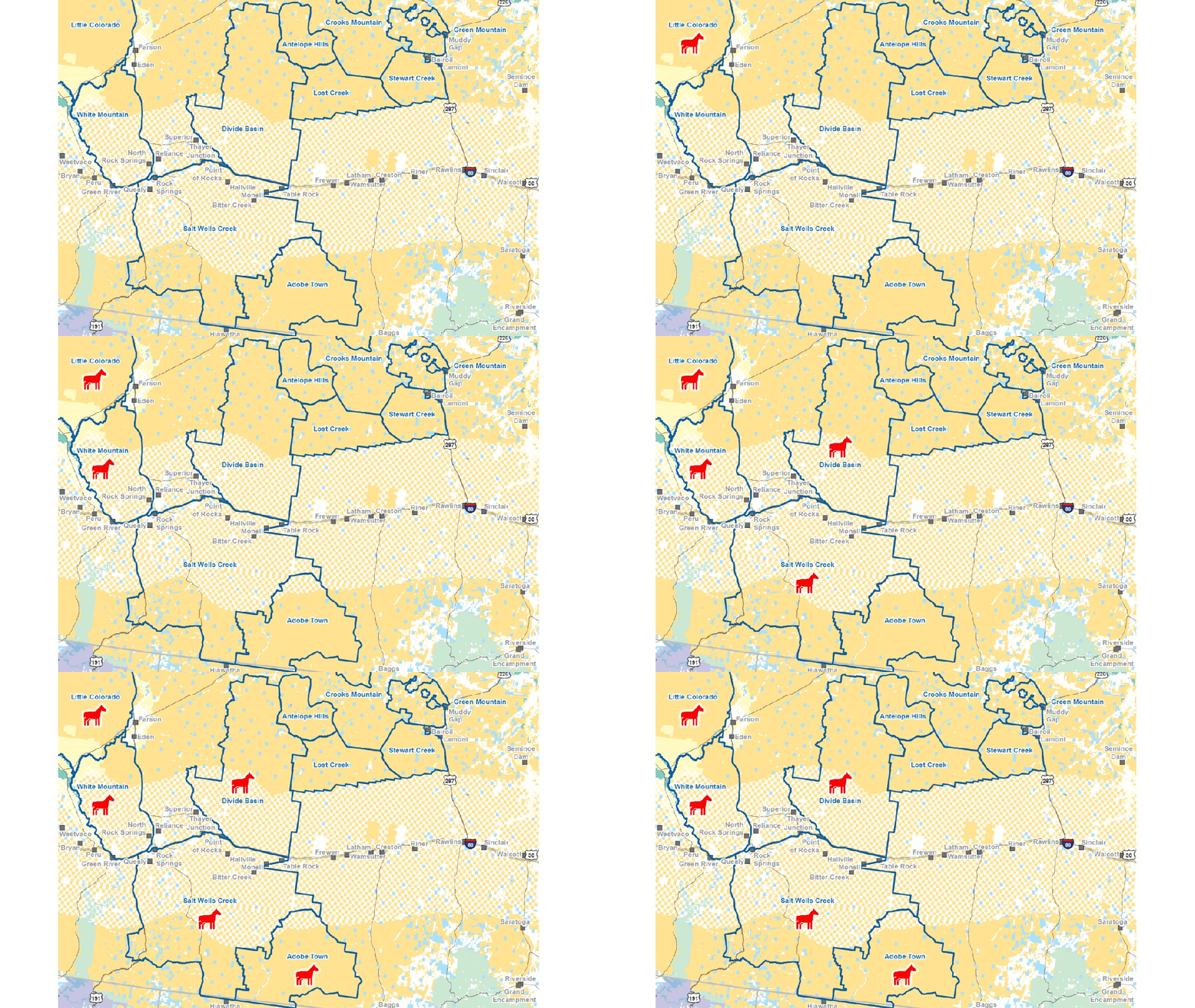
Gather Schedule Updated

The list was updated yesterday, with the Sand Wash roundup currently in progress.

Six burros were removed from the Lake Pleasant HMA in a nuisance gather on February 2, according to the schedule, but Western Horse Watchers was unable to find an announcement on BLM’s main news page.

Next up is nuisance gather in the Piceance-East Douglas HMA (may have already started) and a planned gather in the Black Mountain HMA, home of the Oatman burros.

Onaqui Mountain is on the list for July, with Beatys Butte in August.

More information at the WHB gather page.

Comments Invited on Piper Mountain Range Improvements

The project involves water systems in two grazing allotments that intersect the Piper Mountain HMA near Deep Springs, CA, according to a BLM news release issued today.

Comments will be accepted through March 29.

Piper Mountain HMA Allotments

The EA says the current burro population is zero and horses are very seldom seen.

The management plan for Piper Mountain allows 17 horses and 82 burros on 96,261 acres, for an equivalent stocking rate of 0.6 wild horses per thousand acres.

Horses can be found in the Fish Lake Valley HMA, according to the EA, where an estimated 120 animals live.  See page 30 in the Nevada wild horse maps.

The Allotment Master report shows most of the allotments in the Maintain category.

Senate to Confirm Haaland?

The hearing is set for today, according to a story by AP News.

Not all native peoples are defenders of wild horses.

The Yakama in Washington state have been sending their horses to slaughter for years, including pregnant mares.

Rescue of the foals, born in feedlots while the horses await shipment, has turned into a full-time job for the folks at Chilly Pepper Miracle Mustang of Golconda, NV.

RELATED: Haaland to Head Interior?, Yakama Nation, Champions of the Horse.

Court Unlikely to Halt Caliente Gather Plan

The story is behind a paywall but if you press CTRL+A after dismissing the signup box you can read a few sentences.

The area of interest—consisting of nine former HMAs—is now managed almost exclusively for livestock.

RELATED: BLM Urged to Fight Caliente Legal Action, Moriah’s Cousins.

UPDATE: Oral arguments can be heard in a 22-minute audio segment published by Court Listener.  Are the judges suggesting that the RMP amendments that zeroed out the HMAs are now unassailable, no longer subject to legal challenge?

Beatys Butte Wild Horses Get Short End of Stick

The HMA covers 434,200 acres in southern Oregon, near the Sheldon National Wildlife Refuge, a recently established horse-free zone.

The AML is 250 and the stocking rate allowed by plan is 0.6 wild horses per thousand acres.  As stated earlier, fractional stocking rates may signify large amounts of forage diverted to privately owned livestock.

The horses allowed by plan require 250 × 12 = 3,000 AUMs per year.  The land must be able to produce at least 3,000 ÷ 434,200 × 1,000 = 6.9 AUMs per thousand acres per year to support the horses.

Beatys Butte HMA Map 02-20-21

The HMA lies completely within the 575,495 acre Beaty Butte Allotment, according to page 28 of the EA.  Map 2 in the appendices shows the arrangement.

The Allotment Master report from RAS provides the acreage and active AUMs.  The average grazing season was computed from data in the Authorization Use report.

Beatys Butte HMA Calcs 02-20-21

To fulfill the forage allocation for livestock, the land must be able to produce at least 26,121 ÷ 575,495 × 1,000 = 45.4 AUMs per thousand acres per year, reinforcing an observation made earlier that forage production goes up when land is designated for livestock.  In this case, by a factor of 6.6.

The forage allocation for livestock inside the HMA is approximately 19,000 AUMs per year, according to the discussion on page 55 of the EA.  The Beaty Butte permittees would have to place 3,106 cow/calf pairs inside the HMA to graze off 19,000 AUMs in 6.3 months, for a stocking rate of 6.9 cow/calf pairs per thousand acres.

These figures are compared in the following charts.

Beatys Butte HMA Charts 02-20-21

The HMA is managed primarily for livestock, with the horses receiving just 14% of the authorized forage, neglecting wildlife.

The stocking rate for horses is 8% of that for cattle.

The forage assigned to livestock would support an additional 1,583 wild horses, for a True AML of 1,833.

The current population, based on data from page 7 of the EA, is probably around 500 horses, well within that range, so there is no need for a roundup or darting program.

RELATED: History of Beatys Butte HMA.

Status of Beaty Butte Allotment?

Map 2 in the appendices of a 2019 EA for resource enforcement actions in the Beaty Butte HMA shows the 434,000 acre HMA (purple boundary) inside the 575,000 acre allotment (brown boundary).

Approximately 19,000 AUMs per year have been allocated to livestock inside the HMA, according to page 55 in the EA, compared to 3,000 AUMs for wild horses.

The forage allocation to wildlife is 762 AUMs per year.  The area of interest is in southern Oregon.

The Allotment Master report from RAS puts the allotment in the Improve category.

Most of the active AUMs are held by the Beaty Butte Grazing Association, authorization #3601261.

The Authorization Use report shows over 4,000 animals allowed by plan in the allotment, compared to 250 wild horses in the HMA.

Failure to meet standards for rangeland health in the allotment may be a consequence of the way the allotment is managed, not the HMA.

RELATED: A Place for Excess Horses Off the Beaty Butte Allotment.

Silver King Roundup Over

Operations concluded yesterday, Day 11, with 284 horses gathered, 256 shipped, 25 to be returned and three deaths.

The number of unaccounted-for animals is zero.

The treated mares may require a booster before they can be returned to the HMA, but that was not stated in the news release issued today.

No foals were caught.  Of the captured adults, 46% were male and 54% were female.

The overall death rate was 1.1%.

The incident liberated 3,108 AUMs per year and reduced water demand by an estimated 2,590 gallons per day.

RELATED: Silver King Roundup Day 9.

Eagle Roundup Over

Operations concluded yesterday, Day 43, with 1,074 horses gathered, 995 shipped, 50 returned and 29 deaths.

The number of unaccounted-for animals is zero.

All of the treated mares were released into the Eagle HMA, according to a news release issued today.  The number receiving GPS radios was not given.

Only three foals were caught.  Of the captured adults, 45% were male and 55% were female.

The overall death rate was 2.7%.

The incident liberated 12,288 AUMs per year for other mandated uses in the Complex and reduced water demand by an estimated 10,240 gallons per day.

RELATED: Eagle Roundup Day 41.

Eagle Roundup Day 41

The incident began on January 6.  Gather stats through February 15:

  • Horses captured: 1,070, up from 1,004 on Day 35
  • Goal: 1,131
  • Returned: 0
  • Deaths: 29, up from 27 on Day 35
  • Shipped: 939, up from 895 on Day 35

One death occurred on Day 37 as a result of the roundup and another on Day 41 due to pre-existing conditions.

The overall death rate is 2.7%, same as Day 35.

Three foals have been caught to date.  Roughly 45% of captured adults are male and 55% are female.  Some of the mares may have foaled in the off-range corrals.

The gather page says 28 deaths and 940 horses shipped.

The operation has liberated 12,840 AUMs per year for other mandated uses in the Complex.  Demand for water has been reduced by an estimated 10,700 gallons per day.

Body condition scores are not known.

The location of current activity is not known.  Three HMAs are involved in the roundup.

The number of unaccounted-for animals is 102, up from 82 on Day 35.

Some of the mares will be treated with contraceptives and returned to the range but no such activity has been reported.  Some may receive GPS radio transmitters.

RELATED: Status of Eagle Roundup?

Status of Eagle Roundup?

No activity has been reported since February 11, Day 37, with 1,020 horses captured, 940 shipped and 27 deaths.

The operation has liberated 12,240 AUMs per year for other mandated uses in the Complex.

The number of unaccounted-for animals is 53.  The gather page does not say if the incident is over.

The Red Desert roundup ended with 359 unaccounted-for horses in November 2020.

RELATED: Eagle Roundup Day 35.

Silver King Roundup Day 9

The incident began on February 7.  Gather stats through February 15:

  • Horses captured: 251, up from 213 on Day 7
  • Goal: 283
  • Returned: 0
  • Deaths: 3, same as Day 7
  • Shipped: 214, up from 173 on Day 7

No deaths occurred on Days 8 and 9.  The overall death rate is now 1.2%, down from 1.4% on Day 7.

No foals have been caught to date.  Roughly 47% of captured adults are male and 53% are female.

The operation has liberated 3,012 AUMs per year for other mandated uses in the HMA.

Body condition scores are not known.

The number of unaccounted-for animals is 34, down from 37 on Day 7.

Some of the mares will be treated with contraceptives and returned to the range, but no such activity has been reported.  The effect on pre-born foals is not known.

Data quality has been good.

RELATED: Silver King Roundup Day 7.

Silver King Roundup Day 7

The incident began on February 7.  Gather stats through February 13:

  • Horses captured: 213, up from 201 on Day 5
  • Goal: 283
  • Returned: 0
  • Deaths: 3, up from 2 on Day 5
  • Shipped: 173, up from 85 on Day 5

Helicopters were grounded on Day 7 due to weather.

One horse was put down on Day 6 as a result of pre-existing conditions.  The overall death rate is now 1.4%, up from 1.0% on Day 5.

No foals have been caught to date.  Roughly 48% of captured adults are male and 52% are female.

Body condition scores are not known.

The number of unaccounted-for animals is 37, down from 114 on Day 5.

Some of the mares will be treated with contraceptives and returned to the range, but no such activity has been reported.  The effect on pre-born foals is not known.

Data quality has been good.

RELATED: Silver King Roundup Day 5.