Advocates Seek Roundup Delay in Wake of Strangles Outbreak

In yesterday’s article by Cowboy State Daily, the Campaign Against America’s Wild Horses tried to link the incident at Wheatland to wild horse roundups in Wyoming.

The group wants the helicopters grounded not because they care about the horses but because they want a larger share of the horse removal business.

If the government said “OK, we’ll stop the roundups and get rid of them with PZP,” they’d be delighted, along with their army of volunteers.

RELATED: Strangles Kills Five Horses at Wheatland Off-Range Corrals.

Advocates are the Predators 11-30-21

Status of Allotments in American Prairie Grazing Decision

The Allotment Master Report provides acreage, active AUMs and management status for the seven allotments involved in the project.

The decision was announced last week in a BLM news release.

The figures in the report differ slightly from those in Table I of the Final EA.

American Prairie Allotment Calcs 04-03-22

Garey Coulee, French Coulee, Whiterock Coulee and Flat Creek will flip to bison if the decision is not overturned.  East Dry Fork will remain approved for cattle.

Five of the allotments are in the Improve category, including the two already approved for bison, representing 95.6% of the public acres.

Forage production on the seven allotments averages 128.2 AUMs per year per thousand acres, enough to support ten wild horses per thousand acres, as noted previously.

The allotments are found in four units managed by American Prairie: White Rock, Dry Fork, Sun Prairie and Sun Prairie North.

Dark blue corresponds to the base properties and light blue represents public lands with grazing privileges tied thereto.

American Prairie Land Map 04-03-22

The advocates travel to Billings to learn how to get rid of wild horses.

By going a little farther to the north, you can learn how to preserve them.

RELATED: American Prairie Decision Offers New Way to Save Wild Horses?

American Prairie Decision Offers New Way to Save Wild Horses?

The nonprofit obtained grazing privileges on BLM allotments by acquiring private lands, known as base properties, tied to the allotments.  Then it petitioned the agency to change the type of livestock and seasons of use on those allotments.

The process was documented in the NEPA project.

How do you acquire a base property?  Good question.

Western Horse Watchers surveys Nevada real estate listings from time to time, looking for properties with BLM grazing rights.

None found to date.

The transactions may occur in an inconspicuous manner to make sure the properties don’t fall into the wrong hands.  That would be anyone not in the ranching clique.

But the concept has been identified: Purchase a base property and ask to BLM (or Forest Service) to change the permit, citing the American Prairie decision.

The government may argue that bison are indigenous and horses are not.

Horses appear in the North American fossil record while cattle and sheep do not, yet they dominate western rangelands.

The precedent for non-native animals is well established.

What if you don’t have millions of dollars to purchase a base property then wait five years to see if the bureaucrats approve your request?

You can still help wild wild horses by

  • Not giving money to the advocates
  • Cutting them off
  • Leaving them out of your end-of-life plans

Those steps won’t cost you a nickel.

RELATED: Yes to American Prairie, No to Mustang Monument.

Yes to American Prairie, No to Mustang Monument

If the decision is not overruled, American Prairie will be able to graze bison on four BLM allotments currently permitted for cattle.  Two of the seven allotments covered by the project are already designated for bison.  One is permitted for cattle and will remain that way.

The nonprofit obtained grazing preference through the purchase or acquisition of private lands serving as base properties for the allotments.

In a similar manner, Madeleine Pickens, founder of Mustang Monument, purchased base properties tied to the Spruce and Valley Mountain allotments in eastern Nevada.

The plan was to take 30,000 wild horses out of government pens and put them on the allotments, initially with the concurrence and support of the BLM.

The agency later reneged, as explained in this story by KLAS News of Las Vegas, bowing to pressure from the public-lands ranchers.

The status of the NEPA project that assessed the environmental impacts of the proposed sanctuary is not known, or if one even exists.

The advocates probably won’t see any opportunities for the Montana Solution in the decision favoring American Prairie, which could provide a basis for redress of the BLM’s conduct at Mustang Monument, so don’t be surprised if they ignore it.

RELATED: PLC Has a Cow Over Montana Grazing Changes!

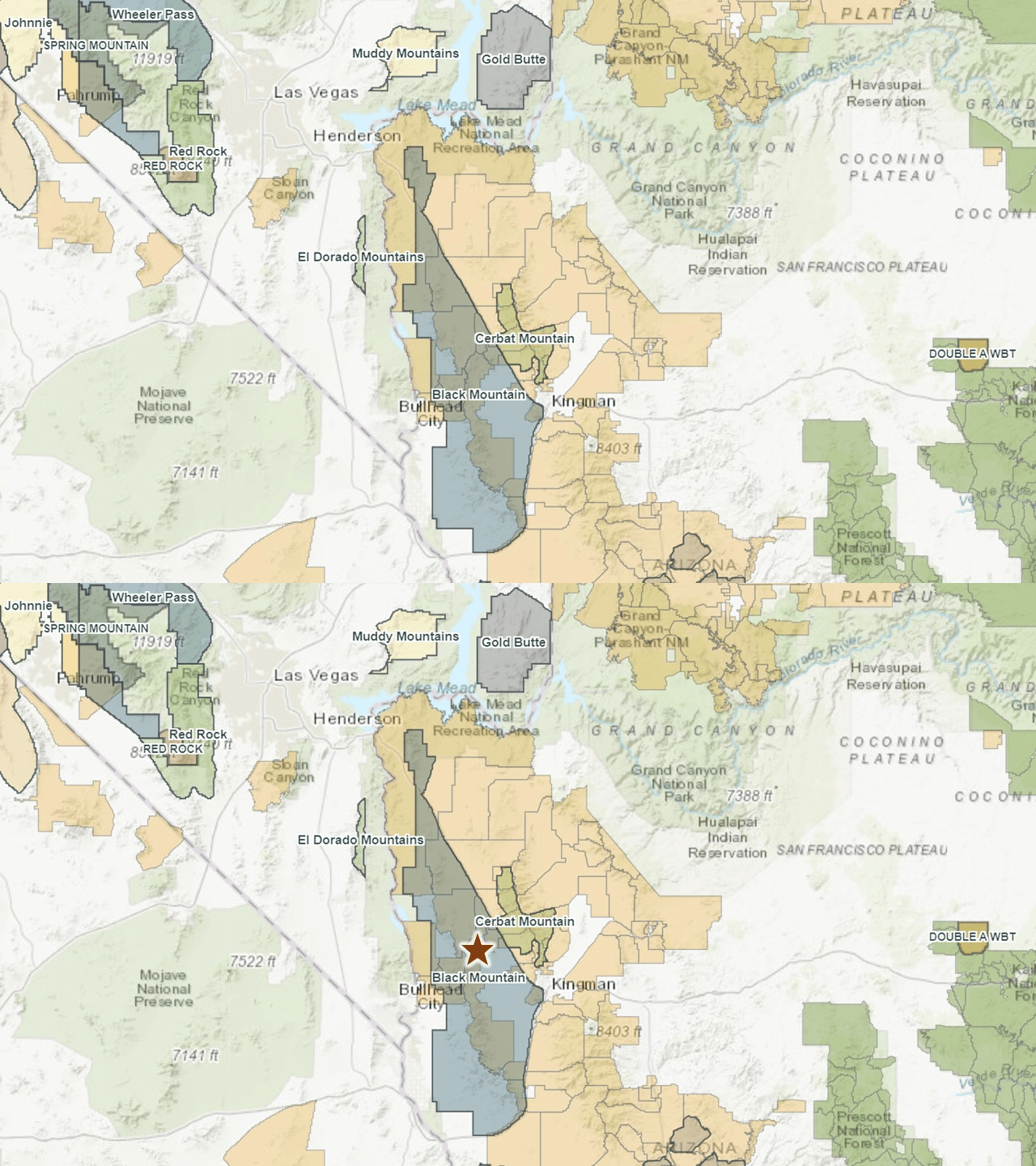
Black Mountain Roundup Over

The operation concluded on March 25, according to a statement at the gather page, with 106 burros captured, 106 shipped and no deaths.

The capture and removal goals were 80 each.

The cumulative total included 58 jacks, 38 jennies and 10 foals.

Youngsters represented 9.4% of the total.  Of the adults, 60.4% were male and 39.6% were female.

The number of unaccounted-for animals was zero.

The location of the trap site within the HMA was not specified.

RELATED: Black Mountain Wild Burro Removal Continues.

Black Mountain HMA Map 02-25-22

Pancake Coalition Continues Legal Battle

Another briefing was filed in federal court yesterday by Animal Wellness Action, CANA Foundation and Wild Horse Education to demonstrate how a lack of management planning fails to protect wild horses from industrial encroachment, loss of genetic viability and even from harm during capture, according to a news release appearing today on EIN.

The group claims that the BLM moves directly to roundups while skipping the Herd Management Area Plans outlined in current policy (HMAPs), shirking any reasonable attempt to manage wild horses on the range.

Laura Leigh of Wild Horse Education said everything on the public lands has a site-specific plan for management that allows full participation by stakeholders except wild horses.  The agency creates removal plans, not management plans.

How can you manage an area principally for wild horses, as specified in the original statute, with 98% of the resources to the horses and 2% reserved for wildlife, when the land-use plan assigns most of the resources to privately owned livestock?

And if you’re going to accept the current resource allocations and miniscule AMLs, why go to the trouble of writing HMAPs?

If you want to see the horses wild and free on their home range, and this does not mean subordination to ranching interests or gradual extermination by the Montana Solution, you have to focus on the land-use plans and the policies that affect them.

Plaintiffs in the case will be speaking at the Save Our Wild Horses Conference later this month.

The Sulphur HMA, which has an HMAP, is a disaster for the horses.

RELATED: Judge Rejects Advocates’ Claims, Won’t Halt Pancake Roundup.

Wyoming Is a Fence-Out State

The rule applies to cattle and bison, according to a brochure posted by the Wyoming Game & Fish Department, but not sheep.

The status of free-roaming horses was not discussed.

The brochure is based on “A Landowner’s Guide to Wildlife Friendly Fences,” written in 2008 for Montana Fish, Wildlife & Parks.  The 2012 edition, included in the Final EA for changes to grazing allotments requested by American Prairie, has many useful ideas for fence design and construction.

Montana is also a fence-out state, limited to cattle only.  The guide is silent on the status of free-roaming horses.

The BLM requires sturdy six-foot fences to adopt wild horses, which are not considered in the brochures.

The permeability of pipe panel fences to wildlife depends on the height and number of rails per panel.  They are an expensive option for large areas.

Wood is not recommended, except for support posts, which should be installed on the outside of the panels.  A horse can break a 4×6 treated post.

From time to time predator poop is found in this corral, probably from coyotes.

RELATED: Is Wyoming a Fence-Out State?

UPDATE: The link to the brochure doesn’t work.  Try this one.

Pipe Panel Fences 04-02-21

Drilling and Mining Move Over, New Threat to Wild Horses

The advocates have a keen ability to focus on the wrong things.

In this column by New York Lifestyles Magazine, Manda Kalimian, founder and CEO of the CANA Foundation, explains why climate change is the greatest threat to wild horses, not the BLM or public-lands ranchers.

She will be one of the speakers at the Save Our Wild Horses Conference later this month and is on record as a proponent of slaughter.

Also headlining the show are a trained PZP darter and a lobbyist for the PZP fanatics.

RELATED: National ‘Save Our Wild Horses’ Conference Debuts in April.

Foal-Free Friday, Dedicated to the Advocates

At the Salt River with Angela J Fellrath.  Listen closely to the remarks at 0:30.

The surrogates for the Campaign Against America’s Wild Horses will be at a crossroads in a few years: Do they back off and allow the mares to foal, which will make them miss their herd reduction target, or do they press on with the darting effort, rendering the mares sterile?

If they opt for the latter, they’ll be able to walk away and ruin another herd, maybe the ‘Jumping Mouse’ horses near Alpine.

RELATED: Foal-Free Friday, Watching the Herds Die Off.

PLC Has a Cow Over Montana Grazing Changes!

The Public Lands Council issued a news release today condemning a decision by the BLM to change the livestock type and grazing seasons on seven allotments near the Charles M. Russell National Wildlife Refuge in the northern half of the state.

The project began with the acquisition of base properties by American Prairie that secured grazing preference on the allotments.

American Prairie then submitted a plan to the BLM to graze bison on those allotments.

Refer to Map 1-1 in Appendix A of the Final EA for the arrangement and Section 1.1 for an overview (pages 93 and 7 in the pdf).

The Allotment Master Report puts five of the allotments in the Improve category, one in Maintain and one in Custodial.

The Authorization Use Report shows five of the allotments permitted for cattle and two for indigenous animals.

The long-term effect of bison on rangeland health is not known.

The BLM news release said the allotments currently provide 7,969 AUMs across 63,500 public acres, or 125 AUMs per year per thousand acres.

That resource would support ten wild horses per thousand acres (125 ÷ 12).

The government has stated repeatedly that public lands in the western U.S. can only support one wild horse per thousand acres (27,000 animals on 27 million acres).

The Virginia Range was carrying ten wild horses per thousand acres before the advocates got involved.  Now they’re forcing the herd into the government box.

WMI Reader Says ASNF ‘Jumping Mouse’ Horses Not Near Alpine

Is Dallas near Fort Worth?

The trap zone is closer to Alpine than Dallas to Fort Worth, by a factor of two, despite the statements in a column dated March 25.

ASNF Trap Zone Near Alpine 03-27-22

The horses moved into the area, which includes habitat for the New Mexico Jumping Mouse, after the 2011 Wallow Fire, according to the report by ABC15 News of Phoenix.

RELATED: Any Accountability to Public in ASNF Wild Horse Roundup?

Public Hearing Next Month Regarding WHB Management

The BLM announced yesterday that an online meeting regarding the use of motorized equipment has been set for April 26.

Statements will be taken during the meeting but require advance registration.

Written comments can be submitted by email.

A requirement for public hearings appears in §1338a of the statute but Western Horse Watchers was unable to find a provision for meeting frequency.

The use of motorized equipment was authorized in 1976 by FLPMA, the first of several amendments to the WHB Act.

Helicopters are the fastest way of shifting resources back to the public-lands ranchers.

The Montana Solution can achieve the same results but over a much longer timeframe.