Decision Announced for Jackson Mountains Enforcement Plan

The Proposed Action has been selected, effective immediately, and implementation can begin once funding and holding space become available.

The decision authorizes the removal of excess horses from lands in and around the HMA over a ten-year period and the use of various fertility control techniques to maintain the population within AML, according to today’s news release.

Birth rates would be limited by PZP, GonaCon, sex ratio skewing and sterilization per Section 2.2 of the Final EA.

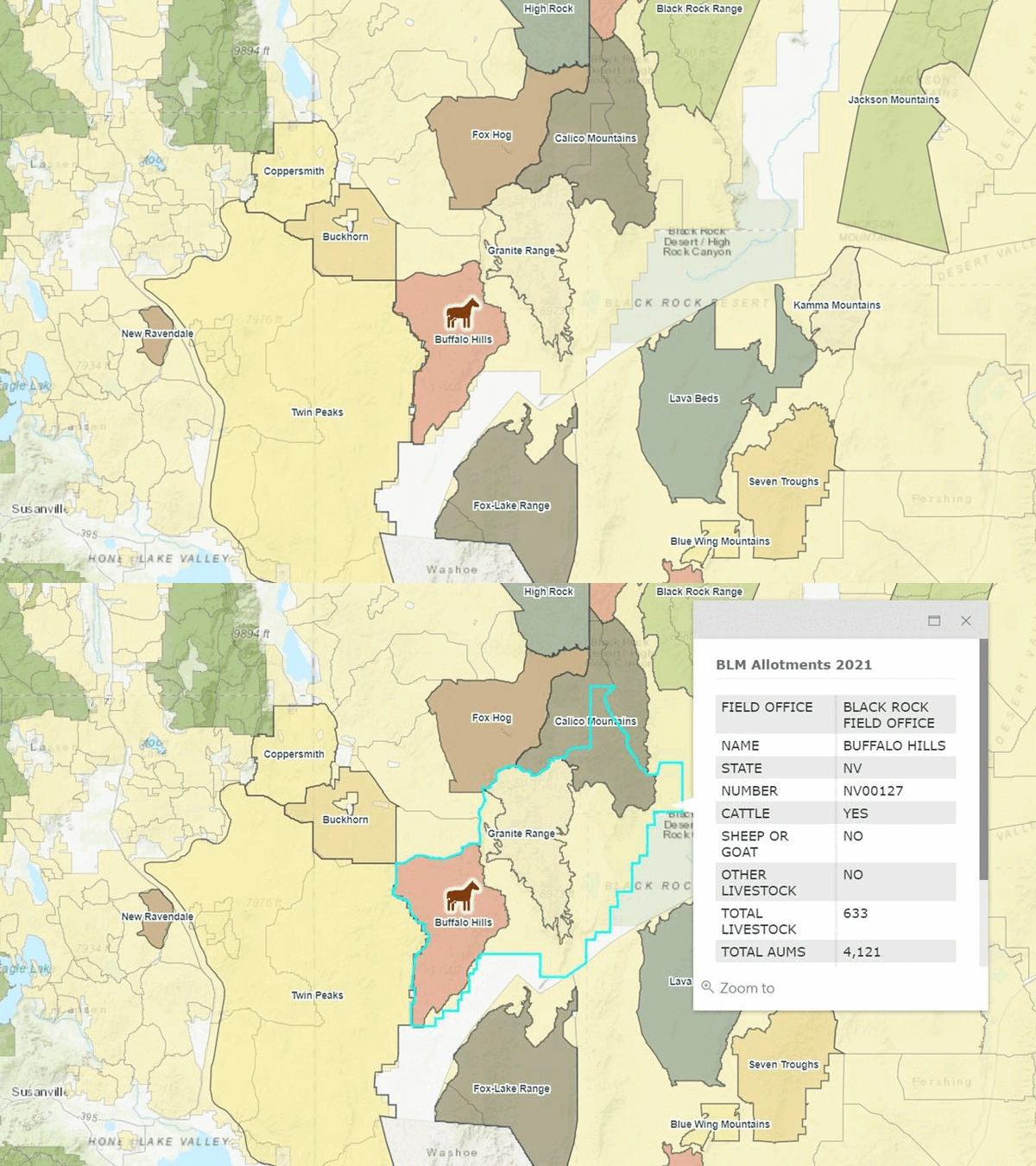
Jackson Mountains HMA Map 05-31-22

The HMA intersects six grazing allotments, identified in Section 3.3.3, and livestock receive approximately three times more forage than the horses.  The new enforcement plan will assure that this ratio is maintained over the life of the project.

The Decision Record and Final EA were posted with other project documents.

The decision is subject to a 30-day appeal period.

RELATED: Draft EA for Jackson Mountains Gather Plan Out for Review.

Giving Foals a Chance at Life

A woman in Eastern Washington rescues wild foals from reservations such as Yakama, Colville and White Swan, and places them into new homes, according to a report posted today by FOX13 News in Seattle.

She expects more horses to be turned loose due to rising hay prices.

Statements in the story that may pique your interest:

  • The foals have been separated from their family bands in Central and Eastern Washington, where officials said the wild horse population is growing too large
  • The Bureau of Land Management controls the population of wild horses on state land through sterilization injections
  • Babies are roped and hog-tied during roundups, and they can be left that way for a significant amount of time until they get back to a trailer
  • Some orphans are purchased by horse traders who contact volunteers to rehabilitate them and when they get a home, they get their money

There are no HMAs or WHTs in Washington state.  What’s going on here?

Western Horse Watchers offers the following explanation, subject to further research:

Native peoples in Washington state are rounding up wild horses and shipping them to slaughter.  Pregnant mares drop their foals in feedlots while awaiting transfer.

The foals are rescued by non-profits that quietly carry out their work without pointing a finger at tribal leadership or their contractors.

If they were to speak publicly about the arrangement, the deal would be over and the foals would be lost because they have little or no value to the kill buyers.

Pine Nut Advocates Not Playing for Home Team

The article in the May edition of Horse Tales gives the herd size.  What else do we know about the Pine Nut Herd Area?

  • Identified for wild horses in 1971
  • AML is zero
  • Managed principally for livestock
  • Could support over 200 wild horses
  • Current population less than 90
  • Subject to Montana Solution
  • Herd dying off

Looks like the advocates are trying to protect the ranchers, not the horses.

RELATED: Still Not Convinced That the Advocates Are Frauds?

Rock Springs RMP Protests Still Trickling In

Two were filed in the past two weeks, bringing the total to eleven.

Protests submitted by mail may not be included in the count.

Only persons or groups that participated in the planning process are eligible and new issues may not be introduced.

The Final EIS was posted with other project documents.

The protest period runs through June 6.

RELATED: Rock Springs RMP Complaints Grow Slightly.

Cañon City Incident, Day 35

A foal was lost on May 26, according to the sitrep for the week ending May 27.

The count for Day 1 was changed from ten to nine, dropping a foal that was originally thought to be part of the outbreak.

That leaves the total at 145.

All fatalities have occurred in pens occupied by the West Douglas horses, displaced from their home range by privately owned livestock.

Approximately 17% were foals.

Previous reports were posted to the Colorado HMA page.

Findings from an internal audit have been released to the public.

RELATED: Cañon City Incident, Day 31.

Cañon City Audit Yields Ten Major Findings

On May 20, a BLM team compared current practices at the facility, where 145 wild horses from the West Douglas Herd Area have died, to applicable standards in the Comprehensive Animal Welfare Program, noting 13 deficiencies.

Ten were classified as major.

Overall compliance was 83%.

The findings, presented in a report dated May 24, include:

  • Inadequate staff
  • Poor maintenance
  • Safety hazards
  • Substandard fencing
  • Stallions mixed with mares
  • Lack of vaccinations

The team, which cannot be described as independent, offered several recommendations to improve compliance.

RELATED: Cañon City Incident, Day 31.

PSA 12-12-19

Foal-Free Friday, Fighting Crime One Mare at a Time

On the Virginia Range, documenting the war on procreation by the Campaign Against America’s Wild Horses and its army of volunteers.

Crime in the Wild Horse World 05-26-22

Their goal is to take a larger share of the wild horse removal business by convincing the bureaucrats, ranchers and politicians that the Montana Solution is a viable alternative to helicopter roundups.

And they need more of your hard-earned donations to make the plan a success.

RELATED: Foal-Free Friday, Barren Before It Was Cool Edition.

Crime Prevention on Virginia Range 05-15-22

Black Mountain Roundup Over

The incident concluded on May 25, according to information at the gather page, with 1,109 burros captured, 1,090 shipped, none released and no deaths.

Figures for Days 8 and 21 were revised.

The numbers don’t balance.  The 19 unaccounted-for animals may correspond to jennies in the HSUS darting experiment that will be returned to the HMA.

The total consisted of 447 jacks, 550 jennies and 112 foals.

Youngsters represented 10.1% of the animals captured.  Of the adults, 44.8% were male and 55.2% were female.

The percentage of foals went down as the number of animals caught went up.

The herd can’t be growing at a rate of 20% per year with a birth rate of 10%.

The percentages of males and females were outside the expected range of variation for a simple random process centered at 50% males / 50% females with 997 adults.

Abnormal sex ratios are not uncommon in herds subject to the Montana Solution.

The capture and removal goals were 1,080 each.

The HMA is subject to permitted grazing.

RELATED: Another Black Mountain Roundup Announced.

Currituck Foal Died of Septicemia

The death was attributed to an infection that entered his body through the umbilicus, according to a story in OBX Today.

The column, written by the herd manager, acknowledges the miraculous arrival of foals who grow into healthy adults despite such challenges [including repeated application of the Montana Solution by her and her supporters].

RELATED: First Foal of Year at Currituck Outer Banks Dead.

Black Mountain Roundup Day 21

The incident began on May 2.  Gather stats through May 22:

  • Target: Burros
  • Type: Planned
  • Method: Helicopter
  • Captured: 1,008, up from 844 on Day 18
  • Average daily take: 48.0
  • Capture goal: 1,080
  • Removal goal: 1,080
  • Returned: None
  • Deaths: None
  • Shipped: 796, no change from Day 18

Helicopters were grounded on Day 19 due to high winds.

The cumulative total includes 391 jacks, 508 jennies and 109 foals, based on figures in the daily reports.  The breakdown at the gather page is 392, 506 and 110.

Youngsters represented 10.8% of the animals captured.  Of the adults, 43.5% were male and 56.5% were female.

The percentage of foals has been going down as the number of animals caught goes up.

The herd can’t be growing at a rate of 20% per year with a birth rate of 11% per year.

The percentages of males and females are still outside the range of expected variation for a simple random process centered at p-bar = .5 (50% males / 50% females) with a sample size of n = 899 adults.

How to Compute p-chart Limits 02-10-22

Abnormal sex ratios are not unusual in herds subject to the Montana Solution.

The report for Day 19 said that burros in the HSUS darting experiment were treated at the holding facility.

The location of the trap site within the HMA was not given.

Black Mountain HMA Map 02-25-22

Day 21 ended with 212 unaccounted-for animals.

With 1,008 burros taken off the range, the removal goal is 93% complete.

Other statistics:

  • AML: 478
  • Forage assigned to burros: 2,868 AUMs per year
  • Pre-gather population: 3,000
  • Forage liberated to date: 6,048 AUMs per year
  • Water liberated to date: 5,040 gallons per day
  • Forage assigned to livestock: 7,333 AUMs per year (estimated)
  • Burros displaced from HMA by permitted grazing: 1,222
  • True AML: 1,700
  • Stocking rate at new AML: 1.7 burros per thousand acres
  • Burros displaced from HMA by drilling and mining: Ask the advocates

RELATED: Black Mountain Roundup Day 18.

Wild Horse Freedom Rallies Set for Next Month

Most will occur on June 11 according to the latest schedule.  Check the list for dates and times in your area.

An announcement on EIN says they were initiated in response to the loss of almost 250 mustangs in Colorado and Wyoming off-range corrals.

To date, 145 horses have died at Cañon City and 11 at Wheatland.

If wild horses and burros have been subjugated to ranching interests, as the organizers state, why aren’t they working on a overhaul of the statutes, regulations and RMPs that determine how public-lands are managed?

  • Livestock confined to base properties (private lands associated with allotments)
  • Most resources assigned to horses and burros
  • Small amount reserved for wildlife

AMLs, which are usually small relative to the available food and water, were not part of the original statute.

RELATED: More Wild Horse Rallies?

What Makes Colorado’s HMAs So Special?

All of them are subject to the Montana Solution, or similar facsimile, according to the latest roundup and fertility control schedule.

An article posted yesterday by The Gazette of Colorado Springs, site of this week’s international conference on wildlife fertility control, refers to volunteers that have partnered with the BLM at the state’s HMAs as “Friends,” which is probably another euphemism like “Advocates.”

Crime Prevention in Wild Horse World 05-19-22

These crime stoppers provide a valuable service for the bureaucrats and ranchers, not just in Colorado, but across the American west: Get rid of the horses with PZP, make sure livestock receive most of their food and water.

RELATED: Crime Prevention in the Wild Horse World.