
On the Navajo Nation with Ron Toahani Jackson.
Category: Range
On the range
Piute Mountain Roundup, Day 43
The incident began on August 19. Progress has been slow and burros have been shipped the same day they are trapped.
As of September 30, 19 animals have been captured and 19 have been shipped, according to reports at the gather page.
The total includes eleven jacks, six jennies and two foals.
Youngsters represented 10.5% of the animals gathered.
Of the adults, 64.7% were male and 35.3% were female.
The HA, no longer managed for burros, lies mostly within the Lazy Daisy Allotment.
The trap may be located near Fenner Spring, west of the HA, the only water source for the burros.
The capture and removal goals are 60 each.
To date, there are no unaccounted-for animals.
RELATED: Piute Roundup in Progress.

How to Embed a Western Horse Watchers Search in Your Site
Suppose you wanted to provide your readers with a list of posts involving the Montana Solution, referred to by the advocates as a better way (to get rid of wild horses).
The search term(s) should be added after “?s=” in the link. For example,
https://westernhorsewatchers.com/?s=montana+solution
Multiple terms should be joined with plus signs.
https://westernhorsewatchers.com/?s=cherished+wild+horses
Acronyms also work:
https://westernhorsewatchers.com/?s=aum
Results may include posts involving AUMs.
Western Horse Watchers has no control over the format and order of the results.
The Western Horse Watchers QR code can be found here.
Calico Roundup Ends Early
The incident concluded yesterday, according to a statement at the gather page, with 863 horses captured, 837 shipped, none released and 26 dead.
The capture goal was 1,076 and the removal goal was 1,036.
There were no unaccounted-for animals.
Data quality was good.
The death rate was 3.0%.
The capture total included 330 stallions, 400 mares and 133 foals.
Youngsters represented 15.4% of the animals gathered, consistent with a herd growth rate of 10% per year.
Of the adults, 45.2% were male and 54.8% were female, within the expected range of variation of a random process centered at 50% males / 50% females.
The plan was to treat up to 40 mares with fertility control and return them to the Complex but the release may occur at a later date.
Captured animals were taken to the off-range corrals in Fallon, NV.
The Complex is subject to permitted grazing but the forage assigned to livestock inside the five HMAs and the number of horses displaced thereby are not known.
The latest schedule still shows capture and removal goals of 1,556 and 1,445.
RELATED: Calico Roundup Announced.
UPDATE: The BLM news release said approximately 40 mares will be treated with fertility control and be released back to the Complex at a later date.
WHBAB Challenge of the Day
How many members of the Wild Horse and Burro Advisory Board are ranchers or ranching sympathizers? Refer to the member biographies for clues.
Western Horse Watchers offers the following assessment:
- Vernon Bleich – Unknown
- Susan McAlpine – Ranching sympathizer
- Steven Yardley – Rancher
- Ursula Bechert – Unknown
- James French – Ranching sympathizer
- Tammy Pearson – Rancher
- Celeste Carlisle – Ranching sympathizer
- Tom Lenz – Ranching sympathizer
- Barry Perryman – Ranching sympathizer
Classifications are subject to change after viewing the October meeting.
BONUS QUESTION: How many members are shills for the drillers and miners?
RELATED: WHBAB Meeting Announced.
Calico Roundup, Day 21
The incident began on September 10. Gather stats through September 30:
- Target: Horses
- Type: Planned
- Method: Helicopter
- Category: Cruel and costly (advocates have a better way)
- Captured: 863, up from 802 on Day 19
- Average daily take: 41.1
- Capture goal: 1,076
- Removal goal: 1,036
- Returned: None
- Deaths: 26, up from 25 on Day 19
- Shipped: 776, up from 725 on Day 19
The figures above are based on the daily reports, not the totals posted by the BLM.
Gather ops concluded on Day 21.
A mare was put down on Day 20 due to a pre-existing injury.
The death rate is 3.0%.
The capture total includes 330 stallions, 400 mares and 133 foals.
Youngsters represented 15.4% of the animals gathered.
Of the adults, 45.2% were male and 54.8% were female.
The herd can’t be growing at a rate of 20% per year with a birth rate of 15% per year.
Body condition scores were not provided.
The location of the trap was not disclosed.
The HMAs and surrounding lands are subject to permitted grazing.

Day 21 ended with 61 unaccounted-for animals.
Mares treated with fertility control may be returned to the area at a later date.
Other statistics:
- Horses allowed by plan (AML): 952
- Forage assigned to horses: 11,424 AUMs per year
- Pre-gather population: 1,593
- Forage liberated to date: 10,356 AUMs per year
- Water liberated to date: 8,630 gallons per day
- Forage assigned to livestock: Unknown
- Horses displaced from Complex by permitted grazing: Unknown
- True AML: Unknown
- Stocking rate at new AML: Unknown
- Horses displaced from Complex by drilling and mining: Ask the advocates
The pre-gather population exceeded the AML but not necessarily the number of horses the land can support.
RELATED: Calico Roundup, Day 19.
Pokegama Roundup in Progress
The incident began on September 26, according to the gather page.
As of today, four horses have been trapped and four have been shipped.
The capture and removal goals are 200 each.
The pre-gather population was thought to be around 230.
RELATED: Pokegama Roundup Rebooted.
Losses Climbing at Wheatland Off-Range Corrals
The facility remains closed due to a strangles outbreak, according to a report posted today by Cowboy State Daily.
Eighteen horses have died.
The Facility Report provided with other materials for the October WHBAB meeting indicates a capacity of 3,500 animals, with 2,640 horses and 29 burros warehoused there as of September 19.
The BLM spends about $4.8 million per year to care for those animals while it collects around $43,000 per year in grazing fees from ranchers occupying their lawful home.
RELATED: BLM Extends Wheatland Closure.
No More Foals for Oatman?
The HSUS darting experiment included jennies in and around the old mining town, according to the research update for the next WHBAB meeting.
Known for its furry panhandlers, Oatman is in the southern half of the Black Mountain HMA on Route 66.
HSUS, signatory to the “Path Forward,” holds the registration for the pesticide.
The BLM removed over 1,000 burros from the HMA in May.
RELATED: Black Mountain Aftermath.

Advocate to BLM: “I Thought We Was Cool!”
“Why you talkin’ like that about our program?”

First Wild Horse Band Removed from Mesa Verde National Park
Sixteen trespass horses were captured on September 24, according to a news release by the Park Service.
The location of the trap site was not disclosed and the incident is not open to public observation.
A report by The Journal of Cortez, CO said the low-impact bait-and-trap gather will continue until all the horses are gone, hopefully by 2024.
The population has declined to less than 100 horses, down from a high of 150.
Captured animals will be taken to Mustang Camp in New Mexico, known for its unusual training methods.
Bribery might be more accurate.
Would you adopt a wild horse who thinks you’re lower than he is?
He pushes, you yield. Then you reinforce the behavior with alfalfa cubes.
RELATED: Mesa Verde Roundup Continues, Private Placement Begins.
BLM Acknowledges Dangers of Montana Solution
From the presentation on research, posted with other WHBAB meeting materials.
The Virginia Range darting program, coordinated by the Campaign Against America’s Wild Horses, is now in its fourth year, with most of the mares at the point of no return.
Calico Roundup, Day 19
The incident began on September 10. Gather stats through September 28:
- Target: Horses
- Type: Planned
- Method: Helicopter
- Category: Cruel and costly (advocates have a better way)
- Captured: 802, up from 735 on Day 17
- Average daily take: 42.2
- Capture goal: 1,076
- Removal goal: 1,036
- Returned: None
- Deaths: 25, up from 22 on Day 17
- Shipped: 725, up from 688 on Day 17
The figures above are based on the daily reports, not the totals posted by the BLM.
A stallion and mare were put down on Day 18 as acts of mercy, followed by another stallion on Day 19. Mercy means not getting what you deserve.
The death rate is 3.1%.
The capture total includes 299 stallions, 377 mares and 126 foals.
Youngsters represented 15.7% of the animals gathered.
Of the adults, 44.2% were male and 55.7% were female.
The herd can’t be growing at a rate of 20% per year with a birth rate of 16% per year.
Body condition scores were not provided.
The location of the trap was not disclosed.
The HMAs and surrounding lands are subject to permitted grazing.
Day 19 ended with 52 unaccounted-for animals.
Mares treated with fertility control may be returned to the area at a later date.
The capture and removal goals at the gather page have not changed despite new targets in the latest schedule.
Other statistics:
- Horses allowed by plan (AML): 952
- Forage assigned to horses: 11,424 AUMs per year
- Pre-gather population: 1,593
- Forage liberated to date: 9,624 AUMs per year
- Water liberated to date: 8,020 gallons per day
- Forage assigned to livestock: Unknown
- Horses displaced from Complex by permitted grazing: Unknown
- True AML: Unknown
- Stocking rate at new AML: Unknown
- Horses displaced from Complex by drilling and mining: Ask the advocates
The pre-gather population exceeded the AML but not necessarily the number of horses the land can support.
RELATED: Calico Roundup, Day 17.
SHOCKER: FREES Network Supports Helicopter Roundups!
They’re the fastest and most efficient way to shift resources back to the public-lands ranchers.
They may be followed by relaxation of AUM curtailments, extension of grazing seasons and more flexible rules for pasture management.
So why wouldn’t a ranching advocacy group endorse them?
The advocates oppose them, claiming they’re cruel and costly, unless they lead to greater use of the Montana Solution, as in catch-treat-release.
They have a better way.
The article, appearing yesterday in St. George News, was written by staff at Utah State University Extension, sponsor of the FREES Network.
RELATED: FREES Agenda Posted.
Cedar Mountain Roundup Over
The incident concluded yesterday, according to a statement at the gather page, with 637 horses captured, 592 shipped, 38 released and eight dead.
The number of horses processed exceeded the number of horses captured by one.
The death rate was 1.3%.
The capture total included 248 stallions, 259 mares and 130 foals.
Youngsters represented 20.4% of the animals gathered, consistent with a herd growth rate of 15% per year.
Of the adults, 48.9% were male and 51.1% were female.
The capture goal was 700 and the removal goal was 400.
Fifty mares will be treated with GonaCon and returned to the HMA with twelve more stallions, bringing the net removal to 537, 34% more than planned.
How Many Wild Horses and Burros in Off-Range Holding?
The Facility Report posted with other WHBAB meeting materials indicates 63,922 as of September 2022, compared to 56,676 in October 2021.
The on-range population was thought to be 82,384 on March 1, before peak foaling season and numerous roundups, according to the HMA Report.
The advocates have a solution—a better way as they describe it: Stop reproduction, let the herds die off, give most of the resources to the public-lands ranchers.
“We’re changing the way wild horse herds are managed, not their land.”

Ian to Drench Paynes Prairie and Cumberland Island Horses?
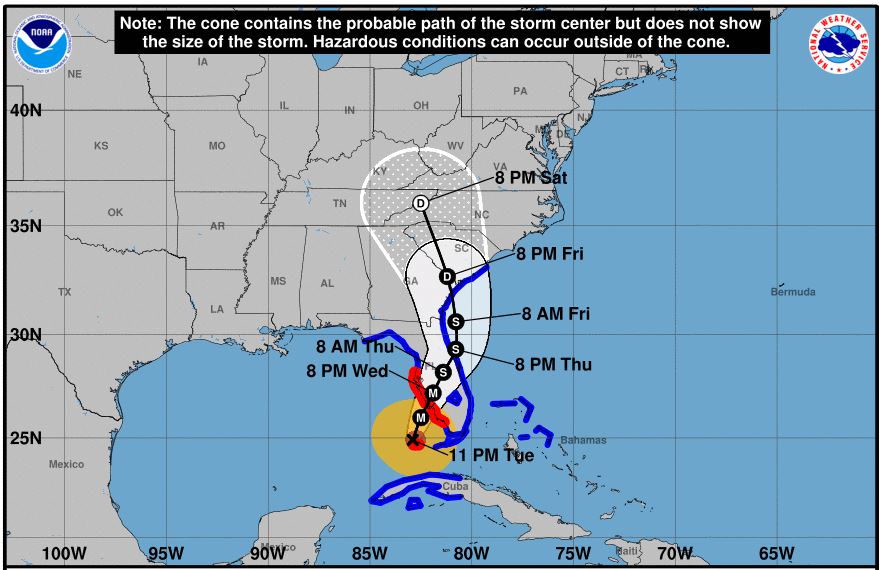
The latest track takes the center of the storm near Gainesville and Paynes Prairie Reserve State Park on Thursday afternoon, then up the coast near Cumberland Island on Friday afternoon, both areas known for their wild horses.
WHBAB Meeting Materials Out for Review
Refer to the bullet list at the WHBAB home page.
Overpopulation means more horses than allowed by plan, not necessarily more horses than the land can support.
The total AML of 27,000 is small relative to the available resources because most of them have been assigned to privately owned livestock.
You don’t have a wild horse problem on America’s public lands, you have a resource management problem.
RELATED: WHBAB Meeting Announced.

Calico Roundup, Day 17
The incident began on September 10. Gather stats through September 26:
- Target: Horses
- Type: Planned
- Method: Helicopter
- Category: Cruel and costly (advocates have a better way)
- Captured: 735, up from 710 on Day 15
- Average daily take: 43.2
- Capture goal: 1,076
- Removal goal: 1,036
- Returned: None
- Deaths: 22, up from 21 on Day 15
- Shipped: 688, up from 654 on Day 15
The figures above are based on the daily reports, not the totals posted by the BLM.
Helicopters did not fly on Day 16. The trap may have been moved to a new location.
A stallion was was put down on Day 17 due to a missing eye. He survived the chase and would be alive today if there was no roundup.
The death rate is 3.0%.
The capture total includes 269 stallions, 346 mares and 120 foals.
Youngsters represented 16.3% of the animals gathered.
Of the adults, 43.7% were male and 56.3% were female.
The herd can’t be growing at a rate of 20% per year with a birth rate of 16% per year.
The observed percentages of males and females are outside the range of variation attributable to a simple random process centered at 50% males / 50% females.
Body condition scores were not provided.
The location of the trap was not disclosed.
The HMAs and surrounding lands are subject to permitted grazing.
Day 17 ended with 25 unaccounted-for animals.
Mares treated with fertility control may be returned to the area at a later date.
The capture and removal goals at the gather page have not changed despite new targets in the latest schedule.
Other statistics:
- Horses allowed by plan (AML): 952
- Forage assigned to horses: 11,424 AUMs per year
- Pre-gather population: 1,593
- Forage liberated to date: 8,820 AUMs per year
- Water liberated to date: 7,350 gallons per day
- Forage assigned to livestock: Unknown
- Horses displaced from Complex by permitted grazing: Unknown
- True AML: Unknown
- Stocking rate at new AML: Unknown
- Horses displaced from Complex by drilling and mining: Ask the advocates
The pre-gather population exceeded the AML but not necessarily the number of horses the land can support.
RELATED: Calico Roundup, Day 15.
Devil’s Garden Roundup, Day 15, Managing for Livestock Edition
The incident started on September 12. Results through September 26:
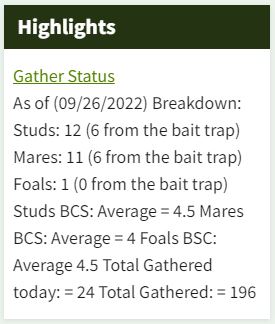
Body condition scores indicate more horses than allowed by plan, not more horses than the land can support. If the horses were starving the scores would be lower.
More information may be available on socialist media but Western Horse Watchers won’t read it or link to it.
- Target: Horses
- Type: Planned
- Method: Unknown
- Captured: 196
- Average daily take: 13.1
- Capture goal: Unknown
- Removal goal: Unknown
- Returned: Unknown
- Deaths: Unknown
- Shipped: Unknown
- Unaccounted-for: Unknown
- Location of trap: Unknown
- Destination of captured animals: Unknown
- Horses allowed by plan (AML): 402
- Pre-gather population: Unknown
- Forage assigned to livestock inside WHT: 15,711 AUMs per year (estimated)
- Horses displaced from WHT by permitted grazing: 1,309
- True AML: 1,711
- Stocking rate at new AML: 6.6 horses per thousand acres
The government collects $21,210 per year in grazing fees from ranching activity inside the WHT while it spends $2,388,925 per year to care for the horses displaced thereby.
Would you say that permitted grazing is a wise use of the public lands?
RELATED: Devil’s Garden Roundup, Day 10, Transparency Not a Law Edition.
 Western Horse Watchers Association