
Horses have the day off. At Custer State Park with Chuck Allen.
Author: Western Horse Watchers
Emergency Roundup Scorecard
- Animals gathered: 0 horses, 29 burros
- Goal: 50 horses, 25 burros
- Animals shipped: 0
- Animal deaths: 0
- Last update: Unknown (daily reports won’t open)
- Gather stats
- Animals gathered: 53 horses
- Goal: 125 horses
- Animals shipped: 0
- Animal deaths: 0
- Last update: August 1
- Gather stats
Triple B / Maverick-Medicine HMAs
- Animals gathered: 51 horses
- Goal: 360 horses
- Animals shipped: 0
- Animal deaths: 0
- Last update: July 31
- Gather stats
The Shawave Mountains roundup starts tomorrow but will be carried out on a planned basis. Same for Saylor Creek, which has not yet started.
Isaias Update, ‘Too Many Vowels’ Edition
NOTE: Some vowels have been removed from this report to achieve a thriving alphabetical balance. This does not mean—and you should not construe—that this blog is managed primarily for consonants, even if they outnumber vowels 37 to 1.
The systm has been downgraded to a tropicl strm. Although the trck has shifted farther to the west, OBX is now undr a tropical storm watch (indicatd by yellow n the map).
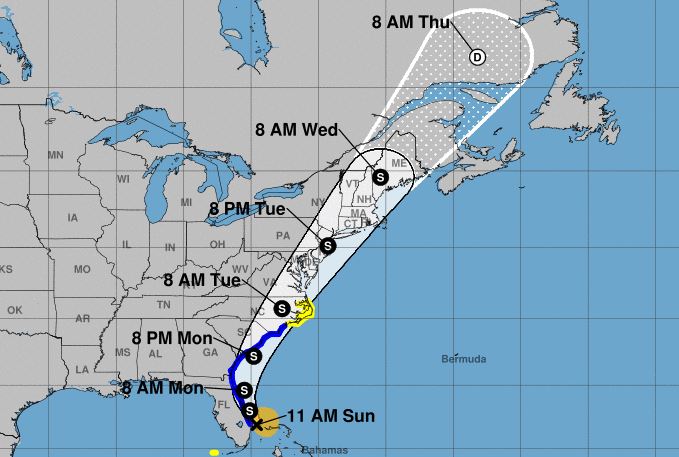
The strm will likely brng heavy rain and floding to the Assateague pones as well.
RELATED: Isaias Still Heading to OBX.
Chincoteague Auction Sets New Record
Not bad for an event that was cancelled, although the auction happened online.
Bidders paid a total of $380,000 this year, according to a report by Delmarva Now.
The ponies usually swim across the bay from Assateague Island (Virginia side) to Chincoteague but they may have been hauled by trailer this year.
The following video by Alyssa Equestrian shows them at the Chintoteague Volunteer Fire Company Carnival Grounds, where the auction usually occurs.
RELATED: No Pony Penning This Year.
Isaias Still Heading to OBX
The track has shifted slightly to the west, taking the center of the storm inland of OBX Tuesday morning. The Banker Horses will be in its northeast quadrant.
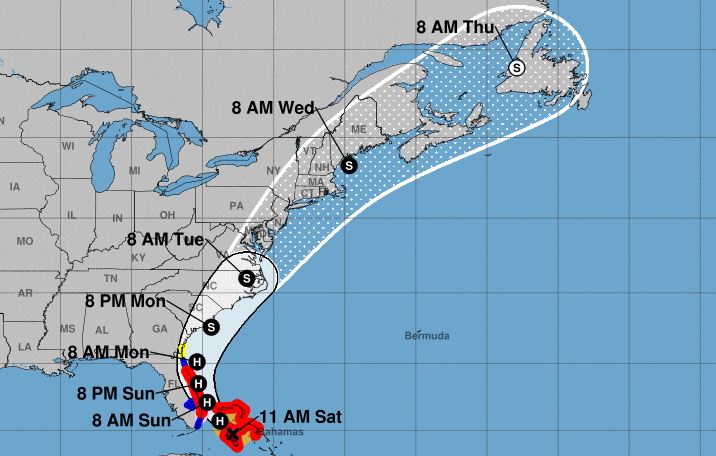
Last year, 28 Cedar Island horses were swept out to sea by Hurricane Dorian.
RELATED: Isaias to Drench Banker Horses?
Can’t Get Good Help Anymore
Hand truck placed near hay several hours earlier but by late afternoon the elves still hadn’t unloaded it. They never showed up to clean the corrals either.

Two Air Tanker Pilots Die Fighting Bishop Fire
The mid-air collision occurred yesterday, according to a BLM news release.
The map at InciWeb puts the blaze in the Delamar Mountains HA, a few miles northwest of Elgin, NV near the Utah border.
Isaias to Drench Banker Horses?
The latest track puts it on top of OBX Tuesday as a tropical storm. Onshore flow will bring rain and flooding to low lying areas.

The counter-clockwise rotation of these systems means onshore flow as they approach and offshore flow as they leave.
Blue Wing Overview
Figure 4, supplied with the Final EA for wild horse and burro management actions in the Blue Wing Complex, shows the five HMAs assigned thereto. All lie within the Blue Wing-Seven Troughs Allotment. The allotment also contains portions of several HAs.
The map appearing on BLM’s livestock grazing page for Nevada shows the size of the allotment compared to others in the state.
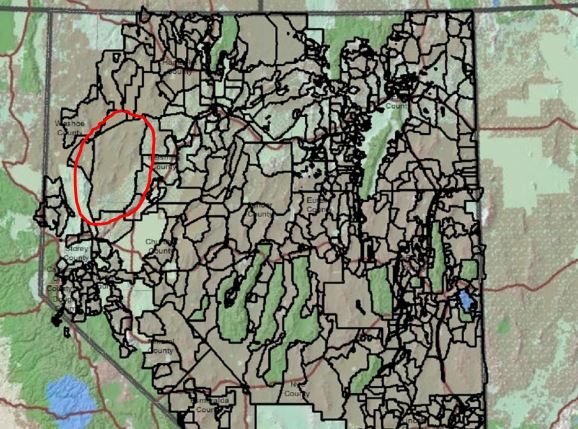
State Route 447, which runs north from I-80 on the west side of the allotment, takes you to Gerlach, a hopping-off point for those attending the Burning Man festival. The event is held on the Black Rock playa, north of the allotment.

The road originates in Wadsworth, home of the Double Lazy Heart Ranch where Charlie and Velma lived.
Free-roaming horses and burros are found in the Blue Wing HMAs.
- Kamma Mountains, managed for horses only
- Seven Troughs, managed for horses and burros
- Lava Beds, managed for horses and burros
- Blue Wing Mountains, managed for horses and burros
- Shawave Mountains, managed for horses only
There are currently around 200 burros on Shawave Mountains but they will be rounded up starting next week.
The total land and forage assigned to horses and burros within the allotment can be computed from HMA data.

Table 11 in the Final EA shows 32,228 AUMs per year assigned to livestock, so the total authorized forage in the allotment is 7,176 + 32,228 = 39,404 AUMs per year, excluding wildlife. The size of the allotment is 1,376,287 acres per Table 9.
The HMAs cover 46% of the allotment (634,391 ÷ 1,376,287) but the horses and burros receive only 18% of the total forage (7,176 ÷ 39,404).
If horses replaced the burros (one for two), the forage on the five HMAs would support 598 of them. The overall stocking rate would be 598 ÷ 634,391 × 1,000 = 0.9 horses per thousand acres, slightly below the average rate of one wild horse per thousand acres across all HMAs.
The forage assigned to livestock would support 2,686 cow/calf pairs, given a 12 month grazing season (11 months per year inside the HMAs per Section 3.2.11 of the EA but omitted for simplicity). The stocking rate would be two cow/calf pairs per thousand acres (2,686 ÷ 1,376,287 × 1,000).
The total authorized forage would support 3,284 wild horses (or cow/calf pairs), with a stocking rate of 2.4 per thousand acres. This value, lower than expected, may be due to the full-year grazing periods, limited resources compared to other areas, or the safety factor applied to resource allocations relative to their availability.
The Blue Wing Decision Record approved Alternative B, described in Section 2.4 of the EA, which will achieve and maintain AMLs with multiple gathers and removals, fertility control and/or sterilization.
Assateague Fundraiser Exceeds Goal
The advocacy group trying to raise $3,100 for two new wild horse interns has collected over $7,000, according to a report posted today by the Maryland Coast Dispatch.
Antelope Valley Roundup Ends
The operation concluded yesterday, according to the daily reports, with 54 wild horses removed from the HMA and no deaths reported. The goal was 50.
The event was expected to last 60 days but was completed in two days.
UPDATE: BLM news release now posted.
RELATED: Antelope Valley Emergency Roundup Starts This Week.
Protecting Livestock and Natural Resources on Public Lands
Refer to this BLM news release on predator management. It’s a nod to the hunters and ranchers, the same people who complain that wild horses have no natural predators.
Where is the Virginia Range?
It’s the area in the following map bordered by Sparks, Patrick, Fernley, Silver Springs, Dayton, Carson City and back up to Sparks.

The Horse Spring Herd Area is on the eastern side. The white patches represent private property. The Pine Nut Mountains HMA is on the other side of Highway 50.
Most of the Virginia Range is in Storey County. The horses are managed by the Nevada Department of Agriculture.
Best Way to End Roundups?
Get rid of the horses.
The FY 2021 spending bill approved by the House last week includes the $11 million PZP Amendment, an idea so good that even the Rolling Stones would support it.
Anybody who reads these pages knows that overpopulation is not the problem, but the big-name ‘advocacy’ groups are trying to convince you otherwise.
This article by Nevada Current, published yesterday, is just one example.
What you’re getting from these groups is capitulation to the ranching agenda, as seen in the disastrous ‘Path Forward.’
They’re trying to ensure that livestock operators receive seventy, eighty, ninety percent or more of the authorized forage on land set aside for wild horses.
Don’t give them a penny!
RELATED: House Passes PZP Amendment to FY 2021 Spending Bill.

Shawave Mountains Roundup Starts Next Week
BLM announced today that 1,600 wild horses and 200 wild burros will be removed from the Shawave Mountains HMA beginning on or about August 3, due to overpopulation.
The operation will be carried out with helicopters, according to the news release, and will be open to public observation.
The HMA covers 177,202 acres in northwestern Nevada. The AML is 136 wild horses and zero wild burros. The aimed-at stocking rate is 0.8 wild horses per thousand acres.
The HMA is managed with four others as a part of the Blue Wing Complex, per Section 1.1 in the Final EA for wild horse and burro management actions in the area.

The map in Figure 4 indicates the HMA lies within the massive Blue Wing-Seven Troughs allotment. The forage allocated to livestock inside the HMA is not known at this time. The horses allowed by plan require 1,632 AUMs per year with no forage allocated to burros.
The current population was estimated to be 1,722 horses and 160 burros, not including this year’s foal crop. They may have exceeded the authorized resources in the area.
Horses removed from the HMA will be taken to the off-range corrals in Fallon, NV and the burros will be shipped to the off-range corrals in Axtell, UT.
Mares returned to their home range will be treated with contraceptives.
Gather stats and daily reports will be posted to this page.
More War Wounds?
Another victim of the darting campaign against the Virginia Range mustangs?
RELATED: War Wounds on Virginia Range.

Montezuma Follow-Up
A project was opened in ePlanning but links to documents and maps don’t work.
No Emergency Roundups Here
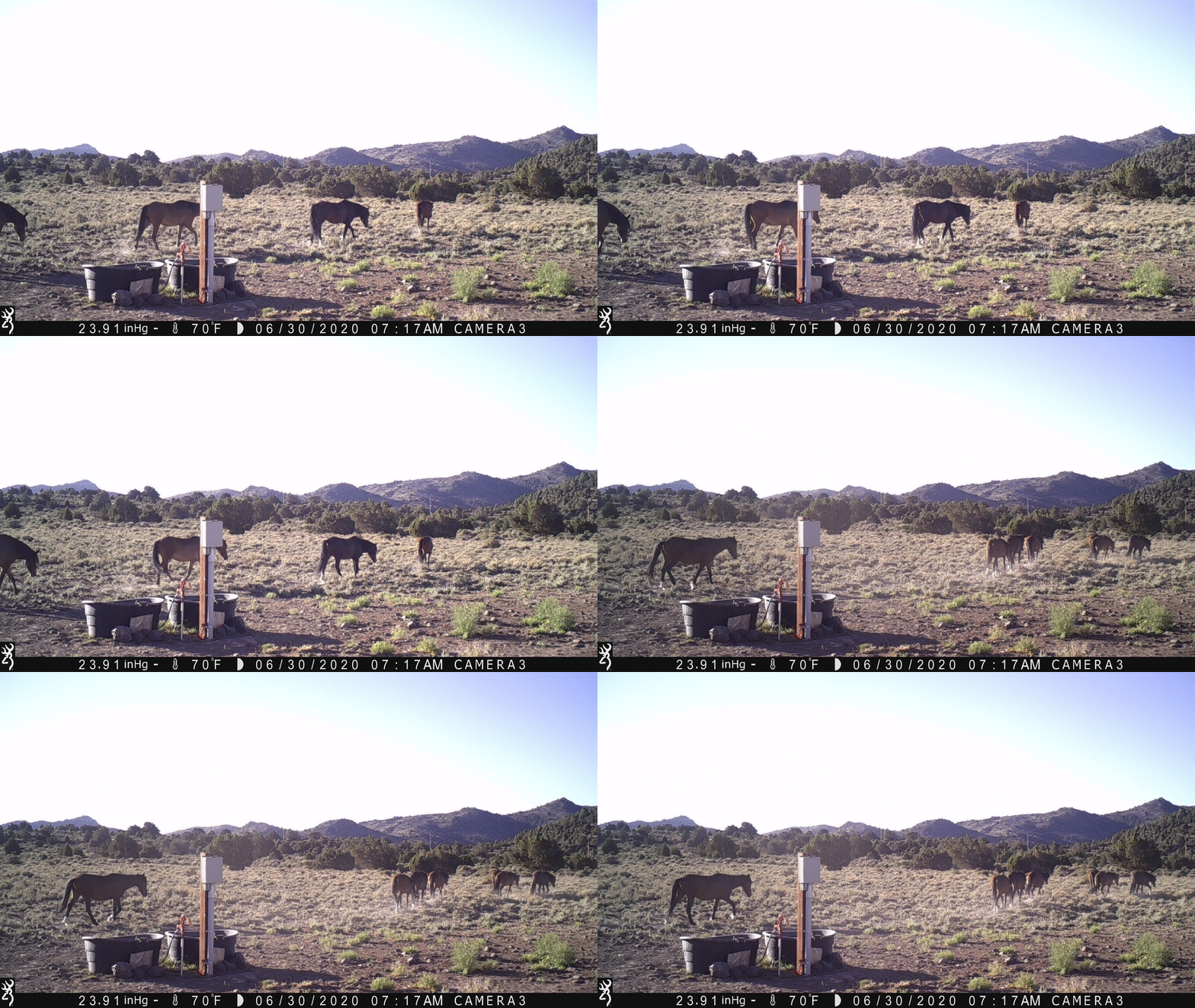
At least not for lack of water.
Pilot Butte Wild Horse Scenic Loop: See It While You Can
If the Rock Springs RMP Amendments are approved and put into practice, the road will still be there but the horses will be gone.
RELATED: So Long, Pilot Butte Wild Horse Scenic Loop?
Montezuma Peak Emergency Roundup Starts This Week
BLM said today that approximately 50 wild horses and 25 wild burros will be removed from the Montezuma Peak HMA beginning July 29, due to insufficient water.
The operation will be carried out with bait traps, according to the news release, and will not be open to public observation.
The HMA covers 77,876 acres in southern Nevada. The AML is 4 horses and 10 burros, equivalent to nine horses (4 + 10 ÷ 2). The equivalent stocking rate would be 0.1 wild horses per thousand acres.

The announcement did not say if the HMA was subject to domestic livestock grazing.
The current population is 130 wild horses and 207 wild burros, excluding this year’s foal crop. The equivalent wild horse population would be 130 + 207 ÷ 2 = 234.
A 20% growth rate would put the herd size at 234 × 1.2 = 281, with a forage demand of 281 × 12 = 3,372 AUMs per year. The total authorized forage on the HMA is unknown.
Captured animals will be taken to the off-range corrals in Ridgecrest, CA.
Gather stats and daily reports will be posted to this page.

