Black Mountain Roundup Day 9

The incident began on May 2.  Gather stats through May 10:

  • Target: Burros
  • Type: Planned
  • Method: Helicopter
  • Captured: 421, up from 267 on Day 7
  • Average daily take: 46.8
  • Capture goal: 1,080
  • Removal goal: 1,080
  • Returned: None
  • Deaths: None
  • Shipped: 351, up from 173 on Day 7

The cumulative total includes 158 jacks, 199 jennies and 64 foals.  The figures at the gather page are 159 jacks, 198 jennies and 65 foals, which sum to 422.

Youngsters represented 15.2% of the animals captured.  Of the adults, 44.3% were male and 55.7% were female.

The herd can’t be growing at a rate of 20% per year with a birth rate of 15% per year.

Four PZP jennies have been caught to date, part of the Humane Society darting project.

The location of the trap site within the HMA was not disclosed.

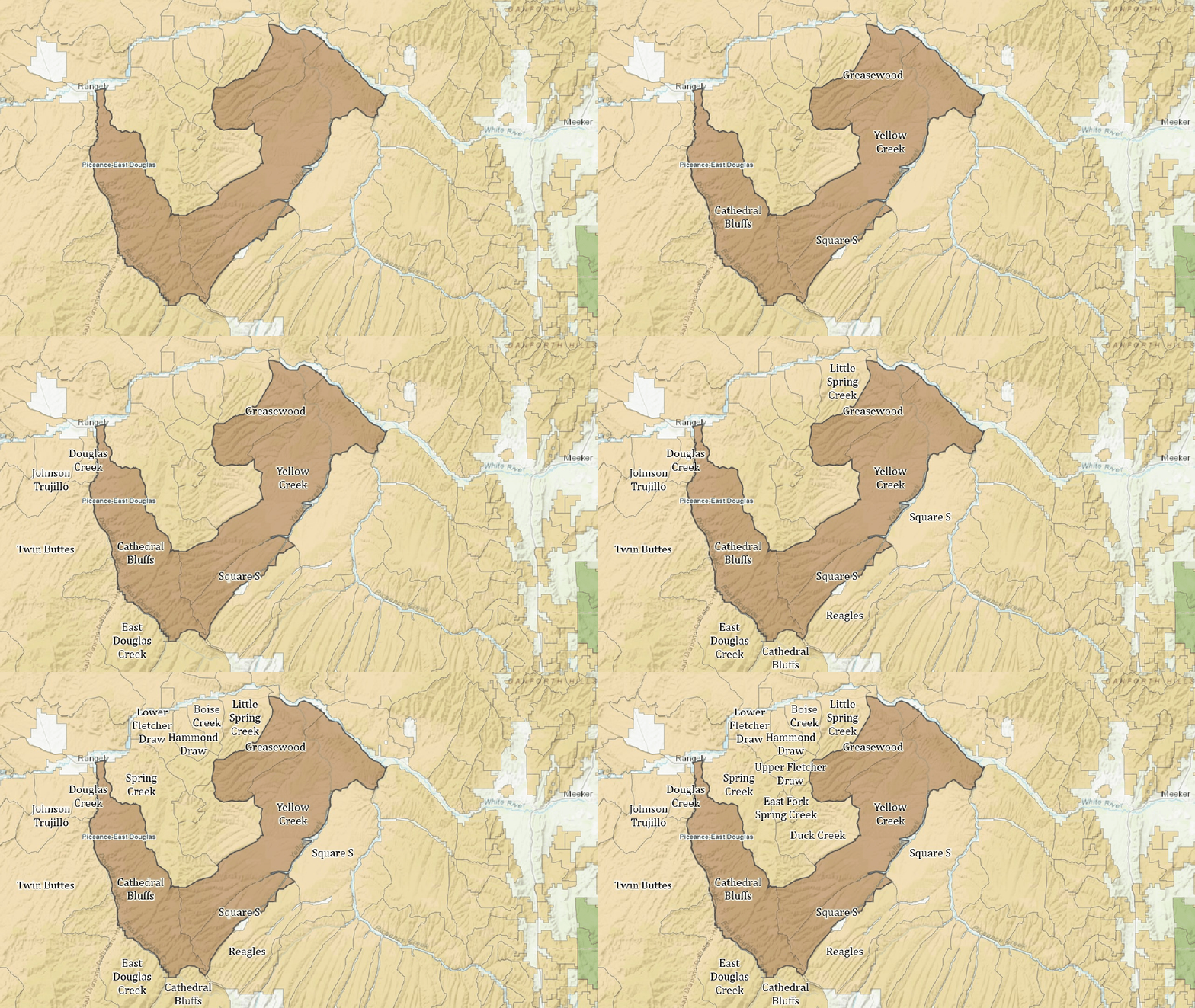
Black Mountain HMA Map 02-25-22

Day 9 ended with 70 unaccounted-for animals.

Other statistics:

  • AML: 478
  • Forage assigned to burros: 2,868 AUMs per year
  • Pre-gather population: 3,000
  • Forage liberated to date: 2,526 AUMs per year
  • Water liberated to date: 2,105 gallons per day
  • Forage assigned to livestock: 7,333 AUMs per year (estimated)
  • Burros displaced from HMA by permitted grazing: 1,222
  • True AML: 1,700
  • Stocking rate at new AML: 1.7 burros per thousand acres
  • Burros displaced from HMA by drilling and mining: Ask the advocates

RELATED: Black Mountain Roundup Day 7.

Fun with Resource Allocations

What can you conclude about the Warm Springs HMA in Oregon based on these data?

Warm Springs AUM Summary-1

1. The AML is 202.  It is small relative to the available resources.

2. Livestock receive eight times more forage than the horses.

3. The HMA is managed principally for livestock.

4. The horses receive 11% of the authorized forage, neglecting wildlife.

5. The number of horses displaced from the HMA by privately owned livestock is 1,616.

6. The True AML is 1,818.

7. If the current population was at 5X AML, the number of excess horses would be zero.

8. The HMA is not overpopulated.

9. There is no justification for a roundup or fertility control program.

10. The number of horses displaced from the HMA by permitted grazing is about 3% of those in off-range holding.

11. All of the animals in off-range holding could be returned to the range by ending public-lands ranching in 35 other such HMAs.

12. The advocates understand all of this and would be happy to explain it to you.

OK, eleven out of twelve is not bad.

Montana Solution Necessitates Helicopter Roundups?

It’s supposed to prevent them according to the advocates.

But Section 3, Part 1, Paragraph c in yesterday’s solicitation for fertility control services says the method of capture will be with the use of [helicopter] drive and/or bait trapping in accordance with the standards of the Comprehensive Animal Welfare Program.

The advocates oppose the use of helicopters, but perhaps they can be accommodated in the early stages of the project until the herds are small enough to stalk the remaining animals on the range and shoot them with darts as taught in Billings.

The advocates refer to sterilized mares as “self-boosting.”

The CAWP and other supporting documents can be found at the solicitation page.

RELATED: Proposals Sought to Catch, Treat, Release Wild Horses and Burros.

Decision, Final EA Released for Spring Mountains Complex

The BLM announced yesterday that the documents had been posted to the project page hosted by the Forest Service.

The Proposed Action features gathers and removals, fertility control, sterilization and sex ratio skewing over a ten-year period.

The Complex includes the Wheeler Pass, Johnnie, and Red Rock Joint Management Areas, and the Spring Mountains Wild Horse and Burro Territory.

Spring Mountains Complex 09-30-21

The plan is subject to a 45-day objection period.

Instructions for submitting a complaint were included in a Forest Service news release dated May 9, posted with other project documents.

Western Horse Watchers is unable to access the files at this time.

A story by KLAS News says a roundup will occur in the area next month.

RELATED: Draft EA for Spring Mountains Complex Out for Review.

Proposals Sought to Catch, Treat, Release Wild Horses and Burros

The BLM said today in a news release that it seeks new contract services to gather wild horses and burros, treat them with fertility control and return them to the range.

Overpopulated herds are at risk of starvation and thirst, and they can overuse food and water that are important for other wildlife species that share public lands.

Not mentioned in the announcement are the herds of privately owned cattle and sheep that also occupy those lands and receive the lion’s share of the resources, as indicated in this example from the Warm Springs HMA in Oregon.

Warm Springs AUM Summary-1

That’s what the contractors will be protecting.

RELATED: Congress Authorizes $11 Million for Montana Solution in FY 2022?

Pancake Gather Plan

Rock Springs RMP Amendments to Affect Horse Removal Market?

The closure of two HMAs and the downsizing of a third will reduce opportunities for the helicopter contractors and wild horse advocates, the two leading players in the livestock protection industry.

The advocates oppose the roundups but not the removals, preferring to take horses off the range with the Montana Solution.

Both groups offer the same results, assuring that most of the food and water in areas identified for the horses go to the public-lands ranchers.

The Montana Solution takes longer to implement but, unlike helicopter roundups, the herds don’t bounce back.

Sand Wash Advocates 01-17-22

Black Mountain Roundup Day 7

The incident began on May 2.  Gather stats through May 8:

  • Target: Burros
  • Type: Planned
  • Method: Helicopter
  • Captured: 267, up from 124 on Day 3
  • Average daily take: 38.1
  • Capture goal: 1,080
  • Removal goal: 1,080
  • Returned: None
  • Deaths: None
  • Shipped: 173, up from 56 on Day 3

Reports for Days 4 to 7 were not posted until yesterday.  Helicopters did not fly on Day 7 due to high winds.

The cumulative total includes 100 jacks, 127 jennies and 40 foals.

Youngsters represented 15.0% of the animals captured.  Of the adults, 44.1% were male and 55.9% were female.

The herd can’t be growing at a rate of 20% per year with a birth rate of 15% per year.

Four PZP jennies have been caught to date, part of the Humane Society darting project.

The location of the trap site within the HMA was not disclosed.

Black Mountain HMA Map 02-25-22

Day 7 ended with 94 unaccounted-for animals.

Other statistics:

  • AML: 478
  • Forage assigned to burros: 2,868 AUMs per year
  • Pre-gather population: 3,000
  • Forage liberated to date: 1,602 AUMs per year
  • Water liberated to date: 1,335 gallons per day
  • Forage assigned to livestock: 7,333 AUMs per year (estimated)
  • Burros displaced from HMA by permitted grazing: 1,222
  • True AML: 1,700
  • Stocking rate at new AML: 1.7 burros per thousand acres
  • Burros displaced from HMA by drilling and mining: Ask the advocates

RELATED: Black Mountain Roundup Day 3.

Minor Problem with Rock Springs RMP Amendments?

The Proposed Action in the Final EIS (Alternative D) did not appear in the Draft EIS and was not subject to public review.

Only those who participated in the planning process can protest and new issues cannot be introduced.

Refer to Section 2.2.4 in each document for a comparison of the two plans.

Suppose you bought land in a new subdivision and the builder offers four floor plans for your consideration.

You go through them and give him your feedback.

A year later he comes back with a new plan that was not among the original four and he wants you to accept it without comment.

Are you going to agree to that?

RELATED: Protests Accumulating in Rock Springs RMP Amendments.

Protests Accumulating in Rock Springs RMP Amendments

Seven complaints have been submitted online as of this morning.  Objections can also be submitted by mail and these may not be reflected in the count.

The Proposed Action (Alternative D in the Final EIS) will close two of the four HMAs under consideration and downsize a third.  The fourth will remain intact but will be subject to population suppression of unspecified type.

In the Draft EIS, three would be closed and the fourth downsized.

Many of the horses in the area were removed in a roundup that ended in January.

RELATED: Paper Misleads Readers About Rock Springs RMP Protest.

Paper Misleads Readers About Rock Springs RMP Protest

An article posted today by the Wyoming Tribune Eagle says now is the time to speak up if you have any concerns about how the BLM responds to land issues involving wild horses in the state, which is not correct.

The protest period is not a public comment period.  Only those who participated in the planning process are eligible.

If you didn’t submit comments at the time don’t hit the Participate Now button!

Refer to the letter on page two of the Final EIS for more information.

RELATED: Protest Period Begins for Rock Springs RMP Amendments.

UPDATE: Link to article fixed.

West Douglas Herd Area Unfit for Wild Horses?

How could it be unable to support the 457 horses living there before the roundup, when the BLM authorizes privately owned livestock equivalent to 832 wild horses in the same area?

Captured animals were taken to the Cañon City off-range corrals, where 136 have died as of May 7.  The foals reported yesterday may have been born in the corrals.

News reports focus on the situation at the corrals, not on the mismanagement of their home range.  Same for the advocates.

RELATED: Cañon City Deaths Preventable?