Beebe Ranch Fundraiser Closing in on Goal

The GoFundMe page says $525,000 has been collected as of June 11.

The goal is $625,000.

Most of the land has already been sold, but the remaining parcel, which includes the home and the area where Misty spent most of her life, is on the market.

The Beebe family hopes the Museum of Chincoteague can acquire the property and maintain it as a ranch.

RELATED: Chincoteague Foal Joins Beebe Ranch Fundraiser.

Misty of Chincoteague Beebe Ranch Fundraiser 03-23-23

Who’s Behind the Marietta Grazing Project?

The affected program is livestock grazing and the applicant is the BLM with interested stakeholder requests, according to the project description.

The identity of the interested stakeholders was not disclosed.

Given that the scope involves health assessments of four idle allotments, the unnamed parties must be drillers or miners, if you believe the advocates.

Only renegades and mavericks would point a finger at their cherished friends and allies, the public-lands ranchers.

RELATED: Marietta Wild Burro Range to Become HMA?

Chincoteague Foal Joins Beebe Ranch Fundraiser

The Chincoteague Volunteer Fire Company will donate the proceeds from a Buy-Back filly to the museum’s effort to purchase the ranch, according to an announcement by Sport Horse Auctions, coordinator of the auction that follows the annual swim.

Bidding starts today and runs through June 14.

Buy-Back foals are usually returned to the Virginia side of Assateague Island after the event in late July, but this auction may be occurring now because the museum is in contract with a closing date of June 30.

RELATED: Chincoteague Museum Puts Contract on Beebe Ranch.

Marietta Wild Burro Range to Become HMA?

The WBR is one of four HMAs, out of 177, where animal agriculture is not allowed.

On May 9, the BLM opened a new project in ePlanning that initiated a land health assessment for the Basalt, Belleville, Little Huntoon and McBride Flat Allotments, to evaluate their potential for livestock grazing and other uses.

A scoping letter was the only document posted for public review.

Basalt and McBride Flat are in the Sierra Front Field Office.  The Allotment Master Report shows no permittees and no active AUMs.

Belleville and Little Huntoon are in the Stillwater Field Office.  The Allotment Master Report shows no permittees and no active AUMs.

Three are in the Maintain category and one is Custodial (condition unknown).

Belleville intersects the WBR according to the National Data Viewer.  Click on image to open in new tab.

Marietta WBR with Allotments 06-09-23

If the allotments are found to be suitable for animal agriculture (the answer may already known), additional planning and decisions would be required, including an EA or EIS in a new project, to revise the applicable RMP(s) and reallocate or reauthorize resources.

The Montgomery Pass HMA may also be affected.

It’s possible the allotment boundaries could be shifted to eliminate the overlap, but history suggests the WHB areas will be sacrificed for the benefit of permitted grazing.

The project may have been instigated by ranching interests, but this was not specified in the description.

Comments will be accepted through June 16.

Foal-Free Friday, Choosing the Best Poison Edition

Of the two leading fertility control pesticides, both on the same EPA list as toxic chemicals, the advocates have a clear preference, Zonastat-H, indicated by comments on the proposed livestock management plan for Theodore Roosevelt National Park.

TRNP PZP Comment 1 06-07-23

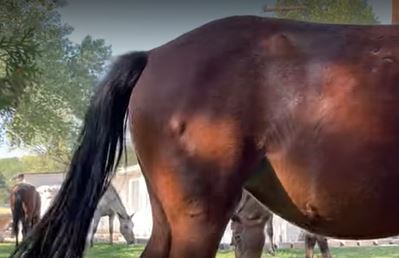
As for injection site reactions, these photos show injuries inflicted by volunteers with the Campaign Against America’s Wild Horses on the Virginia Range.  Click on images to open in new tabs.

Darting Injuries 05-19-22

Previous photos show injuries that persist for weeks and get worse with time.  They were caused by Zonastat-laced darts, fired by the same nitwits for the same group.

Progression of Injuries VR 07-30-21

When the product is used for herd reduction, as it is on the Salt River and Virginia Range, the inevitable result is sterility, as the advocates, desperate to convince the bureaucrats and ranchers that they have a better way, pummel the mares for an extended period to achieve their population goals.

This is what happened on the Maryland side of Assateague Island, where the pesticide was applied with reckless abandon for over twenty years.

RELATED: Foal-Free Friday, Snubbing the Advocates Edition.

Trends in Assateague Population 04-27-23

NNCC Auction Yields $108,200

Bidders paid an average of $5,150 for 21 saddle-started horses trained by inmates at the Northern Nevada Correctional Center, according to a June 5 news release by the BLM.

The highest bid was $11,900.  The lowest was $1,100.

The outplacement program moves wild horses from areas where they’re not wanted to other areas where they’re not wanted if they don’t bring enough prizes and prestige to their new owners.

In this environment, they can look forward to being locked in stalls, smothered with blankets, bathed with carpet cleaner and coerced with bits, spurs, crops and tiedowns, mostly by women.

Curiously, it’s mostly women who are trying to stomp them out in their lawful homes with ovary-killing pesticides.

TRNP Comment Report Shows Strong Support for Wild Horses?

Public opinion regarding the new livestock management plan tilted 63 to 1 in opposition to their removal, according to a story dated June 6 by INFORUM.

A keyword search of the comment report yielded nine occurrences of “PZP” and eight occurrences of “birth control.”

The report provides summaries of comments, so the frequency of such ideas in the original comment pool is likely much higher.

The following snippets reveal a misinformed public, an indication of how far the advocates have propagated their lies.

From Section 3.8:

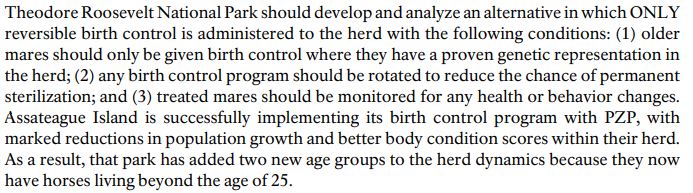
TRNP PZP Comment 1 06-07-23

Safe, proven and reversible?  Nonsense!

VR Darting Injury 09-15-21

Also from Section 3.8:

TRNP PZP Comment 2 06-07-23

Yep, abnormal sex ratios peddled as mares living longer.

In the seven years since the Assateague darting program was shut off, the herd has not bounced back, proving that the safe, proven and reversible fertility control pesticide is anything but.

Trends in Assateague Population 04-27-23

Pay no attention to the advocates!

Their top priority is to keep their base fired up and the donations rolling in, while achieving nothing useful for America’s wild horses.

RELATED: TRNP Mares Sterile?

Wild Horse FAQs, May I Have Another Please?

Q. What do you call a woman who couldn’t convert an AML to AUMs if her life depended on it, much less compute a forage allocation for livestock in an area set aside for wild horses, but graduated with honors from the Billings School of PZP Darting?

A. An advocate.

Q. What do you call a ranching advocacy group that recruits dozens of such women every year to poison wild mares with restricted-use pesticides?

A. The Campaign Against America’s Wild Horses.

Q. Who should you call if you see said women applying said pesticides in areas used for animal agriculture, a purpose for which they were not registered?

A. Law enforcement.

RELATED: More Wild Horse FAQs.

Alamo Roundup Pending?

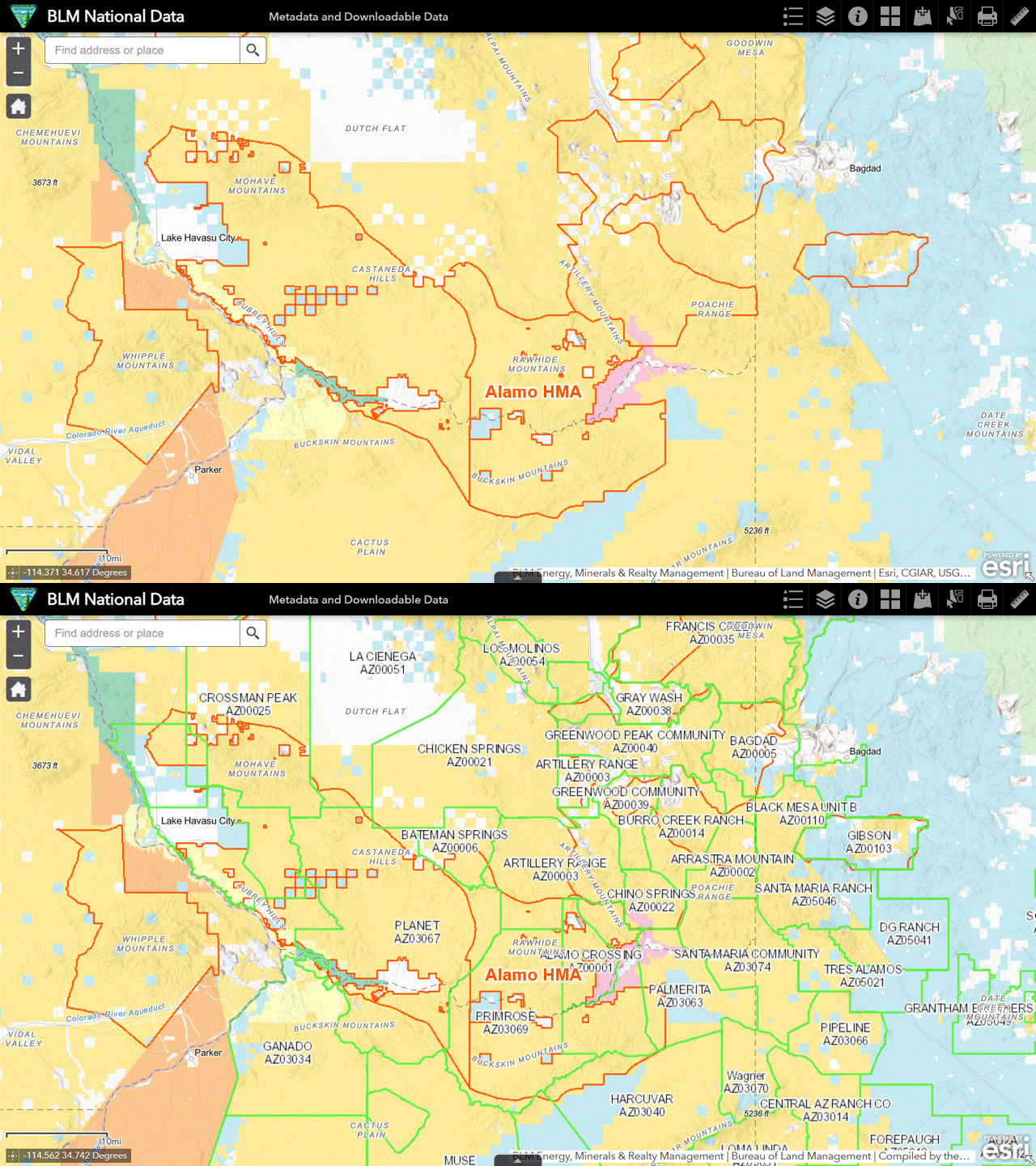
A new project was created in ePlanning yesterday, covering bait trap removal of 150 wild burros from private lands inside the HMA.

Operations run from June through September.  Click on image to open in new tab.

Alamo HMA Map with Trap Sites 06-06-23

Refer to the CX for details.

The incident does not appear in the latest schedule.

There were no opportunities for public involvement.

The project was not announced at the BLM news site.

The HMA is subject to animal agriculture, with allotments shown in green.

Alamo HMA Map with Allotments 06-06-23

Avis Launches New Site to Push Helicopter Ban

The effort was announced in a news release dated June 5.

How do you know HR 3656 is bad for wild horses?  The advocates support it.

They see it as an opportunity to expand their fertility control businesses.

As for the new site, sign the petition if it means areas identified for wild horses will be managed principally for them, as specified in the original statute, but say no to any measure that calls for the poisoning of mares with ovary-killing pesticides.

RELATED: It’s Back: Helicopter Ban for 2023.

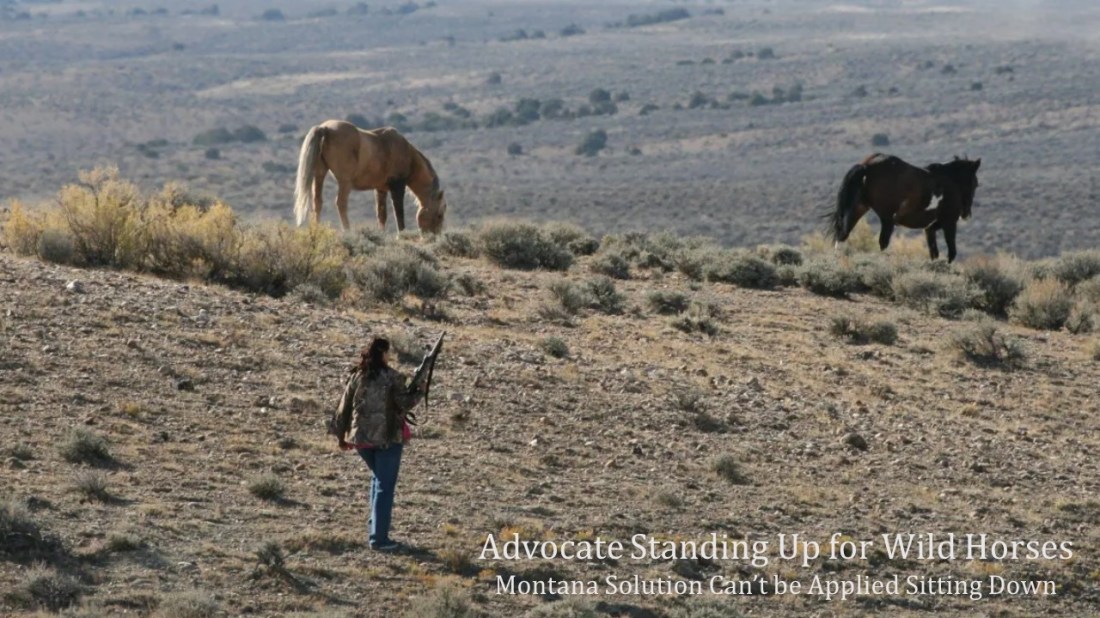
Advocate Standing Up for Wild Horses 06-14-22

More Wild Horse FAQs

Q. What do you call a wild horse removal contractor masquerading as an advocacy group?

A. The Campaign Against America’s Wild Horses.

Q. What do you call an EPA-registered pesticide that can only be used on female horses and burros that are capable of doing environmental damage?

A. Zonastat-H.

Q. What do you call the application of said pesticide by said group on herds that pose a safety hazard or are thought to be overpopulated?

A. Illegal.

RELATED: Wild Horse FAQs.

Wild Horse FAQs

Q. What do you call a stock grower’s association dressed up as an advocacy group?

A. The Campaign Against America’s Wild Horses.

Q. What do you call an ovary-killing pesticide that sterilizes mares in five years?

A. The Montana Solution.

Q. What do you call the application of said pesticide by said group in areas designated for animal agriculture?

A. Unlawful.

RELATED: Multiple Use Applies to Public Lands, Not Registered Pesticides.

Alpine Horses Wild or Feral?

A story dated June 2 by Courthouse News takes a closer look at the debate, but two issues deserve further attention.

Hypocrisy of the advocates—

Simone Netherlands, president of the Salt River Wild Horse Darting Group, said removing horses from public land is “ungrateful” behavior given their significant role in American history.

What is she doing with the aid of her volunteers?  Getting rid of wild horses on public lands with an ovary-killing pesticide.

Silence about permitted grazing—

Wherever you find wild horses you’ll find permitted garzing, with few exceptions.

Horses appear in the North American fossil record but cattle and sheep do not, yet horses are cited as the nonnative/invasive species.

RELATED: Salt River Advocates Accuse Forest Service of Harming Foals!

WHB Act Over 100 Years Old?

This recycled article about population control by Horse Illustrated is so far off the mark it’s hard to imagine how it was approved for publication.

The author is learning to balance motherhood with horses, dogs and writing, but not accuracy, apparently.

The story received a sudden facelift this morning, but here’s a snippet from the original version dated June 1:
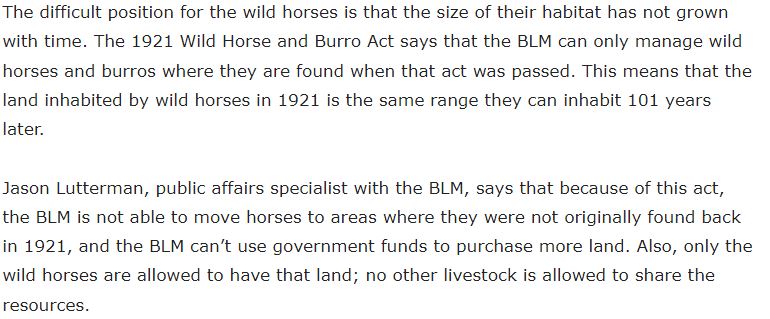
Snippet from HI Article on Population Control 06-02-23

Please mark these statements True or False:

  • The acreage available to wild horses isn’t shrinking
  • More than 65 percent of wild mares are typically pregnant on any given day and in some herds the rate is over 90 percent
  • Fertility control treatments have not shown to have any effect on the natural state of the herd or in the livelihood of the treated mare

The remark about a study that was done on a very small population on an island is almost certainly a reference to Assateague, where the herd has been ruined by the Montana Solution.

If treated mares have less fidelity to their bands and they leave to join other bands, is it because of the vaccine or the absence of a foal?  They don’t have foals because of the vaccine, so it’s because of the vaccine, you idiot!

The article employs the customary euphemisms, such as long-term infertility instead of sterility, and increased longevity of mares instead of abnormal sex ratios.

An inset about the poisoning of mares on the Virginia Range by the Campaign Against America’s Wild Horses concludes with this remark by monster-in-charge Suzanne Roy: “Our program is an aggressive fertility control program to reduce the population size in that area humanely without moving the horses.”

Growth in the Reno area, cited by Roy, affects the western flank of the Virginia Range, a small percentage of the total area, not enough to justify the 80% reduction in herd size she’s trying to accomplish through her volunteers and your charitable contributions.

Moreover, the pesticide she’s using was not approved for use on horses that pose safety hazards or are deemed to be overpopulated.

RELATED: What’s So Important about the Virginia Range?

Foal-Free Friday, Snubbing the Advocates Edition

The June meeting in Reno of the Wild Horse and Burro Advisory Board offered two opportunities to observe the poisoning of mares with fertility control pesticides, but the BLM opted to visit the Blue Wing Complex instead.

Why didn’t they choose the Virginia Range or Pine Nut Mountains, where advocates affiliated with the Campaign Against America’s Wild Horses are suppressing the herds for the benefit of animal agriculture, a purpose for which PZP was not registered?

Let Us Fix Your Wild Horse Problem 02-18-23

Desperate for acceptance and approval, the advocates could explain their philosophy of managing the numbers to fit what’s available for the horses: As the bureaucrats shift more acreage and food to the public-lands ranchers, wild horse numbers must go down, and they have a better way.

On the other hand, Board members accompanied by plain-clothes law enforcement agents could gather information leading to the arrest and conviction of those involved.

If done amicably, they might even go home with “Stay Wild” caps worn by participants and supporters of the programs.

RELATED: Foal-Free Friday, Reinforcing the Status Quo Edition.

Impact of Fiscal Responsibility Act of 2023?

The debt ceiling bill cleared the House last night by a vote of 314-117.

A keyword search of the pdf yielded these results:

  • Horse – 0 occurrences
  • Burro – 0
  • Advocate – 0
  • Pesticide – 0
  • Livestock – 0
  • Allotment – 0
  • Grazing – 0
  • Forage – 0
  • Cattle – 0
  • Sheep – 0
  • AUM – 0
  • RMP – 0
  • BLM – 0
  • PZP – 0

Looks like it won’t have a big effect on the wild horse world, at least not directly.