Wyoming Checkerboard Lands Missouri Hunters in Hot Water

The incident occurred last year east of Rawlins and the HMAs affected by the Rock Springs RMP amendments, when the group tried to access public lands interspersed among private parcels of roughly the same size.

Owners of the private areas consider it unneighborly for outsiders to hopscotch through their land by crossing from one public section to another at the corners where they meet, according to a story dated November 10 by The Wall Street Journal.

“Their land” taken to mean all of it.

The case involved the use of a fence ladder to effect the crossing, shown in an August 23 report by WyoFile.

Apparently, at one of the corners, the landowner, or an agent thereof, drove T-posts into the ground and wrapped them in chains to prevent anyone from crossing at that point.

Note the marker between the posts at the bottom of the photo in the WyoFile article.

Here is an example from the Virginia Range.  Lands in this area are privately owned.

Storey County Section Marker 11-13-22

The private parcels in Wyoming are owned by Elk Mountain Ranch, indicated by the signs in the WyoFile image.

Elk Mountain Ranch is owned by Iron Bar Holdings, which is controlled by North Carolina pharmaceuticals magnate Fredric Eshelman.

The four men were acquitted of criminal trespass charges in state court earlier this year, but Iron Bar has since filed a civil trespassing complaint against them, which will be heard in federal court in 2023.

The map provided by WSJ suggests the ranch occupies the same space as the Home Ranch Allotment, which can be found in the Western Watersheds map.

Home Ranch Allotment Map 11-13-22

Turns out that Iron Bar holds all of the active AUMs in the allotment, making Eshelman a public-lands rancher!

This explains the remark about “their land” above.

Elk Mountain is probably the base property that secures grazing preference on the public parcels.

The allotment is in the Custodial category, probably because most of the acreage and forage are associated with non-BLM lands.

As for the BLM resources, the allotment offers 585 AUMs per year on 7,152 public acres, or 81.8 AUMs per year per thousand acres, enough to support 6.8 wild horses per thousand acres on a twelve-month grazing season.

The BLM maintains that public lands in the western U.S. can only support one wild horse per thousand acres.

The agency also maintains that corner crossings in the Checkerboard or elsewhere are not considered legal public access.

Parachuting might be an option.

Western Horse Watchers does not know if hunters can use fence ladders to haul their trophies out of such areas.

Turmoil at Currituck Wild Horse Advisory Board?

The group convenes on a quarterly basis, at least in theory, but the meetings for August and November were cancelled.

Minutes from the May meeting include a report by Meg Puckett of the Corolla Wild Horse Fund, starting on page six of the pdf.

The on-range population was 106 as of March, with 19 animals in off-range holding.

Six foals were born in 2022, for a birth rate 5.7%.

The Equus Survival Trust classified the herd as Critical/Nearly Extinct in their 2022 Equine Conservation List, yet the advocates have been pummeling the mares with their favorite pesticide for years.

Curiously, only two have been darted this year.

“Due to significant loss over the last several years, an aging population, and questions about the long-term effects of PZP on the mares’ reproductive systems, healthy mares are not being darted in 2022.”

Moreover, “The small roster of mares consistently producing foals has not changed significantly in six years.”

The Assateague herd shows no growth six years after the safe, proven and reversible darting program was shut off.

Will history repeat in Currituck County?

The Currituck advocates have been invited to present research at a conference hosted by the Science and Conservation Center in 2023 (the Billings School of PZP Darting), according to the report.

Truth will likely be in short supply.

The minutes also include a marked-up version of the Wild Horse Management Agreement, starting on page 11, which protects and maintains a thriving ecological balance, and preserves the free-roaming nature and habits of the horses!

RELATED: Advocates, Not Climate Change, to Destroy Currituck Herd.

Standing Up for Wild Horses on Virginia Range 06-18-22

Foal-Free Friday, Choosing Your Own Poison Edition

The advocates, eager to dominate the wild horse removal business, generally don’t support the use of GonaCon Equine, which may act as a sterilant.

As noted by the Wild Beauty Foundation, the product can be irreversible, sterilize wild horses completely and has been proven to shrivel the ovaries of wild mares.

The Montana Solution, favored by most of the advocates, including the Campaign Against America’s Wild Horses, its affiliates and offshoots, accomplishes the same thing in as little as four years, but these charlatans have invested so much in its promotion they’ll never admit their errors.

PZP Dangers 10-21-22

You only have to look at Assateague Island, where the pesticide was applied for over twenty years, to see the destruction.

The advocates are now trying to ruin the herds on the Virginia Range and Salt River, among others.

Meanwhile, the search for a better poison goes on.

These “vaccines” don’t prevent illness, they cause it, and are probably more harmful in the long run than the “cruel and costly” helicopter roundups they seek to replace.

RELATED: Foal-Free Friday, Anathema to the Advocates Edition.

Catch-Treat-Release Rebooted

The original solicitation was withdrawn due to unspecified protests, according to today’s news release.

A new request has been posted.

This is a great opportunity for the advocates to advance their anti-horse agenda, build lasting relationships with former adversaries and embrace their heretofore cruel and costly helicopter roundups.

Proposals can be submitted through November 30.

RELATED: Proposals Sought to Catch, Treat, Release Wild Horses and Burros.

Rationale for Roundups: Healthy Horses on Healthy Rangelands

The term is used in this video from the Piceance adoption at the Mesa County Fairgrounds in Grand Junction.

It’s similar to “If we get rid of them they can stay,” a favorite of the advocates.

If an area set aside for wild horses can support 1,500 animals, and the current population is 800, with an AML of 300, wouldn’t you expect to find healthy horses?

Of course you would.  So what’s the problem?

Eighty percent of the forage, corresponding to 1,200 animals, has been assigned to privately owned livestock.

At least 500 horses have to go.  Some may end up in pens like these.

You can have your wild horse and burro program as long as it doesn’t interfere with the grazing program.

RELATED: BLM Admits Piceance HMA Not Managed Primarily for Horses!

The Carrying Capacity Puzzle

The BLM sells about 12 million AUMs to livestock operators on 155 million acres of public lands in the western U.S. every year.

Livestock Grazing Infographic 08-14-22

That resource would support one million wild horses on a twelve-month grazing season, for an equivalent stocking rate of 6.5 wild horses per thousand acres.

The Virginia Range was carrying ten wild horses per thousand acres before the advocates got involved.

Land designated for wild horses, a subset of the acreage above, can only support one wild horse per thousand acres, according to the official narrative (27,000 animals on 27 million acres).

Why the difference?

The management plans assign most of the forage to privately owned livestock.

By how much are the horses being cheated?

The forage assigned to livestock is the missing piece in the carrying capacity puzzle.

Carrying capacity = Horses allowed by plan + Horses displaced by livestock

The number of horses displaced from their lawful homes by permitted grazing is

6.5 × 27,000,000 ÷ 1,000 = 175,500

The True AML, the number of wild horses the land could support if it was managed principally for them, is

27,000 + 175,500 = 202,500

The figure based on the land originally identified for wild horses, around 53 million acres, is

(1.0 + 6.5) × 53,000,000 ÷ 1,000 = 397,500

This is enough to empty all of the off-range corrals and long-term pastures six times over!

You don’t have a wild horse problem on America’s public lands, you have a resource management problem.

Who’s doing the cheating?

The bureaucrats, of course, with the cooperation of the ranchers and advocates.

Concerns about the rising costs of the wild horse and burro program are bullcrap.

More and more horses will be taken off the range and the costs will go wherever they need to go to protect the grazing program and the public-lands ranchers.

RELATED: Livestock Outnumber Horses and Burros on Public Lands?

AML-1

How to Push Taxes, Spending and Inflation Even Higher

Vote against your own interests.

Show the world how much you care about big, bloated, overreaching, iron-fisted, centralized government, and the massive unelected bureaucracy sustained thereby.

Vote Democrat in November 11-01-22

You don’t ask a poor man how to get rich or the advocates how to save wild horses, and you don’t ask liberals how to protect your God-given rights, including your right to life.

Avis Points to “Massive Priority” Affecting America’s Wild Horses

In lockstep with the advocates, she puts the drillers and miners in the same camp as the public-lands ranchers, in terms of their impact on wild horses, yet the former affects anywhere from a few acres to a few thousand acres, while the latter devours entire HMAs and beyond.

Western Horse Watchers invites you to find one such company that has as official policy the removal of wild horses and burros from public lands, and then name a farm bureau, stockgrowers association or cattlemen’s group that doesn’t.

RELATED: Wild Horse Documentary Takes Award, for What?

Cedar Mountain Release Set for Next Week

Fifty mares treated with GonaCon Equine will be returned to the HMA on November 14, along with twelve stallions, according to today’s news release.

The event will be open to public observation.

Smaller herd sizes and lower birth rates keep the resource scales tipped in favor of the public-lands ranchers for longer periods of time.

The advocates have unmatched expertise in that regard.

RELATED: Cedar Mountain Roundup Over.

Thriving Ecological Balance-3

Life at Wind River Wild Horse Sanctuary (Off-Range Pasture)

The BLM Facility Report refers to it as “Lander,” with a capacity of 225 horses, one of four long-term pastures open to the public.

Unadopted and unadoptable horses, most of whom were removed from their lawful homes in favor of privately owned livestock, are sent there to die.

The Wind River Sanctuary was established in 2016 on the 900-acre Double D Ranch near Lander, WY.  Tours are available by appointment.

Contrary to remarks in the video, overpopulation means more horses than allowed by plan, not necessarily more horses than the land can support.

At the North Lander Complex, not far from the sanctuary, livestock receive over seven times more forage than the horses.

The four HMAs in the Complex can support four thousand more horses than the BLM allows, to be achieved by confining the ranchers to their base properties in a year-round off-season and expecting them to pay the going rate to feed their animals.

The film includes footage from the McCullough Peaks HMA, where a similar situation exists, but the advocates are going after the horses with their favorite pesticide, referred to on these pages as the Montana Solution.

The problem is resource management, not humane management.

Advocate Doesn’t Understand Planning Process?

The writer of a column appearing yesterday in Deseret News complained about the removal last year of cherished wild horses at Onaqui Mountain and Sand Wash Basin, noting they were in good condition and forage was adequate.

What he didn’t tell you is that most of the resource was assigned to privately owned livestock, a result of BLM’s planning and decision process.

The roundups enforced resource allocations already on the books.

If you go too fast on the freeway, you get a ticket.  If you eat too much in your lawful home, you’re removed.

The horses are pests, they rob the permittees of their birthright.

The remark about “A top advocacy group” is probably a reference to the Campaign Against America’s Wild Horses, purveyor of the Montana Solution and defender of the public-lands ranchers.

With the roundups over, the Onaqui and Sand Wash advocates keep the herds from bouncing back with a pesticide that can sterilize the mares in as little as four years, giving the ranchers unfettered access to cheap feed in areas set aside for the horses, as specified in the land-use plans.

The writer supports these efforts.

File under: Charlatans.

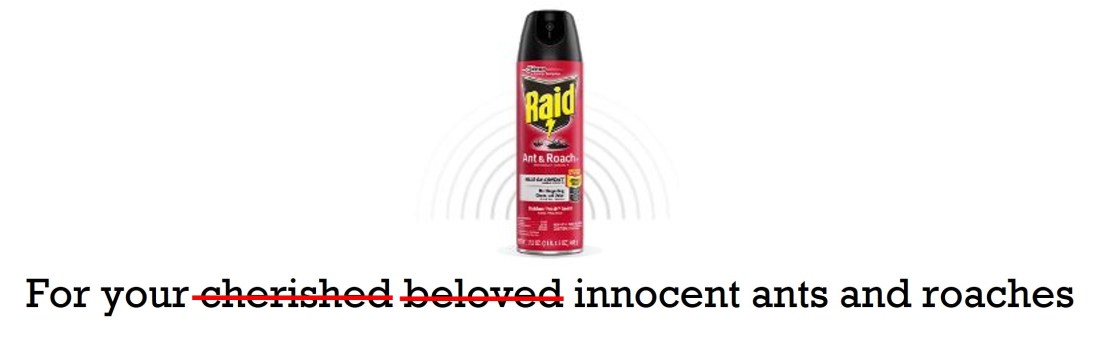
For Your Innocent Ants and Roaches 10-23-22

Foal-Free Friday, Anathema to the Advocates Edition

The Virginia Range advocates rely on predators to take out any foals that slip through their safe, proven and reversible darting program.

Could that be the case at the Salt River?

The release of this video will likely be met with resentment in darting circles and may prompt a root cause investigation to understand how the travesty occurred and to identify corrective actions.

One of the most astonishing developments in the wild horse world is the zeal of the advocates to get rid of wild horses.

In the old days they would walk away.

Today, they are full-fledged participants in the destruction.

RELATED: Foal-Free Friday, Brainwashing the Youngsters Edition.