Join the ranching lovefest, starting at 0800 Pacific time.

RELATED: WHBAB Meeting Materials Omit Key Data.

Western Horse Watchers Association
Exposing the Hypocrisy, Lies and Incompetence of the Wild Horse Advocates
Join the ranching lovefest, starting at 0800 Pacific time.
RELATED: WHBAB Meeting Materials Omit Key Data.
Stop giving them what they deserve!
The title of this news release by IDA speaks volumes about the advocate mindset.
Your contact is Ginger Fedak, a trained PZP darter and author of the recent op-ed about horses and livestock in CounterPunch.
Mercy has no place in the wild horse debate, not when your enemies want you wiped off the map. Defeat comes first.
The incident began on September 12. Results through October 3:
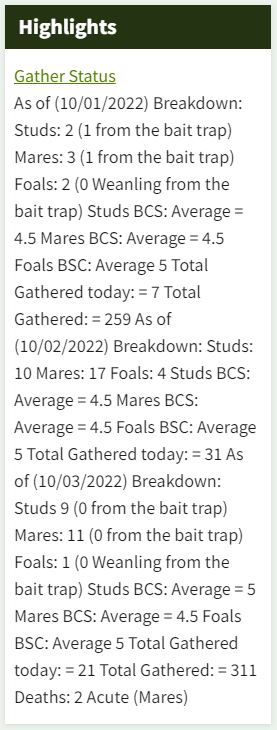
Body condition scores indicate more horses than allowed by plan, not more horses than the land can support. If the horses were starving the scores would be lower.
More information may be available in the land of make-believe on socialist media.
The government collects $21,210 per year in grazing fees from ranching activity inside the WHT while it spends $2,388,925 per year to care for the horses displaced thereby.
Would you say that permitted grazing is a wise use of the public lands?
All of this could be avoided—foals, adults, all of them—with patience and an aggressive darting program.
RELATED: Devil’s Garden Roundup, Day 15, Managing for Livestock Edition.
They were stolen from Spanish colonizers and in the attempt to recover them, some were lost in the fray near today’s Nevada-Utah border, according to a report by KZMU Community Radio of Moab, UT.
The BLM thinned the herd by roughly 60% earlier this year, not to protect rangeland health as indicated in the article, but to protect the public-lands ranchers.
Not mentioned in the story:
RELATED: Lots to Celebrate at Sulphur HMA, If You’re an Advocate.
A pledge from the National Mustang Association increased the payout from $10,000 to $20,000.
It’s not clear from the BLM news release if it’s the group in Colorado, Utah or somewhere else.
The advocates in Colorado are helping NPS remove wild horses from Mesa Verde National Park.
Those in Utah run cattle on a BLM grazing allotment that overlaps the Tilly Creek and Bible Spring HMAs.
The IRS Form 990 suggests it’s the group in Utah.
None of the reports show the forage assigned to livestock inside the HAs and HMAs.
The HA/HMA Report provides acreage, AMLs and current populations, but does not tell the American people how the resources in those areas have been allocated.
Western Horse Watchers believes those numbers would show that HAs are managed principally for livestock, while most of the HMAs, a subset of the HAs, are managed primarily for livestock.
If you neglect wildlife, the HAs—the lawful home of wild horses and burros—would be managed exclusively for livestock.
The report should include (1) the AUMs assigned to horses/burros and livestock, (2) percentages of forage assigned to horses/burros and livestock, (3) horses/burros displaced from each area by permitted grazing, (4) the costs of holding those animals in off-range corrals compared to the fees paid by ranchers occupying those areas, and (5) the True AMLs, to be achieved by confining the ranchers to their base properties.
Don’t look to the advocates for leadership in this regard. They’re down with the ranching agenda, indicated by their near-unanimous support of the Montana Solution.
The meeting starts tomorrow.
The Board is dominated by ranchers and ranching sympathizers.
The wild horse and burro program has been a drag on the grazing program for 50 years.
RELATED: WHBAB Meeting Materials Out for Review.

On the Navajo Nation with Ron Toahani Jackson.
The incident began on August 19. Progress has been slow and burros have been shipped the same day they are trapped.
As of September 30, 19 animals have been captured and 19 have been shipped, according to reports at the gather page.
The total includes eleven jacks, six jennies and two foals.
Youngsters represented 10.5% of the animals gathered.
Of the adults, 64.7% were male and 35.3% were female.
The HA, no longer managed for burros, lies mostly within the Lazy Daisy Allotment.
The trap may be located near Fenner Spring, west of the HA, the only water source for the burros.
The capture and removal goals are 60 each.
To date, there are no unaccounted-for animals.
RELATED: Piute Roundup in Progress.

Suppose you wanted to provide your readers with a list of posts involving the Montana Solution, referred to by the advocates as a better way (to get rid of wild horses).
The search term(s) should be added after “?s=” in the link. For example,
https://westernhorsewatchers.com/?s=montana+solution
Multiple terms should be joined with plus signs.
https://westernhorsewatchers.com/?s=cherished+wild+horses
Acronyms also work:
https://westernhorsewatchers.com/?s=aum
Results may include posts involving AUMs.
Western Horse Watchers has no control over the format and order of the results.
The Western Horse Watchers QR code can be found here.
The incident concluded yesterday, according to a statement at the gather page, with 863 horses captured, 837 shipped, none released and 26 dead.
The capture goal was 1,076 and the removal goal was 1,036.
There were no unaccounted-for animals.
Data quality was good.
The death rate was 3.0%.
The capture total included 330 stallions, 400 mares and 133 foals.
Youngsters represented 15.4% of the animals gathered, consistent with a herd growth rate of 10% per year.
Of the adults, 45.2% were male and 54.8% were female, within the expected range of variation of a random process centered at 50% males / 50% females.
The plan was to treat up to 40 mares with fertility control and return them to the Complex but the release may occur at a later date.
Captured animals were taken to the off-range corrals in Fallon, NV.
The Complex is subject to permitted grazing but the forage assigned to livestock inside the five HMAs and the number of horses displaced thereby are not known.
The latest schedule still shows capture and removal goals of 1,556 and 1,445.
RELATED: Calico Roundup Announced.
UPDATE: The BLM news release said approximately 40 mares will be treated with fertility control and be released back to the Complex at a later date.
How many members of the Wild Horse and Burro Advisory Board are ranchers or ranching sympathizers? Refer to the member biographies for clues.
Western Horse Watchers offers the following assessment:
Classifications are subject to change after viewing the October meeting.
BONUS QUESTION: How many members are shills for the drillers and miners?
RELATED: WHBAB Meeting Announced.
This profile doesn’t correlate everything but it does explain their stubborn adherence to error.
They cover up, Western Horse Watchers shines the light.
RELATED: Rorschach Test for Advocates.
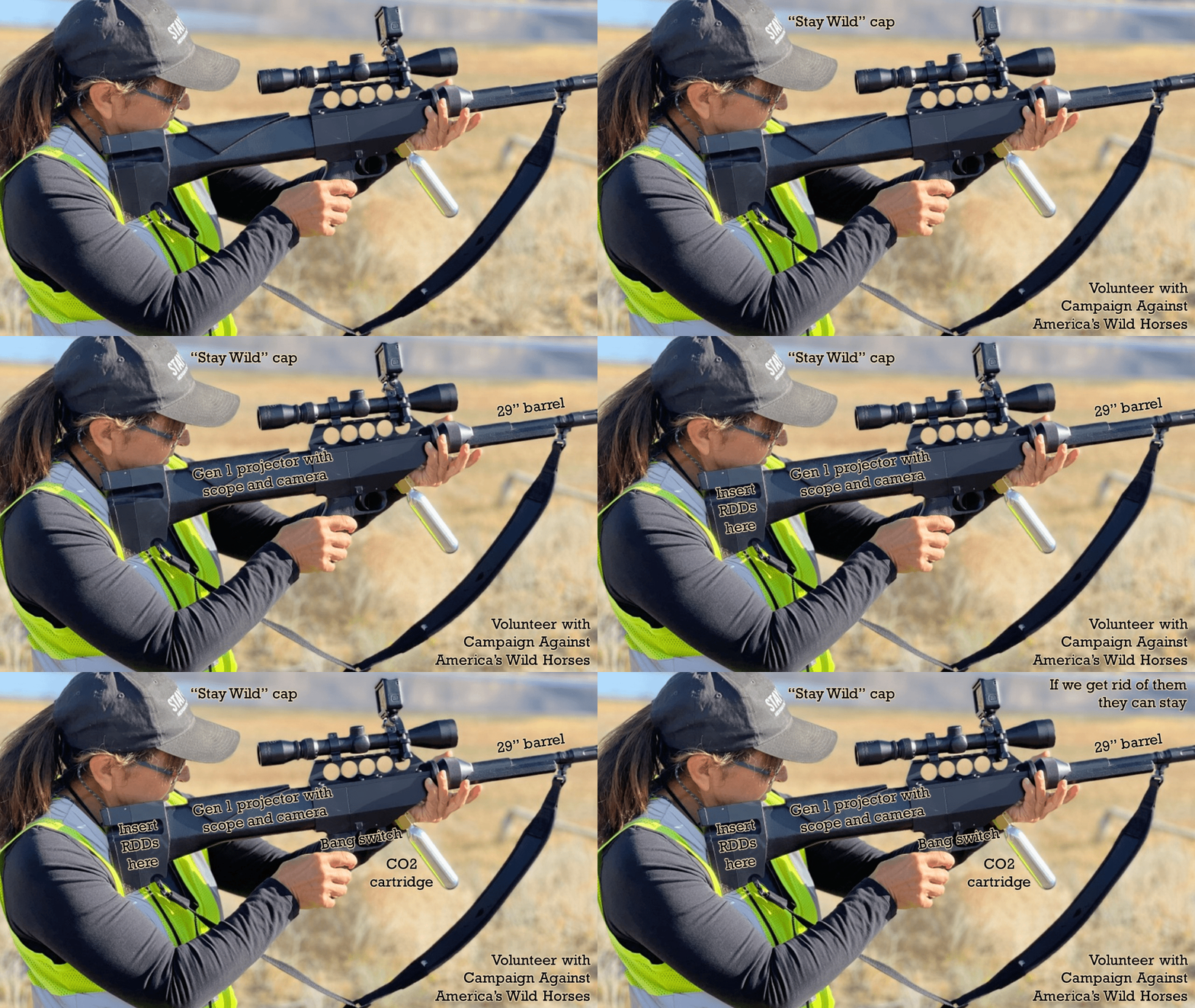
The incident began on September 10. Gather stats through September 30:
The figures above are based on the daily reports, not the totals posted by the BLM.
Gather ops concluded on Day 21.
A mare was put down on Day 20 due to a pre-existing injury.
The death rate is 3.0%.
The capture total includes 330 stallions, 400 mares and 133 foals.
Youngsters represented 15.4% of the animals gathered.
Of the adults, 45.2% were male and 54.8% were female.
The herd can’t be growing at a rate of 20% per year with a birth rate of 15% per year.
Body condition scores were not provided.
The location of the trap was not disclosed.
The HMAs and surrounding lands are subject to permitted grazing.

Day 21 ended with 61 unaccounted-for animals.
Mares treated with fertility control may be returned to the area at a later date.
Other statistics:
The pre-gather population exceeded the AML but not necessarily the number of horses the land can support.
RELATED: Calico Roundup, Day 19.

 Western Horse Watchers Association