So Long, Helicopter Ban?

The bill was was prompted by film from the Pancake roundup showing a foal running on a broken leg and now film from the Buffalo Hills roundup showing a foal being thrown to the ground may kill it.

It was a stupid idea anyway.

The video owner said today in an interview with KLAS News of Las Vegas that imagery of a wrangler body slamming a foal will hopefully boost public support for the ban, after which the removals would be carried out by wranglers!

Are these people nuts or what?

The Advocates Have No Scruples

Consider these two scenarios for helicopter roundups of wild horses.

A. A foal was found dead on Day 1, cause unknown.  A mare was found dead on Day 2 because of a rattlesnake bite.  A stallion was put down on Day 3 due to a physical defect.

B. A foal was found dead on Day 1, cause unknown.  A mare was found dead on Day 2 because of a rattlesnake bite.  A stallion was put down on Day 3 due to a physical defect.

Which one is acceptable?

Both cases are based on the Buffalo Hills roundup.

The first one corresponds to a cruel and costly helicopter roundup that puts more horses in off-range holding.

The second one corresponds to a safe and efficient helicopter roundup that puts more horses into a catch-treat-release program.

Scenario B is better because it leads to greater use of the Montana Solution.

Next time there will be fewer horses to gather.

The Campaign Against America’s Wild Horses voiced support for catch-treat-release during the scoping period for the new Cedar Mountain pest control plan, which ran from February 4 to March 5, yet the solicitation for those services was not announced until May 10.

CAAWH Catch-Treat-Release Cedar Mountain Scoping Comments 07-05-22

Refer to comment #500236786 in Appendix G of the Draft EA.

How did they know about that?  Perhaps they were working with the bureaucrats behind the scenes to steer more business in their direction?  Equivalent to insider trading?

They seem to be more concerned about the welfare of livestock than horses.

Hard to believe, isn’t it?

RELATED: Helicopter Roundups Were Bad Before They Were Good.

Buffalo Hills Roundup Day 3

The incident began on July 1.  Gather stats through July 3:

  • Target: Horses
  • Type: Planned
  • Method: Helicopter
  • Captured: 156, up from 68 on Day 1
  • Average daily take: 52.0
  • Capture goal: 383
  • Removal goal: 353
  • Returned: None
  • Deaths: 3, up from 1 on Day 1
  • Shipped: 72, up from zero on Day 1

A foal was found dead on Day 1, cause unknown.  A mare was found dead on Day 2, rattlesnake bite.  A stallion was put down on Day 3, physical deformity.

The death rate is now 1.9%.

The cumulative total includes 51 stallions, 88 mares and 17 foals.

Youngsters represented 10.9% of the animals captured.  Of the adults, 36.7% were male and 63.3% were female.

The herd can’t be growing at a rate of 20% per year with a birth rate of 11% per year.

The abnormal sex ratio is often found in herds subject to the Montana Solution.

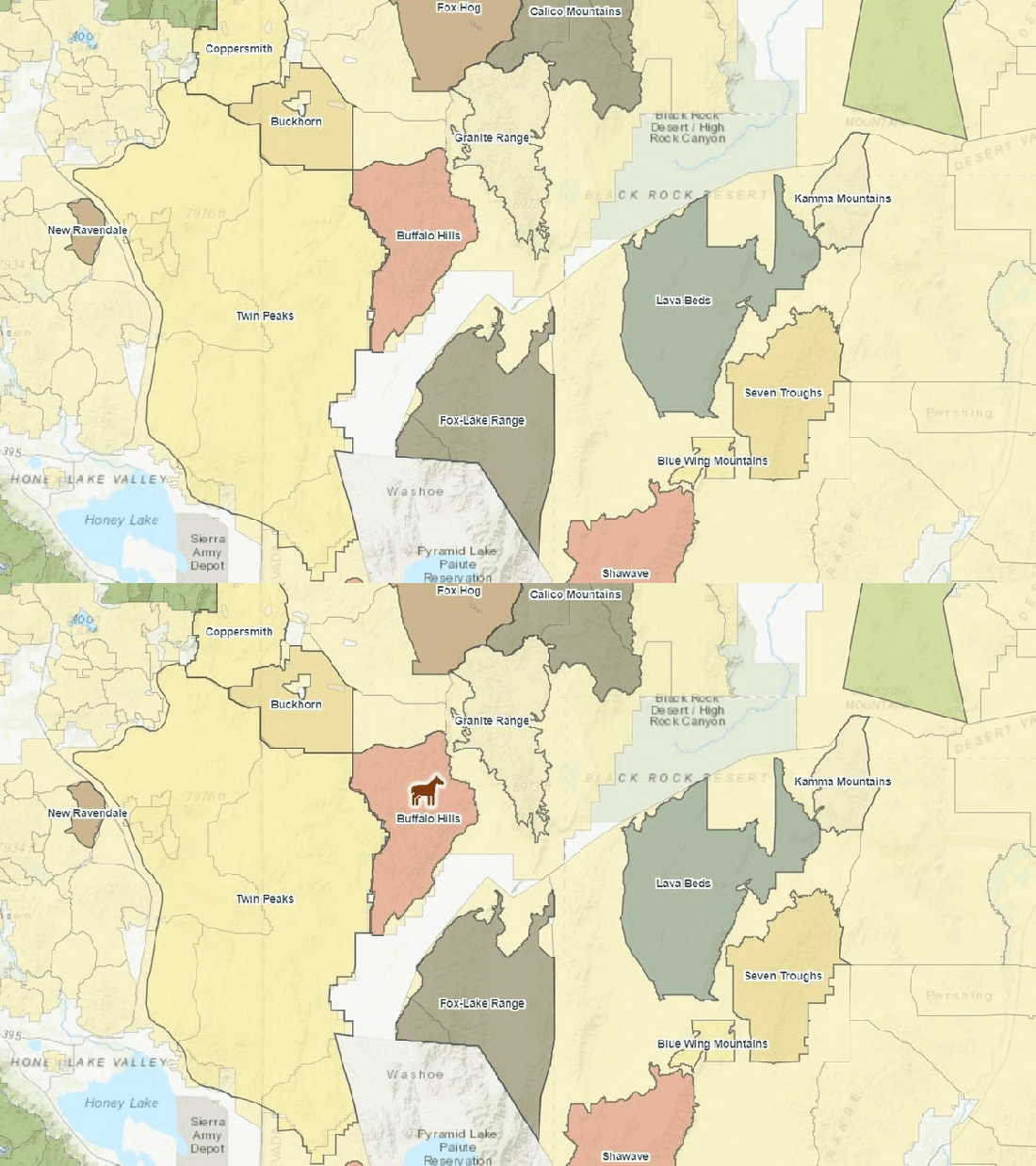
The location of the trap site within the HMA was not disclosed.

Buffalo Hills HMA Map 06-27-22

Day 3 ended with 81 unaccounted-for animals.

The removal goal is 44% complete.  Mares treated with fertility control will be returned to the area at a later date.

Other statistics:

  • AML: 314
  • Forage assigned to horses: 3,768 AUMs per year
  • Pre-gather population: 541
  • Forage liberated to date: 1,872 AUMs per year
  • Water liberated to date: 1,560 gallons per day
  • Forage assigned to livestock: 1,135 AUMs per year (estimated)
  • Horses displaced from HMA by permitted grazing: 94
  • True AML: 408
  • Stocking rate at new AML: 3.1 horses per thousand acres
  • Horses displaced from area by drilling and mining: Ask the advocates

RELATED: Buffalo Hills Roundup Begins.

ZD Cattle Permit Renewal Yields More Data on Forage Availability

The project, situated in the Grand Canyon-Parashant National Monument, would renew grazing permits for another ten years on the Link Spring and Last Chance allotments of northwestern Arizona.

There are no wild horses and burros on those pastures.

The Western Watersheds map shows the arrangement.

ZD Cattle Allotments 07-04-22

Table 2.1 in the Draft EA, currently out for public review, provides active AUMs and Table 3.3 provides acreage.  The Allotment Master Report provides management status.

Link Spring

  • 27,589 public acres
  • 1,094 active AUMs
  • Improve category
  • 39.7 AUMs per year per thousand acres forage production

Last Chance

  • 9,084 public acres
  • 609 active AUMs
  • Maintain category
  • 67.0 AUMs per year per thousand acre forage production

Both allotments are making progress toward meeting the Arizona BLM Standards for Rangeland Health, according to Section 1.1 of the EA, suggesting that substandard conditions exist, so how did Last Chance qualify for Maintain status?

The average forage production across both allotments is 46.4 AUMs per year per thousand acres, enough to support 3.9 wild horses per thousand acres.

The BLM has stated repeatedly, with the concurrence of the advocates, that public lands in the American west can only sustain one wild horse per thousand acres (27,000 animals on 27 million acres).

The latter figure corresponds to a shifting of resources from wild horses to privately owned livestock.

That’s what the bureaucrats, ranchers and advocates are trying to protect.

Piceance Roundup Enjoys Broad Support from Community?

As suspected, the voices in favor of the removal are those of the ranchers and advocates, as explained in a June 30 letter to the editor of the Rio Blanco Herald Times.

“The Makeover [chaired by the author, a public-lands rancher], along with the Piceance Mustangs volunteer work [the advocates], have shown the high level of community support our local White River office of the BLM have for their long awaited and much needed mustang gather.”

The writer went on camera a few weeks ago complaining about the horses and her grazing frustrations on two allotments near the HMA, identified in this map.

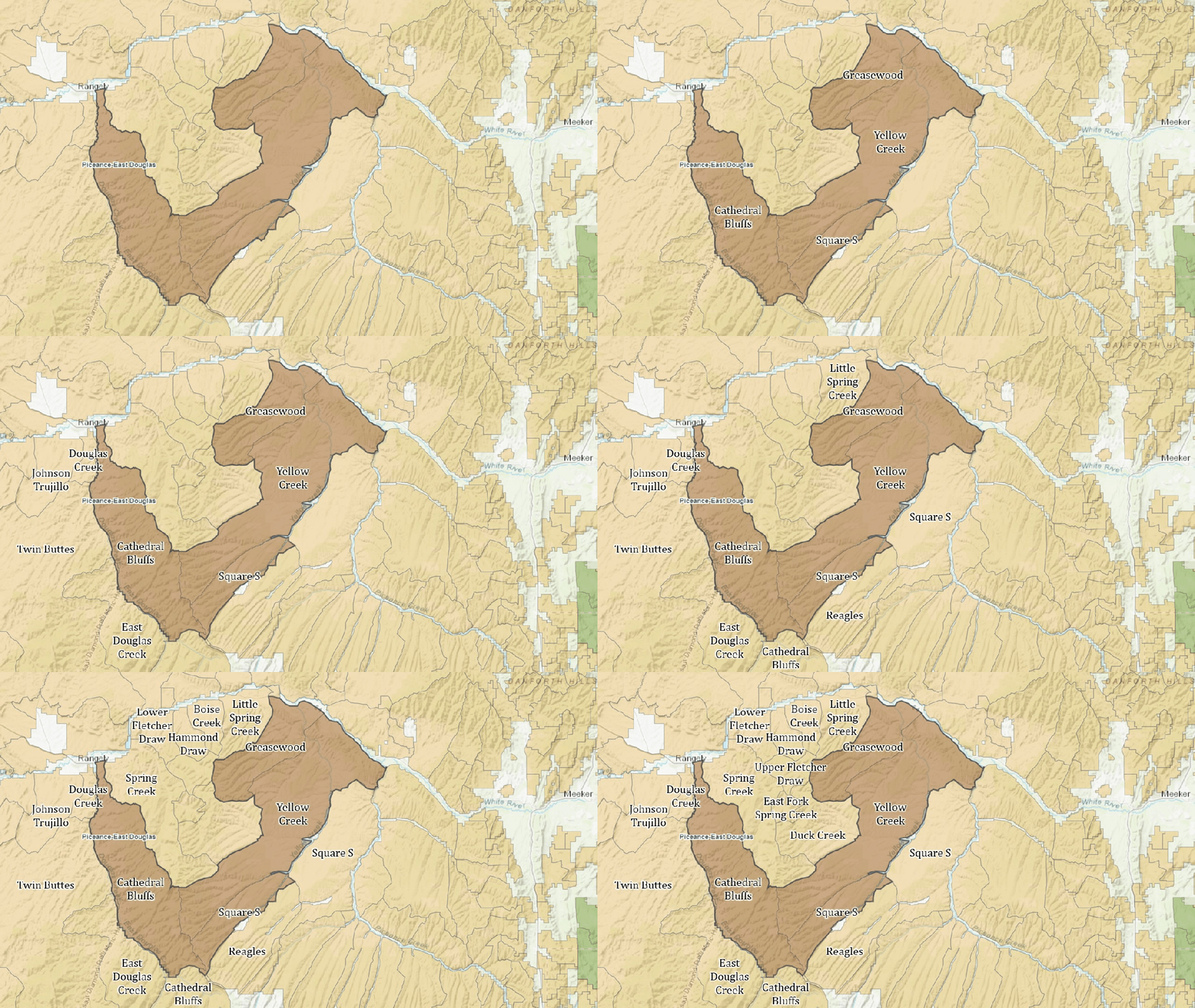
Piceance HMA - Macnab Allotments 06-23-22

The advocates went on record in favor of the roundup a few days later.

The letter was signed by Deirdre Macnab, Meeker Mustang Makeover, not Deirdre Macnab, 4M Ranch.

The BLM has not posted any information about the incident in the usual location, a nice example of the bureaucrats, ranchers and advocates working together for a horse-free future.

RELATED: PZP Fanatics Worried About Piceance Foals!

BLM Retiree Opines About Wild Horses and Baby Murder

The column, published by the Grand Junction Daily Sentinel, begins with a strange remark about overpopulation of wild horses and humans.

As for the horses, they are not native to North America [even though they appear in the fossil record] and have no natural predators [because they would also be interested in privately owned cattle and sheep].

As for the humans, if he thinks there are too many of them, why doesn’t he do anything about it?  Walk the talk.  Be a role model.  Stop breathing.  Save the planet.

Now that Roe has been overturned, “we’re going to grow a lot of people so mentally broken they can’t tell right from wrong.”

Too late, it’s been happening for 60 years.  We call them liberals.

The federal government is full of them.

While Kristi Noem’s wealthy buddies get their abortions on the quiet, his former employer protects his wealthy ranching buddies from the realities of a free market, while showering him with benefits that we in the private sector can only dream of.

Paine Livestock Secures Grazing Preference with State Land

The Rangeland Health Assessment and Evaluation Report for the permit renewal indicates in Section 4.2.1 that the base property tied to the four allotments covered by the project contains 40 acres owned by the state of Nevada.

One of the allotments overlaps a small part of the Wassuk HMA.

A base property is land that has the capability to produce crops or forage that can be used to support authorized livestock for a specified period of the year.

Table 1 in the report suggests that the permittee can access over 88,000 public acres yet during the off season his animals must retreat to just 40 acres?

Perhaps some are moved to rented pastures and others receive supplemental feed.

As for rangeland health, the allotments do not meet these standards according to Section 5.0 of the report, which includes numerous photos of as-found conditions:

  • Soils
  • Riparian and Wetlands
  • Plant and Animal Habitat
  • Special Status Species Habitat

The allotments meet this standard:

  • Water Quality

If permitted grazing is good for the land why are the allotments is such poor condition?

According to Section 5.2.3, bottom of page 94 in the report, wild horses contribute to spring and stream degradation but they typically do not congregate for an extended period of time like cattle.  Wild horses tend to approach a water source to drink then return to the uplands to graze, therefore the time and frequency of damage riparian-wetland areas is generally less than that of livestock at some sites.

That is the usual pattern on the Virginia Range, seen in these trailcam photos.

What’s unusual?  No foals, thanks to the Campaign Against America’s Wild Horses, a leader in the wild horse removal business and defender of the public-lands ranchers.


VR Mustangs Come In for a Drink 05-21-22

Price of Hay Hits New Record

A bale of alfalfa-grass mix was $36 today, 20 bales minimum, up from $30 per bale on June 4, a 20% increase in just four weeks.  The single-bale price was $37.

The price was $19 per bale a year ago.

The average horse would need five bales per month, which works out to $180 per AUM.

The $1,000 adoption incentive would keep your mustang fed for five to six months.

The price of forage to the public-lands ranchers has not changed in the past year, $1.35 per AUM.

Better to cram more wild horses into the feedlots and stick the taxpayers with the bill.

RELATED: Hay Available But Unaffordable.

Square S Grazing Permit Up for Renewal

The Allotment Master Report puts it in the Improve category, with two authorizations attached, both to the same permittee.

The project addresses permit #0500682.

The allotment meets the following standard for rangeland health, according to a BLM report dated March 21:

  • Water Quality

The allotment does not meet these standards:

  • Soils
  • Riparian Systems
  • Healthy Plant and Animal Communities

The report does not indicate if this standard has been achieved:

  • Special Status, T&E Species

If permitted grazing is good for the land because of pasture rotation, rest periods and carefully chosen grazing seasons, why is the allotment in such poor condition?

The answer is obvious: It overlaps the Piceance HMA.

RELATED: Piceance Roundup Prompted by Public Comments?

Piceance Allotments 06-14-22

House Committee Allocates $11 Million for Montana Solution

The Committee on Appropriations designated the amount in the FY 2023 spending bill for Interior, Environment and Related Agencies, according to a report posted this morning by the Wyoming Tribune Eagle.

The move was applauded by the Campaign Against America’s Wild Horses, a ranching advocacy group and leader in the wild horse removal industry.

A compilation of the effects of PZP on wild horses, assembled in 2015, appears in a report prepared by ISPMB, beginning on page 30.

The principle of operation touted by the advocates is not correct.  The pesticide tells the immune system to attack the ovaries.

This explains why mares become sterile after five years of treatment: Their ovaries have been destroyed, or nearly so.  The advocates refer to these animals as “self boosting.”

Back to Business as Usual at Cañon City

Today’s sitrep will be the last, according to the update at the Colorado HMA page.

The mortality table excludes the June 23 death of a West Douglas mare, bringing the total back to 145, although the page still says 146.

A West Douglas mare was found dead on or after June 25 due to an intestinal twist.

A horse was put down on June 27 due to poor body condition.

Another was found dead on June 30 because of colic.

The losses will probably continue, but like the situation at Piceance, you’re not going to hear about them.

RELATED: Cañon City Incident, Day 63.

Burning Man Returns to Black Rock Desert

The BLM announced temporary closures and restrictions yesterday on public lands near the site of the festival, which runs from August 28 to September 5.

The area, about ten miles northeast of Gerlach, NV, is surrounded by HMAs and grazing allotments.  The Western Watersheds map shows the arrangement.

Curiously, roundups are set for Twin Peaks and Blue Wing at that time, according to the latest schedule.  Buffalo Hills starts today.

Black Rock Desert Map 07-01-22

Foal-Free Friday, Exposing the Lies of the Advocates

As stated in April, Western Horse Watchers believes the Campaign Against America’s Wild Horses has been underreporting (lying about) the effects of their darting program on the Virginia Range mustangs.

The graphic included with the post indicated a 42% reduction in the foaling rate.

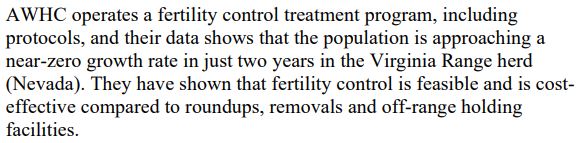
However, a few weeks earlier, during the scoping period for the new Cedar Mountain resource enforcement plan, this leader in the wild horse removal industry told the BLM that herd was approaching a near-zero growth rate.

CAAWH Comments Cedar Mountain Scoping 06-30-22

This means that that foaling rate has been cut by 75% or more, corroborated by trailcam images over the past year, bringing the birth rate in line with the death rate.

Comments from the scoping period can be found in Appendix G of the Draft EA.

The appendix could be subtitled “Frauds on Parade,” given the number of comments supporting the Montana Solution and catch-treat-release.

The advocates are always eager to get rid of wild horses in favor of privately owned livestock, and to do whatever else is necessary to win the approval of their idols, the bureaucrats and ranchers.

They are fools.  Don’t give them a penny.

RELATED: Foal-Free Friday, No Major Side Effects Edition.

VR Mustangs 06-19-22