At the Salt River with THE TRACK ENTHUSIAST.
Sun J and Cattoor, move over! The advocates want a larger share of the wild horse removal business.
RELATED: Foal-Free Friday, Saving Wild Horses by Getting Rid of Them.

Western Horse Watchers Association
Exposing the Hypocrisy, Lies and Incompetence of the Wild Horse Advocates
At the Salt River with THE TRACK ENTHUSIAST.
Sun J and Cattoor, move over! The advocates want a larger share of the wild horse removal business.
RELATED: Foal-Free Friday, Saving Wild Horses by Getting Rid of Them.
The defendant pleaded guilty today to two counts of conspiracy to commit arson and one count of arson, twenty plus years after he participated in a series of attacks that damaged or destroyed environmental targets in Oregon and California.
One of the incidents occurred at the Cavel West meatpacking plant in Redmond, Oregon, where wild horses were slaughtered according to a report by The Oregonian, and another was at the BLM wild horse corrals near Litchfield, California.
RELATED: Litchfield Arsonist to Accept Plea Deal.
Even now, three years after the Nevada Department of Agriculture allowed the PZP fanatics to resume their eradication of the herd, the Virginia Range contradicts the government narrative about the carrying capacity of western rangelands.
“There is attrition in the range and the foal numbers are down, and so we see a reduction in population,” an advocate told a reporter for Courthouse News in the article last August.
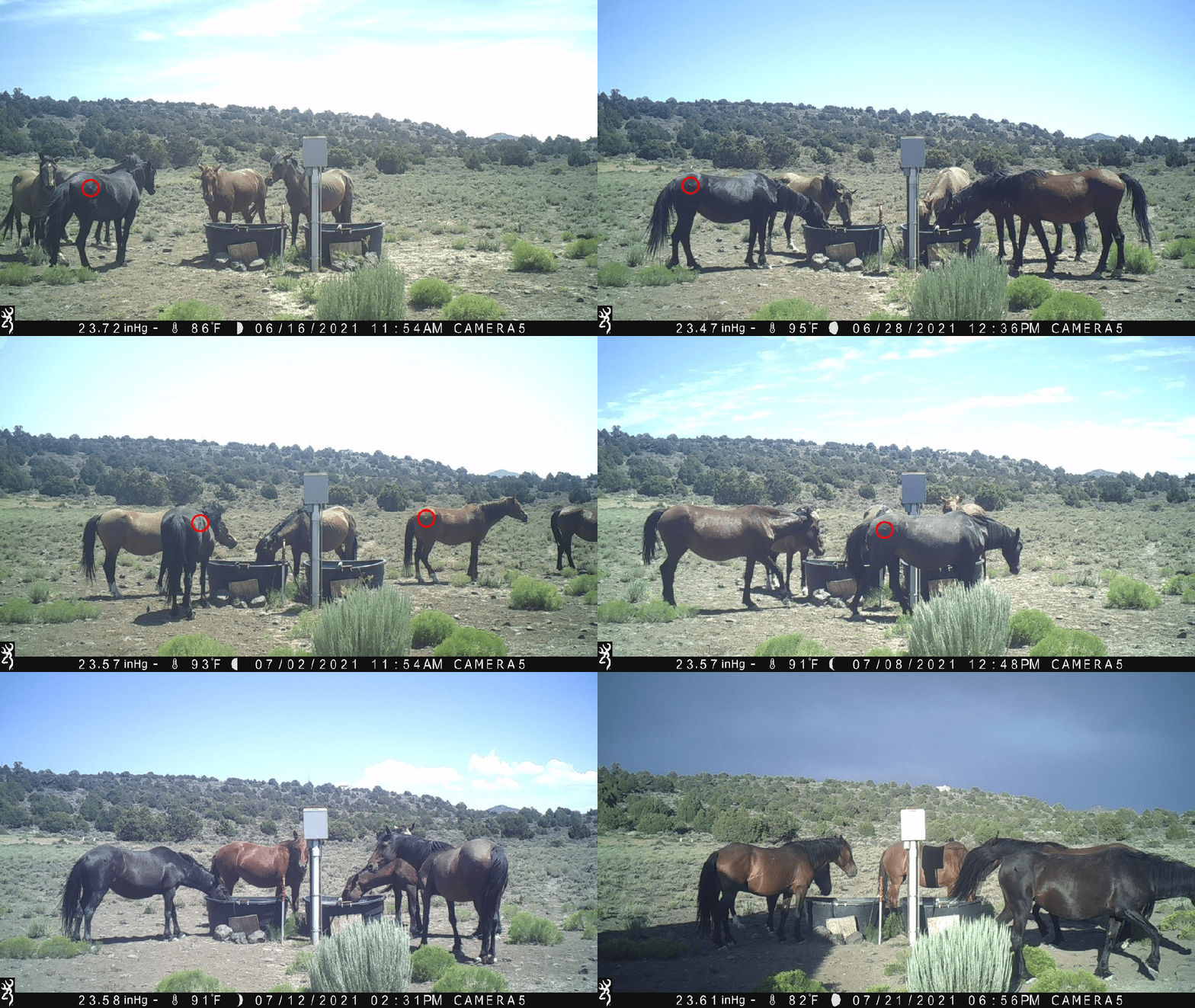
Indeed, trailcams installed by Western Horse Watchers only detected one foal in 2021, not seen in subsequent images and probably lost to predators.
Before the advocates got involved, the Virginia was supporting ten wild horses per thousand acres, maybe a bit more, compared to one wild horse per thousand acres on public lands managed by the BLM (27,000 animals on 27 million acres).
The total number of animals allowed by plan includes burros, so if you corrected for that the target rate would be less than one wild horse per thousand acres.
But the bureaucrats at NDA, an agency staffed by ranchers and ranching sympathizers, among others, claim that the Virginia Range can only support 600 wild horses and ideally no more than 300. The latter figure works out to—wait for it—one wild horse per thousand acres, in line with the BLM narrative!
So the bureaucrats are coordinating their efforts to deceive the public, with the full cooperation of the advocates.
If they achieve their goals on the Virginia Range, “they will provide a valuable template that can be reliably exported to other management areas throughout the American West,” as stated in the article.
RELATED: Move Over Cattoor, Advocates Want Larger Share of Market.
Minden resident Craig Downer, Dr. Don Molde and wild horse rescuer Elaina Deva Proffitt are expected to speak. Singer Jim Eaglesmith will perform and actress Fia Perera will serve as MC, according to a story posted today by The Record-Courier.
The event is set for Saturday in front of the state capitol, part of the Wild Horse Freedom Rally planned for all 50 states.
The article last August by Courthouse News said the Nevada Department of Agriculture had contracted with Wild Horse Connection to implement the fertility control program on the Virginia Range, an area where 3,000 or so horses wander over a triangle-sized piece of desolate land that extends from Reno to Fernley in the east and to Carson City in the south.
A keyword search of their site for “PZP” yielded no results.

Additional searches for “fertility,” “dart” and “vaccine” produced no matches, while a search for “horse” yielded 21 hits.
Are they ashamed of what they’re doing to the horses? Probably not. But they know donations will dry up if the truth gets out.
Their home page features a mare and foal—exactly what they’re trying to prevent—and their projects page includes several photos of a cattle guard that can trap wild horses, as seen recently at the Salt River.
Like the Salt River Wild Horse Darting Group, WHC is a surrogate of the Campaign Against America’s Wild Horses.
RELATED: Advocates Have Answer to Wild Horse Problem?

The BLM issued that reminder this week after the equids approached cars at Discovery Park in Pahrump, NV, according to a story by KTNV News of Las Vegas.
You are to view wild horses from a significant distance and you shall not feed them, unless you are a trained PZP darter and acolyte for the Department of Agriculture.

This news release on EIN, titled “Supporters of Wild Horses to Gather Next Week in Washington D.C.,” has been out for over a day, but a Google search for “Wild Horses” over the past 24 hours yielded no articles with that tagline.
RELATED: National ‘Save Our Wild Horses’ Conference Debuts in April.
This article in the Daily Camera of Boulder, CO refers to the anti-horse bias at the BLM, which dates back to its predecessor, the Grazing Service.
But it’s not just horses. Anything that interferes with public-lands ranching is targeted.
Examples include wildlife, invasive weeds and trees that crowd out forage.
The article includes a post-roundup photo of Sand Wash Basin showing hundreds, if not thousands, of sheep dotting the landscape.
But it does not mention the BLM’s partners in the management process, who protect the ranchers after the fact with the Montana Solution.
In the case of Sand Wash Basin, it’s SWAT, a group that helps the agency enforce the RMP that assigns 79% of the available forage to livestock while guaranteeing that the 1,402 horses displaced from the HMA by permitted grazing never come back.
Good job guys, a fine example of the Love Triangle on America’s public lands.
At or near the Heber WHT with Paul Kiely.
The HMA lies mostly within the Sands Basin Allotment according to the Western Watersheds map.
The 64 horses allowed by plan require 768 AUMs per year and the HMA covers 11,724 acres, so the aimed-at stocking rate is 5.5 wild horses per thousand acres, considerably higher than the target rate across all HMAs of one wild horse per thousand acres.
The land must be able to produce at least 65.5 AUMs per year per thousand acres to support the Sands Basin horses.

The allotment, in the Improve category, covers 13,565 total acres, including 10,883 public acres, and currently offers 558 AUMs per year for livestock, according to the Allotment Master Report.
This means the horses receive more forage than the ranchers!
The percentage of the allotment occupied by the HMA is unknown and the Draft EA may be months away but the forage assigned to livestock inside the HMA has to be less than or equal to 558 AUMs per year.
The allotment must be able to produce at least 41.1 AUMs per year per thousand acres to satisfy the ranchers, enough to support 3.4 wild horses per thousand acres.
The carrying capacity of the HMA, neglecting wildlife, would be 5.5 + 3.4 = 8.9 horses per thousand acres, assuming that forage is evenly distributed across the allotment.
The True AML would be 8.9 × 11,724 ÷ 1,000 = 104, the number of horses the HMA could support if it was managed principally for them.
The horses displaced from the HMA by permitted grazing would be the difference between the True AML and current AML, 104 – 64 = 40, or 3.4 × 11,724 ÷ 1,000.
The current size of the herd is unknown.
RELATED: New Resource Enforcement Plan Coming to Owyhee Mountains?
Horses being horses. No foals, might be a bachelor band? Or maybe the Montana Solution was a bit more effective than advertised?
Census results for 2022 still not known.
Film by Jim Wagner.
Like other HMAs, their AMLs are small relative to the available resources because most of them have been assigned to privately owned livestock.
This is a condition that the PZP fanatics won’t even acknowledge, let alone challenge.
Their mission is to protect the ranchers, not the horses, which is why you shouldn’t be giving them money.
Would Herd Management Area Plans (HMAPs) help?
The BLM allocated forage for livestock in the 2002 Record of Decision for the Southeastern Oregon Resource Management Plan, which was carried forward from the 1984 Southern Malheur Rangeland Program Summary, according to Section 3.2.2 of the Draft EA for resource enforcement actions in the HMAs.
If the HMAPs did not alter the specifications of the RMP, they could only ratify and reinforce current practices, which are biased in favor of the ranchers.
RELATED: How Many Wild Horses Can Jackies Butte HMA Support?

There is no column in the current edition of Horse Tales by the real estate agent and PZP darter in the Minden/Gardnerville area but there is an acknowledgement by the Campaign Against America’s Wild Horses at the bottom of page 18 about the outpouring of support for their work.
Their goal is to convince the bureaucrats that PZP darting is a viable alternative to helicopter roundups and that there is better way of enforcing the lopsided resource allocations that put ranching interests far above those of the horses.
The following video by the Arizona Game and Fish Department discusses the use of habitat enhancement funds on the Heber Allotment, which overlaps the WHT.
The Western Watersheds map shows the arrangement.

The ranchers also benefit from mining operations, in a way you might not expect, as noted at 1:49.
As for the horses, they weren’t considered in the analysis.
The forage assigned to livestock in the allotment is not known and Western Horse Watchers has not yet discovered an equivalent to RAS for the Forest Service.
Forage density (AUMs per year per thousand acres), is a better indicator of carrying capacity than AMLs.
The story begins at 0:52. The advocates get involved at 3:15.
Why is there a cattle guard in an area frequented by wild horses and why would they offer assistance to an animal they’re trying to eradicate?
The woman on the ground at 4:17 might be wearing a “Stay Wild” cap, a signal to others that she’s down with the Montana Solution.
RELATED: Salt River Stallion Freed from Cattle Guard.
The advocates are devastated, or so they say, according to a post on socialist media.
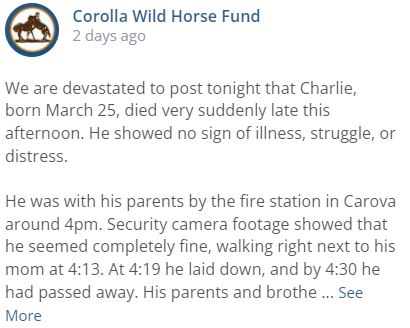
If you’re a purveyor of the Montana Solution, are you really annoyed by the loss of a wild horse?
The death of Charlie, first foal of 2022, is the latest in a string of incidents in the area.
These are the headlines from the past year!
All of this while the advocates bill themselves as “The Official & Only Non-Profit Protectors of the Wild Horses.”
A new project was created in ePlanning yesterday but only a map was posted.
The scope includes the Sands Basin, Hardtrigger and Black Mountain HMAs in western Idaho, with AMLs of 64, 130 and 60, respectively.
All three are subject to permitted grazing, as shown in the Western Watersheds map.
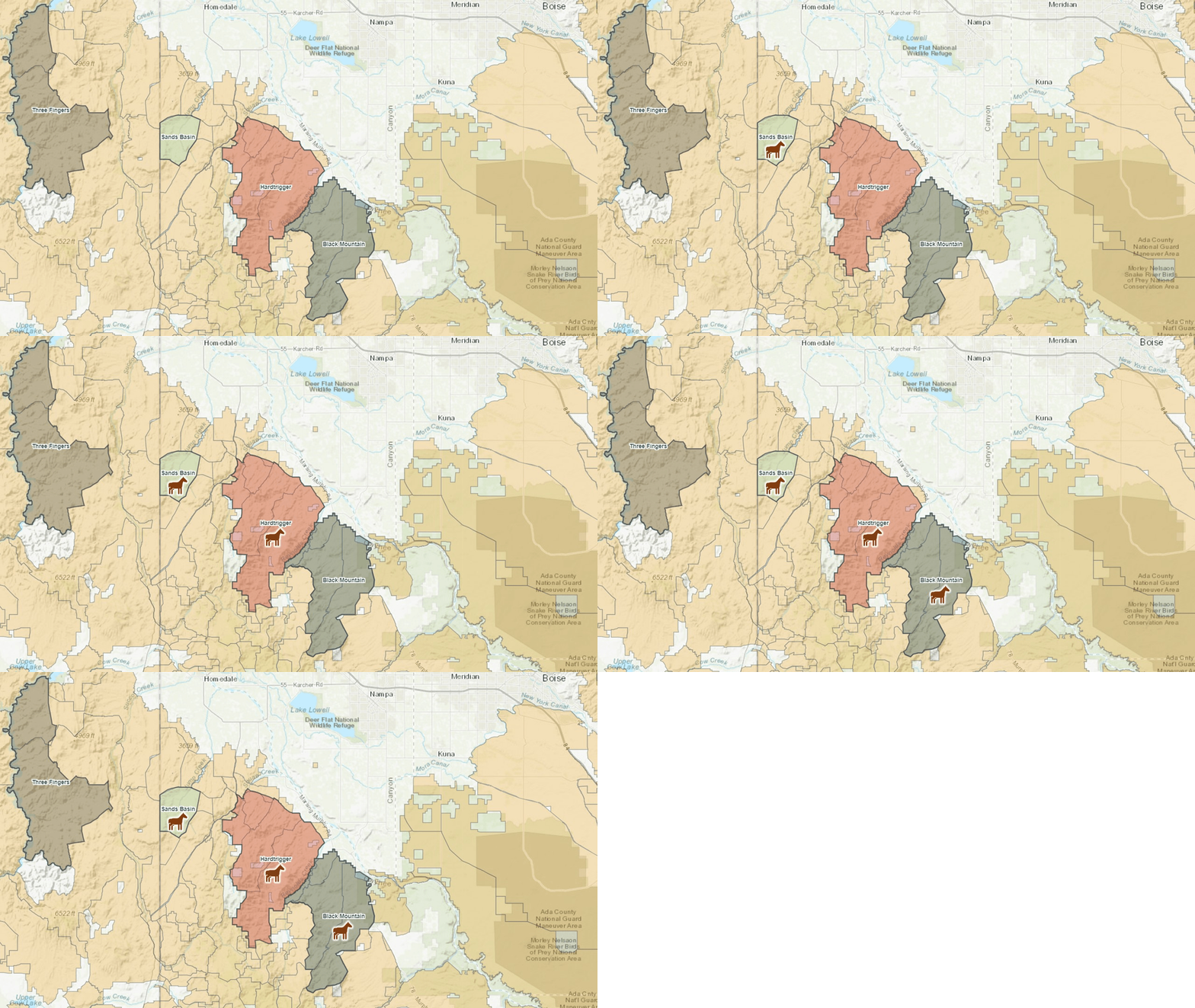
The Proposed Action will likely employ aerial roundups and other forms of population suppression to assure that most of the forage goes to privately owned livestock, as specified in the land-use plan(s).
Many of the horses in the area were removed after the 2015 Soda Fire but some were returned four years later.
He was seen with his parents by the Carova fire station around 4 PM yesterday, according to a story by The Virginian-Pilot, and was gone 30 minutes later.
Necropsy results are pending.
The report did not indicate if his mom had been treated with PZP before she was allowed to conceive and if so for how long.
RELATED: Currituck Herd Grows by One.
The 150 horses allowed by plan require 1,800 AUMs per year.
The the number of wild horses the HMA can support, if it was managed principally for them as specified in the original statute, referred to on these pages as the True AML, can be found as outlined in this post.
The idea is to shift the forage assigned to livestock back to the horses, which is heresy to the bureaucrats, ranchers and PZP fanatics.
Section 3.2.2 of the Draft EA for resource enforcement actions in Three Fingers and Jackies Butte identifies one grazing allotment that overlaps the HMA. The Western Watersheds map shows the arrangement. Click on image to open in new tab.
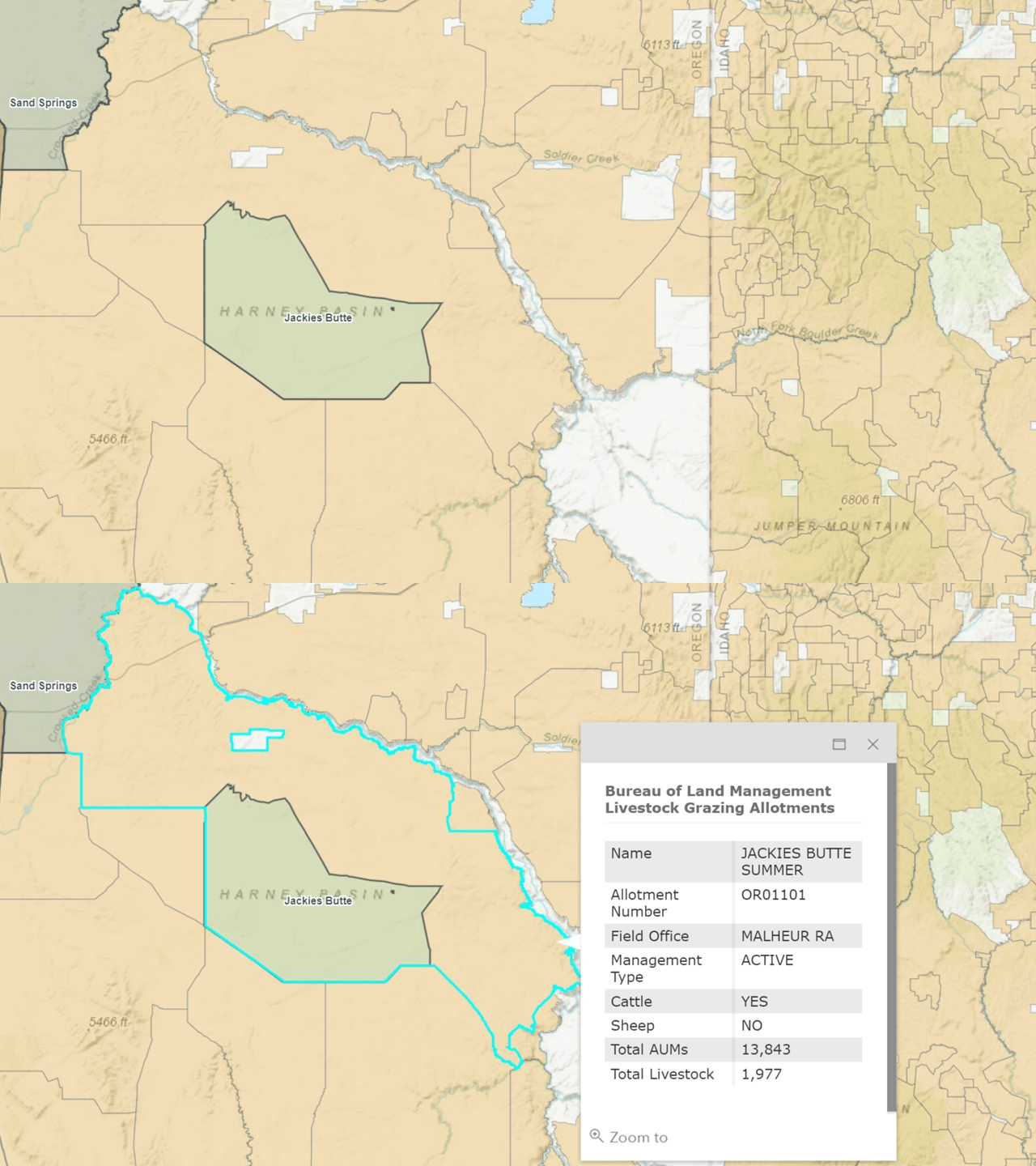
The Allotment Master Report provides the active AUMs.
Table 6 in the EA indicates that 28.5% of Jackies Butte Summer is inside the HMA.
The forage assigned to livestock inside the HMA is 3,947 AUMs per year, assuming the resource is evenly distributed across the allotment.

That amount would support 3,947 ÷ 12 = 328 wild horses.
The True AML is 150 + 328 = 478.
The current herd, thought to include over 200 adults according to Section 1.2 of the EA, is well within this range. The HMA is not overpopulated and there is no justification for a roundup or fertility control program, which the Proposed Action would implement over a ten-year period.
The stocking rate at the new AML, based on the acreage of Section 1.2, would be 478 ÷ 65,211 × 1,000 = 7.3 wild horses per thousand acres.
Given that the horses currently receive 31% of the authorized forage, neglecting wildlife, the HMA is managed primarily for livestock.
The 328 horses displaced from the HMA by permitted grazing represent about 0.6% of the 55,000 animals in off-range holding.
The number of horses displaced from the Three Fingers HMA was 423 and the True AML was 573, as discussed previously.
RELATED: Status of Three Fingers and Jackies Butte Allotments.
The nationwide event will occur on April 23, with gatherings at every state capital.
The venue for Nevada is Carson City, as explained in this announcement.
RELATED: Carson City Wild Horse Rally Part of Nationwide Protest.
 Western Horse Watchers Association