A BLM public affairs officer told Western Horse Watchers today that the trap is operational but has not been visited by any horses.
RELATED: Nuisance Roundup Announced for Carter Reservoir HMA.

Western Horse Watchers Association
Exposing the Hypocrisy, Lies and Incompetence of the Wild Horse Advocates
A BLM public affairs officer told Western Horse Watchers today that the trap is operational but has not been visited by any horses.
RELATED: Nuisance Roundup Announced for Carter Reservoir HMA.
The incident began on January 11. Gather stats through February 13:
Gather operations have concluded.
A stallion was put down on Day 34 and another died of a broken neck, lifting the death rate to 1.3%.
The cumulative total includes 853 stallions, 954 mares and 247 foals.
Youngsters represented 12.0% of the horses captured, consistent with a herd growth rate of seven percent per year, assuming a five percent death rate. A growth rate of 20% per year is often used by land managers to predict herd sizes.
Of the adults, 47.2% were stallions and 52.8% were mares.
Body condition scores were not reported.
The location of the trap site within the Complex was not provided.

Day 34 ended with 50 unaccounted-for animals. Some will be returned to the Complex and some will be shipped, with final results announced on Day 35.
The number of horses removed to date is 2,036.
Other statistics:
RELATED: Pancake Roundup Day 32.
Near Ehrenberg, AZ with Debs Creepy Abandoned Adventures and More.
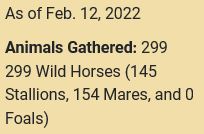
The gather page for Day 5 of the roundup indicates zero foals captured out of 299.
If the herd is growing at a rate of 20% per year, as claimed by the bureaucrats and ranchers, it should contain around 25% foals, allowing for a 5% death rate.
Is the observed percentage of foals sufficiently far from the expected percentage to indicate a problem or should it be written off to chance?
The question can only be answered by calculation, using basic statistical formulas.

The expected range of variation for a simple random process centered at p-bar = .25, with samples of n = 299, is .175 to .325. Every horse in the sample is a foal or it is not.
The observed percentage of foals is outside this range so the result cannot be attributed to chance.
An investigation should be able to link the observed value with one or more assignable causes, such as a fertility control program.
RELATED: Youngsters Hard to Find at Sulphur HMA.
The article can be accessed by subscribers only, but it does include an audio synopsis.
The Complex cannot be overpopulated with 3,244 wild horses, as stated in the story, when the BLM authorizes privately owned livestock equivalent to 3,612 wild horses in the same area, on top of the 638 horses allowed by plan.
The roundup enforces the resource allocations of the land-use plans, and may reduce the effects on the ranchers from a temporary change in the weather.
RELATED: Pancake Roundup Day 32.
The Sulphur HMA features everything they demand, yet it is a disaster for the horses.
RELATED: Lots to Celebrate at Sulphur HMA, If You’re an Advocate.
Here are some of the highlights:
The advocates are pleased with these results. The herd is well on its way to extinction, with benefits accruing to the public-lands ranchers.
This is what you’re supporting when you give them money.
RELATED: Youngsters Hard to Find at Sulphur HMA.
The incident began on February 8. Gather stats through February 12:
Four horses were put down on Day 4, followed by another on Day 5, lifting the death rate from 0.8% to 2.3%.
The cumulative total includes 145 stallions, 154 mares and no foals.
The absence of youngsters implies a negative growth rate. The herd is getting smaller, without the aid of helicopters, a result favored by the advocates. A growth rate of 20% per year is often used by land managers to predict herd sizes.
Of the adults, 48.5% were stallions and 51.5% were mares.
Body condition scores were not reported.
The location of the trap site within the HMA was not provided.

Day 5 ended with 108 unaccounted-for animals.
With an average daily take of 60, the capture goal should be achieved by Day 7.
The number of horses removed to date is 299. Horses returned to the HMA will be treated with population suppression of unspecified type.
Other statistics:
The HMA cannot be overpopulated with 600 wild horses, when the BLM authorizes privately owned livestock equivalent to 854 wild horses in the same area, on top of the 250 horses allowed by plan.
RELATED: Sulphur Roundup Day 3.
Last June, personnel at the Marine Corps Air Station Yuma asked the BLM to remove 30 to 40 wild burros from the western edge of the Chocolate Mountain Aerial Gunnery Range in Imperial County, California, according to a new project at ePlanning.
The range is between the Salton Sea and Chocolate Mule Mountains HMA.
The roundup would be carried out with bait traps and captured animals would be taken to the off-range corrals at Ridgecrest.

The project includes no supporting documents and it has not been announced at the BLM news site.
Opportunities for public involvement may be limited, given that the BLM is seeking approval under a categorical exclusion.
The incident began on January 11. Gather stats through February 11:
Three horses were put down on Day 30, followed by another on Day 31, boosting the death rate to 1.2%.
The cumulative total includes 822 stallions, 919 mares and 239 foals.
Youngsters represented 12.1% of the horses captured, consistent with a herd growth rate of seven percent per year, assuming a five percent death rate. A growth rate of 20% per year is often used by land managers to predict herd sizes.
Of the adults, 47.2% were stallions and 52.8% were mares.
Body condition scores were not reported.
The location of the trap site within the Complex was not provided.
Day 32 ended with 67 unaccounted-for animals.
With an average daily take of 62, the capture goal should be reached by Day 34.
The number of horses removed to date is 1,962. Mares returned to the Complex will be treated with fertility control of unspecified type.
Other statistics:
RELATED: Pancake Roundup Day 29.
Figures for Day 4 of the roundup show zero foals captured to date.

With no new blood hitting the ground, the herd will shrink without the aid of helicopters and the ranchers will be able to enjoy everything their allotments have to offer.
How much longer before the advocates point to the HMA as a paragon of wild horse management? It even has a herd management area plan (HMAP)!
RELATED: Sulphur Roundup Day 3.
So says Eric Thacker, range scientist and shill for the public-lands ranchers, in this Q&A by the Moab Sun News.
RELATED: Tammy Pearson Said We Have a Problem.
Yesterday’s meeting produced a variety of suggestions for reducing collisions with vehicles, according to a story by the Reno Gazette Journal.
Another meeting was scheduled for May 16, to review data and recommendations from speed studies in south Reno. The goal is to draft an action plan by the fall.
Not mentioned in the report is the clear and present danger of the advocates.
Every year they eradicate 600 to 750 wild horses with the Montana Solution, compared to a dozen or so killed by motorists. Why isn’t the city investigating them?
RELATED: City of Reno to Host Meeting on Virginia Range Mustangs.
A private donor has matched the original amount, according to today’s news release.
No activity reported at the gather page for the roundup announced in November.
RELATED: Challis Wild Horses Shot.
The incident began on February 8. Gather stats through February 10:
A colt died from a broken neck on Day 3. The death rate to 0.8%.
The cumulative total includes 115 stallions, 126 mares and no foals.
The absence of youngsters implies a negative growth rate. The herd is getting smaller, without the help of helicopters, a result that will please the advocates. A growth rate of 20% per year is often used by land managers to predict herd sizes.
Of the adults, 47.7% were stallions and 52.3% were mares.
Body condition scores were not reported.
The location of the trap site within the HMA was not provided.
Day 3 ended with 155 unaccounted-for animals.
With an average daily take of 80, the capture goal should be achieved in a few days.
The number of horses removed to date is 241. Horses returned to the HMA will be treated with population suppression of unspecified type.
Other statistics:
The HMA cannot be overpopulated with 600 wild horses, when the BLM authorizes privately owned livestock equivalent to 854 wild horses in the same area, on top of the 250 horses allowed by plan.
RELATED: Sulphur Roundup in Progress.
The contractor has captured 802 stallions, 880 mares and 217 foals as of February 9, according to figures at the gather page, with youngsters representing 11.4% of the total.

If the death rate is 5% per year, the birth rate would need to be around 25% per year to achieve a 20% growth rate, the amount commonly used by land managers to predict herd sizes.
The observed percentage of foals is not even close to 25%, so you might be tempted to say the herd is not growing at a rate of 20% per year, but technically it’s not correct.
You have to account for random variations in the sample results.
If you tossed a coin 100 times and found 42 heads, the result would be attributed to chance. It’s not far enough away from 50, the expected number of heads, to be an indication of anything.
You could get anywhere from 35 to 65 heads in the experiment. A result in that range provides no evidence that the process is not centered at 50% heads / 50% tails.
The expected range of variation for other cases can be computed from basic statistical formulas, where p-bar is the expected proportion and n is the sample size.
In the Pancake Complex, the hypothesized proportion (birth rate) is .25 and the sample size is 1,899. Every horse in the sample is a foal or it is not.
Is the observed proportion, .114, far enough away from .25 to cast doubt on the assumed birth rate?
The range of variation attributable to chance, using the formula above, is .220 to .280, with p-bar = .25 and n = 1,899.
The observed proportion is outside this range, meaning that it is sufficiently far enough away from .25 to suggest that the assumed birth rate is not correct, which means the herd is probably not growing at a rate of 20% per year.
If the herd was growing at a rate of 15% per year, you expect to find around 20% foals, assuming a 5% death rate.
The expected range of variation would be .172 to .228, with p-bar = .20 and n = 1,899.
The observed proportion of .114 is outside this range also, suggesting that a birth rate is of 20% per year is not valid, along with a herd growth rate of 15% per year.
What about a growth rate of 10% per year? The observed proportion is not consistent with that either!
A report posted yesterday by the Las Vegas Review-Journal says lawmakers want the BLM to replace helicopters with wranglers and spend more money on fertility control to manage (i.e., inhibit) population growth.
The proposal does not address the cause of roundups: Resource management plans that put ranching interests far above those of the horses.
It’s a stupid idea, prompted, at least in part, by the advocates.
If legislators want to help America’s wild horses, let them unwind all of the changes to the WHB Act and restore it to its original form.
RELATED: End Helicopter Roundups?
The incident began on January 11. Gather stats through February 8:
Three horses were put down on Day 27, followed by two more on Day 29, lifting the death rate to 1.1%.
Three stallions and 11 mares were returned on Day 27 to an undisclosed location.
The cumulative total includes 784 stallions, 865 mares and 211 foals.
Youngsters represented 11.3% of the horses captured, consistent with a herd growth rate of six to seven percent per year, assuming a five percent death rate. A growth rate of 20% per year is often used by land managers to predict herd sizes.
Of the adults, 47.5% were stallions and 52.5% were mares.
Body condition scores were not reported.
The location of the trap site within the Complex was not provided.
Day 29 ended with 90 unaccounted-for animals.
With an average daily take of 64, the capture goal should be achieved this week.
The number of horses removed to date is 1,842. Mares returned to the Complex will be treated with fertility control of unspecified type.
Other statistics:
RELATED: Pancake Roundup Day 26.
The incident started on February 8, according to the gather page, with 120 horses captured, none shipped and one dead.
Like Pancake, a youngster was put down on Day 1 due to a broken leg.
RELATED: Thriving Ecological Imbalance Coming to Sulphur HMA.
What will be offered as an alternate? Bait and water traps? The Montana Solution?
The original WHB Act was amended by Congress in 1976 to allow the use of motorized equipment, including helicopters, to capture and remove wild horses and burros from their designated habitats, which, in many cases, overlap livestock grazing allotments.
The authorizing paragraph appears in §1338a of the current statute.
RELATED: Save a Horse, Hire a Cowboy?
 Western Horse Watchers Association