How Many Wild Horses Can the Fox-Lake Range HMA Support?

The 204 horses allowed by plan require 2,448 AUMs per year.

Table 7 in the Final EA for resource enforcement actions in the Smoke Creek Complex identifies two allotments that intersect the HMA.  Pole Canyon is 100% inside, along with 90.3% of Rodeo Creek.  Click on image to open in new tab.

Fox-Lake Range Allotments 12-09-21

The Allotment Master report shows 540 AUMs per year available to livestock in Pole Canyon and 5,542 AUMs per year at Rodeo Creek.

The total estimated forage inside the HMA, assuming the resource is evenly distributed across the allotments, is 2,448 + 540 + .903 × 5,542 = 7,992 AUMs per year.  The actual amount may be a little higher due to an allowance for wildlife.

The number of wild horses the HMA can support, if it was managed principally for those animals as specified in the original statute, is 7,992 ÷ 12 = 666.  This is the True AML.

The number of wild horses displaced from the HMA by privately owned livestock is (540 + .903 × 5,542) ÷ 12 = 462, about 0.9% of those in off-range holding.

True AML = AML + Horses displaced

The advocates will tell you that the question is almost impossible to answer, but it’s not that difficult if you’re willing to dig through ePlanning and RAS for the relevant data.

RELATED: Fox-Lake Range Allotment Status.

Countdown to 50 | 4 Days to Go

The addition of AMLs to the original Act put an end to the idea that areas identified for wild horses and burros would be devoted principally but not necessarily exclusively to their welfare.

This undefined concept has shifted large amounts of resources from wild horses and burros to privately owned cattle and sheep.

In this regard the truth is a bit technical and requires some basic analytical skills to articulate.

Today we recognize the importance of data in helping others understand how their public lands are managed.

For example, in the five HMAs subject to the Rock Springs roundup, livestock receive 7.4 times more forage than the horses.  The forage assigned to livestock would support an additional 16,000 wild horses, for a True AML that exceeds 18,000.

There is no overpopulation and no justification for a roundup or darting program.

The horses displaced by livestock in these HMAs account for almost one third of those in off-range holding.

The advocates want you to follow the science (of population suppression) but they don’t want you to follow the math.  They are servants of the public-lands ranchers.

RELATED: Countdown to 50 | 5 Days to Go.

Wild Horse Management

Fox-Lake Range Allotment Status

Section 3.9 in the 2017 Final EA for resource enforcement actions in the Smoke Creek Complex identifies two allotments that overlap the HMA.

The Western Watersheds map shows the arrangement.

Fox-Lake Range Allotments 12-09-21

The Allotment Master report supplies acreage, management status and active AUMs.

Fox-Lake Range Allotment Calcs 12-10-21

Pole Canyon is in the Custodial category, which hides its condition.  All of the acreage and AUMs come from public lands, so it should be classified as Improve or Maintain.

Rodeo Creek is in the Improve category, representing 93% of the grazing land associated with the HMA.

About 90% of Rodeo Creek is inside the HMA, according to Table 7 of the EA.

If forage is evenly distributed across the allotment, .9 × 5,542 = 4,988 AUMs per year have been taken from the horses and given to the permittee.

Pole Canyon is 100% inside the HMA, with all of the forage assigned to livestock.

The total forage available for grazing inside the HMA would be 540 + 4,988 = 5,528 AUMs per year, about 2.3 times higher than the 2,448 AUMs per year assigned to the horses, reinforcing yesterday’s assertion that the aim of the wild horse and burro program is to minimize its impact on the grazing program.

RELATED: Fox-Lake Range Wild Horse Roundup Announced.

Countdown to 50 | 5 Days to Go

Relocation of wild horses and burros to areas of the public lands where they were not found in 1971 was prohibited by the original Act.  That provision carried over into the current statute.

Today we recognize the importance of protecting their land.

Policies and plans that put ranching interests far above those of the horses and burros must be blasted out and replaced with others that reflect the will of the American people, expressed through their elected representatives, fifty years ago.

Don’t expect any leadership from the advocates in this regard, they are already whipped.

RELATED: Countdown to 50 | 6 Days to Go.

Cattle and Horses

Remove Advocates from Virginia Range Now!

The Animal Industry Update for the December 8 Board of Agriculture Meeting indicates that the Campaign Against America’s Wild Horses fired 350 doses (of PZP) into the herd in one month, equivalent to 4,200 doses per year!

This one-sided war on the mustangs rivals the largest of the helicopter roundups and is a throwback to the ‘fast-disappearing’ days.

Contact information for the Nevada Board of Agriculture can be found here.

Responsibility for the situation lies with the Nevada Department of Agriculture.

RELATED: Virginia Range Advocates Report to Nevada Board of Agriculture.

Countdown to 50 | 6 Days to Go

In the original Act, free-roaming horses and burros were to be protected from capture, branding, harassment and death.

Today we see widespread capture, branding, harassment and death, inflicted mostly by the government and the advocates.

VR Darting Injury 09-15-21

Why?  Because most of the resources in areas set aside for wild horses and burros have been assigned to privately owned cattle and sheep.

The wild horse and burro program is a pest control program designed to minimize its impact on the grazing program.

That’s what you’re supposed to celebrate on December 15.

RELATED: Countdown to 50 | 7 Days to Go.

What’s Missing from Wild Horse Darting Programs?

An inconspicuous way of increasing wild horse deaths.

Helicopter roundups shift large amounts of resources back to the ranchers in short periods of time.

Darting programs can accomplish the same thing but over a much longer timeframe, which is why the bureaucrats and ranchers reject them.

To put their programs on par with the roundups and strengthen their relationship with the bureaucrats and ranchers, the advocates need to come up with a strategy that alters birth rates and death rates.

Salt River Advocates Complain About Reduced Water Flow

They don’t protect life, they prevent it.  Now, they’re worried that the herd they’re trying to eradicate won’t have enough food for the winter, according to a report by Cronkite News, the news division of Arizona PBS.

Maybe they don’t like the competition.  Getting rid of the horses is their job.

With the birth rate approaching zero, the herd is shrinking.

The Salt River Horse Exhibit, a product of the local advocacy group in cooperation with the Campaign Against America’s Wild Horses, contains about 440 adults in the Tonto National Forest, east of Phoenix, AZ.

The darting program is equivalent to a roundup of about 100 horses every year.

Countdown to 50 | 7 Days to Go

When the original Act was signed into law, around 9,500 wild horses and 11,000 wild burros remained on western rangelands.

Today we acknowledge the impact of drilling and mining on these animals, which is small compared to that of the government and the advocates.

Those activities affect anywhere from a few acres to a few thousand acres, while public-lands ranching devours entire HMAs and beyond.

Despite the constant thrashing of the advocates, they cannot produce any figures for the number of horses and burros displaced by exploration and production.

They can tell you exactly how much adjuvant to add to the PZP but couldn’t convert an AML to AUMs if their lives depended on it.

RELATED: Countdown to 50 | 8 Days to Go.

Stop the Roundups (But Not the Removals)!

The Campaign Against America’s Wild Horses demonstrates once again in this opinion piece that it is an enemy of free-roaming horses and burros.

Sadly, many well-meaning individuals have been duped by its efforts, as it tries to win the support of the bureaucrats and ranchers.

On the bright side, one follower realized his errors and withdrew his support, as noted by the writer of a column in today’s edition of the Pagosa Daily Post.

Western Horse Watchers disagrees with his proposal to move wild horses from areas where they’re not wanted (by public-lands ranchers) to remote wilderness areas not particularly suited to livestock grazing.

The goal is to move livestock from areas where they’re not wanted (by most of the American people) to deeded acres or rented pastures, where their owners can pay market rates to feed them.  What do you think happens during the off season?

As for the “highly compromised and shrinking home range of the wild horses on the Virginia Range,” consider the photos in this post.

RELATED: End Wild Horse Reproduction, Not Permitted Grazing?

Rock Springs Roundup Day 61

The incident began on October 7.  Gather stats through December 6:

  • Type: Planned
  • Method: Helicopter
  • Horses captured: 3,121, up from 2,940 on Day 58
  • Average daily take: 51.2
  • Capture goal: 4,400
  • Removal goal: 3,500
  • Returned: 181, up from 46 on Day 58
  • Deaths: 16, up from 15 on Day 58
  • Shipped: 2,838, up from 2,708 on Day 58

Helicopters did not fly on Day 60.

A stallion was put down on Day 61 due to arthritis.  The death rate is 0.5%.

The cumulative total includes 1,228 stallions, 1,258 mares and 635 foals.  The gather page shows 1,398 stallions.

1,398 + 1,258 + 635 ≠ 3,121

Foals represented 20.3% of the horses captured.  Of the adults, 49.4% were male and 50.6% were female.

Body condition scores were not reported.

Gather activity has concluded at Salt Wells Creek and Adobe Town.

On Day 60, 97 stallions were returned to Adobe Town and 38 mares, treated with an unspecified type of fertility control, were returned to Salt Wells Creek.

Five HMAs are involved in the roundup.  Operations will resume in January at White Mountain and Little Colorado.

Rock Springs HMAs 10-13-21

Day 61 ended with 86 unaccounted-for animals.  The total number of horses removed is 3,121 – 181 = 2,940, which includes these animals.

Other statistics:

  • AML: 2,165 (across five HMAs)
  • Forage assigned to horses: 25,980 AUMs per year
  • Pre-gather population: 5,105
  • Forage liberated to date: 35,280 AUMs per year
  • Water liberated to date: 29,400 gallons per day
  • Forage assigned to livestock: 191,791 AUMs per year (estimated)
  • Horses displaced from HMAs by livestock: 15,982 (32% of off-range holding)
  • True AML: 18,147

RELATED: Rock Springs Roundup Day 58.

Nuisance Roundup Announced for Carter Reservoir HMA

Approximately 25 wild horses will be removed from the area due to safety concerns along Highway 299, according to yesterday’s news release.  A start date was not given.

The horses will be drawn into the traps with bait and the incident will likely not be open to public observation.

The trap site appears on maps in the Categorical Exclusion, which was posted with other NEPA documents.  The Decision Record was signed on November 15.

The HMA covers 23,468 acres on the California-Nevada border and has an AML of 35.

The stocking rate allowed by plan is 1.5 wild horses per thousand acres.

Carter Reservoir HMA Map 12-07-21

The Western Watersheds map shows grazing allotments on the north, west and south sides of the HMA, which lies mostly within the Sand Creek Allotment.

Captured animals will be taken to an unspecified location.

A link to the gather stats and daily reports was not provided.

Countdown to 50 | 8 Days to Go

In the original WHB Act, areas identified for wild horses and burros were to be devoted principally but not necessarily exclusively to their welfare, in keeping with the multiple-use management concept for the public lands.  Only four of them are.

Today we recognize the efforts of the bureaucrats, who never have to face the voters.

They steadfastly defend and promote the ranching agenda, write their own rules and bring various stakeholders together.

As a result, most of the HMAs are managed primarily for livestock and the former HMAs, demoted to HAs, are managed almost exclusively for livestock.

RELATED: Countdown to 50 | 9 Days to Go.

Love Triangle on Americas Public Lands 08-19-21

The Charade Is Climate Change

It’s a naturally occurring process that is not affected by human activity, despite claims to the contrary by the writers of this column in the Sierra Nevada Ally.

We don’t want livestock off the public lands because they emit carbon, we want them removed because they displace wild horses and burros.

Confine the ranchers to their base properties and let them pay market rates to feed their animals.  Impact on carbon emissions?  None.

Stick with rangeland degradation, which is a repeated and repeatable pattern, but avoid carbon-induced climate change, which is unproven.

Countdown to 50 | 9 Days to Go

The natural ecological balance of the original WHB Act referred to wildlife that inhabit public lands, particularly endangered species.  There was no provision for livestock.

Today we recognize the legislative achievements of the cattlemen.

Their desire for unfettered access to cheap feed on America’s public lands drove many of the changes to the statute, including the introduction of AMLs, which shifted most of the resources in areas identified for wild horses to privately owned livestock.

RELATED: Countdown to 50 | 10 Days to Go.

Thriving Ecological Balance-3

Fox-Lake Range Wild Horse Roundup Announced

The incident will begin on or about December 10, according to a news release dated December 3.

Helicopters will push the horses into the traps and the operation will be open to public observation.

The capture goal is 88 and the removal goal is 20.  Mares returned to the range will be treated GonaCon, a contraceptive that may actually function as a sterilant.

The current population is thought to be around 154.

The HMA, part of the Smoke Creek Complex, covers 177,724 public and private acres in northwestern Nevada and has an AML of 204, as shown in Table 1 of the 2017 Final EA for resource enforcement actions therein.

The stocking rate allowed by plan is 1.1 wild horses per thousand acres, in line with the target rate of one wild horse per thousand acres across all HMAs.

Like Challis, the herd has not reached AML, yet a roundup is needed to prevent “undue or unnecessary degradation of the public lands.”  Removing wild horses, not privately owned livestock, will help achieve standards for rangeland health.

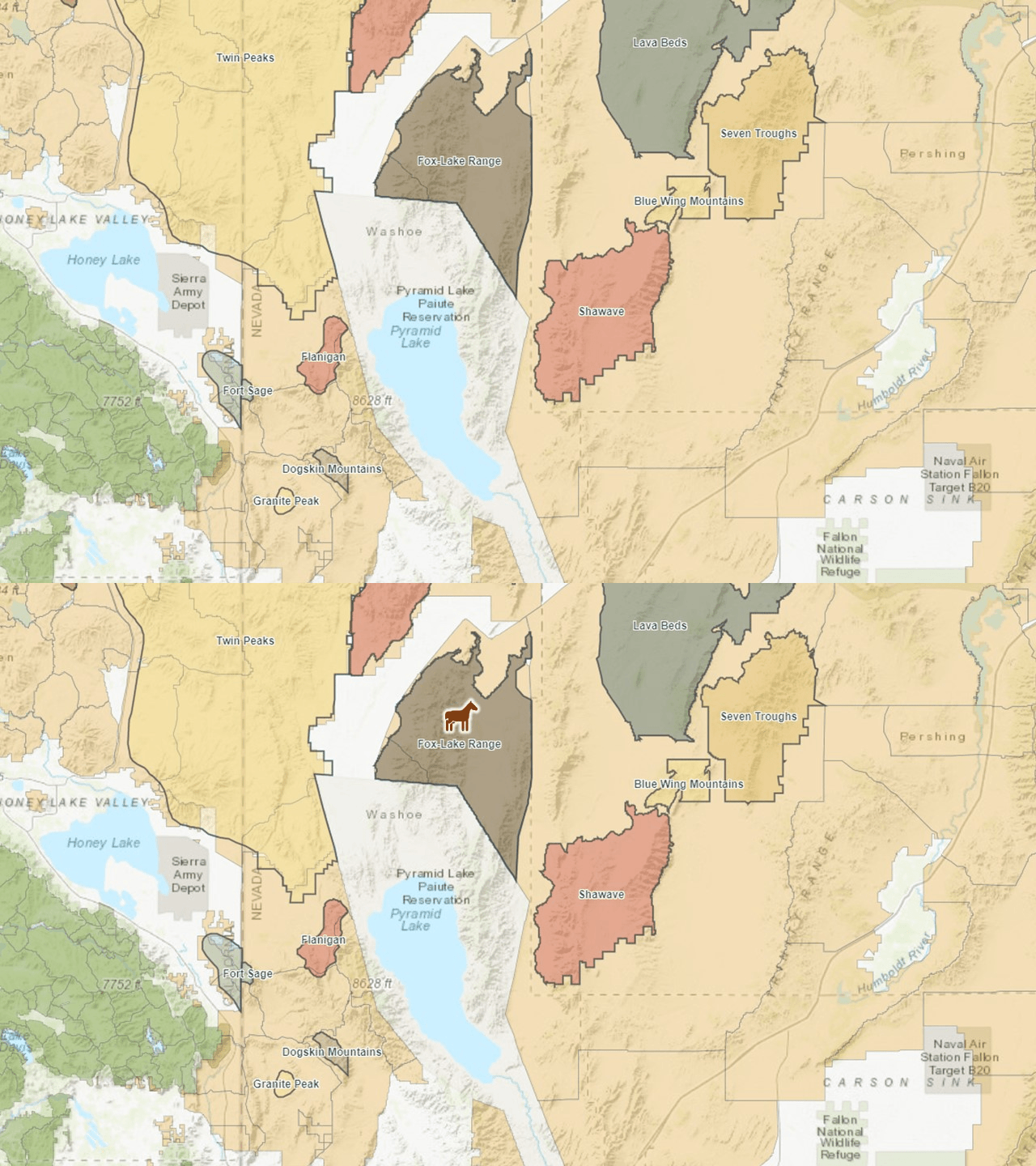
Fox-Lake Range HMA Map 12-05-21

The HMA lies within the Rodeo Creek and Pole Canyon allotments, according to the Western Watersheds map.  The allotment map furnished with other NEPA documents shows the Complex boundary but not the HMA boundaries.

Refer to Section 3.9 in the EA for a discussion of livestock grazing in the Complex.

The land-use plan assigned zero AUMs per year to wild horses and 540 AUMs per year to livestock in Pole Canyon, with 2,448 AUMs per year assigned to wild horses and 5,540 AUMs per year to livestock in Rodeo Creek.

The AUMs available for grazing may have changed since the EA was published but the current values can be accessed at RAS.  Roughly 10% of the Rodeo Creek AUMs are outside the HMA.

Captured animals will be taken to the off-range corrals at Palomino Valley.

Gather stats and daily reports will be posted to this page.