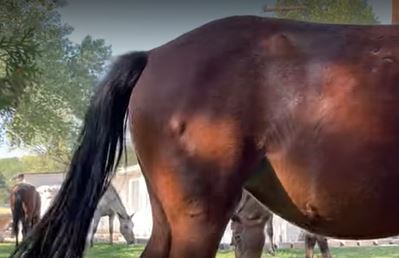
Wild Horse Darting Programs Grow 40% in Two Months

You thought inflation was a problem.

The price of hay has been climbing steadily since the summer.

Now, the number of HMAs with fertility control programs has increased to 14, per the roundup schedule dated October 21, compared to 10 in the August 30 schedule.

Darting in HMAs 12-23-21

The number of animals targeted grew by 4.6%.  Overall, 24.2% of the horses allowed by plan will be treated, probably with PZP, keeping the resource scales in most of the areas tipped in favor of the public-lands ranchers for longer periods of time.

Nevada WHR Roundup Day 3

The incident began on December 20.  Gather stats through December 22:

  • Type: Planned
  • Method: Helicopter
  • Animals captured: 101 horses, 91 burros
  • Average daily take: 33.7 horses, 30.3 burros
  • Capture goal: 648 horses, 100 burros
  • Removal goal: 438 horses, 100 burros
  • Returned: None
  • Deaths: None
  • Shipped: 79 horses, 91 burros

The cumulative totals include 34 stallions, 40 mares and 27 foals.  On the burro side, 47 jacks, 30 jennies and 14 foals.

Youngsters represented 26.7% of the horses captured and 15.4% of the burros.

Of the adults, 45.9% were stallions and 54.1% were mares.  For the burros, 61.0% were jacks and 39.0% were jennies.

Body condition scores were not reported.

The location of gather activity within the WHR is not known.

Nevada WHR Map 12-16-21

Day 3 ended with 22 unaccounted-for horses and no unaccounted-for burros.

The number of animals removed to date is 192.  Mares returned to the area will be treated with GonaCon.

Operations are not open to public observation.

Other statistics:

  • AML: 500 horses, zero burros
  • Forage assigned to horses: 6,000 AUMs per year
  • Pre-gather population: 736 horses, 95 burros and an unspecified number of foals
  • Forage liberated to date: N/A
  • Water liberated to date: N/A
  • Forage assigned to livestock: None
  • Animals displaced from WHR by livestock: None
  • True AML: 500

RELATED: Roundup Begins at Nevada WHR.

Criticize Livestock, Target Horses

This article in Horse Nation, written by a senior advisor to the Animal Welfare Institute, a sponsor of the misleading Rock Springs petition, notes that livestock vastly outnumber wild horses and graze on the same public lands.

Further, the government is trying to reduce the nation’s wild horse population to just 27,000 animals, citing arbitrary AMLs that are not supported by science.

Yet it concludes with this inconsistent and unoriginal idea: The BLM should implement safe and humane fertility control methods to keep horses on the range.

If a darting program prevents 125 births in a herd of 600, it is equivalent to a roundup of 125 wild horses—every year.  It does not keep horses on the range.

There is no turning over of the genetic soil, the older horses die off, and the population goes down.  Exactly what the ranchers want, although on a much longer timeframe.

The wild horse world is full of charlatans.

“Stay Wild,” a favorite of the advocates, is a lie.  Next to the federal government, nobody’s getting rid of more wild horses than they are.

RELATED: Why Don’t the Advocates Talk About Resource Allocations?

BLM Turned Wild Horse and Burro Program on Its Head?

No, Congress did.

Western Horse Watchers reminds you to think in terms of a process and to realize that the causes of roundups, adoptions, warehousing and slaughter are far upstream.

Statutes > Regulations > Policies > Plans > Programs > Procedures > Actions

Problems are solved by addressing the causes, not by treating the symptoms, a concept that has eluded the advocates for decades.

RELATED: We Need Tonic of Wildness Not Sting of PZP.

Restore or Reform Wild Horse and Burro Act?

The year is almost over and while the advocates are reviewing what they did to our wild ones in 2021, Craig Downer explains in this article what can be done for them.

Regarding base properties, Western Horse Watchers believes that they are part of the solution: Confine the ranchers to their deeded acres and let them pay market rates to feed their animals, in a year-round off-season.

The proposed feedlot north of Winnemucca will support 4,000 animals on 100 acres of private property.  If it works for the horses it works for the cattle.

As for climate change, Western Horse Watchers believes that it’s a naturally occurring process that’s been going on for eons and is not attributable to modern life, as the Marxists would have you believe.

They’re not interested in protecting the environment but controlling every aspect of your life.  Why are you still voting for them?

How Many Wild Horses Can the Pine Nut HA Support?

For a quick estimate, convert the AUMs in the Buckeye and Pine Nut allotments to wild horses.  The Allotment Master report has the data.

Pine Nut HA and Allotments 12-18-21

Add the active AUMs and divide by 12:

Horses displaced from HA = (481 + 1,471 + 1,150) ÷ 12 = 258

Given that a small part of Buckeye overlaps the HMA, the number of horses displaced from the HA by privately owned livestock is probably around 250, maybe a bit less.

The AML in this area is zero and the advocates have supplanted the government as resource enforcers, at least for now.

They recently acquired a Jeep to make sure that none of the mares can escape their darting rifles and the fundraising effort has been dropped from their web site.

You might be able to read about it on socialist media.

RELATED: How Pine Nut Advocates Help Government Protect Ranchers.

Corral Expansion Inching Along

The loop-leg pipe panels ordered in early October have been stood up but nothing has been secured.  Bow gates were already on hand.

This space will connect the corral, out of frame on the right in the aerial view, to the barn, out of frame on the left.

Partitions in the barn, where stalls used to be, have been removed, providing another shelter and feeding area for the horses.  Overview of project in this video.

Corral Expansion Inching Along 12-19-21

How Pine Nut Advocates Help Government Protect Ranchers

The December edition of Horse Tales is out, along with another article by the real estate agent and PZP darter in the Minden-Gardnerville area.

The listings are on page 24 and the article begins at the bottom of page 5.

The action takes place on the Pine Nut Mountains HA, which includes the HMA but extends well to the south, coinciding roughly with the Buckeye and Pine Nut allotments.

The land was identified for wild horses in 1971 but has since been taken away and is now managed principally for livestock.

Horses still inhabit the area, which is unfit for them, supposedly.  The AML is zero.

Pine Nut HA and Allotments 12-18-21

Instead of demanding that the HA be managed principally for wild horses—as specified in the statute—the advocates are getting rid of them with PZP.

There is little if any turning over of the genetic soil and the herd may be dying off, depending on how severely they’ve reduced the birth rate.

If things get out of hand, the government will remove them, ensuring that all of their food, except for a small amount reserved for wildlife, goes to public-lands ranchers.

Good job, guys.

Like the Virginia Range a few miles to the north, the Campaign Against America’s Wild Horses has its tentacles in this program.

The Allotment Master report puts Buckeye and Pine Nut in the Improve category.

Fox-Lake Range Roundup Over

The incident ended today, according to a BLM news release.  Here are the final results from the gather page:

  • Horses captured: 82
  • Horses shipped: 19
  • Horses returned: 23
  • Horses to be returned: 37
  • Horses deceased: 4

The numbers don’t balance.

19 + 23 + 37 + 4 ≠ 82

More horses were processed than captured.

No foals were taken.  Of the adults, 46% were male and 54% were female.

The death rate was 4.9%.

If the herd was growing at a rate fifteen to twenty percent per year, 16 to 20 foals should have been pushed into the traps.  But none were.  Why?

RELATED: Fox-Lake Range Wild Horse Roundup Announced.

Wild Horse and Burro Act at 50: Time for Reflection

The legislation became law 50 years ago today.

In his remarks dated December 17, 1971, President Nixon noted that the animals were 99% extinct, with approximately 9,500 unbranded and unclaimed horses and 11,000 free-roaming burros remaining on the public lands.

Today, the number of horses and burros allowed by plan is not much higher, around 27,000.  The land can support many more, but those resources have been assigned to privately owned livestock.

The advocates know a lot about adjuvant but not much about AUMs.  Consumed by the overpopulation narrative, they protect the ranchers, not the horses and burros.

Why are you still giving them money?