
The organization supports a hands-off management philosophy, according to this news release, but how will that fly when the management priority is livestock?
Month: July 2021
Status of Onaqui Allotments
The 2018 EA for resource enforcement actions in the HMA provided little information about livestock grazing, as noted by some of the commenters.
Table 1 in the Comment Report shows ten allotments that intersect the HMA, along with size, available AUMs and grazing seasons.
Unfortunately, the percentage of grazing land (or forage) falling inside the HMA was not provided, so a ‘Short End of Stick’ report is not possible.
All of the data in following table were taken from the Allotment Master report in RAS except the 2018 AUMs, which were sourced from Table 1.
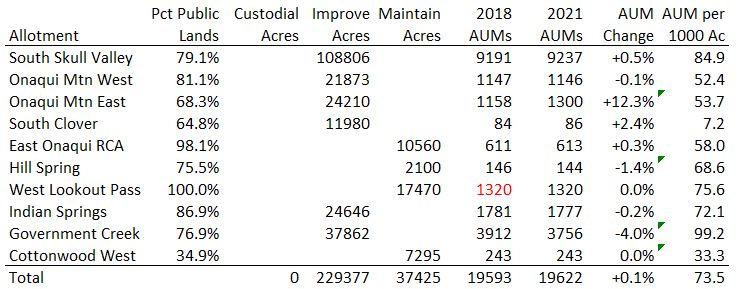
The AUM figures in Table 1 for West Lookout Pass appear to be for the number of animals on the permit, not the amount of forage, per the Authorization Use report for the allotment. The grazing seasons may also be incorrect, so the 2018 allocation was assumed to be the same as 2021 and that’s why the value is marked in red.
The HMA contains about 205,000 public acres according to the EA. The allotments contain about 267,000 public acres, so some of them must extend beyond the HMA boundaries. The map provided with the EA does not show their boundaries.
Six of the ten allotments do not meet standards for rangeland health.
Eighty six percent of the public acres in the allotments do not meet standards for rangeland health.
For every public acre in the Maintain category, there are six acres in the Improve category.
There is no category for blaming substandard conditions on wild horses.
Suppose that 80% of the permitted forage falls within the HMA, about 15,700 AUMs per year.
The horses allowed by plan receive about 2,500 AUMs per year, so livestock would be receiving six times more forage than the horses—on land set aside for the horses.
The HMA would be managed primarily for livestock.
The forage assigned to livestock would support an additional 1,300 wild horses, for a True AML of 1,510.
The pre-gather population was about 500, so there were no excess horses in the HMA and no justification for a roundup or fertility control program.
The 1,300 wild horses cheated out of a spot on their home range account for 2.6% of the 50,000 horses in off-range holding. How many more HMAs would you have to look at to account for all of them?
More on the Arrival of Beatrice
Earlier reports said she struggled to bond with her mom and later had to be rescued from a canal, the subject of this video by WCNC News of Charlotte, NC.
The story did not say if the advocates have darted the mom to prevent any more such mishaps.
RELATED: Currituck Herd Adds Foal #7.
Onaqui Allotment Factoids
Six out of ten allotments, and 86% of the public acres therein, do not meet standards for rangeland health.
Livestock receive six times more forage than the horses, subject to further analysis.
More tomorrow.
No More Roundups This Year at TRNP
The Park Service announced yesterday that wild horse removals would be postponed for the remainder of the year, although mares would still receive contraceptives.
The horses are darted with tranquilizers and youngsters are usually targeted.
A roundup occurred earlier this year.
RELATED: TRNP Roundup in Progress.
Onaqui Roundup Day 2
Today, 94 horses were captured, according to the gather page, including 42 stallions, 46 mares and six foals.
No deaths were reported.
The number of animals shipped was 93, leaving one in the unaccounted-for category.
RELATED: Onaqui Roundup in Progress.
Colville Horses Flee Wildfires
A report by KREM News of Spokane, WA says they were running loose on Highway 155 near Nespelem but were corralled by tribal members.
The fires were started by lightning and are burning on the Colville Reservation.
The overview at InciWeb for the Chuweah Creek fire shows 22,900 acres burned, 20% containment and expected movement to the north and east.
Onaqui Roundup in Progress
Day 1 ended with 14 horses captured, according to the gather page, including one stud, nine mares and four foals.
No deaths were reported.
The number of animals shipped was 14, leaving the unaccounted-for category at zero.
Currituck Herd Adds Foal #7
She was born on July 10 according to a report by WAVY News of Portsmouth, VA.
Birth rates and breeding patterns are determined by the advocates, not the horses.
Dugway Dropped from Onaqui Roundup Scope?
Helicopters will not be flying in that area, according to the gather page, so the incident will be open to public observation every day until complete.
RELATED: Onaqui Gather Page Created.
Virtual Fences Coming to a Pasture Near You?
Think of it as GPS-enabled shock collars. You enter the coordinates of the pasture into the base station, slap on the collars and the system will gently persuade your livestock to stay within the pre-defined boundaries.
There are no posts, no gates, no buried wires.
The story by KFOR News of Oklahoma City did not say what might happen if the power goes out or atmospheric conditions interfere with GPS signals.
The range of the system is not known and if it requires line-of-sight communications between the base station and the animals.
Nevertheless, the technology may be of interest to those on the political left who want to control everything, including you.
A GPS-enabled kill switch in your car would warn you when you’re approaching the limits set by your masters. An ankle bracelet might do the same if you’re on foot.
Curiously, those who would enslave you are the ones tearing down statues because they’re associated with slavery.
Orphaned Foal Moved to Virginia Side of Assateague Island
She was transferred to the Chincoteague National Wildlife Refuge to increase her chances of survival, according to a report by the Maryland Coast Dispatch.
The story did not indicate if she’d still be eligible for the name-that-foal contest.
Onaqui Gather Page Created
Gather stats and daily reports will be posted here. A link was not provided when the roundup was announced.
The incident begins tomorrow and is open to public observation except for Day 2.
RELATED: Onaqui Roundup Delayed.
BLM to Decimate Onaqui Herd, Advocates Offer to Do That
“The science is on our side,” according to a delegate of the Cloud Foundation, stating that “there are win-win solutions that can benefit the ranchers and our wild horses.”
The reference, of course, is to PZP darting of wild mares. The term appears three times in this article by The Salt Lake Tribune. Drive the birth rate to zero and let the herd die off. Don’t let the horses reclaim any of their food from the cattlemen.
Any of you still wondering who the turncoats are in the wild horse world?
Undeniable Truth #2.
RELATED: Capitulation to Ranching Agenda at Onaqui Mountain HMA.
Free-Roaming Horses Native to North America?
Watch how quickly the focus shifts to free-roaming horses on public rangelands—just 20 seconds into the video. Would their story differ from that of horses in other areas?
In this film about science, did they use scientific methods to collect the data and present their findings?
Where in the North American fossil record do cattle and sheep appear? Are they working on a video for that?
This is not science, it is agenda-driven information intended to confuse or mislead, also known as propaganda.
Be very skeptical when you see statements such as “management of these animals informed by independent science,” which was added to the text of AJR-5 in California.
Currituck Wild Mare Put Down by Rescuers
The year-long infection in her leg intensified after she was separated from her colt, removed from the wild and treated aggressively, according to a report by OBX Today.
The advocacy group coordinating the response solicited donations two weeks ago to help with the vet bills.
On the bright side, they did let her have a foal before she died.
AEA Still Promoting Automatic Darting Machine
Refer to this news release by American Equine Awareness.
The advocates won’t oppose it because it can accomplish automatically what they’ve been trying to achieve manually: Getting rid of wild horses with contraceptives.
Western Horse Watchers believes there are some aspects of the machine that its developers aren’t disclosing, such as what happens if studs come in for the bait or the mares continue to feed after they’ve been darted. How will they be repelled?
On the range, will the higher horses allow the lower horses to get near it?
How the Cattlemen Impose Their Will on Us
They’re not lobbying the politicians, as we saw yesterday. They’re schmoozing the bureaucrats, who never have to face the voters.
The practice came up last year, when BLM moved its headquarters to Grand Junction.
Why all the uproar? Loss of access by special interests.
Two years ago, when interviewed about the proposed move, a Colorado senator said “Washington is infested with special interests. You mean to tell me that BLM is insulated from that? They’re infested.”
Congress doesn’t write land-use plans and specify AMLs. How long do you think they’d last if the American people knew they assigned most of the resources in wild horse areas to privately owned livestock? That would be political suicide.
They may agree with it, but they let the bureaucrats do the dirty work.

Mustang Monday
Horses have the day off. At Custer State Park with Ben C. Enlots.
How Many Livestock Are on the Onaqui Mountain HMA?
Would you be upset if it was 2,250 cow/calf pairs for six months per year? What would you say if it was 1,800 cow/calf pairs for four months and 5,250 ewe/lamb pairs for six months? Would you feel better if it was 7,500 ewe/lamb pairs for nine months?
All three cases have the same resource loading, 13,500 AUMs per year.
The management plan allows 210 wild horses for twelve months, requiring 2,520 AUMs per year.
How do you make the comparisons simple? Look at the resource allocations.
Livestock numbers depend on livestock types and grazing seasons.
But the forage allocations tell you immediately that the HMA is managed primarily for livestock.
You can also compute the number of horses displaced from the HMA by livestock, the True AML, and, if you know the current population, the number of excess horses.
RELATED: Resource Allocation Quiz, Filling in the Gaps at Healthy Horse HMA.
 Western Horse Watchers Association