
Refer to this USFS news release. The order goes into effect today and will prevail until July 31 or until rescinded, whichever occurs first. The Lower Salt River is not affected.
Month: June 2021
Currituck Studs Demonstrate Herd Dynamics for Beachgoers
Refer to this report by The Virginian-Pilot of Norfolk, VA. Just another day at the office in the wild horse world.
WHBAB Call for Nominations
Three positions representing public interest, veterinary medicine and wild horse and burro advocacy will become vacant on September 20, according to a BLM news release issued yesterday.
Individuals and organizations may nominate one or more persons to serve on the Board, which typically meets twice per year. Terms are for three years. Hostility to wild horses and burros is not a disqualifier.
Interested parties may also nominate themselves.
The next meeting of the Board begins on June 30.
Wild vs Feral Debate at Park County Commissioners Meeting
Wild horse advocates disputed some of the language in a draft Natural Resources Management Plan at a June 15 meeting of the county commissioners, according to a story in yesterday’s edition of the Cody Enterprise.
The document gives the county a voice in the development of management plans for public lands by federal agencies.
Approval of the plan was the last item on the agenda before lunch.
Minutes of the meeting have not been posted and Western Horse Watchers has not been able to find a copy of the plan but has asked the commissioners’ executive assistant for a link to it.
The McCullough Peaks and Fifteenmile HMAs extend into the county.
As for non-native animals on America’s public lands, you can find them on just about any grazing allotment.
UPDATE: Commissioners are reviewing public comments on the draft NRMP and approval will occur at a future meeting. Discussion of wild horses begins on page 58 of the pdf. A map showing the two HMAs is on page 104.
Banker Foal Gets the ‘Zoomies’
Check out the video in this story by The Charlotte Observer. Filmed at Shackleford Banks, Cape Lookout National Seashore.
AIP Fallout, Managing Humanely and Virginia Range Update
A 27-minute audio segment by KNPR Radio of Las Vegas features the director of the Campaign Against America’s Wild Horses, an organization that’s second only to the federal government in terms of eradicating wild horses.
You see, the number of wild horses in off-range holding could be sharply reduced, along with those shipped to slaughter, if we prevent their birth.
Resources set aside for the horses can be shifted to, well, you know, other users of public lands.
As for the Virginia Range, approximately 1,400 mares have been darted and, with the help of predators, zero population growth has almost been achieved.
Like the Salt River, these people are not just standing around while the herd dies off.
They are actively involved in its demise.
All because some bureaucrat said there should be no more than 600 wild horses, ideally just 300, on the Virginia Range.
RELATED: FOA Files Suit to Stop AIP.

What’s Next in Wild Lands Wild Horses Series?
A news release issued yesterday says future episodes will cover wild horse history, sustainability, herd dynamics, roundups, legislation and adoptions.
Not included in the list:
- Management priorities and resource allocations in areas set aside for wild horses
- Rationale for setting AMLs
- Number of horses displaced from public lands by privately owned livestock
- Number of horses displaced from public lands by drilling and mining
- Rationale for fertility control programs
- Economics of roundups and off-range holding
- Current state of wild horse advocacy
Also missing from the announcement are the funding sources for the program and where the experiences, loyalties and political leanings of the hosts might take it.
RELATED: Wild Lands Wild Horses Pilot Episode Premieres This Week.
Salt River Darting Program Taking Its Toll
Only one foal was born this year, according an update provided by the advocates.
With the birth rate driven to zero, mortality will thin the herd.
A photo shows a mare taking a dart so she can spend her life with her family—except there is no family and no turning over of the genetic soil.
Another photo shows the sorting of mares and stallions in a roundup.
Getting rid of horses with helicopters is bad, but getting rid of them with contraceptives is good.
Therefore, other herds, such as Onaqui and Heber, should receive the same treatment.
Never mind that they’ve already been decimated by resource management plans and the bureaucrats who wrote them.
This group, defeated, is of no use to America’s wild horses.
RELATED: Saving the Salt River Horses by Getting Rid of Them.
Mare’s Tail in the Sky?
Also known as cirrus uncinus clouds, according to a very short story in today’s edition of the Billings Gazette.
Court Affirms Caliente Decision
A District Court’s ruling in favor of the BLM, that it could go ahead with a wild horse roundup in the Caliente Complex, has been affirmed, according to a decision filed on June 18.
The Complex, which doesn’t have enough resources for wild horses, includes nine former HMAs and intersects 26 grazing allotments.
Table 3.2 in a 2018 EA for resource enforcement actions in the Complex, provides data for the allotments and the map in Appendix V shows the arrangement.
The Allotment Master report in RAS gives the public acres and active AUMs. Most of the allotments are in the Custodial category, with condition unknown, but most of the acreage is in the Improve category, approximately 56%.

Although the forage assigned to livestock has decreased by 21% in the past three years, 31,445 AUMs per year are still active. The forage assigned to horses is zero.
To put that in perspective, the forage allocated to livestock would support 2,620 wild horses, in an area that doesn’t have enough food for wild horses!
The court said the plaintiffs waited too long to bring their case against the BLM’s plan, not that the agency wasn’t telling the truth about resource availability in the Complex.
Mustang Monday
Near the Heber WHT with Friends of the Heber Wild Horses.
Free-Roaming Horses?
Note the change in vegetation on the other side of the fence. What caused that?
BLM to Decimate Onaqui Herd, Advocates Say ‘Let Us Do That’
They’re opposed to helicopter roundups, as indicated in this June 18 news release by Animal Wellness Action, but won’t condemn the darting program.
True, the terms ‘humane management’ and ‘fertility control’ don’t appear in the announcement.
The problem is upstream in the management process, namely, the land-use plans that determine who gets what.
The rancher-friendly ‘Path Forward,’ which is mentioned in the announcement, will enforce resource allocations already on the books.
The darting program can only keep the scales tilted in favor of the ranchers.
RELATED: Rallying for Onaqui Wild Horses or Privately Owned Livestock?
Crooked Creek Fire Moving East
The burned area grew to 5,400 acres today, up from 5,200 acres yesterday.
Containment is now 20% and the cause is unknown.
The report at Inciweb says active spread to the east, taking the fire within a few miles of the wild horse range.
RELATED: Crooked Creek Fire Update.
Crooked Creek Fire Update
The fire expanded slowly over the past 24 hours, with 5,200 acres burned as of today, up from 5,100 acres yesterday.
Containment is now 10% and the cause has not been determined.
A new map shows the location of the fire relative to the wild horse range.
RELATED: Fire Near Pryor Mountain WHR.
McCullough Peaks Recap
You have the advocates getting rid of the horses so the ranchers can have the lion’s share of the resources while none of the allotments meet standards for rangeland health.
Can’t get any more screwed up than that. Undeniable Truths #1 and #2.
RELATED: McCullough Advocates Celebrate WHB50 by Getting Rid of Horses.
McCullough Advocates Celebrate WHB50 by Getting Rid of Horses
Personnel with Friends of a Legacy, an advocacy group associated with the McCullough Peaks HMA in northwestern Wyoming, will be showing off their darting program at an event on July 2, according to an article by the Powell Tribune.
The HMA covers approximately 110,000 acres, according to Section 3.1 in a 2012 EA for resource enforcement actions in the area.
The current size is 120,000 acres, according to the HMA page, and the AML is 140, for a target stocking rate of 140 ÷ 120,000 × 1,000 = 1.2 wild horses per thousand acres.
The horses require 1,680 AUMs per year at the AML.
The HMA intersects five grazing allotments, listed in Section 3.2 of the EA.
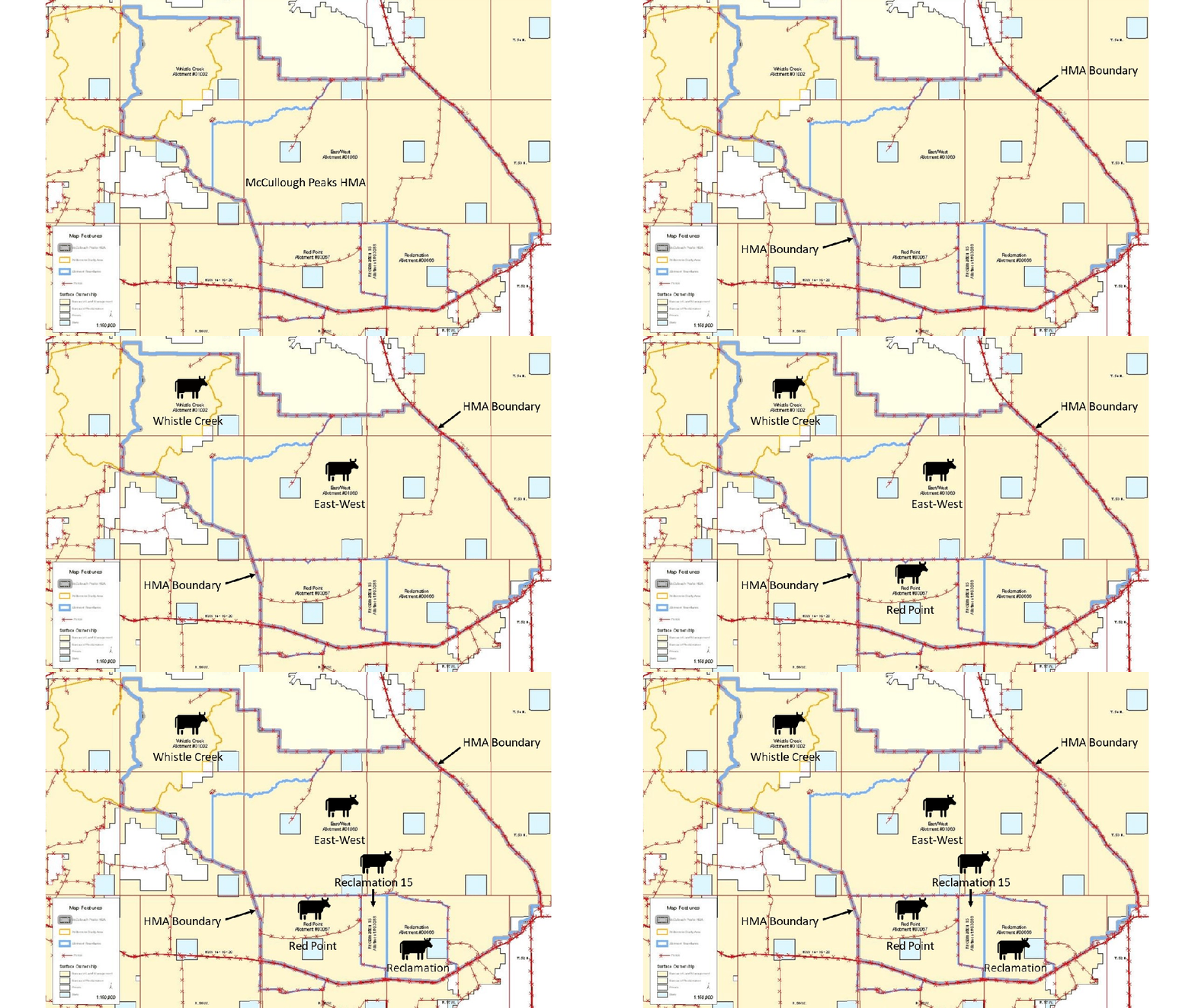
The Allotment Master report in RAS provides data for the allotments.
The forage assigned to livestock inside the HMA has increased slightly, compared to 2012. All five allotments are in the Improve category. Most of the active AUMs are held by the same permittee.
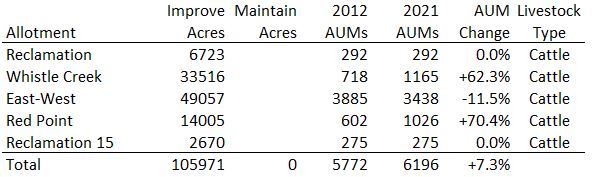
The southwest corner of Red Point extends beyond the HMA boundary, taking with it small part of the forage in the allotment, assumed to be 100 AUMs per year. The table above shows public acres only.
The total authorized forage inside the HMA, neglecting wildlife, is 1,680 + 6,196 – 100 = 7,776 AUMs per year.
The horses receive 1,680 ÷ 7,776 = 21.6% of that resource. The HMA is managed primarily for livestock.
The forage assigned to livestock would support an additional (6,196 – 100) ÷ 12 = 508 wild horses, for a True AML of 140 + 508 = 648.
With 508 wild horses cheated out of a spot in their home range by privately owned livestock, why do the advocates want to get rid of more? Is the current population greater than 648?
Why aren’t they demanding that the HMA be managed principally for wild horses, per the original statute?
The darting program ensures that the ranchers receive most of the resources—in an area set aside for wild horses.
Good work, guys.
Situation Going South at Sand Wash Basin HMA
Refer to this story by the Craig Press.
RELATED: Pond Dries Up at Sand Wash Basin HMA.
Rallying for Onaqui Wild Horses or Privately Owned Livestock?
The news release about the Onaqui rally said the horses receive between nine and fifteen percent of the resources on public lands, taken to mean nine to fifteen percent of the authorized forage in the HMA, with the balance is assigned to livestock. No other details were given.
Several questions come to mind:
- What is the total authorized forage?
- How many horses have been displaced by livestock?
- What is the True AML?
- How does that compare to the current population?
The AML ranges from 121 to 210, according to the HMA page, requiring 1,452 to 2,520 AUMs per year.
If the forage requirement at the low end of the AML is 9% of the total, then the authorized forage must be 1,452 ÷ .09 = 16,133 AUMs per year.
If the forage requirement at the high end of the AML is 15% of the total, then the authorized forage must be 2,520 ÷ .15 = 16,800 AUMs per year.
The two results are not identical but suggest the total is in the mid 16,000s so let’s assume it’s 16,500 AUMs per year, neglecting wildlife.
The forage assigned to livestock is 16,500 − 2,520 = 13,980 AUMs per year, which would support an additional 1,165 wild horses. That is, 1,165 wild horses have been displaced from the HMA by privately owned livestock.
The True AML is the horses allowed by plan plus the horses displaced by livestock, which is 210 + 1,165 = 1,375.
The current population is not known but is almost certainly less than 1,375. If there are no excess horses, there is no justification for a roundup and or fertility control program.
Why do the advocates want to dart the horses when the problem is domestic livestock?
RELATED: Onaqui Rally at State Capital.
Onaqui Rally at State Capital
The event will be held on July 2, followed by at trip to the HMA, according to a news release by Animal Wellness Action.
Opponents of the July 12 roundup said the horses should be kept on the land and managed with fertility control.
Undeniable Truth #2.
RELATED: Caving In to Ranching Agenda at Onaqui Mountain HMA?
 Western Horse Watchers Association