Intrigue at Spruce-Pequop HMA

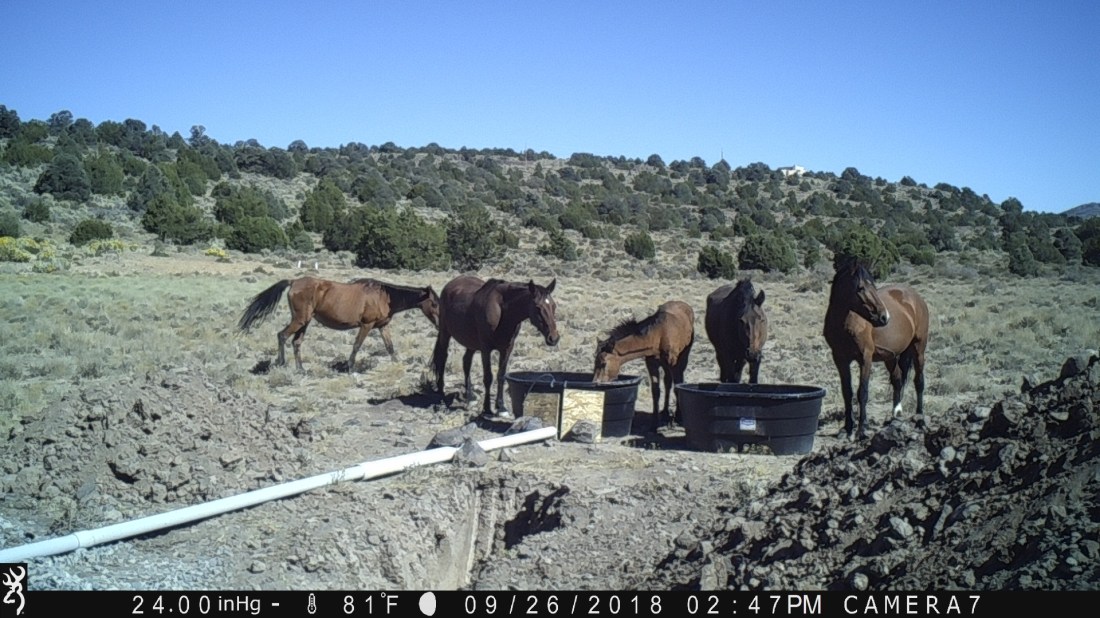
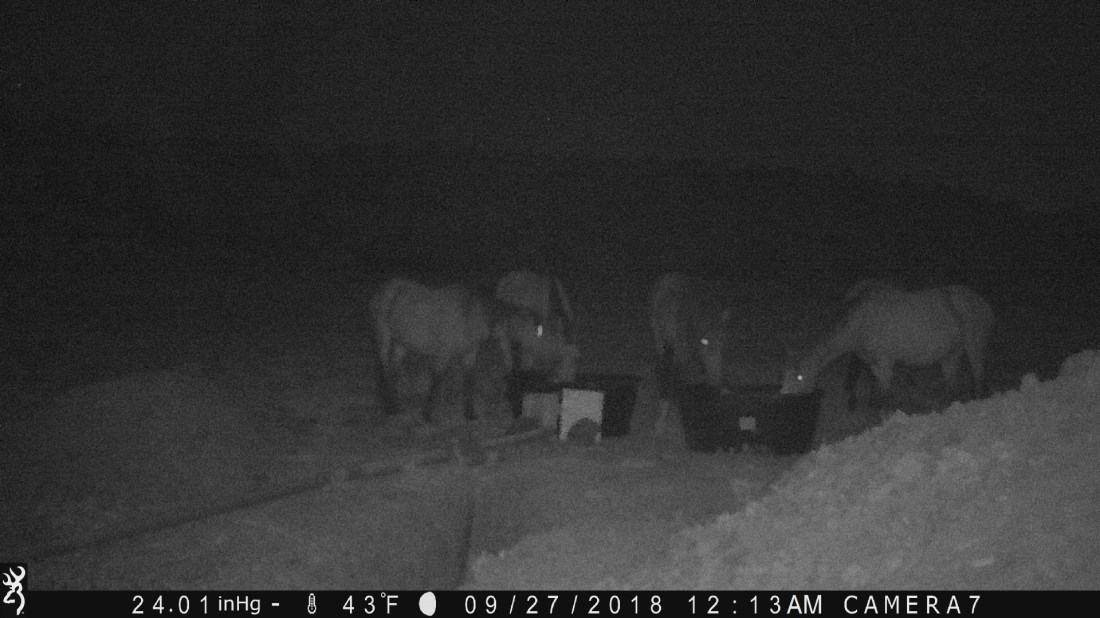
The following map shows the approximate location of the Mustang Monument Resort and Sanctuary vis-à-vis the Spruce-Pequop HMA.  The red dot shows the approximate location of Boone Springs, where the wild horse shooting took place.

White patches correspond to privately owned land, while tan represents lands managed by the BLM.  Most of the sanctuary lies within the 600,000 acre Spruce Allotment in Elko County, NV.

Mustang_Monument_Boone_Springs_Map-1

As of today, the story has not been picked up by any of the national news outlets.

RELATED: Spruce-Pequop Gather Started with Wild Horse Massacre?

Spruce-Pequop Gather Started with Wild Horse Massacre?

A report posted this evening in Las Vegas Now says that eight wild horses were shot by the BLM near Boone Springs in late August, at the beginning of the Spruce-Pequop gather.  The deaths do not appear in the gather reports.  Photographs of the dead horses do not provide a rationale for euthanasia.  Emaciation is not evident.

Businesswoman Madeleine Pickens owns over 20,000 acres in the area, with nearly 600,000 acres of public grazing allotments attached.  Those lands were obtained for the Mustang Monument wild horse sanctuary.  Pickens offered to take 30,000 wild horses out of government pens and put them back on the range.

“But Elko County is cattle country so Pickens has faced opposition at every step.”

The allotments cover much of the Spruce-Pequop HMA, and parts of the Goshute and Antelope Valley HMAs, which were also gathered this year.

Pickens believes the BLM wants to take her land and repurpose it for cattle grazing.

UPDATE: Added video.

Conflict Between Livestock and Horses Plays Out at Heber WHT

The White Mountain Independent of Show Low, AZ posted an article this morning about the Heber WHT that actually mentions livestock on lands used by the horses!

“One of the primary complaints expressed by the ranchers is that the Heber horses are in competition with their cattle for food, water and resources.”

One of the ranchers interviewed for the story said the horses should be managed with permits just like cattle.

“Go through the process and set up payments for your range fees with Forest Service for your allotment.  Then put all of those horses on there and have at it.”

Interesting idea.  Permits could be put up for auction.  The going rate for livestock grazing is $1.41 per AUM.  If a wild horse advocacy group offered $5 per AUM to graze wild horses, would the BLM be obligated to accept it?  Would ranchers be willing to pay $25 per AUM or $50 per AUM or more?

BLM said earlier this week (on Day 2 of the WHB Advisory Board meeting) that the cost of caring for a horse in off-range pastures is $2 per day.  That’s roughly $60 per AUM.

Another rancher used an analogy to explain why the current management approach for the WHT isn’t working and hasn’t for years:

“Consider that you and I were neighbors and we had a piece of property and it was fenced off.  And then I had 50 dogs running on my property and there’s a hole in my fence and all of my dogs go over onto your property.  Does that mean that you should take care of those dogs now?”

What he seems to forget is that the property doesn’t belong to him and a law was passed in 1971 to protect those dogs.

RELATED: Advocates Hauling Water to Heber WHT.

BLM to Use Helicopter to Finish Little Bookcliffs Roundup

Bait traps have not been successful in capturing horses from remote locations, according to a report posted today by The Daily Sentinel.  Forty seven horses have been gathered so far, with twenty seven permanently removed.

Stupid horses, why won’t they surrender their freedom for a life of government benefits?

The stated reason for the gather is overgrazing, but could it be that the horses have roamed beyond the WHR boundaries onto lands covered by grazing permits, robbing forage from the public-lands ranchers?

RELATED: Gather at Little Bookcliffs in Progress, with Aid of ‘Advocates’.

WHBAB Day 3: Achieve AMLs or Else

This story by The Salt Lake Tribune has a summary of today’s proceedings.  Public comments were taken in the afternoon session.  This was the final day of the meeting.

The enmity toward wild horses and burros was astonishing.

Multiple use was cited as the justification for a variety of activities on lands set aside for WHB, such as energy development, livestock grazing and timber harvesting.  Except when adverse conditions are found, such as soil erosion and missing vegetation.  Then it’s single use—all problems are caused by the horses.

Claims were made that AMLs represent the carrying capacity of the land.  If that was true, there could be no livestock grazing on HMAs.

An argument was advanced that livestock can’t be removed from public lands because it would ruin the lives of the ranchers.  Sadly, manufacturers of buggy whips, vacuum tubes and carburetors, along with their workers, were not available for comment.

Neither were the coal miners displaced by the wind farms of an earlier presentation.

RELATED: WHBAB Day 2: Back to the ‘Fast Disappearing’ Days.

BLM Seeks Nominations for RACs in Nevada

BLM has reopened the nomination period for vacant positions on three Resource Advisory Councils in Nevada.  Refer to this news release for more information.

The Sierra Front-Northwestern Great Basin RAC, which serves Washoe, Humboldt, Pershing, Churchill, Storey, Douglas, Lyon, Mineral and Carson City counties, has an open position in the area of wild horses and burros.

Citizens on RACs provide input to the BLM in managing public lands for multiple uses.

RELATED: BLM Seeks Nominations for RACs.

USFS: Removing Modoc Wild Horses Good for Environment

An opinion piece that appeared yesterday in the Redding-based Record Searchlight was written by a spokesman for the USFS to ‘correct some inaccuracies.’  However, it fails to mention that the Devil’s Garden WHT falls within permitted livestock allotments.

So much for accuracy.

Removing wild horses from HMAs and WHTs is good for the public-lands ranchers, their overlords, cheerleaders and political allies.

That is the implication of other statements in the piece, such as ‘reducing competition for limited food, water, and habitat’ and ‘communities that also depend on these lands.’

WHBAB Day 2: Back to the ‘Fast Disappearing’ Days

The low water mark of the morning session came when Barry Perryman, a new member of the Advisory Board, suggested that the BLM find additional reasons to remove wild horses from public lands, such as the protection of threatened species (e.g., sage grouse or desert tortoise).

The highlight of the afternoon session was a remark by Ginger Kathrens, during a review of the BLM Report to Congress, that the proposed actions would take wild horse populations back to ‘fast disappearing’ levels, a reference to the preamble of the WHB Act of 1971.

WHBAB_Day_2-1

If your belief at the beginning of the day was that the BLM wants more players from Team H off the field and more players from Team L on, nothing was offered in the day’s proceedings to convince you otherwise.

RELATED: WHB Advisory Board Tours Onaqui Mountain HMA.

Feinstein Tries to Stop Devil’s Garden Roundup

She knows how to do it.

Leak an embarrassing story about a central figure in the operation.  Employers nowadays are obsessed with diversity and inclusion, so it’s entirely plausible that someone involved has engaged in lewd behavior.

Stop asking questions about the carrying capacity of the land, appropriate population levels, competition on public lands with privately owned livestock, and what steps will be taken to ensure the safety of the horses.  Those topics are irrelevant.

See the report posted yesterday by The Sacramento Bee.

RELATED: Not One Word About Livestock at Devil’s Garden WHT.

WHB Advisory Board Tours Onaqui Mountain HMA

The WHB Advisory Board meeting in Salt Lake City kicked off yesterday with a field trip to the Onaqui Mountain HMA.  BLM staff hosted the tour, eager to associate any and all conditions with the horses.  Refer to this report by Deseret News.

It’s like climate change.  Whatever the perceived malady, blame it on the horses.  Mud or no mud, vegetation or no vegetation, wildlife or no wildlife, ascribe it to the horses.

Don’t mention livestock, don’t mention multiple use.

Recite the wild horse narrative as often as possible.

Cover for the public-lands ranchers.

Polls show that 80% of Americans want these animals protected and preserved.

Do think that will have any effect on the anti-horse juggernaut that has rolled across western rangelands since Trump was elected?

RELATED: WHB Advisory Board Meeting Starts Tomorrow.

Antelope / Goshute Roundups Make the Headlines

A syndicated report has been picked up by major news outlets regarding the second wild horse gather at the Antelope Valley and Goshute HMAs in eastern Nevada.  Refer to this article in the Beaumont Enterprise for example.  Here’s what they have in common:

  • Unquestioned acceptance of statements regarding wild horse populations
  • Erroneous reporting of the number of horses removed
  • Animal deaths not mentioned

Although the stories hint at the role of livestock in the debacle, they fail to acknowledge that all of this is happening on lands set aside for the horses.

RELATED: BLM Ends Antelope Valley and Goshute Gathers.

CA-1

BLM Ends Antelope Valley and Goshute Gathers

Bait trapping ended 10/02/18, with 902 wild horses removed from the two HMAs, according to a news release issued today.  Fifteen deaths were reported, leaving 887 animals to be shipped to the Indian Lakes Off-Range WHB Corrals in Fallon, NV, where they will be offered for adoption or transferred to segregated long-term holding.

Two horses were put down due to blindness.

Ten were put down due to emaciation and weakness.

Three horses died after hitting panels (walls of the traps) and breaking their necks, sometimes referred to affectionately as ‘capture shock’ by those in the field.

All euthanized animals had been given a hopeless prognosis for recovery.

The announcement did not indicate if livestock were present on the HMAs and if they were also affected by inadequate food and water.

RELATED: BLM Wants Another Bite of the Apple at Goshute and Antelope Valley HMAs.

Multiple Use on Lands Set Aside for Horses and Burros

Suppose an area can support ten or more wild horses per thousand acres.  The stated carrying capacity is one horse per thousand acres.  The current population density is three horses per thousand acres.

  • Claims will be made that the area is overpopulated
  • Arguments will be made that excess horses must be removed
  • Meetings will be held to draft a management plan
  • Helicopters will be deployed
  • Horses will be gathered

Given that the area is now underpopulated, what do you suppose will fill the gap?