Sulphur Wild Horses Get Short End of Stick

The Sulphur HMA covers 265,675 acres in western Utah and has an AML of 250, as stated in the Final EA for wild horse management actions therein.

The actions were designed to achieve and maintain AML over a six to ten year period, according to a Decision Record signed in 2016.  The DR authorized Alternative 1 in the EA, the Proposed Action.

AMLs represent a thriving ecological balance between wild horses, wildlife and other mandated uses of public lands.  Sounds great, but what do they tell you about land-use plans and the attitudes and beliefs of those who wrote them?

The 250 horses allowed by plan require 3,000 AUMs per year.  The stocking rate allowed by plan is approximately 0.9 wild horses per thousand acres.

The HMA intersects nine allotments.  The EA provided grazing seasons and authorized forage but did not provide the sizes.  Refer to Table 3.2 in the EA (page 23 in the pdf).

The area subject to permitted grazing was estimated to be 80% of the HMA, based on the map supplied with the EA.  The Mountain Home allotment was inactive when the EA was published.  That may not be the case today.

Sulphur HMA Calcs-1

The stocking rates allowed by plan for each of the allotments could not be determined.

The total estimated forage available to livestock inside the HMA is 10,257 AUMs per year and the total estimated herd size is 1,755 cow/calf pairs.  The weighted average grazing season is 5.8 months per year.

Sheep are allowed on three of the allotments but the calculations are based on cow/calf pairs for a direct comparison to those for wild horses.  The resource requirements of wild horses and cow/calf pairs are said to be equivalent.

The stocking rate allowed by plan is 8.3 cow/calf pairs per thousand acres, based on an estimated 212,540 acres available to livestock.

These management indicators are compared in the following charts.

Sulphur HMA Charts-1

The forage assigned to livestock would support an additional 855 wild horses, for a new AML of 1,105.  The Rule of 5 yields 1,250 wild horses.

That figure, 1,105 wild horses, represents the carrying capacity of the land if permitted grazing was prohibited and the HMA was managed principally for wild horses according to the original WHB Act.  (Forage allocated to wildlife not considered.)

The HMA is currently subject to a roundup that will remove 600 wild horses.

The pre-gather population of 1,193 means there were 88 excess horses on the HMA when the operation began, not 943 per the current AML.

The roundup will take the herd to approximately 50% of the true AML, which probably won’t be exceeded for another five years.

Thriving Ecological Balance-3

Sulphur Roundup, Day 12

Gather stats through August 26:

  • Horses captured: 538
  • Goal: 600
  • Deaths: 6

One mare was put down yesterday after hitting a panel and breaking her neck.

Foals accounted for 20.2% of the horses gathered.

Body condition scores over the last two days ranged from 4 to 5.

If livestock are not free to roam across the nine allotments that intersect the HMA, how are the horses supposed to do that?  The average grazing season is six months per year.

RELATED: Sulphur Roundup, Day 10.

No Major Concerns at Pine Gulch Fire

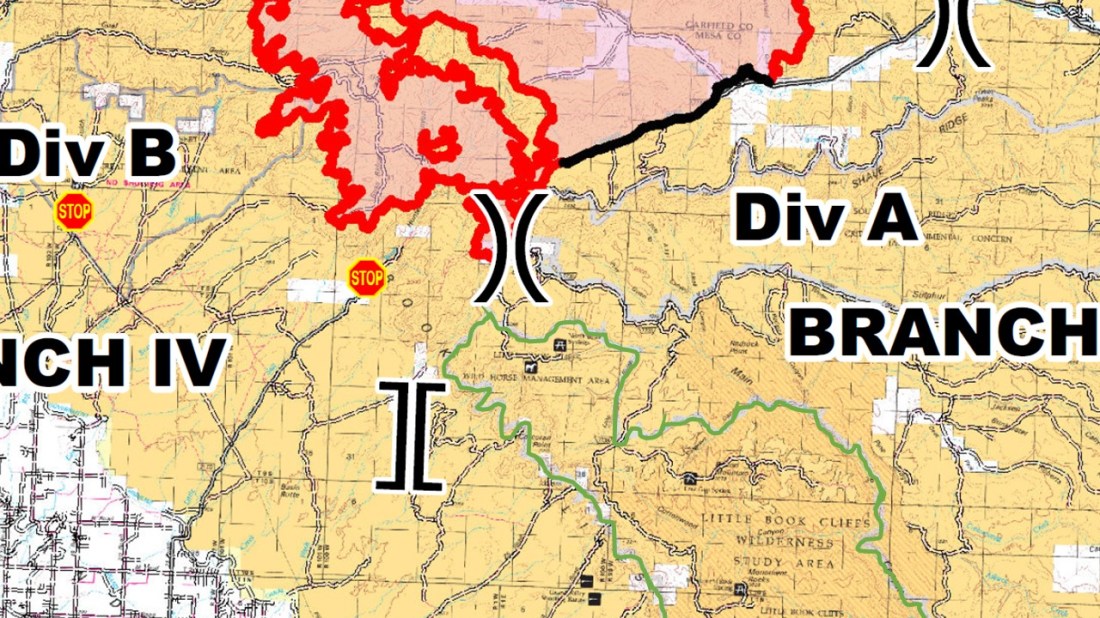
The 9 AM report at InciWeb says there was a small amount of growth to the south at the Division B/A break but it did not threaten the control line.  The area is about a mile north of the Little Bookcliffs WHR.

The break is marked by back-to-back parentheses at the southern edge of the fire on today’s map.  The perimeter at that point is red—not contained—so there is still some risk of spread.

Light winds out of the northwest are predicted today, with a chance of thunderstorms.

The total area burned is now 135,900 acres, compared to 135,000 acres yesterday.

Containment holding at 47% with 935 persons assigned to the incident.

The Division B/A break is discussed at 1:40 in today’s briefing.

RELATED: Crews Taming Pine Gulch Fire?

Shawave Roundup Ends

An announcement has not been posted to the BLM news site but the daily reports say the operation concluded on August 24 with 1,873 animals gathered (horses and burros), 12 deaths and 1,814 animals shipped.

A small crew will probably remain on site for another week or two to treat the 44 mares that received contraceptives at the beginning of the roundup and release them back to the HMA.

The number of unaccounted-for animals remains at three (1,873 – 12 – 1,814 – 44).

RELATED: Shawave Mountains Roundup Starts Next Week.

Big Bear Wild Burro Roundup in the Works?

Refer to this story by Bear Valley News of Big Bear Lake, CA.  The WBT is in the San Bernardino National Forest.

Western Horse Watchers was unable to determine if this is the beginning of a scoping period for a new project, solicitation of comments on a draft environmental assessment for a roundup, or an announcement of a decision that will allow the plan to go forward.

Another possibility is that it’s already been authorized by an existing NEPA project.

WHW does not know if the burros have been denied access to critical resources by other mandated uses of public lands.

Roundup Checks and Balances

What is the relationship between animals gathered, animals returned, animals shipped and animal deaths?  Draw a box around the traps.  The animals going in should equal the animals going out.  Mathematically, this would be expressed as

∑ Animals in = ∑ Animals out

That is,

Animals gathered = Animals returned + Animals shipped + Animal deaths

The formula can be manipulated algebraically to solve for any one of the four terms.

Roundup Checks & Balances

Refer to this roundup report from the Shawave HMA for an example of the calculation.

What about the number of animals removed from the HMA?  That would be equal to the number of animals shipped plus the number of animal deaths.

Crews Taming Pine Gulch Fire?

The fire has not moved any closer to the Little Bookcliffs WHR in the last two days but it has not been marked as contained in that area, according to today’s map, so there is still some risk of spread.

The 9 AM report at InciWeb puts the burned area at 135,000 acres, up slightly from yesterday’s 133,800 acres.  Containment has increased to 47%.

Operations at the Division B/A break, the point nearest the WHR, are discussed at the beginning of today’s briefing.

RELATED: Pine Gulch Fire Holding Near Little Bookcliffs WHR.

Sulphur Roundup, Day 10

Gather stats through August 24:

  • Horses captured: 458
  • Goal: 600
  • Deaths: 5

No deaths were reported over the last two days.

Foals represented 19.4% of the horses gathered.

Body condition scores ranged from 4 to 5.

The HMA, in western Utah on the Nevada border, intersects nine grazing allotments, one of which is not active.  The gather area extends into adjacent allotments as shown on the map supplied with the Final EA for wild horse management actions therein.

RELATED: Sulphur Roundup, Day 8.

Pine Gulch Fire Holding Near Little Bookcliffs WHR

The fire is still about a mile north of the WHR, according to today’s map.

The 9 AM report at InciWeb says that fire crews are monitoring the situation at the Division B/A break (denoted by two back-to-back parentheses on the map) and the management team is looking at options to prevent southerly spread.

The fire is now 44% contained and the total area burned is 133,800 acres, compared to 129,700 acres yesterday.

Light winds out of the northwest are predicted today, with a slight risk of dry lightning.

RELATED: Pine Gulch Fire Approaching Little Bookcliffs WHR.

UPDATE: Tactics for the Division B/A break are discussed at the end of today’s briefing.

Shawave Roundup, Day 21

Gather stats through August 23:

  • Horses captured: 1,578
  • Burros captured: 220
  • Animal deaths: 10

Captured mares now outnumber studs by 152.  Foals accounted for 18.5% of the total.

A mare died in the traps August 22 due to a broken neck.  Body condition scores have not been provided in this roundup.

Helicopter operations may cease in the next day or two, as the gather target of 1,650 horses has almost been reached.

The total number of animals shipped is 1,741.  The number of animals to be returned, according to the following relationship, is 47.

Animals shipped = Animals gathered – Animal deaths – Animals returned

The contractor is holding 44 mares on site (treated with contraceptives) so there are three unaccounted-for animals.

RELATED: Shawave Roundup, Day 19.

Grazing Program Ancillaries

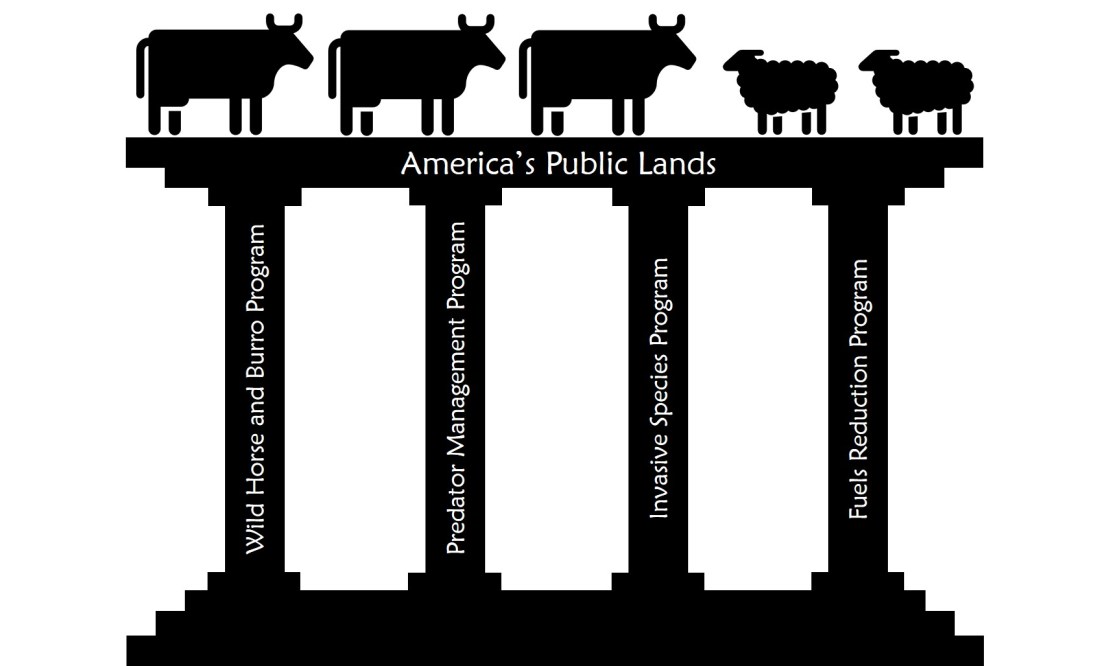
What do they have in common?  They work together to give ranchers unfettered access to cheap feed on America’s public lands.

You don’t have a horse problem on western rangelands, you have a ranching problem, and it is huge.

Grazing Program Ancillaries B-1

Pine Gulch Fire Approaching Little Bookcliffs WHR

The map posted this morning suggests the fire has made an end run around a previously burned area, at the Division B/A break (denoted by back-to-back parentheses in the following image), and is now about a mile from the north end of the WHR.

Today’s report does not acknowledge this.

Winds will be out of the north this afternoon with gusts to 14 mph.  Rain showers are in the forecast for next week.

The area burned since July 31 has increased to approximately 129,700 acres, up from 126,600 acres yesterday.  Containment holding at 19%.

Reports at InciWeb have not indicated if the lands surrounding the WHR are subject to permitted livestock grazing.

NOTE: The previously burned area, from the Hunter Fire, is mentioned at 1:35 in this briefing from August 18.

RELATED: Weather Cooperating with Pine Gulch Fire Fighters.

Little Boocliffs WHR Pine Gulch Fire 08-23-20-1

Sulphur Roundup, Day 8

Gather stats through August 22:

  • Horses captured: 348
  • Goal: 600
  • Deaths: 5

Two studs were put down on August 21 due to pre-existing conditions and another horse was lost to colic.

Foals represented 18.1% of the horses captured.

Body condition scores over the last two days ranged from 3 to 5.

The forage assigned to livestock in the HMA would support an additional 855 wild horses, for a new AML of 1,105.  The stocking rate would be 4.2 animals per thousand acres, slightly lower than predicted by the Rule of 5.

RELATED: Sulphur Roundup, Day 6.

Don’t Forget the Laramie County CAFO!

The announcement earlier this week of three new off-range corrals and the expansion of a fourth complements the announcement earlier this year of the closure of three HMAs and downsizing of a fourth.

These short-term holding facilities are sometimes referred to as ‘concentrated animal feeding operations’ or ‘high-density feeding operations.’

Another such facility may be in the works, thanks to a rule change in Laramie County, WY that will streamline the approval of a CAFO near Burns.  Residents near the proposed feedlot opposed the change, along with the county planning commission.

The facility would have a capacity of 5,000 wild horses.

Weather Cooperating with Pine Gulch Fire Fighters

Today’s report shows 126,600 acres burned since July 31, compared to 124,900 acres yesterday, with 19% containment.  Light winds generally out of the north with a slight chance of afternoon thunderstorms.

The southern edge of the fire is about three miles north of the Little Bookcliffs WHR, according to the latest map.  The horses may be affected by smoke and ash—assuming they haven’t wandered off the reservation.

Crews have been removing fuel ahead of the fire to reduce its spread.

RELATED: Pine Gulch Fire Creeping.

Shawave Roundup, Day 19

Gather stats through August 21:

  • Horses captured: 1,315
  • Burros captured: 220
  • Animal deaths: 9

Helicopters were grounded August 20 due to smoke from wildfires.

Captured mares now outnumber studs by 106.  Foals accounted for 18.9% of the total.

No deaths were reported over the last two days.  Body condition scores have not been provided in this roundup.

The 44 mares treated with contraceptives on or about August 5 will receive boosters after 30 days followed by return to the HMA.

RELATED: Shawave Roundup, Day 17.

Wild Horse Management

Pine Gulch Fire Creeping

Today’s 10 AM report said most of the activity has been on the south side of the fire, which is now about three miles away from the north end of the Little Bookcliffs WHR.

That part of the fire has not been contained, according to the latest map, but it may stall as it moves into a previously burned area.

To date, roughly 124,900 acres have burned, compared to 121,800 acres yesterday.

RELATED: Pine Gulch Fire Correction.

Little Boocliffs WHR Pine Gulch Fire-1