WHB Gather Stats for FY 2020

BLM said today that it removed 10,139 wild horses and burros from western rangelands in FY 2020 and placed 6,162 animals into private care through adoptions and sales.

The fiscal year began on October 1, 2019.

There are 52,000 wild horses and burros in off-range corrals and pastures, according to the news release, at a cost of $57 million annually.

The on-range population is now over three times higher than the number of animals the land can support in conjunction with other legally mandated uses.

Cattle and Horses

Black Mountain Roundup Day 56

The operation started on September 23.  Gather stats through November 17:

  • Burros captured: 478
  • Goal: 500
  • Deaths: 2
  • Returned: 0
  • Shipped: 411

Foals accounted for 13.8% of the total.  Of the captured adults, approximately 52% were jacks and 48% were jennies.

The cumulative total says 482 animals removed.

The number of unaccounted-for burros is 478 – 2 – 0 – 411 = 65.  BLM staff may be holding them on site.  No animals have shipped since November 6.

RELATED: Black Mountain Roundup Day 45.

Forest Service to Reduce Big Summit AML

Wild Horse Education reported earlier this week that the Forest Service has issued a decision notice authorizing a reduction of the AML for the Big Summit WHT, among other things, subject to a 45-day appeal period.

The number of horses allowed by plan would change from 55–65 to 12–57, necessitating a revision to the RMP.  The limiting factor is winter forage.  See “Purpose and Need for Action” in the EA, page 11 in the pdf.

The AML is the number of horses (or burros) an area can support after diverting most of the resources to privately owned livestock.

The horses will require 684 AUMs per year at the upper end of the new AML, while domestic sheep receive approximately 1,700 AUMs per year during a summer grazing season.  The forage assigned to livestock would help the horses bulk up in the summer and be less vulnerable to winter conditions.

The low end of the AML is usually set at approximately 50% of the high end, to provide five years between roundups at a growth rate of fifteen to twenty percent per year.

But the project sets the low end at roughly 20% of the high end, allowing the herd size to be cut to the bone.  This would set new precedent in wild horse management.

If the herd survives from a starting point of 12, how many years would pass before the population reaches 57?  The growth rate at Big Summit is thought to be around 8% per year, according to “Current Conditions” in the EA (page 10 in the pdf).

Here is the mathematical relationship.  Solve for x.

12 × 1.08^x = 57

The answer is 20.24—twenty years to reach the high end of AML.  Throw in some contraceptives and the herd will basically flat-line, the dream of land managers and ranchers everywhere.

RELATED: Comments Invited on Changes to Big Summit Management Plan.

Saylor Creek Release in Photos

Eleven occupiers were released into the disputed territory today, pushing past a small group of its rightful owners.  MagicValley.com has the story.

Welcome to the two-state solution on America’s public lands.  It won’t work here any more than it’ll work in the Middle East.

RELATED: Saylor Creek Release Today.

UPDATE: The release occurred yesterday.  BLM posted this YouTube video.

Tale of Two Interests-1

Pancakes and Pie Charts!

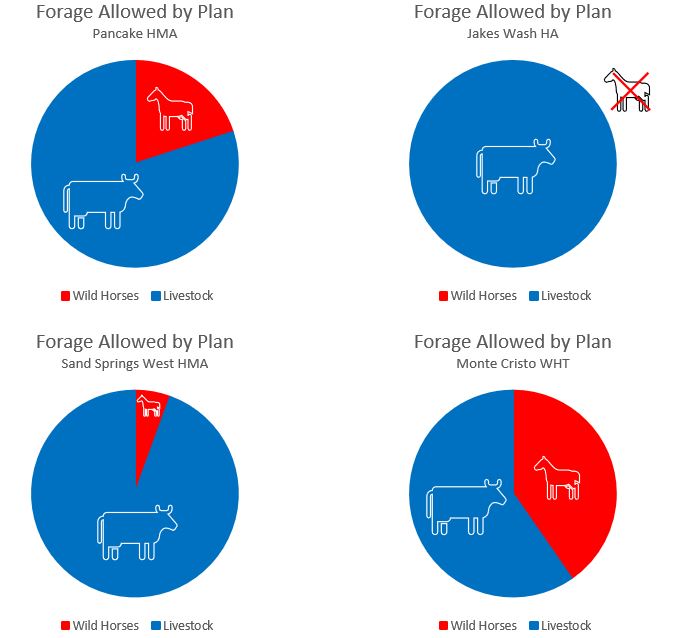
The Draft EA for wild horse management actions in the Pancake Complex provides forage allocations for horses and livestock.

Wild horse forage requirements are computed as AML × 12.  Refer to Table 1.

The forage assigned to livestock is computed as the sum of the permitted AUMs for each allotment times the portion of each allotment inside the wild horse area, assuming the resource is evenly distributed across those parcels.  Refer to Tables 3 – 6.

The forage assigned to wildlife has been ignored.  Cattle and sheep are authorized but an AUM is an AUM regardless of who eats it.

Pancake HMA

  • Forage to horses: 5,916 AUMs per year (20%)
  • Forage to livestock: 23,662 AUMs per year (80%)

Jakes Wash HA

  • Forage to horses: 0 AUMs per year (0%)
  • Forage to livestock: 8,024 AUMs per year (100%)

Sand Springs West HMA

  • Forage to horses: 588 AUMs per year (6%)
  • Forage to livestock: 9956 AUMs per year (94%)

Monte Cristo WHT

  • Forage to horses: 1,152 AUMs per year (40%)
  • Forage to livestock: 1,702 AUMs per year (60%)

These figures are compared in the following charts.

Pancake Complex Charts A-1

None of the areas are managed principally for wild horses.  Overall, livestock receive 85% of the authorized forage.

Don’t conclude that the Forest Service treats the horses better than the BLM.  You only need to look at the numbers from Devil’s Garden to see that’s not true.

RELATED: What’s Driving the Pancake Gather Plan?

Coming Soon: WHB Act at 50

Next year marks its fiftieth anniversary.

Today, most wild horse areas are managed primarily for livestock.

Most of the so-called advocacy groups are trying to ruin the herds with contraceptives.

The rancher-friendly ‘Path Forward‘ will remove 70% of the horses from America’s public lands.

There will be five times as many horses in contracted pastures as on the range.

What exactly are we supposed to celebrate?

RELATED: Fiftieth Anniversary ‘Celebration’ of WHB Act?

Red Desert Roundup Ends Early

The operation concluded on November 13, according to the daily reports, with 1,970 horses gathered, 10 deaths and 197 horses returned, including 100 mares treated with fertility control.

The incident began on October 10 and the gather target was 2,400.

The number of horses shipped was 1,404, leaving 359 unaccounted-for animals.

A news release said the gather could continue at a later date to return wild horse populations to appropriate management levels.

RELATED: Red Desert Gather, Part 2, Starts Next Month.

What Happened to Jakes Wash HMA?

Like the Moriah HMA, it was evaluated for forage, water, cover, space and reproductive viability, and found to be deficient in forage, water, space and cover, according to Section 3.3 of the Draft EA for wild horse management actions in the Pancake Complex.

It was demoted to a Herd Area in 2008 and managed for zero wild horses.  Some horses are present, however, according to Section 3.3, as many as 242.

An emergency roundup occurred in August due to insufficient water, which is consistent with the 2008 decision.

Roughly 8,000 AUMs per year are available to livestock, according to Table 4, which is not consistent with the 2008 decision.  Water shortages are alleviated by man-made sources, such as wells.

The forage assigned to livestock would support over 1,300 cow/calf pairs in a six month grazing season.  That’s equivalent to 650 wild horses.

Jakes Wash may be another example of management duplicity: Resources on public lands are low if you’re talking about wild horses but are more than adequate if you’re talking about privately owned livestock.

RELATED: Moriah’s Cousins, Paisley Desert Neighbors.

Understanding the Relationship Between Roundups and RMPs

Resource management plans determine, among other things, who gets what on America’s public lands.  They set the speed limits.

Roundups enforce those limits.  They are the highway patrol of the wild horse world.

If you exceed the limits, you don’t get a ticket, you are removed from the road.

That you can only go 20 while others can go 80 is beyond the scope of the program.

Wild Horse Management

Initial Thoughts on Pancake Gather Plan

Starting a list of comments on the Draft EA.

1.  Include a map showing the allotment boundaries relative to those of the wild horse areas.  [Are the horse areas 100% subject to permitted grazing?]

2.  Add the allotment sizes to Tables 3 – 6.  [What are the stocking rates for cattle and sheep and is the land more productive when designated for livestock?]

3.  What are the resource impacts of mineral extraction?  [What is the effect on water quality and availability?  How much forage has been lost to drilling and mining?  How many horses could be returned to the range if those activities were stopped?  Would that exceed the number of horses that could stay put if public-lands ranching was ended?]

4.  Add the appendix titles to the table of contents.

Comments regarding forage allocations and management priorities, although valid, should not be submitted.  They are beyond the scope of the project.

RELATED: What’s Driving the Pancake Gather Plan?

What’s Driving the Pancake Gather Plan?

The RMPs in the last paragraph of Section 1.0 in the Draft EA provide a frame of reference not for assessing the environmental consequences of the Proposed Action and its alternatives, but for evaluating the effectiveness of those options relative to the policies and goals therein.

For example, would you expect the No Action Alternative (Section 2.1) to be successful in achieving and maintaining AMLs in the planning area?  Would Alternative D do a good job of enforcing the resource allocations of the RMPs?

The total estimated forage assigned to privately owned livestock, based on data from Tables 3 – 6 in Section 3.7, is approximately 43,300 AUMs per year.

The AML for the Complex is 638, according to Table 1, requiring about 7,700 AUMs per year.  The forage diverted to livestock would support an additional 3,608 wild horses, for a true AML of 4,246.

If you believe the Complex should be managed primarily for livestock, as it appears to be, then Alternative A (the Proposed Action) is best.  It features roundups, fertility control, sex ratio skewing and castration.

Impacts to the horses will be great but those don’t count.

RELATED: Comments Invited on EA for Pancake Management Actions.

Comments Invited on EA for Pancake Management Actions

BLM announced today the availability of a preliminary environmental assessment for wild horse management actions in the Pancake Complex over a ten-year period.

Comments will be accepted through December 12, as noted in the news release.

The EA looks at the effects of a proposed action and several alternatives.

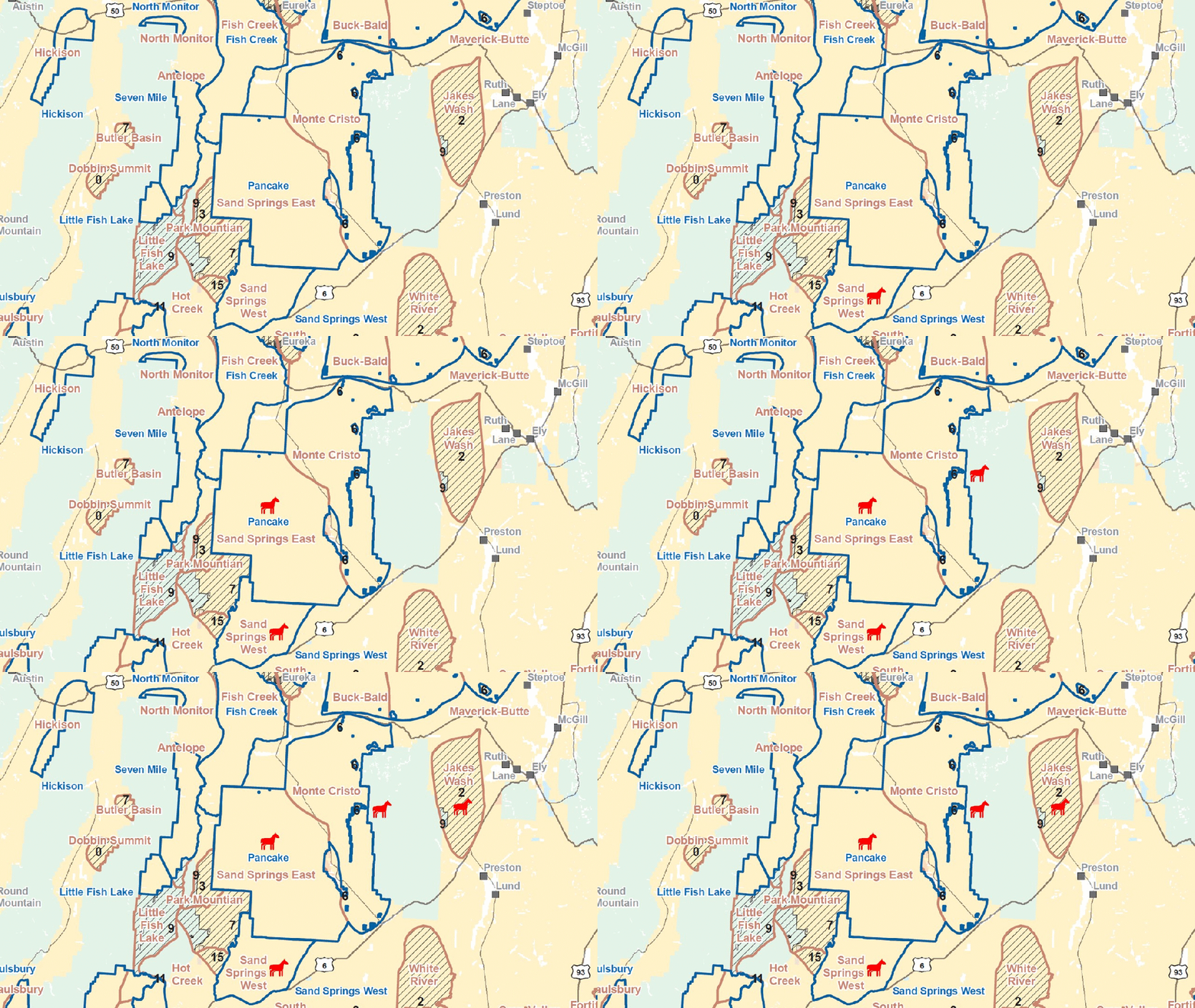
The Complex includes the Pancake and Sand Springs West HMAs, Jakes Wash HA and the Monte Cristo WHT.  The WHT, not shown in the following map, is on Forest Service land east Pancake.

Pancake Complex Map

Section 3.7 in the EA provides data for permitted grazing.  The numbers suggest the Complex is managed primarily for livestock.

Comments about resource allocations and management priorities should be avoided, they are outside the scope of the project.

R.I.P. Assateague Horse Census?

The Park Service counts the horses six times per year, in February, March, May, July, September, and November, according to a news release published in November, 2019.

Western Horse Watchers has been unable to find any data since March, 2020.

Did they stop doing it?  Probably not.

Why did they go underground?  Perhaps they don’t want you to see the long-term effects of the darting program.

What about other such programs?  There’s no accountability to the public.

Every group that administers a darting program, whether on public or private lands, should be required to produce a census count with demographics, at least once a year, so the American people can see what’s being done to their wild horses.

They already have the data.

Remember, there’s no such thing as birth control for horses, only safe and effective birth control for horses, and interfering with nature is a good alternative to roundups.

And above all, never talk about resource allocations, management priorities and privately owned livestock.

RELATED: Assateague Wild Horse Census Temporarily Halted?

Confusion at Confusion HMA About Cause and Effect?

Roundups, sterilization and long-term holding are effects.  They are outcomes of a process.  If you want to change the outcomes, you have to look upstream in the process.

Why are these effects occurring?

How much forage has been allocated to public-lands ranchers?  How many horses would it support?  What is the true AML?  How does the current herd size compare to that?  Would the roundup be necessary if the HMA was managed principally for wild horses?

Why is it managed primarily for livestock?  How are resource allocations determined?

Why are the horses treated like pests on land set aside for them?

RELATED: Confusion Wild Horses Get Short End of Stick.

Thriving Ecological Balance-3