The new rake works pretty darn well. When you’re spending two or more hours a day cleaning corrals, seven days a week, rain or shine, you look for labor-saving ideas.
RELATED: Gathers and Removals: Horse Poop Edition.


Exposing the Hypocrisy, Lies and Incompetence of the Wild Horse Advocates
The new rake works pretty darn well. When you’re spending two or more hours a day cleaning corrals, seven days a week, rain or shine, you look for labor-saving ideas.
RELATED: Gathers and Removals: Horse Poop Edition.
A rebuttal on CounterPunch pushes back against the public-lands ranchers and the November 18 article by The Washington Post.
The viewpoints expressed in the column are those of its writer and are not necessarily those of Western Horse Watchers.
The rancher mentioned in the original piece appears in the following video by Protect the Harvest, which was filmed on “the cattlemen’s land,” according to the narrator.
RELATED: Wild Horse Wars on Drudge, Fish Creek Gather Delayed.
A story by the Elko Daily Free Press published on November 24 probably has details but Western Horse Watchers did not read it because of the stupid GoogleQuestion. The title said it would occur near the Black Rock Desert, site of the Burning Man festival, so the Nevada gather page might be a better place to look.
The operation will begin on or around November 29, according to the Selenite gather page, and will be carried out with helicopters. It will be open to public observation.
The incident has not been announced on the BLM news page as of today. The NEPA project—on which the action is authorized—was not cited at the gather page but it is likely covered by the Blue Wing Gather Plan approved in 2017.
The Selenite Range HA is in the northwest corner of the massive Blue Wing – Seven Troughs allotment and is part of the Blue Wing Complex. It contains 125,300 acres and has no AML, according to Table 1 of the Final EA.

The gather target is 200, which is most, if not all, of the burros now living in the HA.
Captured animals will be taken to the off-range corrals at Palomino Valley.
Fifty six burros were removed from the HA in 2019, according to the gather page, but Western Horse Watchers was unable to find an announcement for that event.
A few members of Congress are still clinging to the idea, according to a news release issued today by Animal Wellness Action, a lobbying group in Washington, DC.
The measure does nothing to change the resource allocations and management priorities that leave America’s wild horses and burros with crumbs, forcing their removal from public lands in favor of privately owned livestock.
RELATED: Op-Ed Pushes Contraceptives.
Of current interest is the rabicano gene, signified by white hair at the base of the tail, according to a report published this morning by The Charlotte Observer.
How many cowboys were needed for a cattle drive with 3,000 head? What did they do at night to keep the herd content while they stopped to sleep?
Find out in the current edition of Horse Tales, a monthly newspaper produced in Gardnerville, NV. Questions on page 8, answers on page 19 [pdf].
There is hope, according to the writers of a guest column published yesterday in Horse Nation, not because the BLM has decided to change the resource allocations and management priorities on lands set aside for wild horses, but because Congress may force it to implement an $11 million darting campaign.
Do they not see that they’ve thrown in with the groups they criticize? Do they really want HMAs managed primarily for livestock? How many wild horse herds are truly overpopulated?
The Confusion HMA, subject of next week’s roundup, certainly isn’t. Would they start the darting program there? Before or after the roundup?
Next to the government and public-lands ranchers, the greatest threat to America’s wild horses is not the oil companies, not the mining companies, but many of the so-called advocacy groups.
BLM announced today that 500 wild horses will be gathered from the HMA starting on November 29, due to overpopulation. Approximately 480 horses will be removed, with a small group of mares returned to their home range after receiving “population growth suppression.”
The roundup—an enforcement action—will be carried out with helicopters, according to the news release, and will be open to public observation.
The HMA covers approximately 235,000 acres in western Utah and has an AML of 115.

The HMA intersects five allotments and is managed primarily for livestock. The current population of 661 is well within the true AML of 932.
Captured animals will be taken to the off-range corrals in Axtell.
Gather stats and daily reports will be posted to this page.
RELATED: Confusion Management Plan In the News.
The link pointed to a copy of the story in the Houston Chronicle.
The government spends $57 million per year to warehouse 52,000 wild horses and burros, according to a recent news release, so it can collect an estimated $850,000 in grazing fees from the ranchers to whom their food is sold.
Revenue = 52,000 horses × 12 AUMs per horse per year × $1.35 per AUM
With taxpayers making up the difference, the grazing program is a fine example of redistribution of wealth. That’s what Protect the Harvest is trying to protect.
RELATED: Wild Horse Wars?, Grazing Program Ancillaries.
Somewhere in Nevada with Donald Cool.
Corral cleaning is like leaf collection: You first have to gather the pieces into piles then transfer them into a container for removal.
The typical manure rake, on the right in the photos below, is made of plastic. It’s designed for scooping not raking. When you flip it over and use it as a rake, the tines break off, usually in the middle. It’s a productivity killer.
Home Depot has a True Temper leaf rake made of metal that works great for gathering the poop into piles. Only complaint is that the handle is a little short and made of metal. In the winter it will pull the heat out of your hands if you’re not wearing gloves.
Price is $16. It’s better and faster than a manure rake for horse poop roundups.

For the same reason you oppose roundups, fertility control, sex ratio skewing and castration: They’re all part of plan to manage wild horse areas primarily for livestock.
That is the goal of the ‘Path Forward‘ and those who signed it.
Everything is off the table until those areas are managed principally for wild horses, per the original statute.
The argument revolves around surgical procedures, not the resource allocations and management priorities for the HMA, in this story by The Salt Lake Tribune.
No mention of legal action that has been taken to stop or delay the plan.
RELATED: Stop the Ovariectomies, Use PZP Instead!

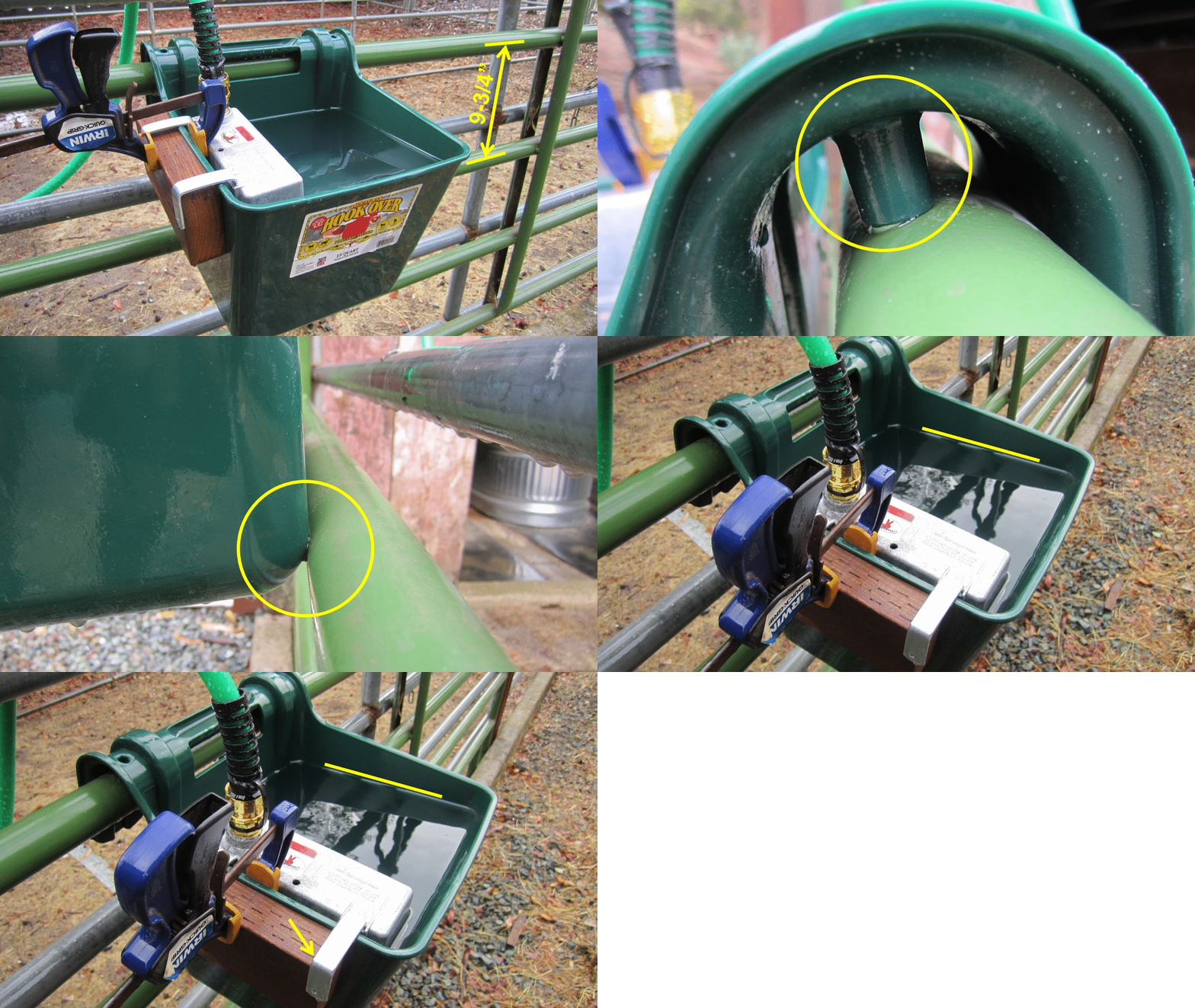
Duraflex buckets won’t work on pipe panels with rail spacings greater than ten inches.
The rails in the Powder River panel below are on 9-3/4″ centers. Lugs under the hooks lift the bucket, so the lower edge barely contacts the rail. The galvanized panel in the background has rails on 12″ centers.
The bucket tilts slightly when hooked over the panel, bringing the water level closer to the rim. Holes for the mounting block should be within an inch from the rim.
The block in these photos is still clamped to the bucket and the brackets for the valve haven’t been secured to it, allowing the valve to slide toward the front of the bucket.
The hose was purchased at Home Depot. The feed store used to carry them but not any more. The hose should have 3/4″ male thread on one end, to connect to the float valve, and a 3/4″ female thread on the other, to connect to a standard hose bibb.
A washing machine hose won’t work.
RELATED: Hookover Bucket Mock-Up.
BLM announced today the signing of a Decision Record authorizing certain wild horse management actions in the Nevada WHR over a ten-year period, subject to a 30-day appeal period.
The approved action (Alternative 1) features roundups, fertility control, sex ratio skewing and castration. Refer to Section 2.1 in the EA.
The WHR is in the northern portion of the Nevada Test and Training Range, covering roughly 1.3 million acres of public lands withdrawn for military use. As such, there is no public access to the area, including hunting, camping and livestock grazing.
The DR and EA were combined into one file and posted with other project documents.
RELATED: Comments Invited on Draft EA for Nevada WHR Roundups.
A rescue team used a special harness and a tractor last night to recover the horse and release it back into the wild, according to a report by KRQE News of Albuquerque, NM.
RELATED: Placitas Horse Freed from Gully.
UPDATE: Added video.
In yesterday’s news release about the WHB Program in FY 2020, BLM said it protects wild horses and burros by gathering and removing excess animals from the range and offering them for adoption or purchase at facilities and events around the country.
Except that’s not what Velma had in mind. They were to be protected on their home range.
Horse #81 is excess in an area where the AML is 80. Same for horse #240. The forage assigned livestock can support 450 of them, for a true AML of 530, so a roundup is not necessary.
If Congress wants to write letters to the Secretary of the Interior about the treatment of wild horses and burros, why not condemn public-lands ranching?
Refer to this report by KTVZ News of Bend, OR. Includes video.
RELATED: Forest Service to Reduce Big Summit AML.

The Animal Welfare Institute said in a news release yesterday that 58 lawmakers from both houses of Congress sent a letter to the Department of the Interior condemning the BLM’s plan to sterilize wild mares from the Confusion HMA in western Utah.
Instead, they suggested, wild horse populations should be controlled with PZP.
Nobody wants to talk about causes.
The HMA is managed primarily for livestock.
Look at the resource allocations and management priorities of the RMP.
Then you’ll understand why the AML is low and the desire to shrink the herd is high.
RELATED: Confusion DR Setting New Precedent in WH Management?
BLM said today that it removed 10,139 wild horses and burros from western rangelands in FY 2020 and placed 6,162 animals into private care through adoptions and sales.
The fiscal year began on October 1, 2019.
There are 52,000 wild horses and burros in off-range corrals and pastures, according to the news release, at a cost of $57 million annually.
The on-range population is now over three times higher than the number of animals the land can support in conjunction with other legally mandated uses.


