The contest raised over $1,500, at $2 per vote, according to a story posted today by the Maryland Coast Dispatch.
RELATED: Assateague Name-That-Foal Contest Starts Next Week.

Exposing the Hypocrisy, Lies and Incompetence of the Wild Horse Advocates
The contest raised over $1,500, at $2 per vote, according to a story posted today by the Maryland Coast Dispatch.
RELATED: Assateague Name-That-Foal Contest Starts Next Week.
Assertions are best. Rock your opponents back on their heels.
If you want to help America’s wild horses, don’t focus on the horses. The advocates focus on the horses. Look upstream in the management process. Change the policies and plans that put ranching interests far above those of the horses.
RELATED: Rift in Wild Horse World, Origin of AMLs?
The incident began on October 7. Gather stats through November 22:
Helicopters did not fly on Day 47. No explanation was given.
A mare ran into the corrals on Day 46 and broke her neck.
The advocates will claim that this and other such losses can be prevented by ending reproduction—not permitted grazing—in areas set aside for wild horses.
Foals represented 19.9% of the horses captured. Of the adults, 49.2% were male and 50.8% were female.
Body condition scores were not reported.
The death rate is 0.4%.
Gather activity continued at Salt Wells Creek. Five HMAs are involved in the roundup.

Day 47 ended with 59 unaccounted-for animals.
Other statistics:
RELATED: Rock Springs Roundup Day 44.
They, and their army of volunteers, steadfastly cling to their anti-horse agenda, under the tagline ‘Stay Wild.’
A source told Western Horse Watchers that the group was invited to sign the letter to Haaland seeking the removal of livestock from HMAs but declined.
They may want to “change the way the ship is run” (3:32) but the destination remains the same: Protect the policies and plans that assign most of the resources in areas set aside for wild horses and burros to privately owned cattle and sheep.
RELATED: Advocates Show Off Virginia Range Darting Program.
They’ve achieved zero population growth in two years, according to a story by KLAS News of Las Vegas, and are now letting the herd die off.
Darting begins when a mare is as young as 10 months old, boosters continue every 8 to 12 months, and then after five to seven years, the mare can no longer reproduce.
The program is sponsored by the Campaign Against America’s Wild Horses.
In northwest Colorado with Epic Mountain Hunter.
Send a film crew back to the HMA to see what type of animals filled the void!
RELATED: Bias in Sand Wash Reporting?
The policy change by the Sierra Club marks a widening gap among those who are trying to protect wild horse and burros.
On one side are the sellouts and charlatans—those who signed the rancher-friendly ‘Path Forward‘ and those who give tacit approval through their darting programs, which includes most of the advocates.
On the other side are the originalists—those who reject the ranching agenda and believe that areas set aside for wild horses and burros should be managed principally for wild horses and burros, as specified in the original statute.
The real estate agent and PZP darter who wrote the article about euthanizing foals in the current edition of Horse Tales also wrote the condescending article in last month’s edition about the dangers to wild horses posed by local residents.
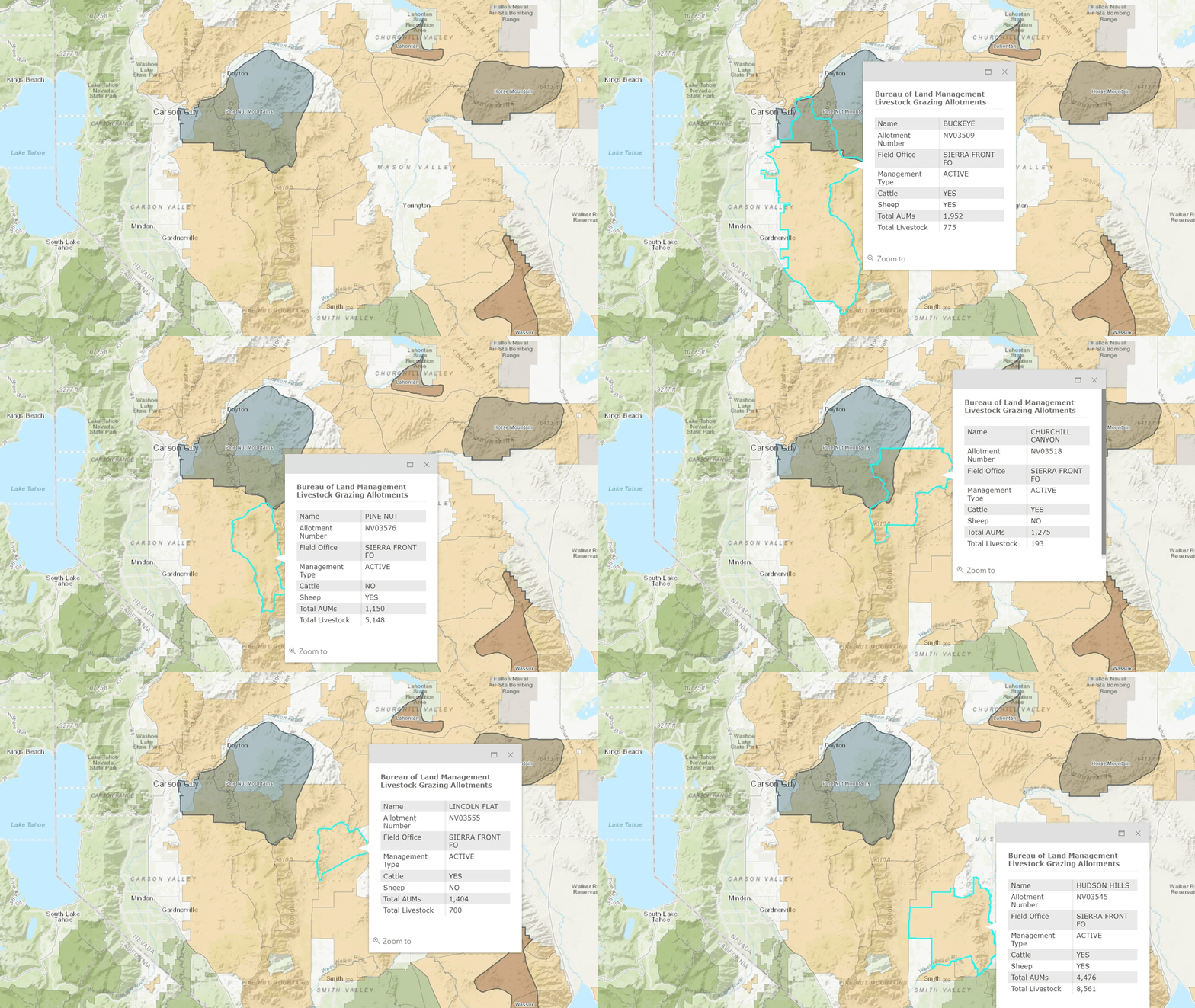
The Pine Nut HA, not shown in the Western Watersheds map, extends well to the south of the HMA. It’s drawn with a brown border on page 15 of the BLM map. The area was identified for wild horses in 1971 but has since been zeroed out. It has no AML.
The HA contains some private land, denoted by white.
Like the HMA, the HA intersects several grazing allotments, notably Buckeye, Sunrise and Pine Nut. All three are in the Improve category according to the Allotment Master report (click on map to open in new tab).
The author’s listings appear on the last page of this month’s edition of Horse Tales.
Some of the parcels have cattle fencing. Others are surrounded by BLM land and have no legal access. The description at the top says “Look for owner name Bently.”
Curiously, the permittee holding most of the active AUMs on the Buckeye Allotment is the Bently Family Limited Partnership.
Interesting.
Depends on how you weigh the value of horses, cattle, wildlife, economic growth and ecological sustainability, according to a column in the Herald Journal of Logan, UT.
The government already knows what resources are available and typically assigns most of them to privately owned livestock, as in this example from the Warm Springs HMA.

The 202 horses allowed by plan receive just 11% of the authorized forage, supporting an observation made earlier this week that livestock, not horses, are are the highly valued animals on western rangelands.
This is not a consequence of the original WHB Act but a result of changes wrought by FLPMA and PRIA, which promoted the interests of ranchers, not wild horses as suggested by the writer.
RELATED: Origin of AMLs?
The incident began on October 7. Gather stats through November 19:
The death rate in this roundup, described as cruel and inhumane by the advocates, is 0.4%. If they are disappointed by any of this it’s that the government is getting rid of the horses, not them.
Foals represented 20.1% of the horses captured. Of the adults, 48.4% were male and 51.6% were female.
Body condition scores were not reported.
Gather activity continued at Salt Wells Creek. Five HMAs are involved in the roundup.
Day 44 ended with 134 unaccounted-for animals.
Other statistics:
RELATED: Rock Springs Roundup Day 42.
A story by Tri-State Livestock News says the group now wants permitted grazing ended in areas set aside for wild horses.
That they had an alliance with the ranchers, or the appearance of one, casts a long shadow over the organization’s mission and intent.
In 1981, according to the report, the Sierra Club adopted a policy that referred to wild horses and burros as feral, to be eliminated from key wildlife habitat and carefully regulated to minimize conflict with wildlife, livestock and other range values.
But earlier this year, their Board of Directors adopted a new policy that likens wild horses and burros to wildlife, and calls for the elimination of livestock from herd management areas administered by the federal government.
The writer tries to downplay the presence of 3,000 domestic sheep in the Sand Wash Basin HMA two months after most of the horses were removed, noting that they were trailing to their winter range, but does not indicate if it was inside or outside the HMA.
The permittee has not been able use his authorized AUMs for over a decade because of overgrazing by wild horses.
The roundup likely fixed that, and the advocates are now working overtime to maintain the new status quo.
RELATED: Sand Wash Horses Get Short End of Stick.
The truth is not always pretty. Sometimes you have to put foals down, the subject of ‘Wild Horse Tales,’ a column in the November edition of Horse Tales.
The advocates like to talk about on-range management of wild horses but whenever they get involved, there are fewer of them on the range. Ever notice that?
The incident occurred on October 10 near Hartsel, CO, according to a story posted today by KUSA News of Denver.
A report published yesterday by The Flume of Bailey, CO said he roamed with a band of 15 animals. All were removed from the range.
There are no HMAs or WHTs in that part of the state but the Western Watersheds map shows BLM and USFS grazing allotments in the area.
Refer to Attachment 2 in the 2018 BLM report to Congress for the cost to remove an animal from his home range and place him into short-term or long-term holding.
The grazing fee is currently $1.35 per AUM.
RELATED: Economics of ‘Path Forward.’
The incident began on October 7. Gather stats through November 17:
The death rate dropped to 0.4%.
Foals represented 20.4% of the horses captured. Of the adults, 48.1% were male and 51.9% were female.
Body condition scores were not reported.
Gather activity continued at Salt Wells Creek. Five HMAs are involved in the roundup.
Day 42 ended with 213 unaccounted-for animals.
Other statistics:
RELATED: Rock Springs Roundup Day 39.
The group submitted a rulemaking petition to new BLM Director Tracy Stone-Manning, according to a news release, asking for the impact of cattle and sheep to be included in rangeland assessments and to immediately reduce the number of those animals within HMAs when any management actions are planned because of rangeland deterioration, followed by a phaseout of all livestock as grazing permits expire.
If the BLM denies the petition, the group will likely take the agency to court.
Western Horse Watchers believes that scientific methods are used to assess resource availability and reliability but the apportionment of those resources is arbitrary and subject to influence by special interests.
When wild horse and burro herds are too large, relative to available natural resources, they can cause substantial damage to rangeland forage plants and soils, outcompete native wildlife species for scarce water, spread invasive plant species such as cheatgrass, reduce sage-grouse populations, limit post-fire ecosystem recovery and affect authorized grazing, according to a statement at the bottom of page 3 in the Strategic Research Plan (page 4 in the pdf).
A statement on page 7 (page 8 in the pdf) says the driver of the fertility control research is the large and increasing number of excess horses and burros living on the range, relative to available resources.
These statements are misleading because they suggest the land can’t support the current number of animals.
They should refer to allocated resources, not available resources, and explain to readers that most of them have been assigned to privately owned livestock through a planning process that puts ranching interests far above those of the horses and burros.
A keyword search search of the document yielded these results:
As usual, Western Horse Watchers has to tell the other side of the story. Don’t expect the advocates to do that, they’re already riding the fertility control bandwagon.
RELATED: Wild Horse and Burro Research Initiative Announced, Origin of AMLs?
Development of safe, effective and longer-lasting fertility control methods is at the top of the list, along with the impact of climate change, according to today’s news release.
The research will support goals in a new Wild Horse and Burro Strategic Research Plan, which identifies topics that are the highest priority for improving BLM’s management of these “highly valued animals.”
No need to waste money on the second item, man-made global warming doesn’t exist.
As for the first item, is it consistent with the idea of highly valued animals?
In a statement following his arrest, a man who beat his wife, pushed her down the stairs and left her stranded on the edge of the road said he loves her.
Do you believe him?
If the bureaucrats take away almost half of their land and manage it principally for livestock, assign 85% of the food on the remainder to privately owned cattle and sheep, and use population suppression to keep the resource scales tipped indefinitely in favor of the ranchers, would you say they’re talking about highly valued animals?
Of course not. You know them by their works, not by their words.
The removal of a large amount of horses is absolutely necessary to maintain the balance for all wildlife, according to the author of a guest column in today’s edition of the White Mountain Independent.
The preliminary EA and management plan were posted under the Analysis tab with other project documents.

