More Wild Horse FAQs

Q. What do you call a wild horse removal contractor masquerading as an advocacy group?

A. The Campaign Against America’s Wild Horses.

Q. What do you call an EPA-registered pesticide that can only be used on female horses and burros that are capable of doing environmental damage?

A. Zonastat-H.

Q. What do you call the application of said pesticide by said group on herds that pose a safety hazard or are thought to be overpopulated?

A. Illegal.

RELATED: Wild Horse FAQs.

Alpine Horses Wild or Feral?

A story dated June 2 by Courthouse News takes a closer look at the debate, but two issues deserve further attention.

Hypocrisy of the advocates—

Simone Netherlands, president of the Salt River Wild Horse Darting Group, said removing horses from public land is “ungrateful” behavior given their significant role in American history.

What is she doing with the aid of her volunteers?  Getting rid of wild horses on public lands with an ovary-killing pesticide.

Silence about permitted grazing—

Wherever you find wild horses you’ll find permitted garzing, with few exceptions.

Horses appear in the North American fossil record but cattle and sheep do not, yet horses are cited as the nonnative/invasive species.

RELATED: Salt River Advocates Accuse Forest Service of Harming Foals!

Foal-Free Friday, Snubbing the Advocates Edition

The June meeting in Reno of the Wild Horse and Burro Advisory Board offered two opportunities to observe the poisoning of mares with fertility control pesticides, but the BLM opted to visit the Blue Wing Complex instead.

Why didn’t they choose the Virginia Range or Pine Nut Mountains, where advocates affiliated with the Campaign Against America’s Wild Horses are suppressing the herds for the benefit of animal agriculture, a purpose for which PZP was not registered?

Let Us Fix Your Wild Horse Problem 02-18-23

Desperate for acceptance and approval, the advocates could explain their philosophy of managing the numbers to fit what’s available for the horses: As the bureaucrats shift more acreage and food to the public-lands ranchers, wild horse numbers must go down, and they have a better way.

On the other hand, Board members accompanied by plain-clothes law enforcement agents could gather information leading to the arrest and conviction of those involved.

If done amicably, they might even go home with “Stay Wild” caps worn by participants and supporters of the programs.

RELATED: Foal-Free Friday, Reinforcing the Status Quo Edition.

Impact of Fiscal Responsibility Act of 2023?

The debt ceiling bill cleared the House last night by a vote of 314-117.

A keyword search of the pdf yielded these results:

  • Horse – 0 occurrences
  • Burro – 0
  • Advocate – 0
  • Pesticide – 0
  • Livestock – 0
  • Allotment – 0
  • Grazing – 0
  • Forage – 0
  • Cattle – 0
  • Sheep – 0
  • AUM – 0
  • RMP – 0
  • BLM – 0
  • PZP – 0

Looks like it won’t have a big effect on the wild horse world, at least not directly.

Deerwood Ranch Open House Next Month

The privately owned off-range pasture west of Laramie, WY will open its doors to the public on June 10, according to a story dated May 30 by This Is Laramie.

The ranch, listed as “Centennial” in the Off-Range Facilities Report, has a capacity of 350 excess animals, horses displaced from their lawful homes by permitted grazing.

It was threatened but not damaged by the Mullen Fire in 2020.

How Many Wild Horses Can the Black Mountain HMA Support?

The Draft EA for pest control actions in the Owyhee Front states in Section 1.1 that the HMA intersects the Hardtrigger, Rabbit Creek and East Reynolds Creek allotments.

The National Data Viewer indicates a small amount of overlap on the west side with the Reynolds Creek allotment but that will be ignored.

Black Mountain HMA with Allotments 05-30-23

The HMA covers 50,904 total acres in western Idaho, including 47,434 public acres, according to the 2023 HA/HMA Report.

The 60 horses allowed by plan require 720 AUMs per year.

The stocking rate allowed by plan is 1.3 wild horses per thousand public acres.

The current population is thought to be 104, according to Table 1 in the EA, plus this year’s foal crop.

There are three layers of forage demand in the HMA: Horses, livestock and wildlife.

  • The carrying capacity of the HMA, referred to on these pages as the True AML, depends on the horse and livestock layers
  • The True AML represents the number of horses the HMA could support if it was managed principally for them, as specified in the original statute
  • Overpopulation means more horses than allowed by plan, not necessarily more horses than the land can support
  • The livestock layer represents horses displaced from their lawful home by permitted grazing, now in off-range holding
  • The allotments mean the HMA is used for animal agriculture, a purpose for which the fertility control pesticides were not registered
  • Persons who apply the products in this manner should be investigated by law enforcement, along with those who authorize them
  • The “vaccines” are on the same EPA list as toxic chemicals

The Allotment Master Report provides acreage, management status and active AUMs.

Black Mountain Allotment Calcs 05-30-23

The allotments are in the Improve category.

They offer a weighted-average 62.3 AUMs per year per thousand public acres, equivalent to 5.2 wild horses per thousand public acres.

This is on top of the 1.3 wild horses allowed by plan.

Therefore, the True AML should be around (1.3 + 5.2) × 47,434 ÷ 1,000 = 308, 5.1 times higher than the current AML.

The stocking rate at the new AML would be 1.3 + 5.2 = 6.5 wild horses per thousand public acres, considerably higher than the target rate of one wild horse per thousand acres associated with a thriving ecological balance (27,000 animals on 27 million acres).

The number of horses displaced by permitted grazing is 308 – 60 = 248, about 0.4% of those in off-range holding.

If you performed this analysis for every HA/HMA/WHT—better yet, the government reported the forage assigned to livestock in every HA/HMA/WHT—you’d find that all of the off-range corrals and long-term pastures could be emptied several times over by ending permitted grazing in areas identified for wild horses.

The HMA is managed primarily for animal agriculture, with livestock receiving 80% of the authorized forage, neglecting wildlife.

In a nutshell, the land-use plan allows 60 wild horses in the HMA, plus livestock equivalent to 248 cow/calf pairs, seven days a week, twelve months per year.

The True AML can be achieved by confining the ranchers to their base properties in a year-round off season.

The Wild Horse Fire Brigade, established by a rancher for the benefit of ranchers, would move the horses to a remote wilderness area not particularly suited to livestock grazing, giving the permittees access to all of their food.

RELATED: Owyhee Resource Enforcement Plan Out for Review.

Thriving Ecological Balance-3

How Many Wild Horses Can the Hardtrigger HMA Support?

The HMA intersects the Elephant Butte, Rats Nest, Reynolds Creek, Shares Basin and Hardtrigger allotments, as stated in Section 1.1 of the Draft EA for pest control actions in the Owyhee Front.

The National Data Viewer shows the arrangement.  Click on image to open in new tab.

Owyhee HMAs with Allotments 05-28-23

The allotments represent another layer of forage demand in the HMA, probably the largest, in addition to that of wildlife and wild horses.

  • The carrying capacity of the HMA, referred to on these pages as the True AML, depends on the wild horse and livestock layers
  • The True AML represents the number of horses the HMA could support if it was managed principally for them, as Velma and the 92nd Congress intended
  • Overpopulation means more horses than allowed by plan, not necessarily more horses than the land can support
  • The livestock layer represents horses displaced from their lawful home, now stockpiled in off-range holding
  • The allotments mean the HMA is subject to animal agriculture, a purpose for which the fertility control pesticides were not registered
  • Those who apply the products in this manner should be investigated, along with those who authorize them

Tables 5 and 6 in the EA refer to the Wildcat allotment, not Rats Nest, and include two other allotments that overlap the HMA in negligible amounts.

The HMA covers 69,910 total acres in western Idaho, including 62,149 public acres, according to the 2023 HA/HMA Report.

The 130 horses allowed by plan require 1,560 AUMs per year.

The stocking rate allowed by plan is 2.1 wild horses per thousand public acres.

The Allotment Master Report provides acreage, management status and active AUMs.

Hardtrigger Allotment Calcs 05-28-23

All five allotments are in the Improve category.

The allotments offer a weighted-average 96.5 AUMs per year per thousand public acres, equivalent to eight wild horses per thousand public acres.

This is on top of the 2.1 wild horses allowed by plan!

Therefore, the True AML should be around (8.0 + 2.1) × 62,149 ÷ 1,000 = 628, 4.8 times higher than the current AML.

The current population is thought to be 101, plus this year’s foal crop, according to Table 1 in the EA.

The number of horses displaced from the HMA by permitted grazing is 628 – 130 = 498, about 0.8% of those in off-range holding.

The HMA is managed primarily for animal agriculture, with livestock receiving 79% of the authorized forage, neglecting wildlife.

In a nutshell, the land-use plan allows 130 wild horses and livestock equivalent to 498 cow/calf pairs in the HMA, seven days a week, twelve months per year.

The True AML can be achieved by confining the ranchers to their base properties in a year-round off season.

The Wild Horse Fire Brigade would move the horses to a remote wilderness area, not particularly suited to livestock grazing, giving the ranchers access to all of their food.

The HMA does not have an HMAP.  If it did, the document would comply with the forage allocations above.

RELATED: Owyhee Resource Enforcement Plan Out for Review.

Forage Allocations in HMAs

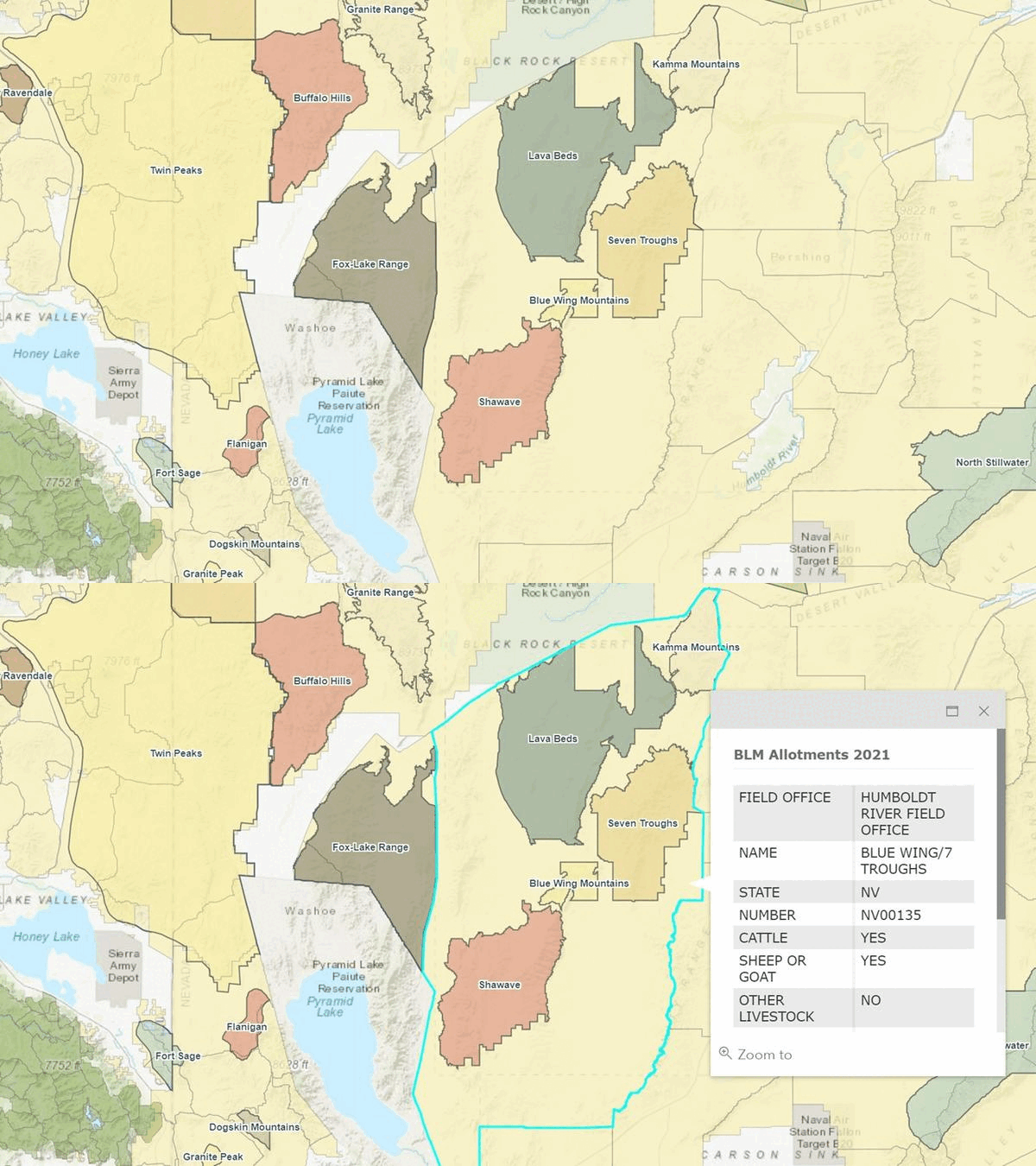
WHBAB Educational Tour Set for Blue Wing Complex

Participants must register in advance according to today’s news release.

The Complex lies within the massive Blue Wing / Seven Troughs Allotment.

Only one of the four permittees will be active on the date of the tour.

The other three are in their off seasons.

You may want to ask your tour guide how resources have been allocated between wild horses, livestock and wildlife.

Five HMAs are affected.

RELATED: WHBAB Meeting Returning to Traditional Format.

Blue Wing Complex Allotment Map 07-30-22

Economic Benefits of Multiple Use in FY 2021

A new report shows economic output on BLM lands in FY 2021.

It was announced in a blog post dated May 23.

Which states lead the way in each category?

  • Grazing – Idaho
  • Timber – Oregon/Washington
  • Recreation – Utah
  • Renewables – California
  • Coal – Wyoming
  • Nonenergy Minerals – Nevada
  • Oil and Gas – New Mexico

The least valuable use of public lands, in terms of economic output, is livestock grazing and the greatest is oil and gas production.  Click on image to open in new tab.

An interesting exercise would be to compute economic output per acre used and show the results in a bar graph.

Economic Output of BLM Lands in FY 2021 05-26-23

It’s Back: Helicopter Ban for 2023

The bill would not end wild horse removals from public lands, an idea that keeps livestock operators up at night.

Instead, it would achieve more humane and cost-effective methods to gather equine populations, according to a story posted today by the Las Vegas Sun.

The text has not appeared at Congress.gov as of this evening.

Last year’s version was nicknamed the Save a Horse, Hire a Cowboy Act.

Everything went south when film from the Buffalo Hills roundup showed a wrangler—a hero in the new management method and a steward of our public lands—abusing a foal!

RELATED: New Tagline for Helicopter Ban.

Stock Tanks Buried

The water system was put back in service yesterday but trailcam photos from February show the tanks covered in snow, well over two feet deep.

This went on for at least three months, as “atmospheric rivers” rolled across California and into Nevada, starting on December 31.

With access to little food and water at the higher elevations, the horses either migrated to lower elevations or died.

All this as the advocates, relentless in their pursuit of the horses and desperate for the approval of the bureaucrats and ranchers, press on with their ruinous darting program, now in its fifth year, putting many of the mares at risk of sterility.

RELATED: Buried on the Virginia Range.

Stock Tanks Buried 02-25-23

SB90 Dies in Committee?

The status on NELIS as of today is no further action allowed per Joint Standing Rule No. 14.3.3.

The bill cleared the Senate but timed out in the Assembly.

The advocates did a great job painting wild horses as pests, a message that resonated with at least one member of the Committee, who asked in the May 16 hearing if any other states had invasive species as their state animal.

Video queued up to the mark, just hit Go.

RELATED: Assembly Committee Hears SB90.