BLM Responds to Antelope Legal Complaint

The agency believes it’s complying with the Comprehensive Animal Welfare Program, citing “sensational allegations” in the lawsuit, according to a story dated August 8 by KLAS News.

The North roundup is approximately 80% complete, although it was suspended yesterday for a “resource flight.”

The South roundup concluded on July 26.

The report indicated that a similar complaint had been filed in Oregon by The Cloud Foundation, seeking real-time monitoring of gather operations.

Attention will shift to that area next week when three roundups are scheduled to begin.

The group’s founder stated that “The public has the right to see how our federal government is using our tax dollars and how the agency is treating America’s wild horses and burros.”

Your host believes the American people need to know how the advocates, including TCF, are treating wild horses and burros.

Deniz Bolbol TCF Darter 03-11-23

They think the agency should be controlling their numbers with pesticide-laced darts, not motorized equipment, so ranchers can access most of the food and water in their lawful homes.

RELATED: Antelope Legal Action Unlikely to Stop Roundup?

Antelope Roundup North, Day 31

The incident began on July 9.  Results through August 8:

  • Scope: Spruce-Pequop, Goshute, Antelope Valley HMAs
  • Purpose: Pest control, resource enforcement, rancher protection
  • Target: Horses
  • Type: Planned
  • Method: Helicopter
  • Category: Cruel and costly*
  • Better way: Poison mares with ovary-killing pesticides*
  • Captured: 1,607, up from 1,568 on Day 29
  • Average daily take: 51.8
  • Capture goal: 2,000
  • Removal goal: 2,000
  • Returned: 5, no change from Day 29
  • Deaths: 21, no change from Day 29
  • Shipped: 1,563, up from 1,490 on Day 29

The figures above are based on the daily reports, not the totals posted by the BLM.

The number of horses captured is 1,613 and the number shipped is 1,565 according to the figures in the sidebar.

Gather operations were suspended in favor of a “resource flight” on Day 31.

The death rate is 1.3%.

The capture total includes 629 stallions, 735 mares and 243 foals.

Youngsters represented 15.1% of the animals gathered.

Of the adults, 46.1% were male and 53.9% were female.

A 15% birth rate corresponds to a growth rate of 10% per year, a bit less than the 20% growth rate used by land managers to predict herd sizes and management actions.

Body condition scores on Day 30 ranged from 3 to 5.

The location of the trap site was not disclosed.

The HMAs and surrounding lands are subject to permitted grazing.

*According to advocates.

Antelope Complex with Allotments 07-06-23

Day 31 ended with 18 unaccounted-for animals.

Other statistics:

  • Forage liberated to date: 19,224 AUMs per year
  • Water liberated to date: 16,020 gallons per day
  • Forage assigned to livestock: Unknown
  • Horses displaced from area by permitted grazing: Unknown
  • True AML: Unknown
  • Stocking rate at new AML: Unknown
  • Horses removed because of drilling and mining: Ask the advocates

Overpopulation means more horses than allowed by plan, not necessarily more horses than the land can support.

RELATED: Antelope Roundup North, Day 29.

How Many Wild Horses Can the Hog Creek HMA Support?

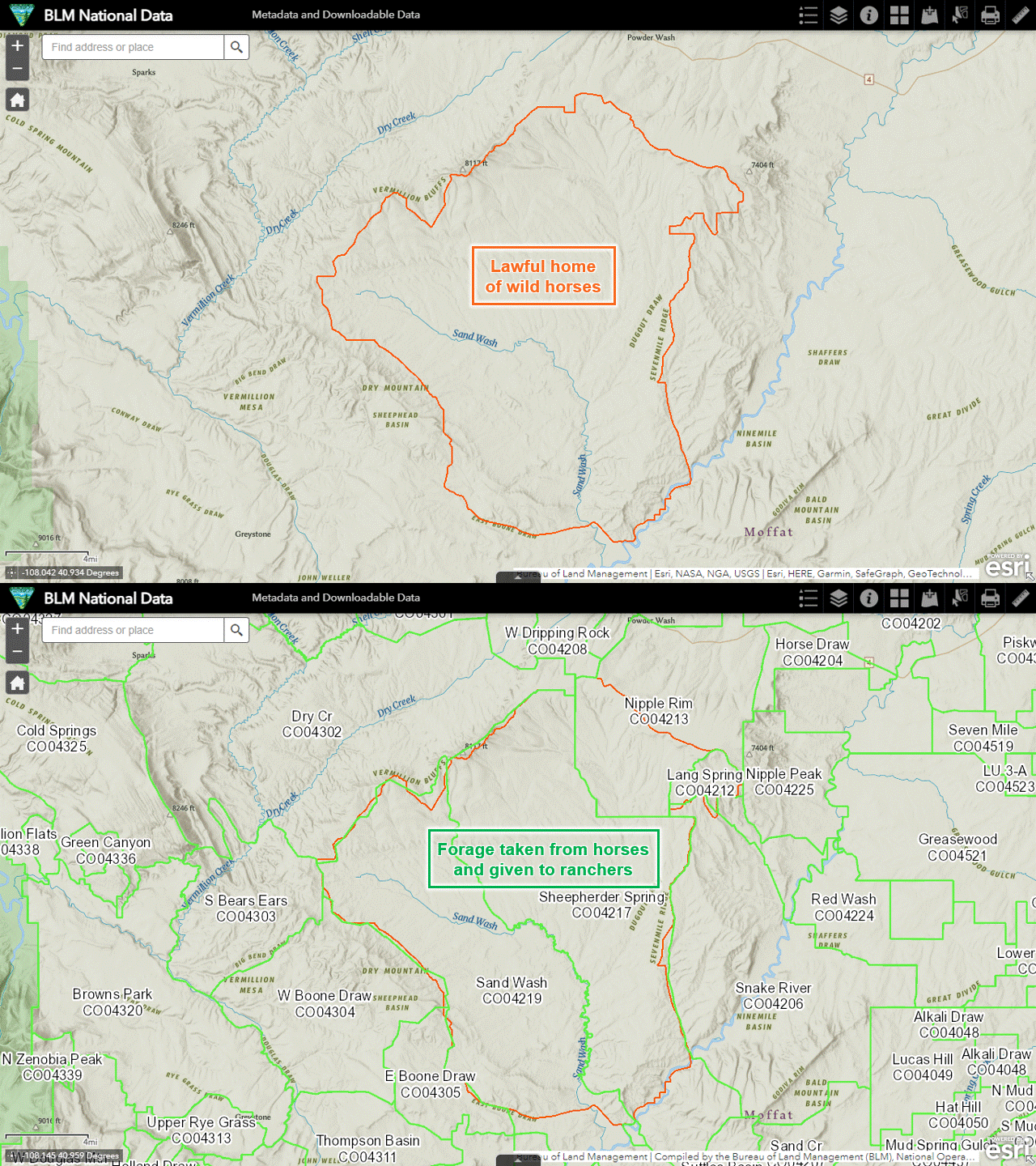
The HMA is a subset of Allotment #4, which offers 5,502 active AUMs on 58,369 public acres, according to the Allotment Master Report.

The HMA covers 22,381 total acres, including 21,819 public acres, according to the 2023 HA/HMA Report, and the AML ranges from 30 to 50.

The forage assigned to livestock inside the HMA would be 21,819 ÷ 58,369 × 5,502 = 2,057 AUMs per year, assuming the resource is distributed evenly across the parcel.

The number of horses displaced from the HMA by permitted grazing is 2,057 ÷ 12 = 171.

The True AML would be 50 + 171 = 221, to be achieved by confining the ranchers to their base properties and expecting them to pay the going rate to feed their animals.

The stocking rate at the new AML would be 221 ÷ 21,819 × 1,000 = 10.1 wild horses per thousand public acres, ten times higher than the target rate across all HMAs of one wild horse per thousand acres (27,000 anmials on 27 million acres).

The BLM collects 2,057 × 1.35 = $2,777 per year from ranching activity inside the HMA, while it spends 171 × 5 × 365 = $312,075 per year to care for horses displaced thereby.

Would you say that’s a wise use of public lands?

RELATED: Hog Creek Roundup Announced.

Hog Creek HMA with Allotments 08-08-23

Nonreproducing Herd Coming to Hog Creek HMA?

The roundup will take all horses off the range.

Thirty will be released.

The July 13 schedule indicates that 15 will be treated with fertility control.

The balance will probably be stallions.

The post-gather population will consist of 15 stallions and 15 barren mares.

The growth rate may go negative.

The breeding population will be zero.

If the pesticide-of-choice is GonaCon Equine, will it be applied unlawfully as at Reveille HMA?

RELATED: Hog Creek Roundup Announced.

Hog Creek Roundup Announced

The incident will begin on or around August 21, according to a BLM news release, but the capture and removal goals were not given.

The July 13 schedule shows 66 and 36.

The current population is thought to be 66, suggesting it’s a purge—all horses will be taken off the range, followed by selective return.

A helicopter will push them into the trap and the two-day operation will be open to public observation.

The announcement did not indicate if any of the retained mares would be treated with fertility control pesticides.

The HMA covers 22,381 total acres in eastern Oregon, including 21,819 public acres, according to the 2023 HA/HMA Report, and the AML ranges from 30 to 50.

At the upper end, the AML corresponds to a forage demand of 27.5 AUMs per year per thousand public acres.

The stocking rate allowed by plan is 2.7 wild horses per thousand public acres.

The HMA lies within Allotment #4.

The National Data Viewer shows the arrangement.  Click on image to open in new tab.

Hog Creek HMA with Allotments 08-08-23

The parcel offers 5,502 active AUMs on 58,369 public acres, according to the Allotment Master Report, or 94.3 AUMs per year per thousand public acres of forage supply.

That resource would support 94.3 × 21,819 ÷ 1,000 ÷ 12 = 171 wild horses, on top of the 50 allowed by plan, for a True AML of 221.

The stocking rate would be 10.1 wild horses per thousand public acres, on par with the Virginia Range before the advocates got involved.

The HMA is not overpopulated.

You don’t have a wild horse problem, you have a resource management problem.

Animals identified for removal will be taken to the off-range corrals in Hines.

A link to the gather stats and daily reports was not provided but should be added to the Oregon gather and removal page before the start date.

Antelope Roundup Summary, Day 29

The incidents began on July 9.  The North roundup continues.  The South roundup ended on July 26.

Combined results through August 6:

The figures above are based on the daily reports, not the totals posted by the BLM.

The death rate is 1.2%.

The capture total includes 980 stallions, 1,224 mares and 471 foals.

Youngsters represented 17.6% of the animals gathered.

Of the adults, 44.5% were male and 55.5% were female, still outside the expected range of variation from a simple random process centered at 50% males / 50% females with a sample of 2,204 adults.

A birth rate of 18% per year corresponds to a herd growth rate of 13% per year.

Day 29 ended with 52 unaccounted-for animals.

The HMAs and surrounding lands are subject to permitted grazing, with livestock receiving over seven times more forage than horses inside the Complex.

That resource would support an additional 6,079 wild horses, putting the True AML at 6,868.

Overpopulation means more horses than allowed by plan, not necessarily more horses than the land can sustain.

*According to advocates.

RELATED: Antelope Roundup North, Day 29Antelope Roundup South Over.

Antelope Complex with Allotments 07-06-23

Antelope Roundup North, Day 29

The incident began on July 9.  Results through August 6:

  • Scope: Spruce-Pequop, Goshute, Antelope Valley HMAs
  • Purpose: Pest control, resource enforcement, rancher protection
  • Target: Horses
  • Type: Planned
  • Method: Helicopter
  • Category: Cruel and costly*
  • Better way: Poison mares with ovary-killing pesticides*
  • Captured: 1,568, up from 1,530 on Day 27
  • Average daily take: 54.1
  • Capture goal: 2,000
  • Removal goal: 2,000
  • Returned: 5, no change from Day 27
  • Deaths: 21, no change from Day 27
  • Shipped: 1,490, up from 1,449 on Day 27

The figures above are based on the daily reports, not the totals posted by the BLM.

The number of horses captured is 1,574 and the number shipped is 1,492 according to the figures in the sidebar.

The death rate is 1.3%.

The capture total includes 612 stallions, 717 mares and 239 foals.

Youngsters represented 15.2% of the animals gathered.

Of the adults, 46.0% were male and 54.0% were female.

A 15% birth rate corresponds to a growth rate of 10% per year, a bit less than the 20% growth rate used by land managers to predict herd sizes and management actions.

Body condition scores on Days 28 and 29 ranged from 3 to 5.

The location of the trap site was not disclosed.

The HMAs and surrounding lands are subject to permitted grazing.

*According to advocates.

Antelope Complex with Allotments 07-06-23

Day 29 ended with 52 unaccounted-for animals.

Other statistics:

  • Forage liberated to date: 18,756 AUMs per year
  • Water liberated to date: 15,630 gallons per day
  • Forage assigned to livestock: Unknown
  • Horses displaced from area by permitted grazing: Unknown
  • True AML: Unknown
  • Stocking rate at new AML: Unknown
  • Horses removed because of drilling and mining: Ask the advocates

Overpopulation means more horses than allowed by plan, not necessarily more horses than the land can support.

RELATED: Antelope Roundup North, Day 27.

Johnnie Roundup Over

The incident concluded on August 5 with 16 horses captured, 16 shipped and none dead, and 115 burros captured, 114 shipped and one dead.

There were no unaccounted-for animals.

The capture goals were 25 horses and 100 burros.  The removal goals were identical.

The capture total for horses included four stallions, eight mares and four foals.

For burros, the total included 47 jacks, 58 jennies and 10 foals.

The gather received little if any news coverage.

UPDATE: BLM issued news release on August 7.

RELATED: Johnnie Roundup Announced.

Antelope Legal Action Unlikely to Stop Roundup?

The complaint seeks a temporary restraining order, but a hearing will not occur before August 10, according to a story dated August 4 by KLAS News.

The BLM is scheduled to file a response tomorrow.

The south roundup concluded on July 26.

The average daily take in the north roundup since July 27, when a second helicopter was put into service (probably from the south unit), is 105.

With 1,530 horses captured as of August 4, and a goal of 2,000, operations will probably conclude by the hearing date.

RELATED: Antelope Roundup North, Day 27.

Reveille HMA to Become Crime Scene?

The roundup ended July 3.  Up to 27 mares were to be treated with GonaCon Equine and be returned to the range, along with 26 stallions.

As of today, 30 stallions have been released but no mares, suggesting they’re awaiting a second dose.

The booster can only be given 90 or more days after the primer, according to a 2017 EPA labeling amendment.

Gonacon 90-Day Requirement 07-01-23

If the gather page shows the return of mares before October 1, the booster dose was dropped or it was given illegally.

GonaCon Violation of Federal Law 08-05-23

Sadly, the advocates have already designated most wild horse areas as crime scenes.

Crime in the Wild Horse World 05-26-22

But they’ve joined forces with the bureaucrats and ranchers to fix the problem once and for all.

RELATED: BLM Using Outdated Information to Apply GonaCon Equine?

Working Together for a Horse-Free Future 12-21-22

Johnnie Roundup, Day 15

The incident started on July 20.  Results through August 3:

No horses were captured on Days 14 and 15, leaving the total at 16.

The goal was 25.

All have been shipped.

Eleven burros were caught on Day 14 followed by 18 on Day 13, bringing the total 115.

The goal was 100.

Sixty-six have been shipped, no change from Day 13.

No deaths were reported and no animals have been returned to the range.

Youngsters represented 8.7% of the burros gathered.

Of the adults, 44.8% were male and 55.2% were female.

At the end of Day 15, there were 49 unaccounted-for burros.

The location of the trap site was not disclosed.

With a score of -9 for the horses and +15 for the burros, the incident will likely conclude this weekend.

RELATED: Johnnie Roundup, Day 13.

Antelope Roundup North, Day 27

The incident began on July 9.  Results through August 4:

  • Scope: Spruce-Pequop, Goshute, Antelope Valley HMAs
  • Purpose: Pest control, resource enforcement, rancher protection
  • Target: Horses
  • Type: Planned
  • Method: Helicopter
  • Category: Cruel and costly*
  • Better way: Poison mares with ovary-killing pesticides*
  • Captured: 1,530, up from 1,344 on Day 25
  • Average daily take: 56.7
  • Capture goal: 2,000
  • Removal goal: 2,000
  • Returned: 5, no change from Day 25
  • Deaths: 21, up from 17 on Day 25
  • Shipped: 1,449, up from 1,251 on Day 25

The figures above are based on the daily reports, not the totals posted by the BLM.

The number of horses captured is 1,536 and the number shipped is 1,451 according to the figures in the sidebar.

A mare and colt were put down on Day 26 due to pre-existing fractures.  A mare was euthanized on Day 27 due to a tumor and a stallion was dispatched due to curvature of the spine.

All four survived the chase and would probably be alive today if there was no roundup.

The death rate is 1.4%.

The capture total includes 600 stallions, 699 mares and 231 foals.

Youngsters represented 15.1% of the animals gathered.

Of the adults, 46.2% were male and 53.8% were female.

A 15% birth rate corresponds to a growth rate of 10% per year, a bit less than the 20% growth rate used by land managers to predict herd sizes and management actions.

Body condition scores on Days 26 and 27 ranged from 2 to 4.

The location of the trap site was not disclosed.

The HMAs and surrounding lands are subject to permitted grazing.

*According to advocates.

Antelope Complex with Allotments 07-06-23

Day 27 ended with 55 unaccounted-for animals.

Other statistics:

  • Forage liberated to date: 18,300 AUMs per year
  • Water liberated to date: 15,250 gallons per day
  • Forage assigned to livestock: Unknown
  • Horses displaced from area by permitted grazing: Unknown
  • True AML: Unknown
  • Stocking rate at new AML: Unknown
  • Horses removed because of drilling and mining: Ask the advocates

Overpopulation means more horses than allowed by plan, not necessarily more horses than the land can support.

RELATED: Antelope Roundup North, Day 25.

McCullough Peaks Bait Trap Removal Tops Most Active List

The project has received 1,241 comments as of this evening.

The numbers change minute-by-minute.

A petition at Change dot org equates bait trap removal to killing wild horses by running them to death, a process that will greatly reduce the population in the national park.

Don’t worry though, advocates with Friends of a Legacy are already on the job.

RELATED: Draft EA for McCullough Pest Control Out for Review.

McCullough Peaks Tops Most Active List 08-03-23

Antelope Roundup North, Day 25

The incident began on July 9.  Results through August 2:

  • Scope: Spruce-Pequop, Goshute, Antelope Valley HMAs
  • Purpose: Pest control, resource enforcement, rancher protection
  • Target: Horses
  • Type: Planned
  • Method: Helicopter
  • Category: Cruel and costly*
  • Better way: Poison mares with ovary-killing pesticides*
  • Captured: 1,344, up from 1,201 on Day 23
  • Average daily take: 53.8
  • Capture goal: 2,000
  • Removal goal: 2,000
  • Returned: 5, up from 2 on Day 23
  • Deaths: 17, no change from Day 23
  • Shipped: 1,251, up from 1,126 on Day 23

The figures above are based on the daily reports, not the totals posted by the BLM.

The number of horses captured is 1,350 and the number shipped is 1,253 according to the figures in the sidebar.

The death rate is 1.3%.

A stallion was released (or escaped) on Day 24, followed by two more on Day 25, but no details were given.

The capture total includes 523 stallions, 612 mares and 209 foals.

Youngsters represented 15.6% of the animals gathered.

Of the adults, 46.1% were male and 53.9% were female.

A 16% birth rate corresponds to a growth rate of 11% per year, a bit less than the 20% growth rate used by land managers to predict herd sizes and management actions.

Body condition scores on Days 24 and 25 ranged from 3 to 4.

The location of the trap site was not disclosed.

The HMAs and surrounding lands are subject to permitted grazing.

*According to advocates.

Antelope Complex with Allotments 07-06-23

Day 25 ended with 71 unaccounted-for animals.

Other statistics:

  • Forage liberated to date: 16,068 AUMs per year
  • Water liberated to date: 13,390 gallons per day
  • Forage assigned to livestock: Unknown
  • Horses displaced from area by permitted grazing: Unknown
  • True AML: Unknown
  • Stocking rate at new AML: Unknown
  • Horses removed because of drilling and mining: Ask the advocates

Overpopulation means more horses than allowed by plan, not necessarily more horses than the land can support.

RELATED: Antelope Roundup North, Day 23.

Johnnie Roundup, Day 13

The incident started on July 20.  Results through August 1:

No horses were captured on Days 12 and 13, leaving the total at 16.

All have been shipped.

Eight burros were caught on Day 12 followed by one on Day 13, bringing the total 86.

Sixty-six have been shipped, no change from Day 11.

No deaths were reported and no animals have been returned to the range.

Youngsters represented 5.8% of the burros gathered.

Of the adults, 46.9% were male and 53.1% were female.

At the end of Day 13, there were 20 unaccounted-for burros.

The location of the trap site was not disclosed.

The capture and removal goals are identical, 25 wild horses and 100 wild burros.

RELATED: Johnnie Roundup, Day 11.