
Antelope Roundup South, Day 11

The incident began on July 9.  Results through July 19:

  • Scope: Antelope, Antelope Valley HMAs
  • Purpose: Pest control, resource enforcement, rancher protection
  • Target: Horses
  • Type: Planned
  • Method: Helicopter
  • Category: Cruel and costly*
  • Better way: Poison mares with ovary-killing pesticides*
  • Captured: 826, up from 679 on Day 9
  • Average daily take: 75.1
  • Capture goal: 1,107
  • Removal goal: 1,107
  • Returned: 2, no change from Day 9
  • Deaths: 7, no change from Day 9
  • Shipped: 783, up from 658 on Day 9

The figures above are based on the daily reports, not the totals posted by the BLM.

The death rate is 0.8%.

The capture total includes 259 stallions, 377 mares and 190 foals.

Youngsters represented 23.0% of the animals gathered.

Of the adults, 40.7% were male and 59.3% were female.  These statistics fall outside the expected range of variation from a simple random process centered at 50% males / 50% females with a sample of 636 adults.  The disparity might be explained by the contractor targeting family bands.

How to Compute p-chart Limits 02-10-22

A birth rate of 23% per year corresponds to a growth rate of 18% per year.

Land managers often use growth rates of 20% per year to predict herd sizes and management actions.

Body condition scores were not provided.

The location of the trap site was not disclosed.

The HMAs and surrounding lands are subject to permitted grazing.

*According to advocates.
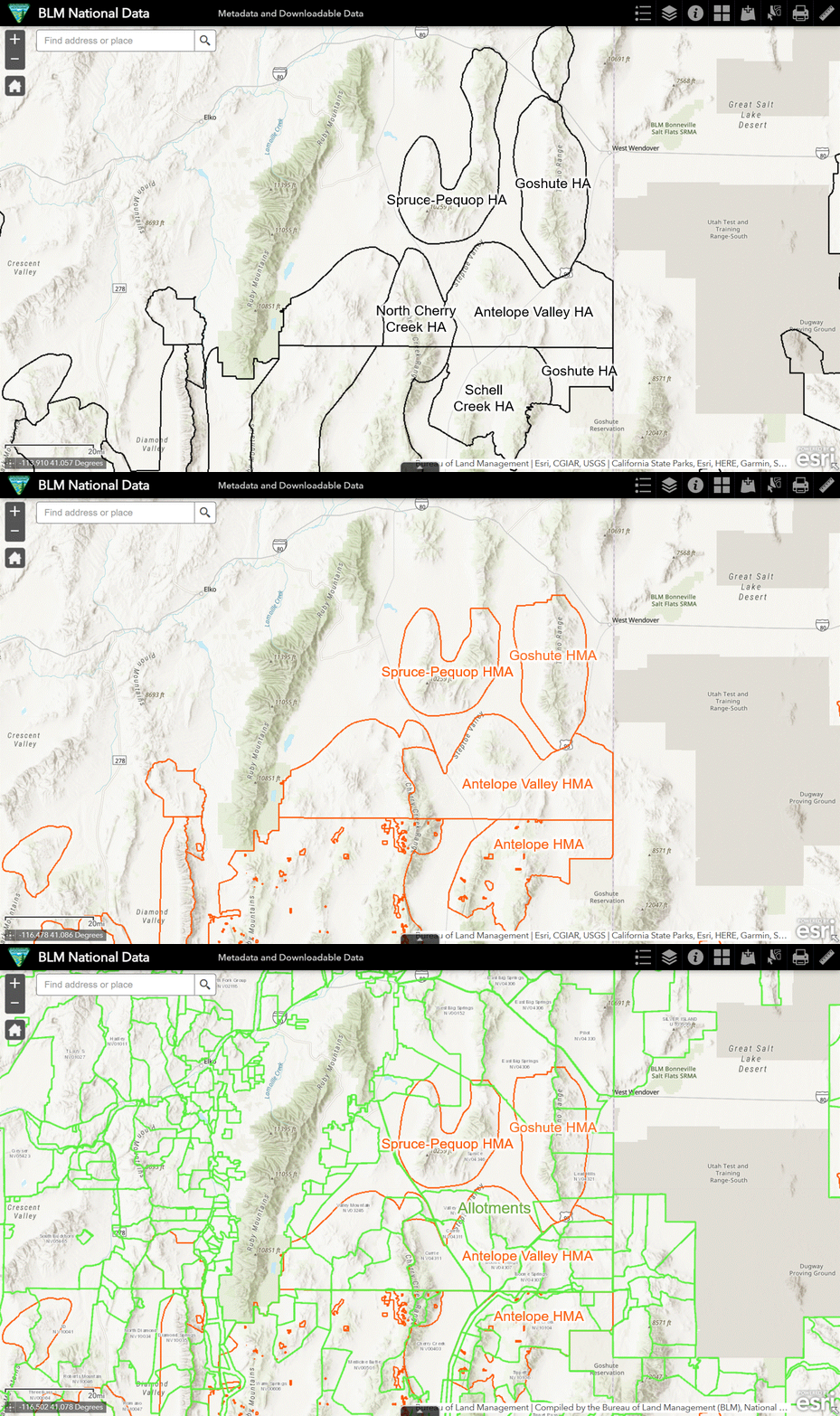
Antelope Complex with Allotments 07-06-23

Day 11 ended with 34 unaccounted-for animals.

Mares treated with fertility control pesticides will be returned to the area at a later date.

Other statistics:

  • Forage liberated to date: 9,888 AUMs per year
  • Water liberated to date: 8,240 gallons per day
  • Forage assigned to livestock: Unknown
  • Horses displaced from area by permitted grazing: Unknown
  • True AML: Unknown
  • Stocking rate at new AML: Unknown
  • Horses removed because of drilling and mining: Ask the advocates

Overpopulation means more horses than allowed by plan, not necessarily more horses than the land can support.

RELATED: Antelope Roundup South, Day 9.

Antelope Roundup North, Day 11

The incident began on July 9.  Results through July 19:

  • Scope: Spruce-Pequop, Goshute, Antelope Valley HMAs
  • Purpose: Pest control, resource enforcement, rancher protection
  • Target: Horses
  • Type: Planned
  • Method: Helicopter
  • Category: Cruel and costly*
  • Better way: Poison mares with ovary-killing pesticides*
  • Captured: 347, up from 289 on Day 9
  • Average daily take: 31.5
  • Capture goal: 2,000
  • Removal goal: 2,000
  • Returned: None
  • Deaths: 5, up from 4 on Day 9
  • Shipped: 268, up from 234 on Day 9

The figures above are based on the daily reports, not the totals posted by the BLM.

The number of horses shipped to date is 274 according to the summary.

The trap was moved on Day 10.

A mare was put down on Day 11 due to blindness in one eye, a non-life-threatening condition.

The death rate is 1.4%.

The capture total includes 107 stallions, 180 mares and 60 foals.

Youngsters represented 17.3% of the animals gathered.

Of the adults, 37.3% were male and 62.7% were female.  These statistics fall outside the expected range of variation from a simple random process centered at 50% males / 50% females with a sample of 287 adults.  The disparity might be explained by the contractor targeting family bands.

How to Compute p-chart Limits 02-10-22

A 17% birth rate corresponds to a herd growth rate of 12% per year.

Land managers often use growth rates of 20% per year to predict herd sizes and management actions.

Body condition scores on Day 11 ranged from 3 to 4.

The location of the trap site was not disclosed.

The HMAs and surrounding lands are subject to permitted grazing.

*According to advocates.

Antelope Complex with Allotments 07-06-23

Day 11 ended with 74 unaccounted-for animals.

There are no plans to treat captured mares with fertility control pesticides and return them to the area.

Other statistics:

  • Forage liberated to date: 4,164 AUMs per year
  • Water liberated to date: 3,470 gallons per day
  • Forage assigned to livestock: Unknown
  • Horses displaced from area by permitted grazing: Unknown
  • True AML: Unknown
  • Stocking rate at new AML: Unknown
  • Horses removed because of drilling and mining: Ask the advocates

Overpopulation means more horses than allowed by plan, not necessarily more horses than the land can support.

RELATED: Antelope Roundup North, Day 9.

Johnnie Roundup Announced

It’s on the July 13 schedule but not on the June 14 schedule.

Billed as a nuisance roundup, the BLM will remove approximately 25 wild horses and 100 wild burros from private lands near Pahrump, NV, starting on or about July 20.

Animals will be drawn into the traps with bait and operations will not be open to public observation.

Captured animals will be taken to the Ridgecrest off-range corrals.

Gather stats and daily reports will be posted to this page.

The horses and burros are crossing state highways and have entered private properties, damaging fencing, water lines and vegetation, according to today’s news release.

The HMA is managed for burros.  The AML for horses is zero.

Assateague Pony Census, July 2023

The herd on the Maryland side of the island consisted of 14 bands and 81 horses, according to the inventory dated July 16, no change from June.

Seven foals were born this year.

The sex ratio cannot be determined but is likely skewed in favor of females.

If a dominant stallion runs each band, and seven mares are viable, the breeding population is very small, less than 20% of the herd size, seven years after the safe, proven and reversible darting program was shut off.

The BLM WHB Handbook indicates the breeding population should exceed 50 animals to maintain an acceptable level of genetic diversity.

The pesticide of choice was Zonastat-H, a miracle drug according to the advocates.

The Assateague Island Alliance updates the lists monthly.

RELATED: Assateague Pony Census, June 2023.

Antelope Roundup South, Day 9

The incident began on July 9.  Results through July 17:

  • Scope: Antelope, Antelope Valley HMAs
  • Purpose: Pest control, resource enforcement, rancher protection
  • Target: Horses
  • Type: Planned
  • Method: Helicopter
  • Category: Cruel and costly*
  • Better way: Poison mares with ovary-killing pesticides*
  • Captured: 679, up from 631 on Day 7
  • Average daily take: 75.4
  • Capture goal: 1,107
  • Removal goal: 1,107
  • Returned: 2, no change from Day 7
  • Deaths: 7, up from 5 on Day 7
  • Shipped: 658, up from 533 on Day 7

The figures above are based on the daily reports, not the totals posted by the BLM.

Aerial operations were cut short on Days 8 and 9 by temperature and wind.

A mare and stallion died of fractured necks on Day 8, probably due to collisions with pipe panels.

The death rate is 1.0%.

The advocates will point to these losses as justification for their ruinous darting programs.

The capture total includes 212 stallions, 309 mares and 158 foals.

Youngsters represented 23.3% of the animals gathered.

Of the adults, 40.7% were male and 59.3% were female.  The proportions fall outside the expected range of variation from a simple random process centered at 50% males / 50% females with a sample of 521 adults.  The disparity might be explained by the contractor targeting family bands.

How to Compute p-chart Limits 02-10-22

A birth rate of 23% per year corresponds to a growth rate of 18% per year.

Land managers often use growth rates of 20% per year to predict herd sizes and management actions.

Body condition scores were not provided.

The location of the trap site was not disclosed.

The HMAs and surrounding lands are subject to permitted grazing.

*According to advocates.

Antelope Complex with Allotments 07-06-23

Day 9 ended with 12 unaccounted-for animals.

Mares treated with fertility control pesticides will be returned to the area at a later date.

Other statistics:

  • Forage liberated to date: 8,124 AUMs per year
  • Water liberated to date: 6,770 gallons per day
  • Forage assigned to livestock: Unknown
  • Horses displaced from area by permitted grazing: Unknown
  • True AML: Unknown
  • Stocking rate at new AML: Unknown
  • Horses removed because of drilling and mining: Ask the advocates

Overpopulation means more horses than allowed by plan, not necessarily more horses than the land can support.

RELATED: Antelope Roundup South, Day 7.

Antelope Roundup North, Day 9

The incident began on July 9.  Results through July 17:

  • Scope: Spruce-Pequop, Goshute, Antelope Valley HMAs
  • Purpose: Pest control, resource enforcement, rancher protection
  • Target: Horses
  • Type: Planned
  • Method: Helicopter
  • Category: Cruel and costly*
  • Better way: Poison mares with ovary-killing pesticides*
  • Captured: 289, up from 249 on Day 7
  • Average daily take: 32.1
  • Capture goal: 2,000
  • Removal goal: 2,000
  • Returned: None
  • Deaths: 4, no change from Day 7
  • Shipped: 234, up from 193 on Day 7

The figures above are based on the daily reports, not the totals posted by the BLM.

The number of horses shipped to date, based on the daily reports, is 234, compared to a total of 240 in the summary.

The trap may have been moved on Day 8, possibly to another HMA, because no horses were captured and none were shipped on Day 9.

The death rate is 1.4%.

The capture total includes 93 stallions, 146 mares and 50 foals.

Youngsters represented 17.3% of the animals gathered.

Of the adults, 38.9% were male and 61.1% were female.  The proportions fall outside the expected range of variation from a simple random process centered at 50% males / 50% females with a sample of 239 adults.  The disparity might be explained by the contractor targeting family bands.

How to Compute p-chart Limits 02-10-22

A 17% birth rate corresponds to a herd growth rate of 12% per year.

Land managers often use growth rates of 20% per year to predict herd sizes and management actions.

Body condition scores on Day 9 were 4.

The location of the trap site was not disclosed.

The HMAs and surrounding lands are subject to permitted grazing.

*According to advocates.

Antelope Complex with Allotments 07-06-23

Day 9 ended with 51 unaccounted-for animals.

There are no plans to treat captured mares with fertility control pesticides and return them to the area.

Other statistics:

  • Forage liberated to date: 3,468 AUMs per year
  • Water liberated to date: 2,890 gallons per day
  • Forage assigned to livestock: Unknown
  • Horses displaced from area by permitted grazing: Unknown
  • True AML: Unknown
  • Stocking rate at new AML: Unknown
  • Horses removed because of drilling and mining: Ask the advocates

Overpopulation means more horses than allowed by plan, not necessarily more horses than the land can support.

RELATED: Antelope Roundup North, Day 7.

Genuine Advocates Disappearing Faster Than Wild Horses?

Probably a fair statement.  Most of them are frauds.

But what would you say if the writer was an acolyte for the Wild Horse Fire Brigade, a group that wants wild horses moved from areas where they’re not wanted, sometimes referred to as their lawful homes, to remote wilderness areas not particularly suited to livestock grazing?

Pot calling the kettle black?

You can’t judge a book by its cover but you can certainly dismiss an article written by one of the Benedict Arnolds of the wild horse world.

RELATED: Capitulation, Surrender, Defeat.

Pesticide Pushers 07-17-23

Spring Creek Base Property Hits Market for $7.9 Million

Triangle L Ranch covers 5,885 deeded acres, with grazing preference on 74,000 public acres producing 5,132 AUMs per year, according to the listing by Hall and Hall.

That works out to 69.4 AUMs per year per thousand public acres, enough to support 5.8 wild horses per thousand public acres, despite claims by the bureaucrats that public lands in the western U.S. can only support one wild horse per thousand acres (27,000 animals on 27 million acres).

Why the difference?  The bureaucrats assigned most of the forage in the lawful homes of wild horses to privately owned livestock.

The property features nine miles of a perennial creek and a 125-acre pivot.

The asking price includes all farm equipment but not cattle and hay.

The agent’s map ties the deeded acreage to BLM and Forest Service allotments.

On the BLM side: Frost Creek, Lindsay Creek and Browne, all in the Tuscarora Field Office, and Railroad Pass in the Bristlecone Field Office.

For the Forest Service: Mica North, Corral Creek and Cherry Springs, all in the Ruby Mountains Ranger District (Humbolt-Toiyabe National Forest).  Unfortunately, the AOIs for this area have not been published.  The allotments can be found on the Western Watersheds map but will not be covered here.

The National Data Viewer shows the BLM allotments vis-à-vis nearby HMAs.

Railroad Pass overlaps Diamond Hills South.  Click on image to open in new tab.

Triangle L Ranch with HMAs and Allotments 07-16-23

The Allotment Master Reports (Tuscarora | Bristlecone) put Frost Creek and Lindsay Creek in the Maintain category, and Browne and Railroad Pass in the Improve category.

The seller does not hold all of the active AUMs in the allotments.

Livestock retreat to base properties during the off season and during periods of voluntary or mandatory non-use due to drought, wildfires or overgrazing.

Instead of competing with wild horses, a buyer could leverage the deeded acres in a rewilding project by asking the BLM for change in livestock type and season of use, as American Prairie did for bison in Montana.

In this way, less than 6,000 private acres would control 74,000 public acres, exactly what the ranchers are doing except the landscape would be dotted with free-roaming horses, not privately owned cattle and sheep.

RELATED: Eureka Base Property Hits Market for $2.75 Million.

Antelope Roundup South, Day 7

The incident began on July 9.  Results through July 15:

  • Scope: Antelope, Antelope Valley HMAs
  • Purpose: Pest control, resource enforcement, rancher protection
  • Target: Horses
  • Type: Planned
  • Method: Helicopter
  • Category: Cruel and costly*
  • Better way: Poison mares with ovary-killing pesticides*
  • Captured: 631, up from 391 on Day 5
  • Average daily take: 90.1
  • Capture goal: 1,107
  • Removal goal: 1,107
  • Returned: 2, up from 1 on Day 5
  • Deaths: 5, up from 3 on Day 5
  • Shipped: 533, up from 320 on Day 5

The figures above are based on the daily reports, not the totals posted by the BLM.

A mare died of a fractured neck on Day 6, probably due to impact on a pipe panel.

A foal was lost on Day 7 because of an umbilical hernia.  The report did not indicate euthanasia.

The death rate is 0.8%.

The capture total includes 197 stallions, 286 mares and 148 foals.

Youngsters represented 23.5% of the animals gathered.

Of the adults, 40.8% were male and 59.2% were female.  These proportions don’t look they came from a simple random process centered at 50% males / 50% females with a sample size of 483.

How to Compute p-chart Limits 02-10-22

A birth rate of 23% per year corresponds to a growth rate of 18% per year.

Land managers often use growth rates of 20% per year to predict herd sizes and management actions.

Body condition scores were not provided.

The location of the trap site was not disclosed.

The HMAs and surrounding lands are subject to permitted grazing.

*According to advocates.

Antelope Complex with Allotments 07-06-23

Day 7 ended with 91 unaccounted-for animals.

Mares treated with fertility control pesticides will be returned to the area at a later date.

Other statistics:

  • Forage liberated to date: 7,548 AUMs per year
  • Water liberated to date: 6,290 gallons per day
  • Forage assigned to livestock: Unknown
  • Horses displaced from area by permitted grazing: Unknown
  • True AML: Unknown
  • Stocking rate at new AML: Unknown
  • Horses removed because of drilling and mining: Ask the advocates

Overpopulation means more horses than allowed by plan, not necessarily more horses than the land can support.

RELATED: Antelope Roundup South, Day 5.

Antelope Roundup North, Day 7

The incident began on July 9.  Results through July 15:

  • Scope: Spruce-Pequop, Goshute, Antelope Valley HMAs
  • Purpose: Pest control, resource enforcement, rancher protection
  • Target: Horses
  • Type: Planned
  • Method: Helicopter
  • Category: Cruel and costly*
  • Better way: Poison mares with ovary-killing pesticides*
  • Captured: 249, up from 202 on Day 5
  • Average daily take: 35.6
  • Capture goal: 2,000
  • Removal goal: 2,000
  • Returned: None
  • Deaths: 4, up from 3 on Day 5
  • Shipped: 193, up from 122 on Day 5

The figures above are based on the daily reports, not the totals posted by the BLM.

A mare was put down on Day 6 due to blindness in one eye, a non-life-threatening condition.

The death rate is 1.6%.

The capture total includes 85 stallions, 122 mares and 42 foals.

Youngsters represented 16.9% of the animals gathered.

Of the adults, 41.1% were male and 58.9% were female.

A 17% birth rate corresponds to a herd growth rate of 12% per year.

Land managers often use growth rates of 20% per year to predict herd sizes and management actions.

Body condition scores on Days 6 and 7 ranged from 3 to 4.

The location of the trap site was not disclosed.

The HMAs and surrounding lands are subject to permitted grazing.

*According to advocates.

Antelope Complex with Allotments 07-06-23

Day 7 ended with 52 unaccounted-for animals.

There are no plans to treat captured mares with fertility control pesticides and return them to the area.

Other statistics:

  • Forage liberated to date: 2,988 AUMs per year
  • Water liberated to date: 2,490 gallons per day
  • Forage assigned to livestock: Unknown
  • Horses displaced from area by permitted grazing: Unknown
  • True AML: Unknown
  • Stocking rate at new AML: Unknown
  • Horses removed because of drilling and mining: Ask the advocates

Overpopulation means more horses than allowed by plan, not necessarily more horses than the land can support.

RELATED: Antelope Roundup North, Day 5.

Wild Burros Found Dead in Death Valley

The remains of five animals were found earlier this week, according to a report dated July 13 by KLAS News of Las Vegas.

The animals were shot and killed in the Lower Wildrose area of the park.

The report was likely based on a news release from NPS.

The BLM assisted NPS with burro removal last year, suggesting that officials with the Park Service were not satisfied with the progress of a private contractor.

RELATED: NPS Dissatisfied with Peaceful Valley Rescue, Orders Roundup?

Antelope Roundup South, Day 5

The incident began on July 9.  Results through July 13:

  • Scope: Antelope, Antelope Valley HMAs
  • Purpose: Pest control, resource enforcement, rancher protection
  • Target: Horses
  • Type: Planned
  • Method: Helicopter
  • Category: Cruel and costly*
  • Better way: Poison mares with ovary-killing pesticides*
  • Captured: 391, up from 270 on Day 3
  • Average daily take: 78.2
  • Capture goal: 1,107
  • Removal goal: 1,107
  • Returned: 1, no change from Day 3
  • Deaths: 3, up from 2 on Day 3
  • Shipped: 320, up from 200 on Day 3

The figures above are based on the daily reports, which may differ slightly from the totals posted by the BLM.

A foal died of dehydration on Day 5.

The death rate is 0.8%.

The capture total includes 131 stallions, 171 mares and 89 foals.

Youngsters represented 22.8% of the animals gathered.

Of the adults, 43.4% were male and 56.6% were female.

A birth rate of 23% per year corresponds to a growth rate of 18% per year.

Land managers often use growth rates of 20% per year to predict herd sizes and management actions.

Body condition scores were not provided.

The location of the trap site was not disclosed.

The HMAs and surrounding lands are subject to permitted grazing.

*According to advocates.

Antelope Complex with Allotments 07-06-23

Day 5 ended with 67 unaccounted-for animals.

Mares treated with fertility control pesticides will be returned to the area at a later date.

Other statistics:

  • Forage liberated to date: 4,680 AUMs per year
  • Water liberated to date: 3,900 gallons per day
  • Forage assigned to livestock: Unknown
  • Horses displaced from area by permitted grazing: Unknown
  • True AML: Unknown
  • Stocking rate at new AML: Unknown
  • Horses removed because of drilling and mining: Ask the advocates

Overpopulation means more horses than allowed by plan, not necessarily more horses than the land can support.

RELATED: Antelope Roundup South, Day 3.

Draft EA for McCullough Pest Control Out for Review

The comment period opened yesterday and runs through August 12, according to the BLM news release.

The Proposed Action, discussed on page 6 of the EA, features bait trap removal of excess horses to achieve AML, continued application of the fertility control pesticide PZP and something new—use of the longer-lasting pesticide GonaCon Equine on mares that have contributed to the genetic diversity of the herd.

Older horses would be allowed to remain within the HMA.

The HMA, a subset of the HA, covers 120,412 total acres east of Cody, WY, including 113,938 public acres, and the AML ranges from 70 to 140.

The stocking rate allowed by plan is 1.2 wild horses per thousand public acres.

The area is managed primarily for animal agriculture, a purpose for which PZP was not approved.

As for the project, it does not allocate resources.

It cannot change resource allocations.

It enforces resource allocations already on the books, just like HMAPs.

RELATED: Scoping Begins for McCullough Peaks Livestock Protection Plan.

McCullough Peaks HMA with Allotments 07-14-23

Antelope Roundup North, Day 5

The incident began on July 9.  Results through July 13:

  • Scope: Spruce-Pequop, Goshute, Antelope Valley HMAs
  • Purpose: Pest control, resource enforcement, rancher protection
  • Target: Horses
  • Type: Planned
  • Method: Helicopter
  • Category: Cruel and costly*
  • Better way: Poison mares with ovary-killing pesticides*
  • Captured: 202, up from 71 on Day 3
  • Average daily take: 40.4
  • Capture goal: 2,000
  • Removal goal: 2,000
  • Returned: None
  • Deaths: 3, up from zero on Day 3
  • Shipped: 122, up from zero on Day 3

The figures above are based on the daily reports, which may differ slightly from the totals posted by the BLM.

A foal died on Day 5 due to colic and a stallion was put down because of a compound break in his left rear leg.  A foal was euthanized due to lameness.

The death rate is 1.5%.

The capture total includes 69 stallions, 99 mares and 34 foals.

Youngsters represented 16.8% of the animals gathered.

Of the adults, 41.1% were male and 58.9% were female.

A 17% birth rate corresponds to a herd growth rate of 12% per year.

Land managers often use growth rates of 20% per year to predict herd sizes and management actions.

Body condition scores were not provided.

The location of the trap site was not disclosed.

The HMAs and surrounding lands are subject to permitted grazing.

*According to advocates.

Antelope Complex with Allotments 07-06-23

Day 5 ended with 77 unaccounted-for animals.

There are no plans to treat captured mares with fertility control pesticides and return them to the area.

Other statistics:

  • Forage liberated to date: 2,424 AUMs per year
  • Water liberated to date: 2,020 gallons per day
  • Forage assigned to livestock: Unknown
  • Horses displaced from area by permitted grazing: Unknown
  • True AML: Unknown
  • Stocking rate at new AML: Unknown
  • Horses removed because of drilling and mining: Ask the advocates

Overpopulation means more horses than allowed by plan, not necessarily more horses than the land can support.

RELATED: Antelope Roundup North, Day 3.

PBS Looks at Invasive Species

As usual, the nonprofit is silent about permitted grazing and the presence of livestock in this 12-minute segment about wild horses.

If they were honest about that, their viewers would understand why there are few if any predators in these areas.

They didn’t admit that horses appear in the North American fossil record while cattle and sheep do not.

The roundup scenes were probably filmed last year at the Twin Peaks HMA.

The July 23 report at the BLM gather page mentions a PBS production crew working on “Human Footprint, the Film.”

Video queued up to the mark, just hit go.

RELATED: What PBS Didn’t Tell You About America’s Wild Horses.

Antelope Roundup North, Day 3

The incident began on July 9.  Results through July 11:

The figures above are based on the daily reports, which may differ slightly from the totals posted by the BLM.

The capture total includes 26 stallions, 30 mares and 15 foals.

Youngsters represented 21.1% of the animals gathered.

Of the adults, 46.4% were male and 53.6% were female.

The herd may be growing at a rate of 16% per year, given a birth rate of 21% per year.

Body condition scores were not provided.

The location of the trap site was not disclosed.

The HMAs and surrounding lands are subject to permitted grazing.

Antelope Complex with Allotments 07-06-23

Day 3 ended with 71 unaccounted-for animals.

There are no plans to treat captured mares with fertility control pesticides and return them to the area.

Other statistics:

  • Forage liberated to date: 852 AUMs per year
  • Water liberated to date: 710 gallons per day
  • Forage assigned to livestock: Unknown
  • Horses displaced from area by permitted grazing: Unknown
  • True AML: Unknown
  • Stocking rate at new AML: Unknown
  • Horses removed because of drilling and mining: Ask the advocates

Overpopulation means more horses than allowed by plan, not necessarily more horses than the land can support.

*According to advocates.

RELATED: Antelope Roundups in Progress.