Pariahs in their Lawful Homes

There are no voices for the horses in this story by The Nevada Independent about the Antelope-North roundup, not even the advocates.

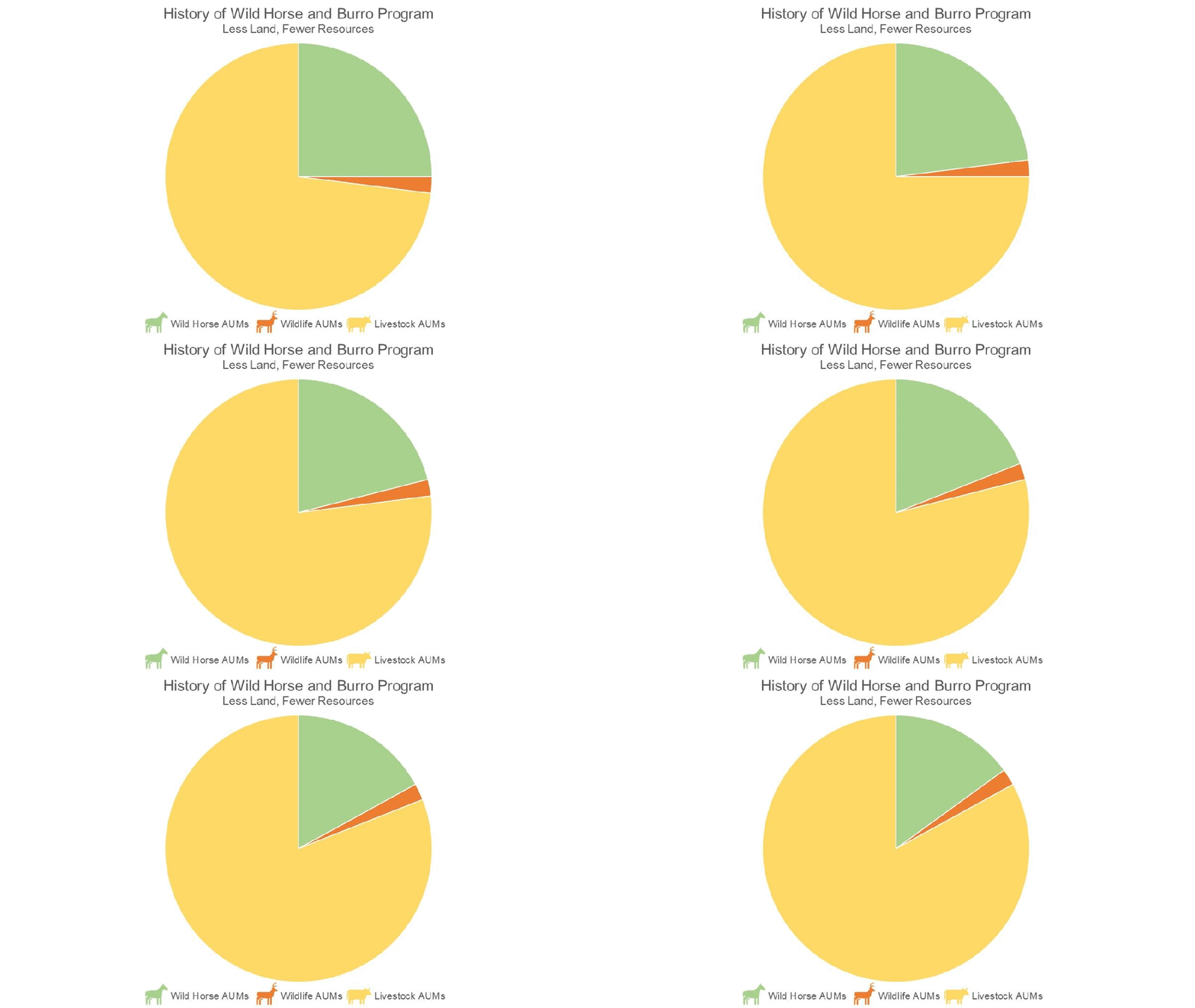
Livestock in the Antelope Complex (North + South) receive over seven times more forage than the horses.

That resource would support over 6,000 horses, on top of the 789 allowed by plan.

You don’t have a wild horse problem, you have a resource management problem.

Areas identified for wild horses are managed primarily for cattle and sheep.

Overpopulation means they’re trying to reclaim some of their food from the poor ranchers.

Their punishment is to waste away in feedlots, the domain of animal agriculture.

RELATED: Antelope Roundup North Over.

CAAWH Publishes Virginia Range Darting Resources

Your host is not sure if the materials were intended for public consumption but the page is working as of this morning.

Links in the following comments include local versions in case the site goes dark.

Of immediate interest is the current agreement [local] between NDA and CAAWH which includes a stipulation for reductions in herd size over the 12-month period, contradicting a goal in the Darting SOP [local] about stabilizing population growth.

Progress reports, monthly and yearly, were posted to a separate page.

The Year 4 Report [local], covering 2022-2023, indicates 1,225 mares received 1,691 doses of PZP, a restricted-use pesticide.

One hundred and forty two foals were born during the period, with two removed and 41 deceased or missing and presumed dead.

With the reduction in birth rates, coupled with the activity of predators, many herd treatment areas experienced a population decline.

VR Reduction in Birth Rates 08-26-23

With a population of 3,507 confirmed living horses, the birth rate is four percent, too low to sustain the current herd.  It is declining as the bureaucrats desire.

A list of approved properties for darting [local] was also provided.

Curiously, the page has a list of training materials, including a link to literature at the Billings School of PZP Darting and Public Deception with password!

Training Materials 08-26-23

The final link to The Pinto Post, a monthly newsletter that covers the incredible work of the many wild horse organizations in the area, is not correct but you can reach it here.

RELATED: What’s So Important about the Virginia Range?

Dust-Up in the Desert Set for September 7

A debate between Scott Beckstead, director of campaigns for Animal Wellness Action, and Nevada State Senator Ira Hansen will begin at 6:00 PM Pacific time at the Elko Convention Center, according to an EIN news release dated August 25.

Dust-Up in the Desert 08-25-23

The event can be viewed online.  Registration is required.

Hansen, a voice for rural areas in the state, led the opposition to SB90 earlier this year.

Beckstead disputes his claims, arguing that substandard conditions on Nevada public lands are caused by hundreds of thousands of cattle and sheep, not wild horses.

A video of the debate will be posted to the AWA YouTube channel.

Hog Creek Roundup Begins, Ends

The incident started and finished on August 23, with 38 horses captured, 24 shipped, 14 released and no deaths.

There were no unaccounted-for animals.

The gather page does not indicate if any of the returned mares were treated with fertility control pesticides.

The pre-gather population was thought to be 66.

The plan was to capture all of them and return a nonreproducing herd back to the HMA.

RELATED: Hog Creek Roundup Delayed by Weather.

BLM Approves Another Nuisance Removal Near Cibola-Trigo HMA

A new project was opened in ePlanning yesterday and an approved CX was copied to the document folder.

There were no opportunities for public comment.

Under the Proposed Action, the only alternative considered, the agency will remove 100 wild burros from the Picacho State Recreation Area and 75 burros from private lands south of Palo Verde, CA.

The incident, to be carried out with baited traps, was prompted by complaints involving property damage and concerns about public health and safety.

It does not appear on the latest schedule.

The National Data Viewer shows the arrangement.

Attachments 1 and 2 in the CX provide details.

Given that both locations are on the California side of the Colorado River, maybe they should be associated with the Chocolate-Mule Mountains HMA?

The HAs are unfit for wild horses and burros, supposedly.

RELATED: BLM to Yank More Horses and Burros from Cibola-Trigo HMA?

Pichaco Burro Removal 08-22-23

BLM Awards $1 Million for Wild Horse Protection?

Six organizations will receive grants ranging from $77,331 to $468,033 to support the agency’s mission of managing and protecting wild horses and burros on public lands, according to a news release dated August 21.

Four of the programs involve nonmotorized removal.

Two involve educational outreach.

All are anti-horse/pro-ranching.

In Oregon, High Desert Strategies received the lion’s share of the funds for application of fertility control pesticides.  They are already doing this.  Western Horse Watchers has been unable to find their web site.  They may have a presence on socialist media.

In Colorado, Piceance Mustangs received a six-figure shot-in-the-arm to bolster their pest control efforts.  The group was featured last month in a story about GonaCon darting.  They make no effort to conceal their disdain for wild horses.

In Utah, the Campaign Against America’s Wild Horses will poison the Cedar Mountain mares with an ovary-killing pesticide while collaborating with one of the permittees.

Are you surprised by any of this?  They’re all frauds!

As for the lack of predators, they were eradicated years ago by state wildlife agencies and local inhabitants because of their attraction to calves and lambs.

RELATED: New Grants Available for Wild Horse and Burro Management.

Stinkingwater Roundup Over

The incident concluded on August 20, with 63 horses captured, 63 shipped, none released and no deaths.

The number of unaccounted-for animals was zero.

The pre-gather population was thought to be 103.

The goal was 83.

The capture total included 24 stallions, 32 mares and 7 foals.

Youngsters represented 11.1% of the horses gathered.

Of the adults, 42.9% were male and 57.1% were female.

Approximately 20 mares will be returned to the area after treatment with a fertility control pesticide.

The HMA is subject to permitted grazing, with livestock receiving 90% of the authorized forage, neglecting wildlife.

RELATED: Palomino Buttes, Stinkingwater Roundups Announced.

Rock Springs RMP Update Out for Public Review

A 90-day comment period began on August 18 for a Draft EIS covering changes to the land use plan administered by the Rock Springs Field Office, according to a BLM news release dated August 17.

The project anticipates changes to the HMAs affected by the RSGA consent decree approved in 2022, cleared for implementation in 2023 and now subject to legal challenges by several advocacy groups.

Go to the placeholder section under Biological Resources (BR) – Wild Horses (4900) on page 2-85 in the EIS (page 155 in the pdf).

The scope of the changes is not accurate, a potential comment on the EIS.

Section 3.9 says the Wild Horse Management EIS will amend the management plan for the Adobe Town, Divide Basin, Salt Wells Creek, and White Mountain HMAs, but there were no changes to White Mountain in the latest iteration.

Section 3.16 indicates there are 304,261 active AUMs within the planning area on 79 grazing allotments covering approximately 5.27 million acres, which works out to 57.7 AUMs per year per thousand acres, equivalent to 4.8 wild horses per thousand acres.

However, public lands in the western U.S. can only support one wild horse per thousand acres according to the bureaucrats (27,000 animals on 27 million acres).

The total number of animals allowed by plan (upper end of AML) is actually 23,866 wild horses and 2,919 wild burros according to the last table in the 2023 HA/HMA Report, so the total forage requirement would be

23,866 × 12 + 2,919 × (12 ÷ 2) = 286,392 + 17,514 = 303,906 AUMs per year

Therefore, livestock in one BLM field office receive roughly the same amount of forage as wild horses and burros in ten western states!

Moreover, the disparity will increase as the Rock Springs HMAs are zeroed out.

Antelope Roundup North Over

The incident concluded today with 1,971 horses captured, 1,936 shipped, five released and 29 dead.

The figures above were taken from the sidebar at the gather page.  They don’t balance.

1,971 ≠ 1,936 + 5 + 29

The capture total included 769 stallions, 893 mares and 309 foals.

Youngsters represented 15.7% of the animals gathered.

Of the adults, 46.3% were male and 53.7% were female.

The death rate was 1.5%.

Video of a stallion that shattered a hind leg while trying to jump the trap was picked up by major news outlets in support of the helicopter ban, even though it had nothing to do with helicopters.

A U.S. district judge allowed the roundup to continue after hearing arguments from attorneys representing the advocates and the BLM.

Other groups insisted that wild horse populations should be controlled with ovary-killing pesticides, not motorized equipment.

The South roundup ended on July 26.

RELATED: Antelope Roundups Announced.

Antelope Roundup North Winding Down

Gather operations have concluded with 1,965 horses captured, 1,862 shipped, 27 deaths and five released.

With 71 unaccounted-for animals, some additional sorting and shipping may occur.

The figures above are based on the daily reports, not the totals posted by the BLM.

The capture goal was 98% achieved.

Was the arrival of Hilary a factor in the decision?

This is not mentioned at the gather page.

No mares were to be treated with fertility control pesticides and returned to the area.

RELATED: Antelope Roundup North, Day 41.

Antelope Roundup North, Day 41

The incident began on July 9.  Results through August 18:

  • Scope: Spruce-Pequop, Goshute, Antelope Valley HMAs
  • Purpose: Pest control, resource enforcement, rancher protection
  • Target: Horses
  • Type: Planned
  • Method: Helicopter
  • Category: Cruel and costly*
  • Better way: Poison mares with ovary-killing pesticides*
  • Captured: 1,914, up from 1,870 on Day 39
  • Average daily take: 46.7
  • Capture goal: 2,000
  • Removal goal: 2,000
  • Returned: 5, no change from Day 39
  • Deaths: 27, up from 26 on Day 39
  • Shipped: 1,824, up from 1,781 on Day 39

The figures above are based on the daily reports, not the totals posted by the BLM.

The sidebar on the gather page says the number of horses captured is 1,920 and the number shipped is 1,826.

A case of missing teeth was reported as a death on Day 41.

The death rate is 1.4%.

The capture total includes 751 stallions, 867 mares and 296 foals.

Youngsters represented 15.5% of the animals gathered.

Of the adults, 46.4% were male and 53.6% were female.

A 16% birth rate corresponds to a growth rate of 11% per year, a bit less than the 20% growth rate used by land managers to predict herd sizes and management actions.

Body condition scores on Days 40 and 41 ranged from 2 to 4.

They’re not starving but a few may be struggling.  Not unusual for older horses or mares with foals.

The location of the trap site was not disclosed.

The HMAs and surrounding lands are subject to permitted grazing.

*According to advocates.

Antelope Complex with Allotments 07-06-23

Day 41 ended with 58 unaccounted-for animals.

Other statistics:

  • Forage liberated to date: 22,908 AUMs per year
  • Water liberated to date: 19,090 gallons per day
  • Forage assigned to livestock: Unknown
  • Horses displaced from area by permitted grazing: Unknown
  • True AML: Unknown
  • Stocking rate at new AML: Unknown
  • Horses removed because of drilling and mining: Ask the advocates

Overpopulation means more horses than allowed by plan, not necessarily more horses than the land can support.

RELATED: Antelope Roundup North, Day 39.

Clover Valley Base Property Available for $5.25 Million

Located south of Wells, NV, the ranch covers 2,518 deeded acres, according to the listing, with grazing preference on a 6,000-acre Forest Service allotment.

There are 900 acres under irrigation producing nearly 1,000 tons of hay annually.

The Annual Operating Instructions for the allotment indicate 90 cow/calf pairs on approximately a 3.3 month grazing season for a total of 305 AUMs per year.

Livestock retreat to the base property during the off season.

The allotment is west of the deeded acreage in the Ruby Mountains.

The Western Watersheds Map shows the arrangement.  Click to open in new tab.

The allotment does not overlap any wild horse areas, but it might be a rewilding opportunity, to be achieved by asking the Forest Service for a change in livestock type and season of use, as American Prairie did for bison in Montana.

At 50 AUMs per year per thousand acres, forage in the allotment is equivalent to four wild horses per thousand acres, despite claims by the bureaucrats that public lands in the western U.S. can only support one wild horse per thousand acres (27,000 animals on 27 million acres).

Clover Valley Ranch with Allotment 08-18-23