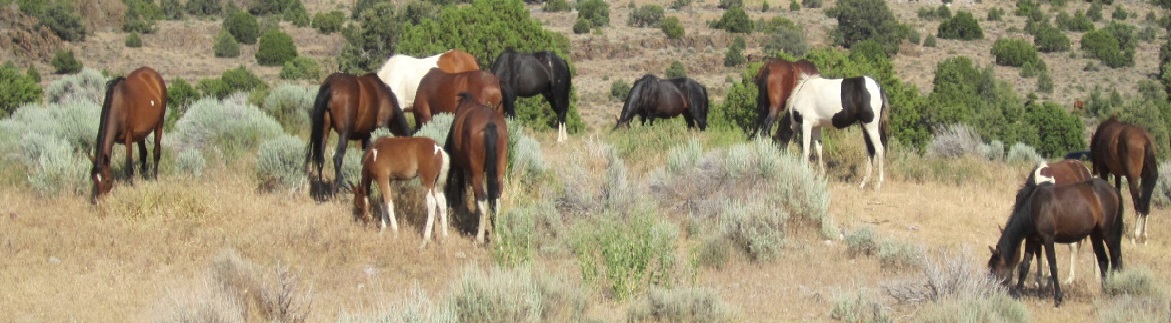
Wild horse advocates are working with the BLM to maintain existing systems and bring water in from other sources if necessary. Sand Wash Basin HMA is in northwest corner of Colorado. Updates can be found at the FB page of Wild Horse Warriors for Sand Wash Basin.
Category: Range
On the range
Wild Horse Mesa
Might be in southern Colorado, near the town of San Luis, not far from Sanchez reservoir and the New Mexico border. Land ownership unknown (public or private).
This article in The Taos News, dated 02/29/16, may be relevant.
Anyone with more info, please post to comments. H/T Bonnie Scherer for video.
BLM Returning Horses to Sands Basin HMA
Twenty six wild horses will be returned to the Sands Basin HMA in western Idaho on 06/13/18, according to this news release from the BLM. The action follows an emergency gather in 2015 of all horses due to the Soda Fire.

Horses in the nearby Hardtrigger and Black Mountain HMAs were also affected. Refer to page nine in the BLM rehab report for more information. The fire was started by lightning.
The Sands Basin HMA covers 11,724 acres and has an AML of 64, for a target population density of 5.5 horses per thousand acres.
Fire Reported at Little Bookcliffs Wild Horse Range
The wildfire is burning an area of five to ten acres, according to this story at Western Slope Now, posted 06/05/18. BLM fire crews are on the scene.

The affected area is north of Grand Junction, CO. The Little Bookcliffs Wild Horse Range is one of three areas dedicated primarily for wild horses by the BLM.
Are There Any Wild Burros in Oregon?
A few, they can be found in the Warm Springs HMA, south of Burns, along with an occasional mule. State route 205 marks the eastern boundary of the HMA, second largest in the state.

The target population density of the HMA is 0.42 animals per thousand acres (based on upper range of AML), compared to a state average of 0.97. The likelihood of actually seeing a burro or mule in the area is small, unless they tend to hang out in one place and you know where it is.
A WHB specialist based in Burns or Hines may be able to help you find them.
Mustang Monday
Blindness: Death Sentence for BLM Horses?
Refer to BLM Instruction Memorandum 2015-070 for care of animals managed by the WHB Program, including deworming, vaccination, evaluation of condition and determination of an appropriate end-of-life action.
Refer also to the daily reports from the Triple B gather earlier this year. Note that some of the horses, although they survived the chase, were put down due to blindness. Keep in mind they were strong enough to travel across the range, perhaps for several days, to the trap site.
In the first three cases, none of the horses were emaciated, according to their body condition scores (BCS). The body condition of the fourth horse was not given. The fifth horse had a score of 2, which put her in the emaciated category, subject to euthanization according to section A of Attachment 2, Animal Evaluation and Response. But the reason for ending her life was blindness.
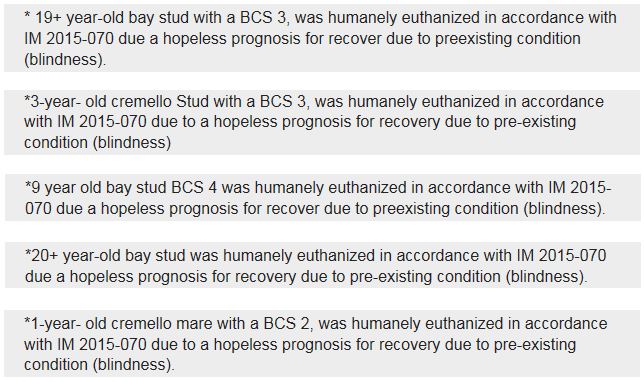
When did the nineteen year old stud go blind? Yesterday? Or was he like that since birth? The case of the cremello mare suggests that blindness can occur early in life. If it is a hopeless prognosis, how did the twenty year old stud stay alive for so long in such harsh conditions?
The term ‘blindness’ does not appear anywhere in Attachment 2. That it provides justification for euthanasia must be the interpretation of the specialist on the case.
Maybe the prognosis is hopeless because nobody wants to adopt blind horses and most rescues are not interested in them? If so, then why not let them stay on the range with their seeing-eye helpers? How can you refer to these life-ending actions as ‘humane?’
The Triple B Complex includes the Triple B HMA, Maverick Medicine HMA, Antelope Valley HMA west of Hwy 93, and Cherry Spring WHT.
New VR Plate Moving Ahead
Comstock Gold
Trailcam photo of a Virginia Range buckskin, taken 05/20/18. The black points (mane, tail, lower part of legs) tell you his base color is _________.

Stood Up Again
Trailcam photo of no Virginia Range mustangs on 05/21/18. Same for 05/27/18, none in sight, after driving through an area of hundreds of acres.
Keep in mind that the population density of the VR is ten times higher than your average HMA, 9.4 horses per thousand acres vs. 0.8 on BLM rangelands in Nevada.

Mustang Monday
Burros Found Dead Near Beatty, NV
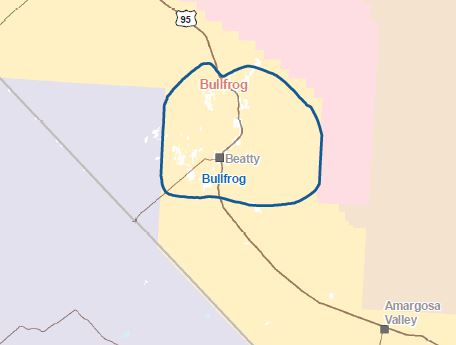
Thirteen wild burros were executed near Beatty, NV, according to a report in the Pahrump Valley Times dated 05/16/18. The animals were probably associated with the Bullfrog HMA, which has a target population of 91 (upper value of AML) and covers 157,180 acres.
See also this report dated 05/14/18 from the Fox affiliate in Las Vegas. Includes video.
Anyone with information about the event can call the BLM at 1-800-521-6501. To date, no arrests have been made in the case.
Related: Where to find burros in Nevada.
UPDATE: The following video was posted by the NBC affiliate in Las Vegas on 05/14/18.
This Is the Lord’s Doing, and It Is Wonderful in Our Eyes
Trailcam photos of youngsters on the Virginia Range, 05/05/18 and 05/06/18.


They Have Pintos Too
Trailcam image of a paint horse on the Virginia Range, 05/05/18. This color pattern is known as ‘tobiano,’ meaning white across the spine, extending downward. Base color is black.

USFS Ends Cold Creek Gather
Refer to this press release from the Forest Service. More information can be found at this page.
Results of gather:
- 148 horses removed (72 studs, 67 mares, 9 foals)
- 19 horses euthanized (12.8% death rate)
The remaining population was estimated to be around 140 horses. The affected area consists of the Spring Mountain WHT (102,221 acres) and Wheeler Pass HMA (275,575 acres). The AML is 66, for a target stocking rate of 0.2 horses per thousand acres. The actual stocking rate, based on animals remaining, is 0.4 horses per thousand acres.
The action was prompted by drought conditions in the southwestern U.S.
UPDATE: One of the euthanized horses was not emaciated, not injured in the gather, but was blind. Almost certainly he had one or more seeing-eye buddies on the range and would have been fine if allowed to stay there. If nobody wants to adopt blind horses, returning them to the range would be more humane than putting them down?
Barefoot On the Mountains
Trailcam photo of a Virginia Range mustang, taken 05/05/18, showing condition of the hoof. The natural rounding of the edge is known as the ‘mustang roll.’
Hard to tell with overcast skies, but she appears to be a dark bay. Elevation 6500 feet.

Keeping Up Appearances
Two Virginia Range mustangs visiting with the neighbors on 05/18/18.

Mustang Monday
On Wheeler Pass HMA.
Yakama Horses
1. Watch the following video about the Yakama Indians and their horses.
2. Go to Chillypepper.org and observe the endless string of rescued foals coming from Washington state.
3. Download the 05/09/18 episode of Mustang Matters and listen to the remarks from 14:50 to 23:10.
Are you connecting the dots? They’re sending pregnant mares to slaughter.
In trucks marked ‘666?’
Disgusted? Want it to stop? Call a press conference and tell the truth.
Darkness hates the light.
Some of the horses may be traceable to the Horse Heaven Hills.

