What is a Wild Horse Territory?

The WHB Act protected horses and burros on lands where they were found when the law was signed by President Nixon in December 1971.  Some of those lands are managed by the Bureau of Land Management (BLM), some are managed by the U. S. Forest Service (USFS).  Lands managed by the USFS are called ‘Territories.’  BLM uses the term ‘Areas.’

There are currently 34 active WHB territories in seven states, some managed jointly with the BLM.  They can be found on this map.  If you can’t find a territory on the USFS list, try the BLM HMA page.

The USFS FAQ page provides a history of equines in North America, stating that horses and burros are indigenous species, evolving on the continent with its grasslands.

USFS_FAQ_Natural_Ecology-1

This contradicts one of the elements in the wild horse narrative, namely, that horses are non-native animals.

Ten to twelve thousand years ago, most of the large mammals became extinct in North America, including horses, mammoths and saber-tooth tigers.  Horses returned to the continent with the arrival of Spanish explorers.

USFS_FAQ_Native_Species-1

Ian Tyson’s La Primera, the soundtrack in this video, takes it from there.  The story is told from the horse’s viewpoint.  H/T Sandy Palen at Wild in the Pryors.
Fox Guarding the Hen House

An editorial that appeared in The Salt Lake Tribune on 05/01/18 points out the conflicting interests of the BLM in the area of rangeland management.  The photo at the top of the page was probably taken near the National Wild Horse and Burro Summit held in Salt Lake City last August.

The conference organizers and conference participants are not wild horse advocates.  How many elements of the wild horse narrative can you find in their plenary session?

The commentary is a response to the recent BLM Report to Congress about management of wild horses and burros on Western rangelands.

The writer argues that commercialization is the cause of rangeland degradation, not wild horses and burros.

It’s easy to see what livestock can do to the land, harder to imagine how widespread damage can be attributed to oil and gas exploration.  Go to 5:04 in this video for the scene at Stewart Creek HMA in Wyoming.

If the goal is to change the way Americans think about western rangelands, and to supplant traditional notions of freedom, ruggedness and self-reliance with new-age ideals of weakness, vulnerability and dependence on government, then the landscape should be dotted with cattle and sheep, not free-roaming horses and burros.

Emergency Gather Planned Near Cold Creek, NV

Refer to this report dated 05/07/18 in the Las Vegas Review-Journal.  See also this press release dated 05/07/18 from the U.S. Forest Service.

A similar action was carried out in 2015, against the wishes of local residents.  At the time of the gather, the horse population was at 7X AML and no cattle were grazing in the area.  The case is briefly discussed beginning at 21:48 in this video.

The town of Cold Creek falls within the Wheeler Pass HMA or Spring Mountain HA.

New Band on the Virginia Range

Photo of VR stallion scouting out the territory on 05/04/18.  A mare and foal lagged about 600 feet behind, awaiting instructions.

IMG_5301

He decided things were not safe for the rest of the family so he circled back and moved them elsewhere.

IMG_5305

Picked up by trailcam as he circled back.  A contractor arrived on site while these photos were taken, pulling a trailer with backhoe, and that’s what spooked him.

IMG_6901a

Gone Now

This video tells the story of the Sheldon horses in NW Nevada, former inhabitants of Sheldon National Wildlife Refuge.  Rounded up a few years ago.  The area is managed by the FWS, not the BLM, although a BLM contractor was involved in the gathers.

The size of the refuge is 574,000 acres, and at the time of the removals there were 800 horses and 90 burros roaming the land, for a stocking rate of 1.6 animals per thousand acres, almost twice the rate of your average HMA in Nevada.

The gathers themselves, sometimes difficult to watch, are an effect, not a cause.  Instead of criticizing the contractor, question the basis on which they were justified.  Does everything appear to be legit?

Sheldon-Horses-1

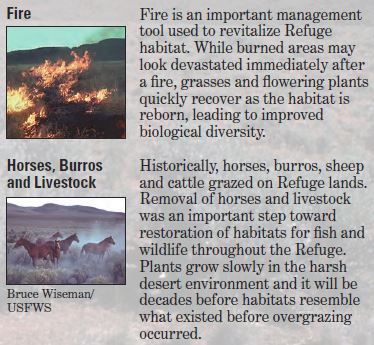
For example, this section of the SNWR brochure indicates that plants grow back quickly after a fire but grow slowly after grazing.  Does that sound right?  What happens to the risk of fire when you allow vegetation to grow unchecked?

Quick Tour of Virginia City

Aerial view of Virginia City posted to this FB page.  Starts with some mining ruins, including hoisting works and tailings.

The view beginning at -1:37 is to the east, away from town, followed by a view to the west, towards town, with a snow-covered Mt. Davidson in the background (originally Sun Mountain).

St. Mary’s church appears at -1:11, followed by the Fourth Ward School at -1:06.

Next is the Silver Terrace Cemetery (NE part of town) at -0:57.  The Silverland Inn is at the center of the frame at -0:32.

The view at -0:12 is to the north, showing some of the ‘alphabet’ streets.  The main drag running through town is C Street.  Mine owners and superintendents lived up the hill on A and B Streets while the rank-and-file lived in the lower part of town, D Street, E street, etc.

The Virginia Range mustangs occasionally pass through the area, as noted in this post.

H/T St. Mary’s in the Mountains.

Nevada HMA Stocking Rates

The chart below shows the stocking rate in animals per thousand acres as a function of land area for HMAs in Nevada.  Stocking rates are based on the upper values of the AMLs and include both horses and burros.  The stocking rate for the Virginia Range (horses only) is based on a census in early 2018.

Three observations from the chart:

  • Most stocking rates are less than 2 animals per thousand acres
  • Stocking rates vary inversely with HMA size
  • Stocking rates for large HMAs (above 500,000 acres) are basically constant

The average HMA in Nevada has 193,000 acres.

The HMA with the largest stocking rate is Fort Sage (formerly Fox Hog).

The largest HMAs are the Nevada Wild Horse Range and Triple B.  The smallest is Fort Sage.

The average stocking rate for Nevada HMAs is 0.84 animals per thousand acres.

NV-SR-HMA-1

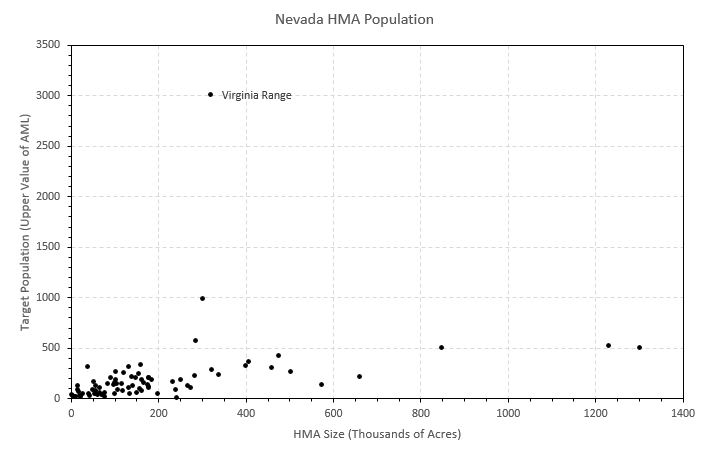
Nevada HMA Population

The chart below shows the population target for HMAs in Nevada as a function of HMA size.

Inspection of the chart yields three conclusions:

  • Most of the HMAs are smaller than 200,000 acres in size
  • Most of the AMLs are less than 500 animals
  • AML varies with size but not linearly

Regarding that last point, HMAs with a size of 100,000 acres have an average AML of about 150 animals.  If AML varied linearly with size, an HMA of 500,000 acres would have a population target of roughly 750 animals, which is not the case.  Larger HMAs have a disproportionally low population target.

The Virginia Range, in the western part of the state, has been included for comparison (actual population, not a target, mostly private land).  It does appear to be an outlier compared to the HMAs, with a disproportionally high number of animals for it’s size.

And no, the VR horses are not standing around on dry lots starving to death, as you can see in this video from 2016.

NV-AML-HMA-1

Keeping a Safe Distance

You just drove two and a half hours to your favorite HMA.  Or maybe you went for a hike on the Virginia Range.  Just to your west, barely visible, you spot a band of wild horses.

IMG_5066

As you’re watching, some of the horses drift closer, including a mare and foal.  A yearling steps in first for a closer look.  What should you do?

IMG_5100

If you’re in a remote area, where the horses have little or no contact with people, this probably won’t happen.  You’ll need a long lens.  They’ll make sure you keep a safe distance.

What if you’re in a area where the horses are familiar with people?  (Recall this example involving burros.)

Some folks say get out of there if approached by a wild horse.  Good advice?  Or bad lesson for the horse?

Look at the photo above.  No high head, no ear pinning, no tail swishing.  If you step back, if you move your feet, he wins.  You just told the horse you’re lower.

If a horse approaches you respectfully, as in the case above, don’t yield to his pressure.  Stand your ground.  Push back if you have to.  He’ll probably take a few sniffs and move on.

Backing away tells him he’s higher, which may encourage more boldness, more interactions with people.  Bad lesson for the horse.

If a horse approaches you aggressively, pick up a rock, a stick, whatever you can get your hands on, and be ready to throw it.  Raise your posture, look bigger.  Use your voice.  He’ll probably steer clear of you.  Horses are comfort-seeking animals and don’t like confrontation.

IMG_5108

Nine Point Four

More evidence of overpopulation on the Virginia Range, an area with a stocking rate ten times higher than your average HMA in Nevada, 9.4 horses per thousand acres vs. 0.84 horses (plus a few burros) per thousand acres on HMAs.  Photo taken 04/15/18.

Critics argue that the range can’t support these numbers.

Don’t be fooled, they’re not trying to protect the land, they’re trying to protect a narrative.

IMG_5222

Principally But Not Exclusively

Public lands inhabited by wild horses and burros in 1971, when the WHB Act was signed into law, are devoted primarily to WHB, right?

Nope, not according to the BLM.  Only three areas in the western U.S. are managed principally for horses and one for burros.

Principally

Listen carefully to the remarks from 0:05:30 to 0:06:12 in the presentation by John Ruhs, State Director for BLM in Nevada, at this post.  The areas of interest, unnamed in the video, are (1) Pryor Mountains Wild Horse Range, (2) Nevada Wild Horse Range, (3) Little Bookcliffs Wild Horse Area and (4) Marietta Wild Burro Range.

Note that all four are listed as HMAs.  Little Bookcliffs is referred to as an Area, while the other three are called Ranges.

You have HMAs, you have Ranges, you have Areas.  HMAs can be upgraded to Ranges if the Director of the BLM so designates.  Only in such cases do the benefits of ‘principally but not exclusively’ apply.

Is that what Congress intended in 1971?

Stocking rates for these areas (based on upper values of AMLs):

  • Pryor Mountains WH Range: 317 acres per horse (3.2 horses per thousand acres)
  • Nevada WH Range: 2603 acres per horse (0.38 horses per thousand acres)
  • Little Bookcliffs WH Area: 240 acres per horse (4.2 horses per thousand acres)
  • Marietta WB Range: 620 acres per burro (1.6 burros per thousand acres)

The Nevada WH Range is part of Nellis Air Force Base.  Principal use is weapons development and flight training, no public access.

H/T Wild Horse Education.