
Virginia Range horses stop by Cindy’s Bar and Graze for some refreshments, 07/20/18.
Category: Range
On the range
Wild Burro Hit in Ear with Arrow
Animal control personnel are trying to locate the injured animal, which roams the Reche Canyon area south of San Bernardino, CA, according to a report dated 07/19/18 in The Sacramento Bee.
The area of interest is not on BLM land. The nearest BLM Herd Areas are 20 to 30 miles to the east. They have no AMLs and are not managed for WHB.
A $1000 reward has been offered for information leading to the arrest and conviction of the person(s) responsible.
Utah HMA Stats
Most of the herd management areas in Utah are on the western side of the state.
Here are some statistics for them, developed from individual pages at the BLM web site.
- Number of HMAs: 18 (one jointly managed with USFS)
- Total land: 2.7 million acres (mostly public, some private)
- Total animals: 1911 (mostly horses, some burros, based on upper values of AMLs)
- Average stocking rate: 1397 acres per animal (0.72 animals per thousand acres)
- Stocking rate at 3X AML: 466 acres per animal (2.15 animals per thousand acres)
The last figure is offered as an estimate of the current situation, as many of the HMAs have more animals than allowed by the upper end of their AMLs.
Livestock grazing was reported on the Sulphur HMA and presumably occurs on others.
The largest HMA is Cedar Mountain at 411,636 acres, while the smallest is Tilly Creek at 37,006 acres.
Stocking rates vary from 1.5 animals per thousand acres at Range Creek HMA to 0.4 animals per thousand acres at King Top Mountains HMA.
The North Hills HMA is jointly managed with the USFS.
Are There Any Wild Burros in Utah?
You might see a few of them on the Muddy Creek and Sinbad HMAs, both of which are managed for horses and burros. I-70 passes through both areas, in a part of the state known as the San Rafael Swell.

The Muddy Creek HMA covers 208,810 acres and has an AML of 125, for a target population density of 0.6 animals per thousand acres. Sinbad contains 285,518 acres and has an AML of 125 (horses and burros) for a target density of 0.4 animals per thousand acres.
In the map above, Muddy Creek appears to be at least 50% larger than Sinbad, so the numbers are wrong or the HMA boundaries were drawn incorrectly. The Sinbad HA includes two parcels, one of which is adjacent to the Muddy Creek HMA. The map may show the combined area of the Muddy Creek HMA and western portion of the Sinbad HA?
Range Creek Gather Ended
BLM announced today that it had concluded the removal of wild horses from lands outside the Range Creek HMA in east-central Utah. The news release indicated that 92 horses had been gathered but did not indicate if they were on lands falling within the Range Creek HA and if any livestock were present on those lands.
One horse died in the operation but circumstances of the loss were not given.
Captured horses were taken to a contract facility in Axtell, Utah, where they will be evaluated and prepared for adoption.
RELATED: BLM Plans Gather at Range Creek HMA.
BLM Bringing WHB to Cheyenne Frontier Days
Wild horses and burros will be offered for adoption in Cheyenne, WY on 07/27/18, according to a BLM news release posted yesterday. The ten-day celebration of western heritage begins on 07/20/18 and features a rodeo, concerts, parades, western art show, carnival and museum.
Trainers with experience in gentling mustangs will provide demonstrations each day at 10 AM and 4 PM.
Personnel from Heroes and Horses will be available July 23 – 26 to explain how horses can help veterans suffering from PTSD.
WHB posters will be available at the BLM booth.

Opponents of Fish Springs Roundup Protest in Reno
Wild horse enthusiasts met yesterday at the BLM office in Reno, NV, to protest the removal of 50 animals from the Fish Springs area near Gardnerville, according to a report dated 07/17/18 in Nevada Appeal.
The BLM argues there are too many horses in and around the Pine Nut Mountains HMA, which covers 104,316 acres in western Nevada. Current population is 775 horses with an AML of 179.

The target population density is 1.7 animals per thousand acres and the actual population density is 7.4 animals per thousand acres. These figures do not include the lands of the Pine Nut Mountains HA, which the horses inhabit, that would make the densities LOWER.
Meanwhile, a few miles north, on the Virginia Range, the population density is running at ten animals per thousand acres.
Look at the photos here, here and here from June, 2018. Do you see any denuded lands or emaciated animals?
RELATED: Opposition to Pine Nut Roundup Continues.
Vendor Advisory for 2018 Burning Man
Sellers of goods and services at this year’s Burning Man are warned that only permitted and approved vendors will be allowed to conduct business at the event. Refer to this BLM news release posted today.
Anyone engaged in commercial activity without a permit will be removed.
The festival opens 08/26/18 in the temporary metropolis of Black Rock City, northeast of Gerlach, NV, on a dry lake bed called ‘the playa.’

Anyone planning to offer tours into the hills to see the wild horses and burros that surround the place is expected to comply as well.
RELATED: Burn More.
Off the Reservation
Wild burros on the Arizona side of Lake Mead. Refugees from Black Mountain HMA?
Always On the Move
Tail end of a band heading down one of the trails on the Virginia Range 07/13/18.

Mustang Monday

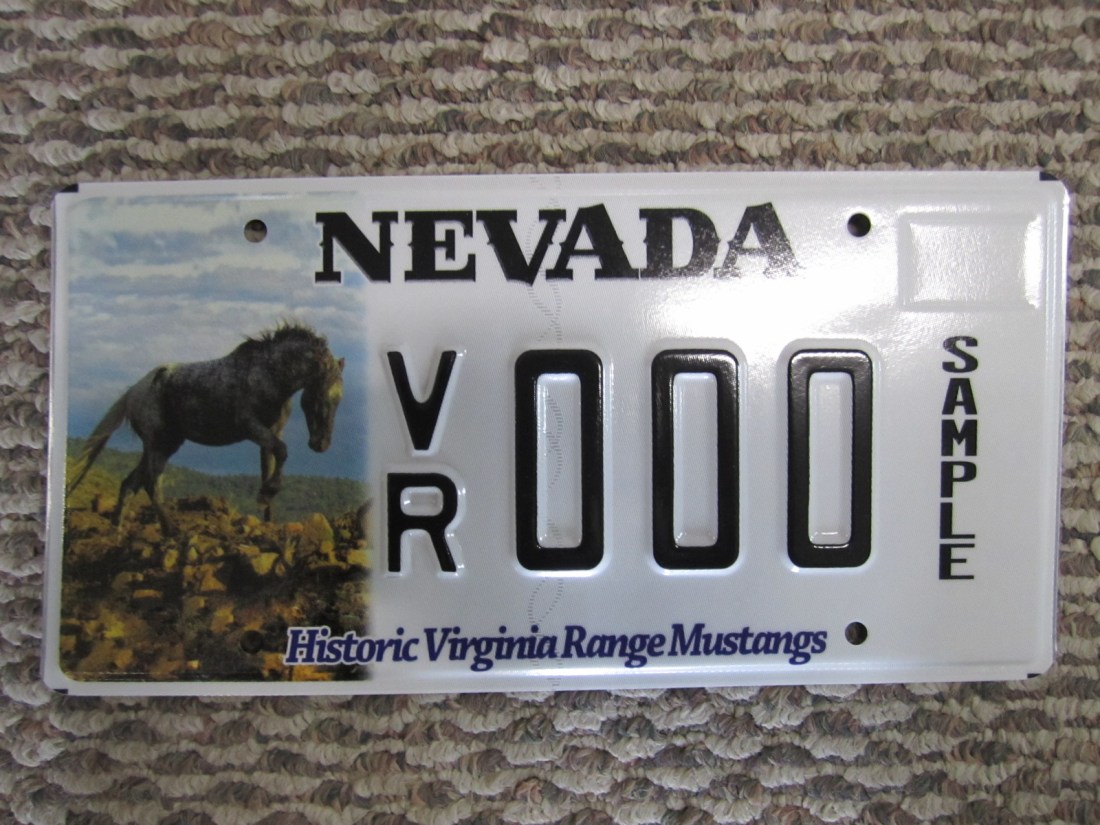
New Plate Captures the Struggle of America’s Wild Horses
The new specialty plate for the Virginia Range mustangs features an image of ‘Ghost,’ a stallion that roams the hills near Hidden Valley, east of Reno, NV.
It symbolizes the ruggedness of wild horses and their uphill battle against those who want them removed from western rangelands.
The plate will be available to drivers across the state and a collector’s version will be offered to individuals outside of Nevada.
The Virginia Range is ‘ground zero’ in the wild horse preservation movement, launched in 1950 by Velma Johnston.
RELATED: Proof of New Virginia Range Specialty Plate Released.
BLM Skips Public Meeting on Pine Nut Roundup
Roughly 300 people attended a meeting at the Fish Springs Fire Department on 07/12/18 to protest the removal of wild horses from the Pine Nut Mountain Herd Area east of Gardnerville, NV, which could begin next week. BLM representatives were not among their number. See the report posted today in The Record-Courier.
RELATED: Opposition to Pine Nut Roundup Continues.
BLM Ends Goshute Roundup
Bait-trapping concluded on 07/12/18, with 135 horses removed from lands outside the Goshute HMA, according to a BLM news release dated 07/13/18. The report did not indicate if livestock were present on lands where the horses were grazing.
One of the captured animals was put down because of blindness.

Refer to this chart for an explanation of Body Condition Scores.
RELATED: BLM to Gather Horses on Goshute HMA Starting Next Week.
Things Horses Do When Not Locked in Stalls
Virginia Range mustangs exploring new things.

Things Horses Do When Not Locked in Stalls
Two bachelors kicking up dust on the Virginia Range.

BLM Urged to Fight Caliente Legal Action
The BLM should not back away from its plan to remove over 1700 wild horses from the Caliente HA Complex, according to an opinion piece that appeared today in the Mesquite Local News.
Plaintiffs consider wild horses to be “…more important than the livelihoods of ranchers who graze 4,500 head of cattle and sheep in the area.” That the animals were placed on lands set aside by Congress for wild horses and burros seems to have been overlooked by the writer.
The editorial contains several elements from the wild horse narrative and lays most of the blame for rangeland degradation at the feet of the horses.
Herd areas, like herd management areas, include lands where horses and burros were found when the WHB Act was signed into law (go to the 8:30 mark in this video). Over the years BLM has argued that herd areas don’t have the resources to sustain horses and burros. If that’s true, why are they planning a gather in the Caliente complex? There’s nothing to remove.
And if the land is too harsh for horses and burros, it must be unfit for cattle and sheep?
If the land is suitable for cattle and sheep, it’s suitable for horses and burros, who take priority over the livestock because of the WHB Act.
RELATED: Lawsuit: BLM Can’t Remove Horses in Favor of Livestock.
Are Horses Afraid of Water?
The Salt River herd answers that question. H/T Robert Koblewski.
Things Horses Do When Not Locked in Stalls
Two youngsters grooming each other on the Virginia Range.

Corolla Horses Share Beach with Vacationers
On the Outer Banks of North Carolina. Maybe we should call them the Salt Water horses.
RELATED: Salt River Horses Share Water with Vacationers.

