BLM Plans Another 100% Gather at Beatys Butte HMA

Helicopters would be used to gather all wild horses on Beatys Butte HMA, followed by the return of 100 studs and mares to the range, according to a news release issued yesterday by the Lakeview office.  Mares would be treated with a contraceptive (such as PZP).  Public comments must be received by 09/28/18.

The HMA is in southern Oregon on the Nevada border.  It contains 437,120 acres and will have a population density of 0.23 animals per thousand acres at the end of the process, almost nothing.

The announcement did not indicate if the goal was to have the area horse-free within ten years, but it sure sounds like it.  Also omitted from the remarks was the innovative Beatys Butte Wild Horse Training Facility.

Beatys_Butte_HMA_Map-1

A 100% gather was completed in 2015, the result of a new cooperative program between ranchers and the BLM.

The proposed gather marks the next phase of a long-term strategy developed by ranchers, wild horse advocates, environmental groups, elected officials, and state and federal fish and wildlife agencies, according to the announcement.

How many advocates want to see horses removed from western rangelands, families broken up, breeding patterns determined by government?  Who benefits from this arrangement?

The wild horse population on Beatys Butte was over 1000 in 2015.  Today it’s around 250.  The number of livestock in and around the HMA was not provided.

Common Causes, Special Causes

The trailcam photo below shows an underweight horse on the Virginia Range.  A WHB specialist might give it a BCS of 3.  A wild horse critic (ahem, cough-cough, hater) might argue the horses are overpopulated and need to be removed from the range.

Would that be a fair statement?

A ‘common cause’ belongs to the system and affects all horses in an area.  The illness affecting the Waipio Valley horses would be an example.  It will probably be attributed to common causes, something in their environment.  Ditto for the Sand Wash horses, who are threatened by fencing and drought.

A ‘special cause’ is outside the system and affects only individual herd members.  An example would be the horse recently removed from Big Summit WHT.

If you saw many horses with low body condition scores, you’d be thinking common causes, such as excess animals / not enough land / insufficient forage.

In this example you only see one such horse, so you’re looking for a special cause, like illness, injury or loss of teeth.

Two mistakes are possible: (1) attributing a problem to a special cause when it was produced by common causes and (2) attributing a problem to common causes when it was produced by a special cause.

Calling a horse ‘stupid’ because he wandered onto a road and was hit by a car is an example of Mistake #1.  Any of the horses in his band could have done that, because a new subdivision is chewing up their land and now they must find food elsewhere.

The critic above is wrong.  He has made Mistake #2.

IMG_7397-1

BLM Ends Roundup at Nevada Wild Horse Range

Bait trapping ended 08/29/18, according to a news release issued today, with 801 horses removed from the Nevada Wild Horse Range, the largest HMA in Nevada.

Thirty one deaths were reported (3.9%) and the number of horses returned to the range was not stated.  Captured animals were taken to the Palomino Valley Center near Reno, NV and the Ridgecrest Regional Corrals in Ridgecrest, CA.

Gather stats and daily reports can be found on this page.

RELATED: BLM Starts Emergency Gather at Nevada Wild Horse Range.

Are There Any Wild Horses Left in Utah?

The state has been ‘ground zero’ for wild horse gathers this year, with the Range Creek, Cedar Mountain, Four Mile, Bible Springs, Tilly Creek, Sulphur and Muddy Creek HMAs targeted for removals.  Next on the list is the Onaqui Mountain HMA.

An article posted today in the Odgen-based Standard-Examiner looks at a proposed roundup that would remove 84% of the horses.  Opposing viewpoints are considered.

“BLM does review range health when they renew grazing permits, but it’s true there are hundreds more cattle and thousands more sheep permitted than there are wild horses on the Onaqui.”

At what point do we start calling it collusion?

A Simple Experiment in Diversionary Watering

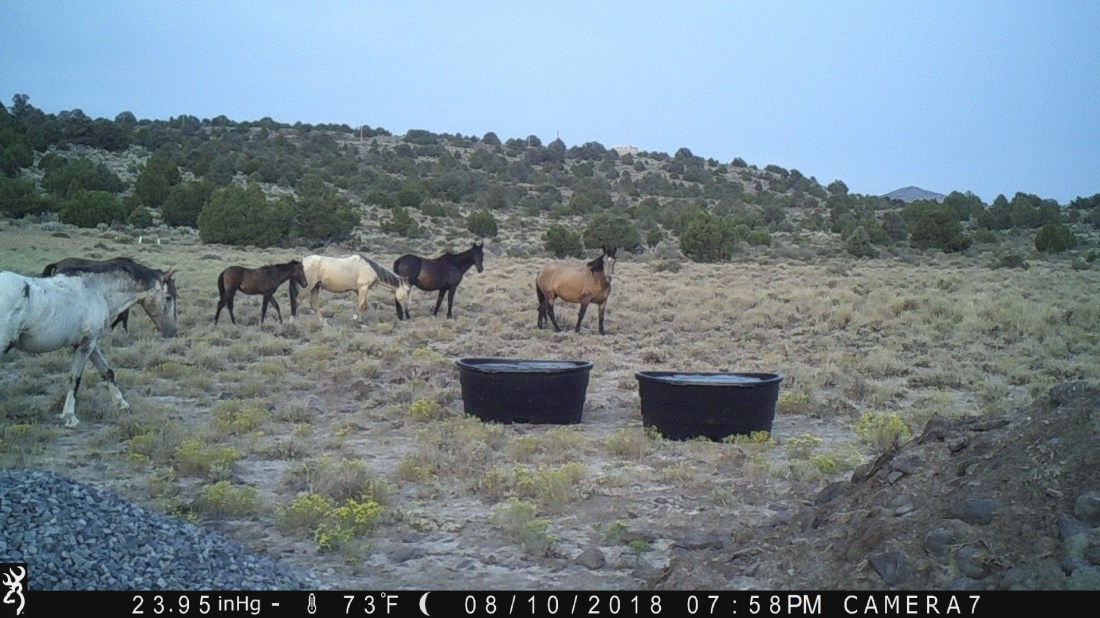
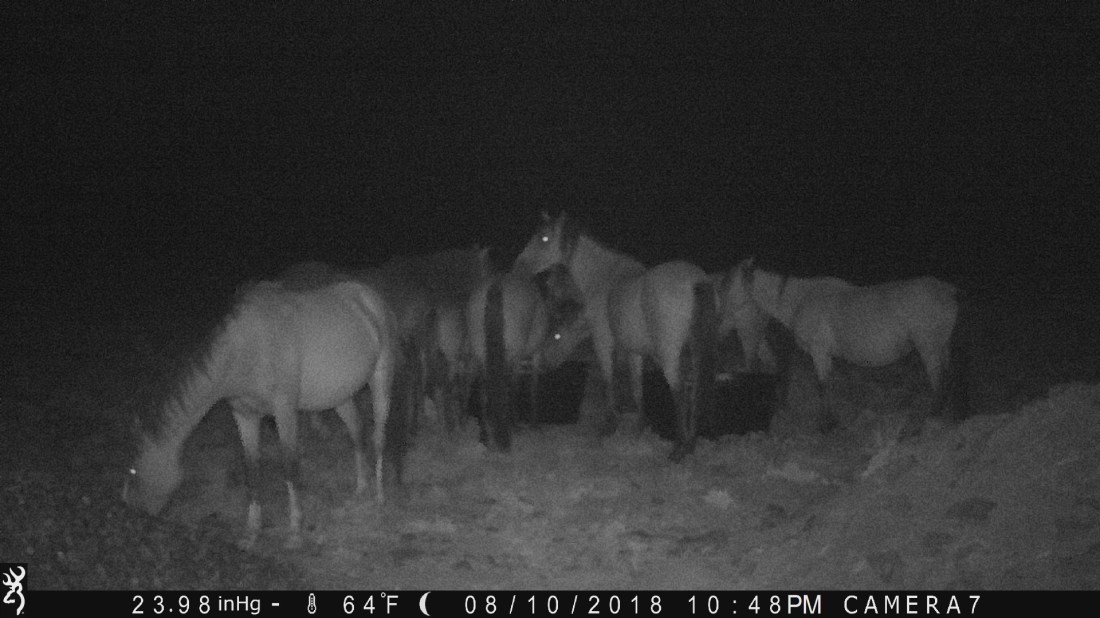
Trailcam hasn’t picked up any Virginia Range mustangs last few weeks, so I put out two stock tanks and filled them with water on 08/10/18.  They found them that evening!

The idea is to keep the horses up in the hills and away from populated areas.

Bait traps use the same concept.  Put out some food and water but enclose the area with a pipe panel fence and attach the gate to a trip wire.  See the video at this post.

IMG_7304-1

IMG_7317-1

Best Way to See the Pryor Mountains Horses

A detailed article posted recently in Just Horse Crazy provides some background on the Pryor Mountains Wild Horse Range, along with recommendations for viewing the horses.  It’s pretty much everything you need to know.  The drive into the mountains should not be attempted without a 4WD vehicle.

The PMWHR is one of just three areas in the western U.S. devoted primarily to wild horses.  It may become the subject of a gather in early September, although the BLM has not formally announced it.

RELATED: Pryor Mountain Horses.

BLM Starts Emergency Gather at Spruce-Pequop

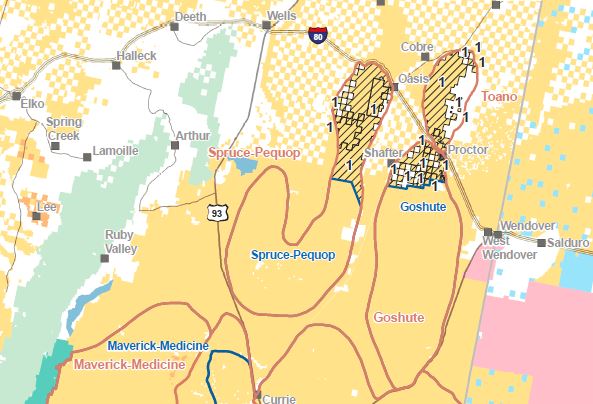
Bait traps will be used to remove approximately 300 wild horses from the Spruce-Pequop HMA, according to a news release issued yesterday.  The stated reason for the roundup is inadequate water and forage relative to the number of horses in the area.

Livestock are present on the HMA but were not mentioned in the announcement.

Gather operations will not be open to public inspection.

The HMA is on the south side of I-80 in eastern Nevada, about 40 miles south of the town of Wells.  It covers 240,744 acres and has an AML of 82, for an aimed-at population density of 0.34 horses per thousand acres.

Goshute_HMA_Map-1

Captured animals will be taken to the Indian Lakes Off-Range Corral in Fallon, NV, where they will be checked by a veterinarian and prepared for adoption.

The announcement did not indicate if the horses would be available for sale (under the the new cash-and-carry rules).  Adoption is better for the horses.  You provide a foster home for a year.  You do the heavy lifting to prove your worthiness.  Then you get title.

Gather stats and daily reports can be found at this page.

Case Against Man Who Rescued Foal Dismissed

A man from Placitas, NM, charged with unlawfully impounding a stray animal, appeared in court yesterday but the case was dropped.  The New Mexico Livestock Board could not prove that the foal was a stray or was found on public land.  See the story posted 08/22/18 by KRQE News in Albuquerque, NM.

The defendant operates the non-profit Placitas Animal Rescue and cares for cats, dogs and horses.

Sounds like the wild horses near Placitas are managed at the state level, like the Virginia Range mustangs near Reno, NV.

RELATED: Wild Horse Shares Road with Cyclist in Placitas, NM.

Red Desert Gather Ends Early

A BLM news release issued today indicates the Red Desert gather ended sooner than planned because the off-range corrals housing the animals had reached maximum capacity.  Of the 1442 horses removed from the range, 25 were returned and 10 died.

The announcement said horses were moving outside of HMAs, causing impacts in places not identified for their management.  Details were not provided.

A wild horse was euthanized on August 8 for a pre-existing condition and again on August 9 but the conditions were not explained.

A foal died in a temporary corral on August 12, cause of death undetermined.

Two horses were put down on August 13 for pre-existing conditions that were explained.

Captured animals will be available for adoption or purchase through the Wild Horse and Burro Program.  Animals not adopted or purchased will be placed in off-range pastures.

Gather stats and daily reports can be found on this page.

RELATED: Red Desert Gather Announced.

Virility and Potency in Action

Check out the photos of a cremello stallion defending his band in this article by the Daily Mail, dated 08/22/18.  The incident occurred in the western desert of Utah.

The photographer associated the stallion’s behavior with preparations for a roundup.

“Usually he keeps them farther away from the others but because water supplies have been drained in some locations as they get ready to do a round-up it meant they were all coming together in the same area.”

The location of the event was not provided in the story, but under what scenario would someone tamper with water sources for the horses?

A helicopter roundup?  Probably not.  So where are they bait-trapping in western Utah?

How about Cedar Mountain, near the Nevada border?