Pine Nut Roundup Set for Next Week

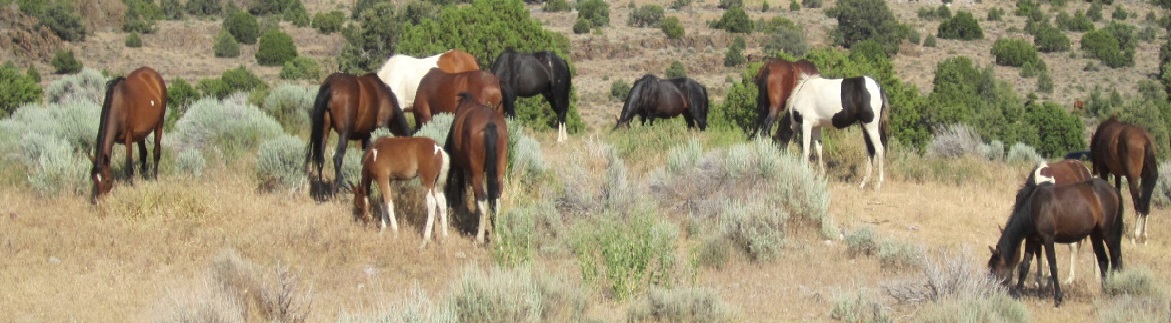
BLM announced today that 575 ‘excess’ wild horses would be removed by helicopter from the Pine Nut Mountains HMA beginning on or about February 6.  The gather will be open to public observation and captured animals will be taken to the Palomino Valley Off-Range Corrals north of Sparks, NV, where they will be prepared for adoption.

Gather stats and daily reports will be posted to this page.

The HMA covers 104,316 acres in western Nevada and has an AML of 179, for an aimed-at population density of 1.7 animals per thousand acres.  Forage consumption would amount to 2,200 AUMs annually.
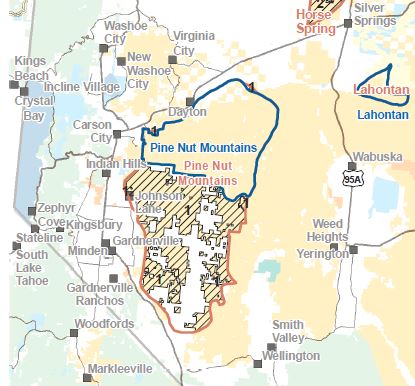
Pine_Nut_Mountains_Map-2

The estimated population in early 2018 was 775 horses.  A 20% growth rate would put the herd at roughly 900 horses today, for a population density of 8.6 animals per thousand acres.

Forage consumption would be 10,800 AUMs per year.  Resource loading attributable to horses would be 0.1 AUM per acre per year.

Wild horses that interfere with ‘other mandated uses’ of the land are said to be ‘excess.’

Would those uses be recreation, mineral extraction and timber harvesting?  No, they don’t require forage.  What could the other uses be?

Livestock grazing.  The Pine Nut HMA is subject to multiple grazing allotments.

Pine_Nut_Grazing_Allotments_Map-1

To decide which species is consuming more than its fair share of the available resources, you’d need to know

  • How many cattle and sheep are allowed on the HMA, or
  • How many AUMs are allocated to livestock, and
  • How many AUMs are set aside for wildlife

These figures never appear in the news releases.

Therefore, it must be the horses.  Livestock are blameless, always.

RELATED: Livestock Grazing in Nevada.
Comments Sought on Proposed Gather of Fifteenmile Horses

BLM announced today a plan to bring the wild horse population of Fifteenmile HMA in line with the capacity of the land to support them and ‘other mandated uses.’  The news release did not indicate what those other uses might be.

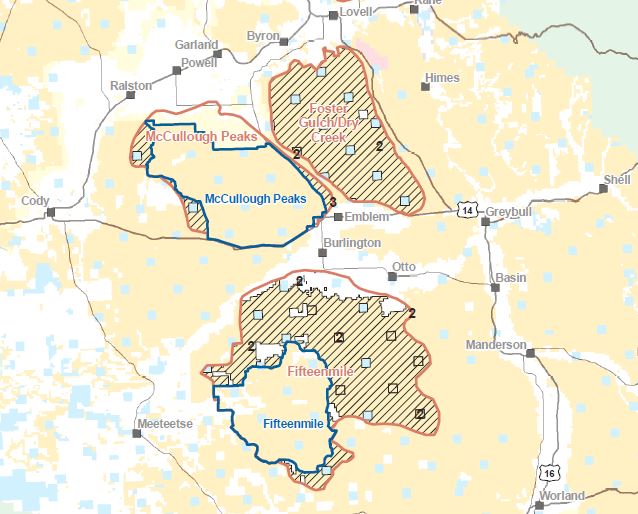
The HMA covers 81,000 acres in northern Wyoming and has an AML of 160, for an aimed-at population density of two animals per thousand acres.  The current population, said to be approaching 500 horses, yields a density of six animals per thousand acres and puts the herd at 3X AML.

mccullough_peaks_hma_map-1

The horses would consume about 1,900 AUMs annually at AML and nearly 6,000 AUMs annually at current population levels.

The announcement did not mention that livestock grazing occurs on the HMA.

mccullough_peaks_grazing_map-1

The number of livestock allowed on the HMA was not given in the announcement.

The aimed-at population density for livestock was not given in the announcement.

The forage allocated to livestock in the HMA was not given in the announcement.

Until these values are known there is no way of deciding which species needs to go.

But in a state where the BLM allocates 1.9 million AUMs to livestock every year, compared to 45,000 AUMs for horses, you can rest assured it ain’t the horses.

RELATED: Livestock Grazing in Wyoming.

Shannon County Horses Subject of Photo Exhibit

Photographs of wild horses that live in and around Echo Bluff State Park in southern Missouri will be on display at Social on Patton in Springfield starting February 1, as reported yesterday by the Springfield News-Leader.

Dean Curtis, who visits the area five or six times a year, will be present to answer questions and talk about his experiences photographing the horses.

These animals have roamed freely in Shannon County for more than a century and have organized into four herds: Round Spring, Shawnee Creek, Broadfoot and Rocky Creek.

The Broadfoot and Rocky Creek horses are said to be the most elusive.

RELATED: Wild Horses in Missouri?

Heber Death Toll Now at Seven

That’s since January 12.  Refer to this story by FOX-10 News in Phoenix.  Also killed were several coyotes (not mentioned in the report).

The WHT is like an Israeli settlement on Arab lands.  See the map on page seven of this document.  The Arabs view the occupiers with dripping contempt.

Do they have a motive for killing the settlers?  Absolutely.

Did they do the deed?  We’ll probably never know.  You see, they have friends at the U.N., the occupiers don’t.

RELATED: More Horses Found Dead at Heber WHT.

Alto Colts Subject of Court Battle

Two colts that have been held in a Santa Fe pen since June are wild and not under the jurisdiction of the New Mexico Livestock Board, according to volunteers with the Wild Horse Observers Association.  They should be returned to the range, just like the horses released by the court in September of 2018.

A hearing, originally set for January 21, has been rescheduled for next month.  Refer to this report, posted today by Ruidoso News.

RELATED: Judge Rules in Favor of Alto Wild Horses.

More Horses Found Dead at Heber WHT

The remains of four wild horses and several coyotes were found between January 15 and 22, near State Highway 260, according to a story posted today by the White Mountain Independent of Show Low, AZ.

All were dispatched by gunshots.

The discoveries were reported to the Navajo County Sheriff’s Office.  Personnel from the Forest Service were not available due to the federal government shutdown.

A motive was not discussed in the article.

The Heber WHT lies within—and is surrounded by—grazing allotments.  See the map on page seven of this document.

That wild horses rob forage from the public-lands ranchers is well established, including mares that have been darted with contraceptives.

Can coyotes take down young calves?

Last October, two stallions were found dead in the WHT, also killed by firearms.

RELATED: USFS Still Silent on Heber Wild Horse Shooting, Advocates Disappointed with Heber Recommendations, Wild Horse Narrative.

DVM Pushes Back Against Colville Gather

Although the wild horse roundup has been delayed, a veterinarian and member of the Colville Tribes has spoken out to make sure it doesn’t happen.

She observed that wild horses are an ‘easy scapegoat,’ but noted that

“Many legitimate studies by government agencies, universities, and animal groups show that livestock with cloven hooves can do a broader range of damage, can consume more types of plant species, and will drink more water than horses.”

A long term program that benefits the tribe and the horses should be developed, she explained, to avoid “…the loss of this basic element of our heritage.”  Refer to this story, posted yesterday by The Star of Grand Coulee, WA.

RELATED: Colville Gather Announced.

Wyoming Advocates Push for ‘Wild Horse Highway’

Volunteers with Friends of a Legacy, a group that works with the BLM to manage the wild horses of McCullough Peaks HMA, has asked the state legislature to formally name a section of U.S. 14/16/20 running from Cody to Emblem, according to a report posted yesterday by the Powell Tribune.

The HMA is on the north side of the road, while the neighboring Fifteenmile HMA is a few miles to the south.

mccullough_peaks_hma_map-1

Both HMAs are subject to permitted livestock grazing.

mccullough_peaks_grazing_map-1

The group received $5,000 last year from ASPCA to dart mares with contraceptives, signifying their assent to the overpopulation narrative.  (The ASPCA, an organization that guards against cruelty to animals, actually inflicts it.)

You have to wonder if these people have ranching backgrounds or ties to the ranching industry.  What a great way to get rid of the last few wild horses remaining on western rangelands.

These maps indicate that roughly half the land in this part of Wyoming set aside for wild horses is no longer managed for them, supposedly due to inadequate food and water, yet it can support privately owned cattle and sheep.

RELATED: Wyoming Advocacy Group Receives $5000, Aids Ranchers, Livestock Grazing in Wyoming.

Advocates Disappointed with Heber Recommendations

The proposed management plan for the Heber WHT is now in the public domain and some wild horse advocates are not happy with it, according to a story that appeared today in the White Mountain Independent.

One person said the collaborative working group that drafted the plan had a pre-set agenda to remove all free roaming horses from the Apache-Sitgreaves National Forest.

Another said the group was trying to solve a problem that didn’t exist.

A third person said she was removed from the group because she disagreed with some of the recommendations.

Comments on the plan can be submitted to the Forest Service this summer, according to the report.

RELATED: Heber Management Plan Drafted.

Horses of the Coalfields

Wild horses roam the abandoned coal mines in southern West Virginia, according to a story posted today by the Herald-Dispatch of Huntington, and mine owners don’t always consider them a welcome addition.

Tinia Creamer, founder of the Heart of Phoenix rescue, says many were abandoned by people who don’t want them anymore, or are looking to sell them but let them go to save money until a buyer is found.

She met last week with legislators to discuss the wild horse issues but concedes the meeting focused mostly on tourism, noting that organizations that use the horses for that take no responsibility for their care.

Given that things didn’t go exactly as planned, she wonders what the legislators might propose and if the horses would be better off left alone.