Silver King Progress Report

Helicopters started flying on 11/27/18.  Results through 11/29/18:

  • Horses gathered 185
  • Horse deaths 2
  • Horses returned to range 0

The wild horse population was approximately ten times AML at the beginning of the roundup, which affected ‘other mandated uses’ of the land.

Robbing_Too_Much_Forage-1

See also this story posted today by The Ely Times.

When the gather is complete, the horses will be at 2X AML, consuming maybe twenty percent of the AUMs on the HMA.  Livestock will receive the rest.  If people understood this, the overpopulation narrative would fall to the ground, taking the fertility control programs with it.

RELATED: Another Unbalanced Report on Silver King Roundup.

Wyoming HMA Population

The following chart shows the population target (AML) for HMAs in Wyoming as a function of HMA size.  Accordingly,

  • Most of the HMAs contain 500,000 acres or less
  • Most of the AMLs are 400 or less
  • AMLs are loosely correlated with HMA size

The correlation coefficient for population and acreage is .46, which means the variations in HMA size are somewhat useful in explaining the variations in AMLs.  The closer the value of this statistic to 1, the stronger the relationship between population and acreage.

Wyoming_HMA_Population-1

If the correlation coefficient was 1, all of the data would fall on a straight line, indicating that population was proportional to acreage.  HMAs of 200,000 acres would have twice as many horses as HMAs of 100,000 acres.

Note that the largest HMA does not have the largest AML and the smallest HMA does not have the smallest AML, but, in general, population goes up as acreage goes up.

Dispersion among the AMLs on the left side of the chart (smaller HMAs) is less than the dispersion among the AMLs on the right side of the chart (larger HMAs), a problem in statistical work known as ‘non-constant variance.’

RELATED: Wyoming HMA Stats.

Wyoming HMA Stats

Most of the Herd Areas and Herd Management Areas are in the southwestern part of the state.  Refer to the map on page 2 of this document.

Acreage and AMLs for HAs are not available, as they are not managed for WHB.

  • Total number of HMAs: 16 (four reported together as a complex)
  • Total land: 4,784,344 acres (mostly public, some private)
  • Total animals: 3,725 (per AMLs)
  • Average population density: 0.78 per thousand acres (1,284 acres per animal)
  • Population density at 3X AML: 2.34 animals per thousand acres
  • HMAs affected by grazing allotments: 16 (see this map)

Wild burros were not reported at any of the Wyoming HMAs.

The largest HMA is Salt Wells Creek, at 1,173,000 acres, and the smallest is Crooks Mountain at 58,000 acres.

Four HMAs have population targets (AMLs) below 150, the minimum number of animals for genetically viable herds.

Population densities vary from 2.56 animals per thousand acres at Green Mountain HMA to 0.33 at Lost Creek HMA.

The average density of 0.78 animals per thousand acres is slightly below the aimed-at density of one animal per thousand acres for all HMAs (across ten western states).

The target density of one horse or burro per thousand acres has little to do with the carrying capacity of the land.  Rather, it represents the forage loss that is considered acceptable by the public-lands ranchers and their allies at the BLM.

NDA OKs Diversionary Feeding of Virginia Range Mustangs?

The Nevada Department of Agriculture has authorized two advocacy groups to feed horses that have come down from the hills, to draw them away from populated areas, according to a report posted yesterday by KRNV-4 TV in Reno.  The animals migrate to lower elevations in the winter, searching for food and water.

The report did not name the advocacy groups.

IMG_3534

Feeding wild horses is generally not recommended and the practice is illegal in Nevada.

UPDATE: The advocacy groups may be the Virginia Range Sanctuary and Wild Horse Connection, based on remarks in this article by The Nevada Independent.

Alto Horses Get Temporary Warning Signs

The New Mexico Department of Transportation has installed fixed warning signs and radar speed signs along Hwy 48 near the town of Alto.  The signs were put in place until Lincoln County commissioners decide if flashing beacons would be appropriate for the area.  Refer to this report, posted today by Ruidoso News.

Alto_Horse_Warning_Signs-1

The Alto horses were recently returned to the range after two years in captivity when a district court judge ruled they were wild, not livestock.

RELATED: County May Agree to Flashing Warning Signs for Alto Horses.

Devil’s Garden Horses Get Short End of Stick

If the management plan is enforced, wild horses will receive 18% of the forage, with the balance going to livestock, according to data in a legal complaint filed in October.  Keep in mind that these are aimed-at values and do not reflect current conditions.Devils_Garden_AUM_Distribution-1

The complaint, which has 25 pages, reveals the mindset of the public-lands ranchers and should be read by anyone interested in wild horse preservation.

RELATED: Devil’s Garden Outplacement Program Up and Running.

Silver King Roundup In the News

A friendly reminder from The Ely Times: Helicopters will be pushing ‘excess’ horses off the Silver King HMA starting next week, because the land can’t support them along with other wildlife.  That the HMA is subject to several grazing allotments seems to have been overlooked by the writer(s).

The concern, of course, is not the body condition of the horses, but the body condition of the livestock.  Can’t let those horses rob the public-lands ranchers of their birthright!

AML_Roundup_Criteria_Rev-1

If the management plan is successful, roughly ten percent of the available forage will be allocated to horses, with the balance going to cattle and sheep.

RELATED: BLM to Gather Silver King Horses After Thanksgiving.

Devil’s Garden Outplacement Program Up and Running

Twenty former wild horses were adopted last weekend, with twenty four sold, according to a report posted 11/22/18 by the Herald and News of Klamath Falls, OR.
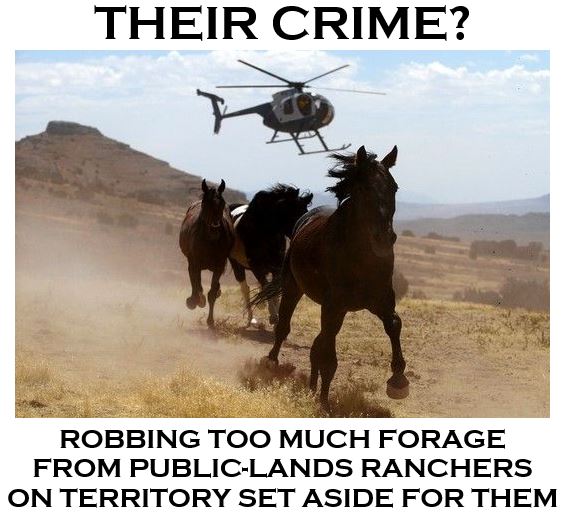
Robbing_Too_Much_Forage-1

Over 200 ‘excess’ horses remain at the made-to-order Double Devil Wild Horse Corrals in Alturas, CA.

RELATED: Forest Service Ends Devil’s Garden Roundup.

UPDATE: Refer to this legal complaint, filed in October on behalf of the Devil’s Garden ranchers against the U. S. Forest Service, for reducing the AUMs available to livestock.

The Forest Service had issued permits for 26,880 AUMs per year on the WHT, which means at least 4,480 cow/calf pairs were allowed, assuming they graze six months per year or less.  The allowable number of horses on the WHT is 402.  These are aimed-at numbers.  The horses would consume 4,824 AUMs annually.

The carrying capacity of the WHT is unknown.

The pre-gather wild horse population was 3,900.  The livestock population at the time of the gather is also unknown.

“Currently, wild horses on the Modoc NF [National Forest] are consuming more forage than is allocated in the wild horse territory for livestock, wildlife, and wild horses combined.”

They seem to forget that these lands were to be managed ‘principally but not necessarily exclusively’ for wild horses.

If the Forest Service is forced to achieve the targets, there will be roughly ten cow/calf pairs on the range for every wild horse, a ‘thriving ecological balance’ indeed.

Park Service Shares Results of Assateague Pony Census

There were 21 males and 57 females in the herd this month, according to a report posted today by WMDT-47 in Salisbury, MD.  Sounds about right, what’s the problem?

Well, the proportion of males seems low.  Alternatively, the proportion of females seems high.

The expected proportion of males is .50.  Ditto for females.  But those are properties of herds that are indefinitely large.

For herds of 78 animals, the observed proportions should fall within calculated limits, namely, .50 plus or minus an amount attributable to random variation.

Using p-chart limits, with n = 78 and p = .5, the proportion of males (or females) in the herd should fall between .33 and .67.  The observed proportion of males is 21 / 78 = .27, which is assignably low.  The observed proportion of females is 57 / 78 = .73, which is assignably high.

What is happening to the Assateague ponies?  A special cause should be sought.

Bands of free-roaming stallions might be bad for tourism so maybe they are the subject of an outplacement program.

Could it be that the fertility control program is screwing up the herd by interfering with natural breeding patterns?  Why would mortality favor males?

What might this portend for other herds where PZP is administered?

RELATED: Baby Boom Next Year on Assateague Island?