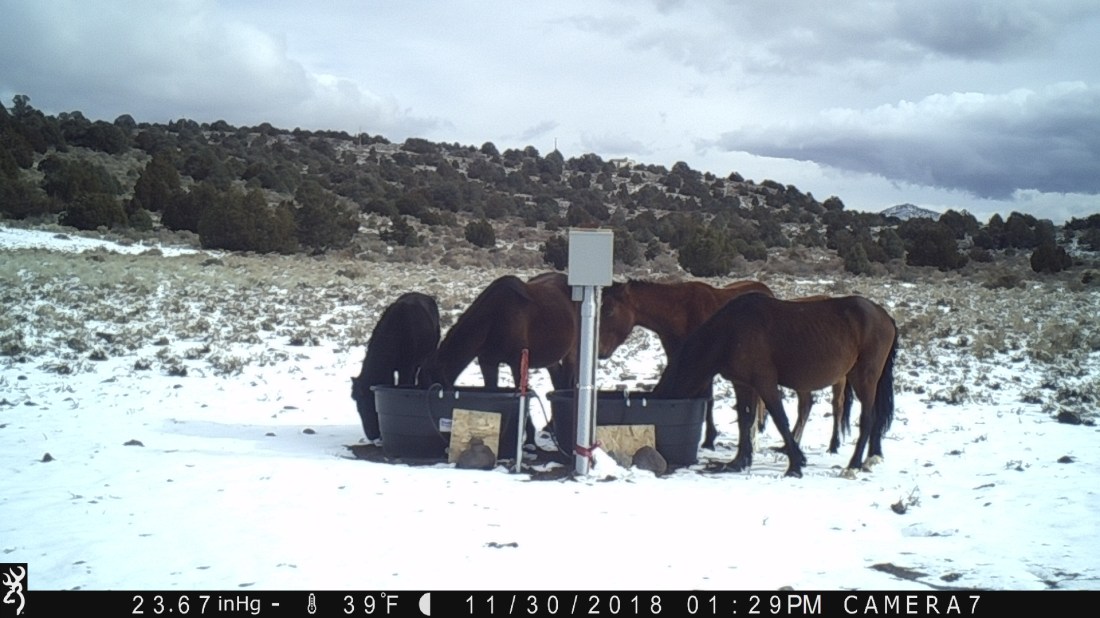
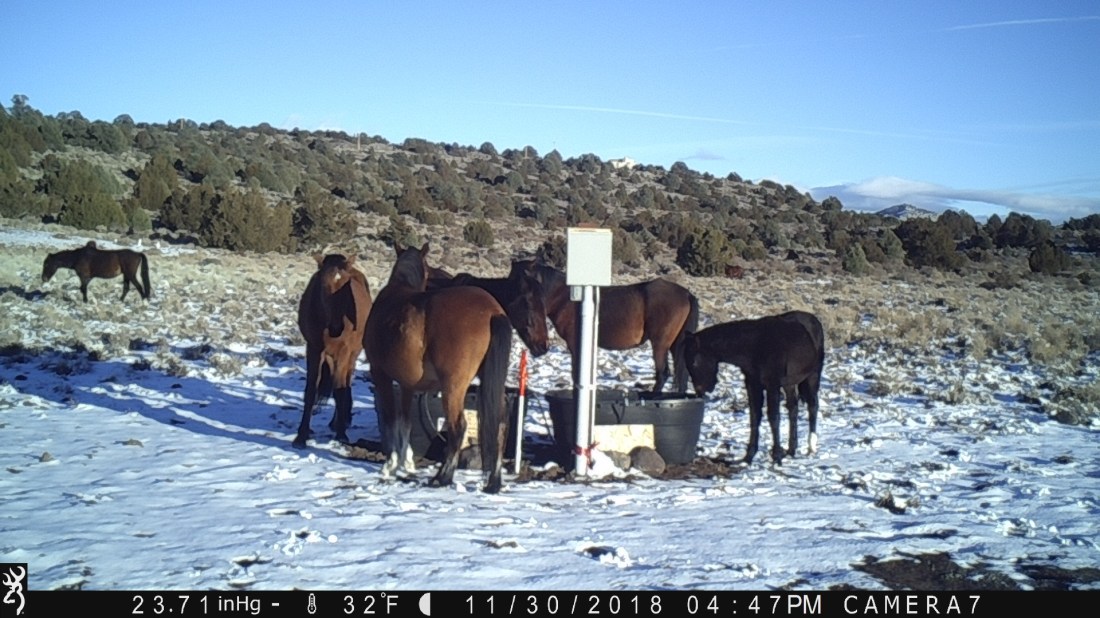
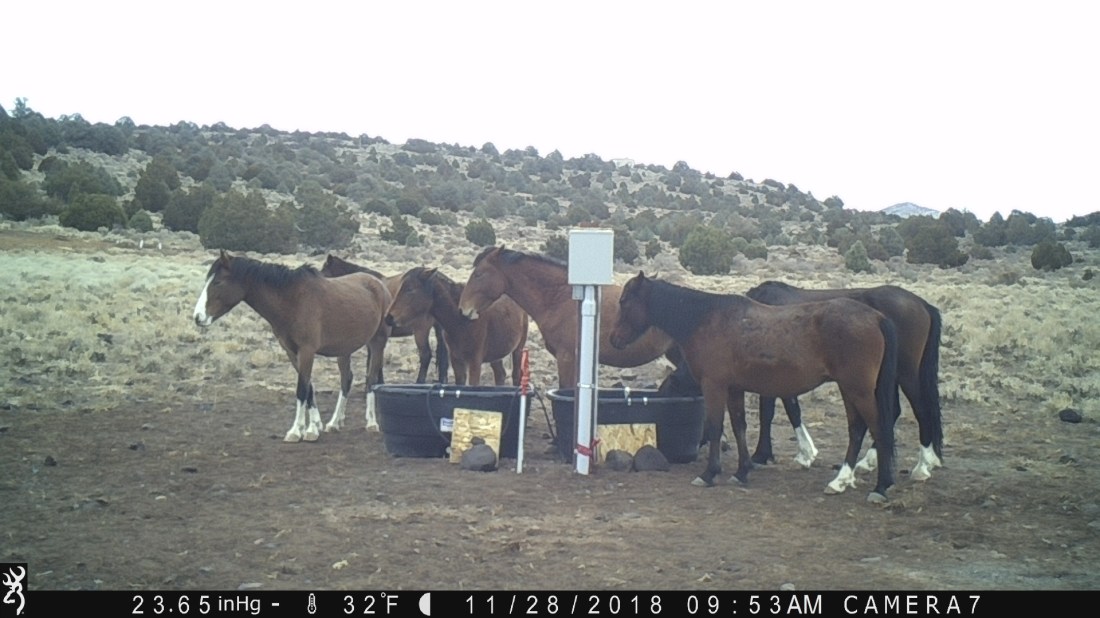
Their heads tell you there’s not much water in the tanks. The handle on the yard hydrant is shut, even though a block of wood was installed on 11/16/18 to keep it open.

Western Horse Watchers Association
Exposing the Hypocrisy, Lies and Incompetence of the Wild Horse Advocates
On the range
Their heads tell you there’s not much water in the tanks. The handle on the yard hydrant is shut, even though a block of wood was installed on 11/16/18 to keep it open.
On the Salt River. H/T makelafamily1999.
Virginia Range mustangs hang out at the stock tanks after getting a drink.
Take exit 32 on I-80 and travel south on USA Parkway. There is another entrance a few miles to the west, exit 28. The Google aerial image is terribly out of date. Try Bing.
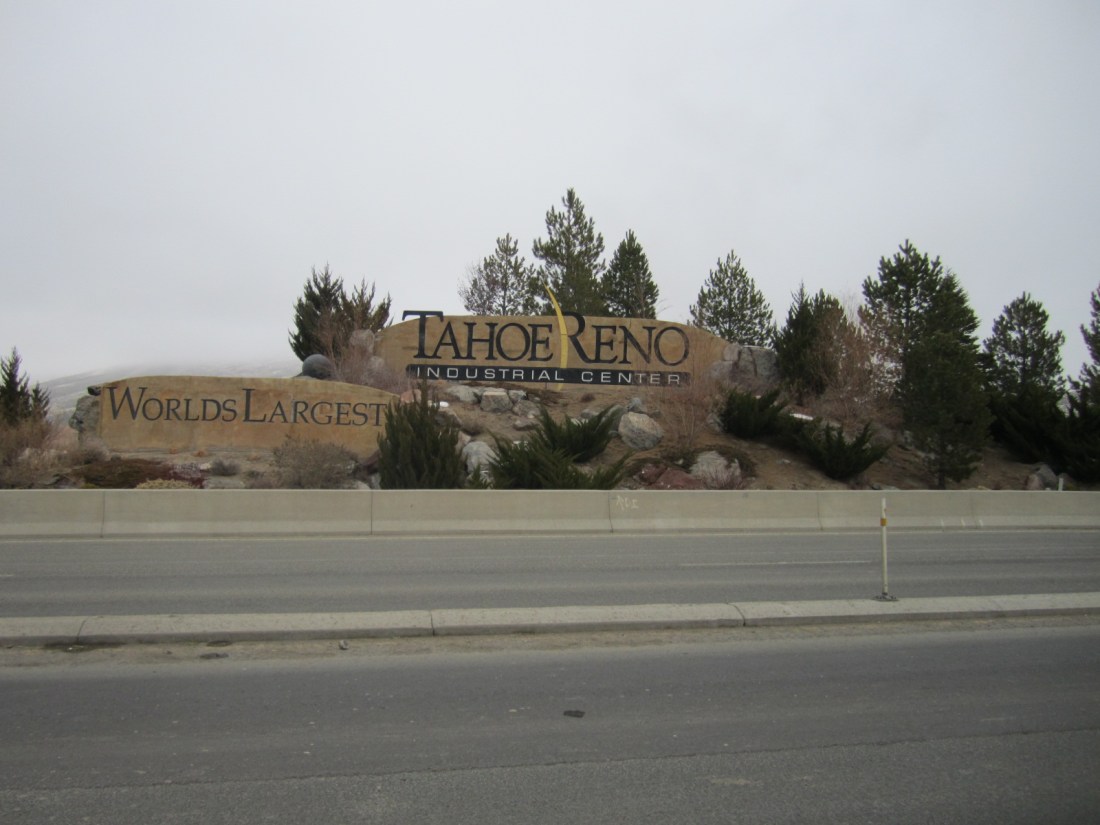
TRIC is at the northern end of the Virginia Range and is home to hundreds of wild horses, as well as the Tesla Gigafactory.

Weather was cold and damp but horses were spotted in the hills along Waltham Way and on both sides of USA Parkway. Photos taken 12/08/18.
RELATED: Giga Ponies on a Cold Foggy Day.
Small band of Virginia Range mustangs grazing on a ridge about a mile from the Tesla Gigafactory (Tahoe Reno Industrial Center). Filmed 12/08/18.
The Colville Tribes of northeastern Washington have issued an RFP to remove up to 1,500 wild horses from their reservation in the first quarter of 2019, according to a report that appeared yesterday in the Tribal Tribune of Nespelem, WA.
The goal of the roundup is to “…is to minimize the negative impacts of feral horses while maintaining a healthy and desirable population of approximately 50 to 200 of the highest quality, most desirable animals for use by the tribal membership.”
The report did not indicate if the gather would be open to public observation (probably not) and the disposition of captured horses.
Given that the area is only about 60 miles from the Canadian border, they may ship to slaughter, a common practice of their Yakama brothers to the south.
Cumulative totals for the Silver King roundup, as of 12/06/18:
The pre-gather population density, per the original announcement, was 2.1 horses per thousand acres, about one fourth the population density of livestock in Nevada.
The post-gather population density of 0.4 animals per thousand acres means the HMA will almost be a horse-free zone, good news for the public-lands ranchers.
RELATED: Silver King Progress Report.
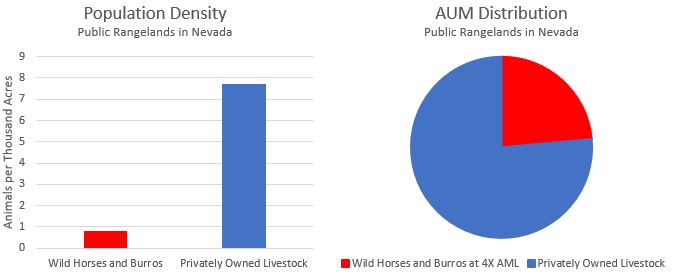
Data from the BLM rangeland grazing page and wild horse management page in Nevada:
Assuming that livestock graze six months per year, the AUM figure yields 333,000 cow/calf pairs on public lands in the state (2 million divided by 6). The population density for these animals would be 7.7 cow/calf pairs per thousand acres (333,000 divided by 43 million times 1,000).
The population density for horses and burros is 0.8 animals per thousand acres (12,811 divided by 15.6 million times 1,000).
Land in Nevada can support ten times as many cow/calf pairs as horses and burros (7.7 divided by 0.8). On HMAs subject to grazing allotments (which is most of them), it’s the same land!
Given that horses graze twelve months per year, they would consume roughly 154,000 AUMs annually (12,811 times 12). If they were at 4X AML they would consume less than one third of the forage allocated to livestock (4 times 154,000 divided by 2 million).
Note that 4X AML represents almost two thirds of the wild horses and burros living on public lands managed by the BLM in the western U.S. Earlier this year the total number of horses and burros was around 82,000 but is probably less than 70,000 now thanks to the roundups.
Two thirds of America’s wild horses and burros consume one third of the forage assigned to livestock in just one state, which supports an observation made earlier on these pages that the lion’s share of resources goes to cattle and sheep on western rangelands. This is especially troubling on lands set aside for horses and burros.
The Virginia Range, on the western side of the state, has a population density of ten animals per thousand acres, maybe a bit more, providing further evidence that HMAs with densities of two or three animals per thousand acres are far from overpopulated.
RELATED: Livestock Grazing in Wyoming.
Aerial footage of some Virginia Range mustangs about two miles south of the Tesla Gigafactory, Tahoe-Reno Industrial Center. H/T Aden Klinger.
In the southwestern part of the state, possibly Adobe Town HMA. H/T Rio Verde Westward Overland.
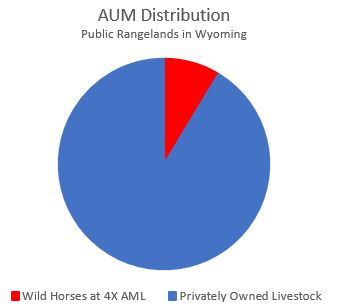
Data from the BLM rangeland grazing page and wild horse management page in Wyoming:
Assuming that livestock graze six months per year, the AUM figure yields 316,000 cow/calf pairs on public lands in the state (1.9 million divided by 6). The population density for these animals would be 18.6 cow/calf pairs per thousand acres (316,000 divided by 17 million times 1,000).
The population density for horses is 0.7 animals per thousand acres (3,725 divided by 5 million times 1,000).
Land in Wyoming can support 26 times as many cow/calf pairs as horses (18.6 divided by 0.7). In some cases, it’s the same land!
Given that horses graze twelve months per year, they would consume roughly 45,000 AUMs annually (3,725 times 12). If they were at 4X AML they would consume less than ten percent of the forage allocated to livestock (4 times 45,000 divided by 1.9 million).
On hearing these results, the PZP zealots cried out “Hurry, we must dart those mares!”
RELATED: Livestock Grazing in Utah.
Refer to this report posted today by WTKR News in Norfolk, VA. The ailment, formally known as pythiosis, has claimed two lives this year.
Sequel to Pryor Mountains video posted yesterday. Very clever scene in the editing room beginning at 7:22! H/T Bigfoot Dad Explores Montana.
RELATED: Pryor Mountains Adventures, Part 1.
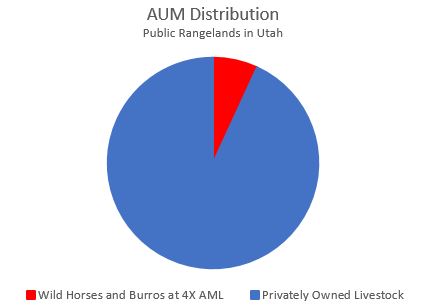
Data from the BLM rangeland grazing page and wild horse management page in Utah:
Assuming that livestock graze six months per year, the AUM figure yields 216,000 cow/calf pairs on public lands in the state (1.3 million divided by 6). The population density for these animals would be 9.8 cow/calf pairs per thousand acres (216,000 divided by 22 million times 1,000).
The population density for horses and burros is 0.8 animals per thousand acres (1,956 divided by 2.5 million times 1,000).
Land in Utah can support twelve times as many cow/calf pairs as horses and burros. In some cases, it’s the same land!
Given that horses and burros graze twelve months per year, they would consume roughly 24,000 AUMs annually. If they were at 4X AML they would consume less than one tenth of the forage allocated to livestock in the state.
Yet, the horses are overpopulated. They have to go. Livestock are blameless, always.
Hop in for a ride to the Pryor Mountains Wild Horse Range on the Montana-Wyoming border, one of only three areas in the western U. S. managed primarily for horses, not livestock. Filmed in the summer of 2017. Features the cabin visited by Ginger Kathrens in the Cloud documentary. H/T Bigfoot Dad Explores Montana.
RELATED: Ride a Side-by-Side to See the Pryor Mountains Horses.
On South Steens HMA. H/T Lori Walker.
The chart below shows the stocking rate in animals per thousand acres as a function of land area for HMAs in Wyoming. Stocking rates (population densities) are based on the upper values of the AMLs.
Three observations from the chart:
The largest stocking rate was found at Green Mountain HMA, 2.56. The smallest rate corresponds to Little Colorado HMA, 0.16.
The correlation coefficient for HMA size and stocking rate is -0.53. This statistic ranges in value from -1 to +1. The closer the result to -1 or +1, the stronger the relationship between the two variables, in this case HMA size and stocking rate.
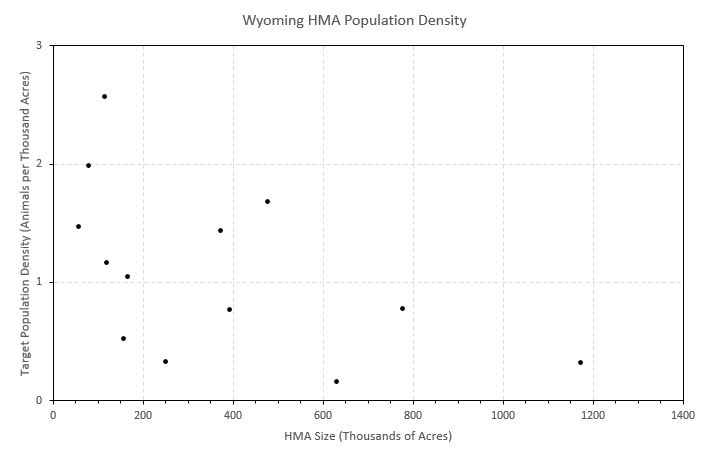
Note that the larger stocking rates are found at the smaller HMAs, while the smaller stocking rates occur at the larger HMAs, confirming the negative sign on the correlation coefficient. A ‘shotgun’ pattern on the chart would have a correlation coefficient near zero, indicating no relationship between the two variables.
RELATED: Wyoming HMA Population.
An ‘excess’ horse jumps a six foot fence on Day 4 of the roundup, injuries unknown.
What’s in the background grazing peacefully at 0:07 in this video from Day 1, as wild horses run by, driven from land set aside for them? H/T AWHC.
RELATED: Silver King Progress Report.
Yep, at Echo Bluff State Park, near the Current River in the southern half of the state.
H/T hebronz28 for the video. See also this story dated 10/08/17 by KSMU Radio.
Helicopters started flying on 11/27/18. Results through 11/29/18:
The wild horse population was approximately ten times AML at the beginning of the roundup, which affected ‘other mandated uses’ of the land.
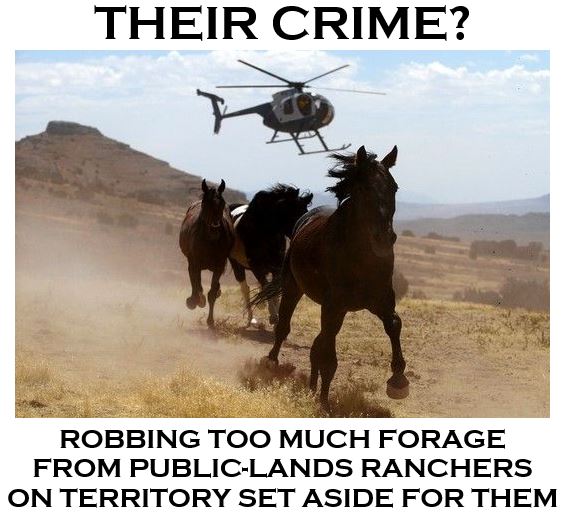
See also this story posted today by The Ely Times.
When the gather is complete, the horses will be at 2X AML, consuming maybe twenty percent of the AUMs on the HMA. Livestock will receive the rest. If people understood this, the overpopulation narrative would fall to the ground, taking the fertility control programs with it.

