
In Breathitt County with Reginald Bareham. The horses roam freely in eastern Kentucky, as explained in this account by the Appalachian Horse Project.
Category: Range
On the range
Virginia Range Foal Spotted on Mother’s Day!
Posting these photos to piss off the advocates. They are as wicked as the day is long.
RELATED: PZP Zealots Missed One.

Cañon City Incident, Day 30
No deaths were reported in the May 22 update, leaving the total at 145.
All fatalities have occurred in pens occupied by the West Douglas horses.
Approximately 16% were foals.
The May 22 sitrep provides no new details.
RELATED: Cañon City Incident, Day 29.
Who Polluted the Water Tanks?
Trailcams took over 6,000 photos in the last four weeks.
This is the best time of year to see the Virginia Range mustangs at the higher elevations.
Normally they’d bring youngsters with them but not since the advocates got involved.
They have pumped almost 6,000 doses of PZP into the herd over the past three years.
Western Horse Watchers believes they are underreporting (lying about) the decline in birth rates based on these photos.
RELATED: Advocates Take Orphaned Foal from Virginia Range.

Cañon City Incident, Day 29
One horse was lost in the May 21 update, bringing the total to 145.
This breaks a string of five consecutive days with no deaths.
All fatalities have occurred in pens occupied by the West Douglas horses.
Approximately 16% were foals.
The May 21 sitrep provides no other details.
RELATED: Cañon City Incident, Day 28.
Advocates Take Orphaned Foal from Virginia Range
His mom was hit by a car on May 5 according to a report by KOLO News of Reno.
A woman interviewed for the story, described as a volunteer with Wild Horse Connection, was listed as the Special Projects Coordinator for the Campaign Against America’s Wild Horses in the slide deck for the May 16 meeting in Reno about safety issues related to the horses.
Removal of the mom/baby pair takes some pressure off the darting effort and brings the advocates another step closer to their goal of herd eradication.
One of the slides indicates that half of the foals born last year were lost to predators.

However, most of the foals weren’t born, as the true predators deny life and thwart the turning over of the genetic soil with the Montana Solution.
They are as eager to take horses off the range as the bureaucrats and ranchers, whose approval they seek at all costs, while taking market share from the pilots and wranglers.
RELATED: Are We Paying for Eradication of Virginia Range Mustangs?
Black Mountain Roundup Day 18
The incident began on May 2. Gather stats through May 19:
- Target: Burros
- Type: Planned
- Method: Helicopter
- Captured: 844, up from 710 on Day 15
- Average daily take: 46.9
- Capture goal: 1,080
- Removal goal: 1,080
- Returned: None
- Deaths: None
- Shipped: 796, up from 630 on Day 15
The cumulative total includes 322 jacks, 425 jennies and 97 foals, based on figures in the daily reports. The breakdown at the gather page is 323, 423 and 98.
Youngsters represented 11.5% of the animals captured. Of the adults, 43.1% were male and 56.9% were female.
The herd can’t be growing at a rate of 20% per year with a birth rate of 12% per year.
The percentage of foals has been going down as the number of animals caught goes up.
The percentages of males and females are still outside calculated limits of variation for a simple random process centered at p-bar = .5 (50% males / 50% females) and a sample size of n = 747 adults.

Abnormal sex ratios are not uncommon in herds treated with the Montana Solution.
No PZP jennies have been reported since Day 6.
The location of the trap site within the HMA was not given.
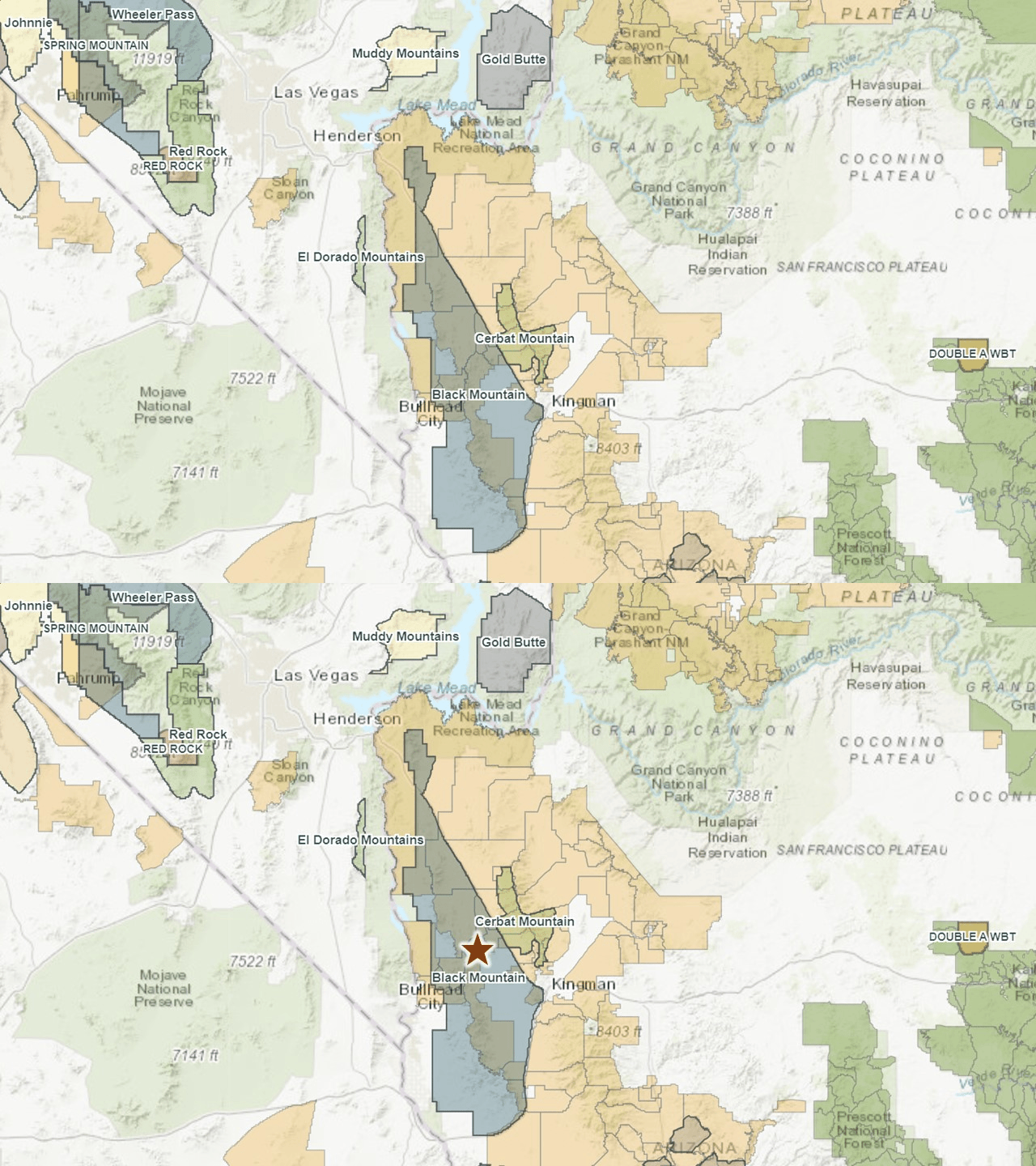
Day 18 ended with 48 unaccounted-for animals.
The number of animals taken off the range is 844 and the removal goal is 78% complete.
Other statistics:
- AML: 478
- Forage assigned to burros: 2,868 AUMs per year
- Pre-gather population: 3,000
- Forage liberated to date: 5,064 AUMs per year
- Water liberated to date: 4,222 gallons per day
- Forage assigned to livestock: 7,333 AUMs per year (estimated)
- Burros displaced from HMA by permitted grazing: 1,222
- True AML: 1,700
- Stocking rate at new AML: 1.7 burros per thousand acres
- Burros displaced from HMA by drilling and mining: Ask the advocates
RELATED: Black Mountain Roundup Day 15.
Cañon City Incident, Day 28
No horses were lost in the May 20 update, leaving the total at 144.
This is the fifth consecutive day of zero deaths.
All fatalities have occurred in pens occupied by the West Douglas horses.
Approximately 15% were foals.
The May 20 sitrep provides no new details.
RELATED: Cañon City Deaths Unchanged at 144.
CBS Looks at “Multiple Use” on Colorado Public Lands
The two-state solution, sometimes referred to as “multiple use,” is responsible for the capture, branding, harassment and death of wild horses and burros, from which they were to be protected in the original statute.
It will never work. One side must be defeated.
- Livestock confined to base properties
- Most resources assigned to horses and burros
- Small amount reserved for wildlife
Lands identified in 1971 were to be devoted principally but not necessarily exclusively to their welfare in keeping with the multiple-use management concept for the public lands, as it existed when the Act was signed into law.
Foal-Free Friday, Barren Before It Was Cool Edition
On the Salt River with Stan Wiley. Filmed last July but posted this week.
The effects of the Montana Solution were already apparent.
Now, thanks to the advocates, other herds will suffer its long-term effects, evident at Assateague Island but buried by the Park Service, and they’ll likely have to endure the trauma of roundups to receive it.
As predicted last week, they will drop their opposition to the roundups, and the losses associated therewith, if it means greater use of PZP.
RELATED: Foal-Free Friday, Lipstick on a Pig Edition.
Cañon City Deaths Unchanged at 144
No horses were lost in the May 19 update.
This is the fourth consecutive day of zero deaths.
All fatalities have occurred in pens occupied by the West Douglas horses.
Approximately 15% were foals.
The May 19 sitrep provides no new details.
RELATED: Cañon City Deaths Holding at 144.
Draft EA for Bible Springs Complex Out for Review
Comments will be accepted through June 17, according to yesterday’s news release.
The Proposed Action, discussed in Section 2.2.1 of the EA, features roundups to the low end of AML, population suppression using PZP, GonaCon or IUDs, sex ratio skewing and GPS tracking of animals over a ten-year period.
The project area includes the Blawn Wash HA, not shown in the Western Watersheds map, and three HMAs. The map in Appendix 1 puts Blawn Wash on the north side of the Four Mile HMA.
Blawn Wash was zeroed out in 2005. A 2001 land exchange shifted 43% of the acreage and 70% of the forage from the BLM to the State of Utah School and Institutional Trust Lands Administration. Forage in that portion of the HA is managed by SITLA.
The four areas cover 215,350 total acres in western Utah and have a combined AML of 80 to 170, per Table 1.1 of the EA.
The 170 horses allowed by plan require 2,040 AUMs per year. The stocking rate allowed by plan is approximately 0.8 wild horses per thousand acres.
The current population is thought to be 831, five times more horses than allowed by plan, but not necessarily above the carrying capacity of the land.
In their zeal to spread the Montana Solution across the American west, the advocates ignore this critical detail, giving cover to the public-lands ranchers.
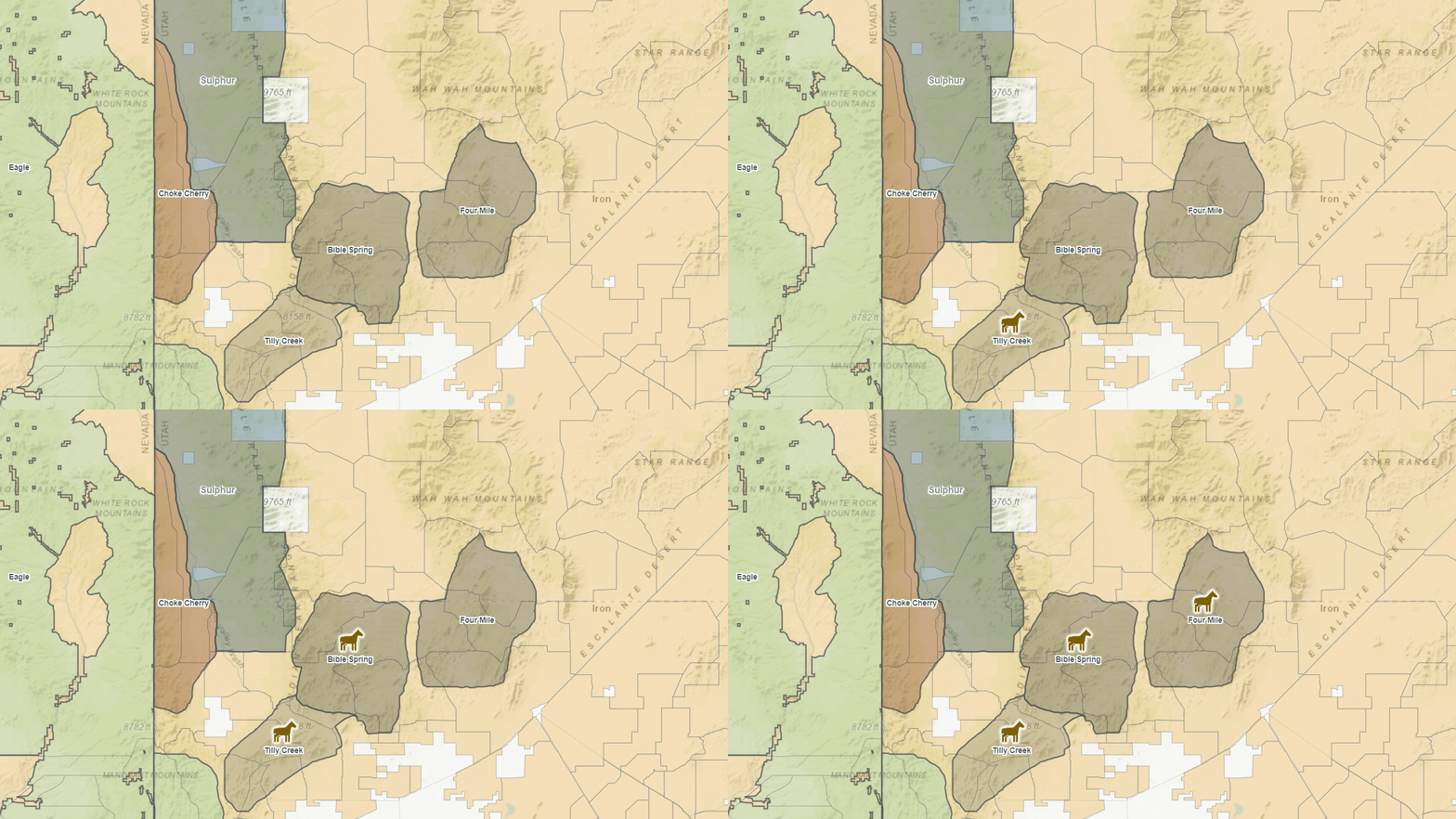
Table 3.1 shows 16 grazing allotments that intersect the Complex, including the HA.
Section 3.3.2 indicates that livestock receive 5,696 + 1,533 = 7,229 AUMs per year inside the Complex, 3.5 times more forage than the horses.
The new enforcement plan will ensure that this resource stays with the ranchers.
The forage assigned to livestock would support an additional 602 wild horses, for a True AML of 772, which is smaller than the current population. On the basis of these data, excess animals exist within the Complex.
Water is the limiting factor, according to Section 3.3.1, consisting of isolated springs and man-made developments for permitted grazing. If grazing is curtailed due to drought or other reasons, these sources may not be maintained and can fall into disrepair.
The HMAs do not have Herd Management Area Plans. The EA indicates that HMAPs are not prerequisites to resource enforcement actions.
The Complex does not appear in the latest roundup schedule.
Comments may be submitted online. As of today, the count is zero.
RELATED: New Resource Enforcement Plan for Bible Springs Complex?
Cañon City Deaths Holding at 144
No deaths were reported in the May 18 update.
All fatalities have occurred in pens occupied by the West Douglas horses.
Approximately 15% were foals.
The May 18 sitrep provides no new details.
RELATED: No Change in Cañon City Deaths.
Black Mountain Roundup Day 15
The incident began on May 2. Gather stats through May 16:
- Target: Burros
- Type: Planned
- Method: Helicopter
- Captured: 710, up from 607 on Day 13
- Average daily take: 47.3
- Capture goal: 1,080
- Removal goal: 1,080
- Returned: None
- Deaths: None
- Shipped: 630, up from 508 on Day 13
The cumulative total includes 264 jacks, 359 jennies and 87 foals, based on figures in the daily reports. The breakdown at the gather page is 265, 357 and 88.
Youngsters represented 12.3% of the animals captured. Of the adults, 42.4% were male and 57.6% were female.
The herd can’t be growing at a rate of 20% per year with a birth rate of 12% per year.
The percentage of foals has been going down as the number of animals caught goes up.
The percentages of males and females are now outside calculated limits of variation for a simple random process centered at p-bar = .5 (50% males / 50% females) with a sample size of n = 623 adults.
Abnormal sex ratios are not unusual in herds treated with the Montana Solution.
It’s one of the characteristics the Park Service is hiding at Assateague Island.
No PZP jennies have been reported since Day 6.
Is that result lower than expected? Where did they go? The experiment will likely be discussed next week at the International Fertility Control Conference.
The location of the trap site within the HMA was not given.
Day 15 ended with 80 unaccounted-for animals.
The number of animals taken off the range is 710 and the removal goal is 66% complete.
Other statistics:
- AML: 478
- Forage assigned to burros: 2,868 AUMs per year
- Pre-gather population: 3,000
- Forage liberated to date: 4,260 AUMs per year
- Water liberated to date: 3,550 gallons per day
- Forage assigned to livestock: 7,333 AUMs per year (estimated)
- Burros displaced from HMA by permitted grazing: 1,222
- True AML: 1,700
- Stocking rate at new AML: 1.7 burros per thousand acres
- Burros displaced from HMA by drilling and mining: Ask the advocates
RELATED: Black Mountain Roundup Day 13.
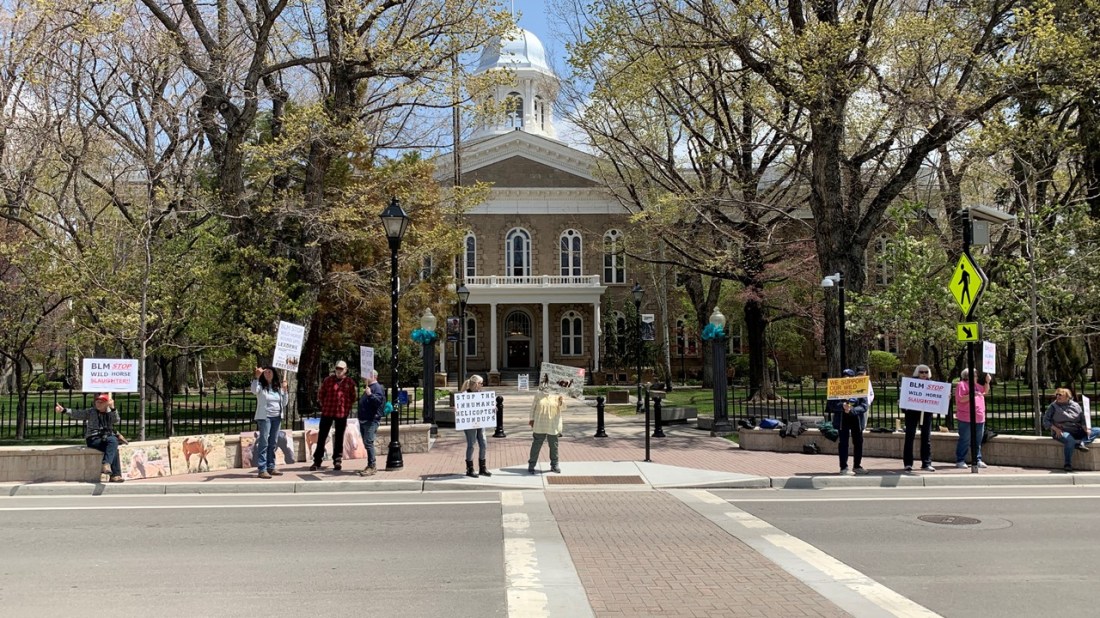
More Wild Horse Rallies?
The organizers have announced dates and locations in most states.
They are still pushing HR 6635, the helicopter ban.
Consider these scenarios for taking wild horses off the range:
A. By helicopter
- Horses before incident – 400
- Horses after incident – 250
- Forage shifted to ranchers – 1,800 AUMs per year
B. By wrangler
- Horses before incident – 400
- Horses after incident – 250
- Forage shifted to ranchers – 1,800 AUMs per year
C. By Montana Solution
- Horses before incident – 400
- Horses after incident – 250
- Forage shifted to ranchers – 1,800 AUMs per year
What have the advocates accomplished by ending helicopter roundups?
The bill will likely require changes.
Initially, helicopter roundups were bad but with the rollout of the catch-treat-release program and its potential for expanded use of the Montana Solution, they are good.
No Change in Cañon City Deaths
No deaths were reported in the May 17 update, leaving the total at 144.
All fatalities have occurred in pens occupied by the West Douglas horses.
Data in the May 17 sitrep indicate 15.3% were foals. The report did not indicate if they were born in captivity or taken off the range.
RELATED: Cañon City Deaths Stable at 144.
Cañon City Deaths Stable at 144
No deaths were reported in the May 16 update, leaving the total at 144.
All fatalities have occurred in pens occupied by the West Douglas horses.
The May 16 sitrep includes a breakdown between adults and foals lost to the virus.
RELATED: Cañon City Deaths Climb to 144.
Black Mountain Roundup Day 13
The incident began on May 2. Gather stats through May 14:
- Target: Burros
- Type: Planned
- Method: Helicopter
- Captured: 607, up from 524 on Day 11
- Average daily take: 46.7
- Capture goal: 1,080
- Removal goal: 1,080
- Returned: None
- Deaths: None
- Shipped: 508, up from 454 on Day 11
No gather activity occurred on Day 12.
The cumulative total includes 234 jacks, 293 jennies and 80 foals, based on figures in the daily reports. The breakdown at the gather page is 235, 291 and 81.
Youngsters represented 13.2% of the animals captured. Of the adults, 44.4% were male and 55.6% were female.
The herd can’t be growing at a rate of 20% per year with a birth rate of 13% per year.
No PZP jennies have been reported since Day 6.
The location of the trap site within the HMA was not given.
Day 13 ended with 99 unaccounted-for animals.
The number of animals taken off the range to date is 607.
Other statistics:
- AML: 478
- Forage assigned to burros: 2,868 AUMs per year
- Pre-gather population: 3,000
- Forage liberated to date: 3,642 AUMs per year
- Water liberated to date: 3,035 gallons per day
- Forage assigned to livestock: 7,333 AUMs per year (estimated)
- Burros displaced from HMA by permitted grazing: 1,222
- True AML: 1,700
- Stocking rate at new AML: 1.7 burros per thousand acres
- Burros displaced from HMA by drilling and mining: Ask the advocates
RELATED: Black Mountain Roundup Day 11.
Mustang Monday
At the Ozark National Scenic Riverways with Tim Layton.
Cañon City Deaths Climb to 144
One death was reported in the May 15 update, bringing the total to 144.
All fatalities have occurred in pens occupied by the West Douglas horses.
No new details were provided in the May 15 sitrep.
RELATED: Cañon City Deaths Unchanged at 143.

