An issue with the fuel system on #3 engine could not be resolved in a timely manner.
The next opportunity for liftoff is September 2, according to the live feed from NASA.
Western Horse Watchers Association
Exposing the Hypocrisy, Lies and Incompetence of the Wild Horse Advocates
On the range
An issue with the fuel system on #3 engine could not be resolved in a timely manner.
The next opportunity for liftoff is September 2, according to the live feed from NASA.
Near Wild Horse Reservoir with Dynamic Jasmine.
Overpopulation means more horses than allowed by plan, not necessarily more horses than the land can support.
AMLs, which represent the number of horses allowed by plan, are small relative to the authorized forage, because most of it has been assigned to privately owned livestock.
The authorized forage may correspond to half of the available forage, a safety factor that allows for natural variations in climate.
To determine if the area is really overpopulated, compare the current population to the True AML, which requires a few calculations as previously explained.
For example, the current population at Roberts Mountain HMA is 1,132, including foals, according to Table 1 of the Draft EA for resource enforcement actions in the Complex.
The True AML is 678, computed earlier today, to be achieved by confining the ranchers to their base properties. (What do you think happens during the off season?)
The HMA is overpopulated because the current population exceeds the True AML.
The footnote in the table says the current population includes horses outside the HMA, and the number of foals was based on a 19% growth rate (24% birth rate, assuming a 5% death rate), so the situation inside the HMA may not be as bad as originally thought.
Table 15 in the Draft EA for resource enforcement actions in the Roberts Mountain Complex indicates that 38% of the Roberts Mountain Allotment overlaps the HMA along with 46% of the Three Bars Allotment.
The HMA covers 99,990 acres and is 100% subject to permitted grazing.
The 150 wild horses allowed by plan require 1,800 AUMs per year.
The Western Watersheds map shows the arrangement.
The Allotment Master Report shows 5,840 active AUMs on Three Bars and 9,624 active AUMs on Roberts Mountain. These figures may differ slightly from those in the EA.
The forage in Three Bars assigned to livestock inside the HMA would be 5,840 × .46 = 2,686 AUMs per year, assuming the resource is evenly distributed across the parcel.
The forage in Roberts Mountain assigned to livestock inside the HMA would be 9,624 × .38 = 3,657 AUMs per year.
The total estimated forage assigned to livestock inside the HMA is 2,686 + 3,657 = 6,343 AUMs per year, enough to support an additional 528 wild horses.
The True AML would be 150 + 528 = 678.
The stocking rate at the new AML would be 6.8 wild horses per thousand acres, compared to a target rate across all HMAs of one wild horse per thousand acres.
The Virginia Range was carrying ten, before the advocates got involved.
Livestock in Roberts Mountain receive 3.5 times more forage than the horses, yet the area was set aside for the horses.
The HMA is managed primarily for livestock.
The BLM will collect 6,343 × 1.35 = $8,563 per year in grazing fees from ranching activity inside the HMA while it spends 528 × 5 × 365 = $963,600 per year to care for the horses displaced thereby.
Would you say that permitted grazing is a wise use of the public lands?
The Comstock Lode put the town on the map, with most of the production occurring between 1860 and 1880.
Today, it’s mostly a tourist attraction.
Virginia Range mustangs can be seen nearby.
Volunteers with the Campaign Against America’s Wild Horses are the greatest threat to their existence, not the BLM, not the visitors and not the townspeople.
RELATED: Virginia Range Darting Program a Model for Herd Management?
The theme of this year’s festival is Waking Dreams. Most of the attendees will be woke.
The Reno Gazette Journal published several articles about the event this week.
One of the stories covers an art project known as Wild Horses of the American West.

Curiously, the area has been cleared of thousands of wild horses, following roundups over the past few months at Twin Peaks, Buffalo Hills and Blue Wing.
Calico is on the list for September 10.
The general route to Black Rock City is I-80 to Wadsworth, NV (home of Velma and Charlie), then north to Gerlach on 447, then northeast on 34 to the playa.
RELATED: Burning Man Returns to Black Rock Desert.
A statement at the gather page yesterday said gather ops concluded on August 24 but results for August 25 were not posted until this morning.
Operations ended with 1,897 horses captured, 1,849 shipped, 25 released and 23 dead.
The were no unaccounted-for animals.
The death rate was 1.2%.
Data quality was good.
The capture goal was 1,900 and the removal goal was 1,800.
The number of horses removed was 1,872. Mares treated with fertility control may be returned to the Complex at a later date, bringing the figure closer to target.
The capture total included 654 stallions, 908 mares and 335 foals.
Youngsters represented 17.7% of the animals gathered.
Of the adults, 41.9% were male and 58.1% were female.
The observed percentage of foals suggests the herd was growing at a rate of 13% per year, not 20% per year, a rate used by land managers to predict herd sizes and justify resource enforcement actions.
The percentages of stallions and mares cannot be explained by a simple random process centered at 50% males / 50% females.
Abnormal sex ratios are common in herds subject to the Montana Solution but not double-digit birth rates.
The Complex is managed primarily for livestock.
RELATED: Triple B Roundup Announced.
UPDATE: Up to 50 mares will returned to the Complex, according to today’s news release, and the event will be open to public observation.
An estimated 250 wild horses have been displaced from their lawful home in the Pine Nut Mountains HA by permitted grazing.
The HA has a resource management problem, not a wild horse problem, yet the advocates are going after the horses.
“We’re changing the way wild horse herds are managed, not their land.”
That means taking them off the range with the Montana Solution, not helicopters.
Consider these two scenarios:
A. Helicopter roundup
B. Darting program
Only scenario A qualifies as removal. Scenario B ranks as protection.
“We’re protecting them from removal by getting rid of them with PZP.”
Absurdity may be a symptom of too much exposure to the pesticide.
RELATED: Foal-Free Friday, On-Range Management Edition.
The allotment, subject of today’s stewardship awards, offers 2,657 active AUMs on 14,008 public acres.
It’s on the small side, as far as allotments go, but forage availablility is high, 189.7 AUMs per year per thousand acres.
For comparison, the allotments in the Roberts Mountain Complex offer an average of 49.7 AUMs per year per thousand acres.
The BLM authorizes privately owned livestock in Cedar Creek equivalent to 221 wild horses, with a stocking rate of 15.8 wild horses per thousand acres!
The average rate across all HMAs is one wild horse per thousand acres.
They will be recognized today in a ceremony during the 2022 Public Lands Council Annual Meeting for their exemplary rangeland management and outstanding accomplishments in restoring and maintaining rangeland health, according to yesterday’s news release.
The event will be open to public observation starting at 1:00 PM Mountain Time.
The conference agenda says the awards luncheon runs from 12:30 to 2:00 PM.
The winner of the Rangeland Stewardship Award is Charles Hibner of Cebolla, NM, a retired soil conservationist with the USDA’s Natural Resources Conservation Service and BLM permittee since taking over his father’s operation in the 1970s.
The winner of the Sagebrush-Steppe Stewardship Award is the Cedar Creek Grazing Association of Glendive, MT. Established in 1967, it’s managed by a board and employs an experienced manager focused on positive outcomes for the land and its members.
The Operator Information Report in RAS ties Hibner to authorization #3001044.
The Allotment Information Report associates that number with the Rio Cebolla, Daggett Canyon, Tanques and Navajo Peak allotments.
The Allotment Master Report puts all four in the Improve category, suggesting that they don’t meet standards for rangeland health.
Hibner holds all of the active AUMs.
The Operator Information Report links the Cedar Creek Grazing Association with authorization #2502899 and #2502946.
The Allotment Information Report ties those numbers to the Lange and Cedar Creek allotments.
The Allotment Master Report puts Lange in Custodial and Cedar Creek in Improve.
The grazing association holds all of the active AUMs.
Western Horse Watchers is unable to explain how these results qualify as exemplary rangeland management.
The allotments should be in the Maintain category.
There are no federally designated wild horse areas near Glendive.
The Hibner allotments are near the inactive Mesa De Las Viegas WHT, according to the Western Watersheds map.
The incident began on August 6.
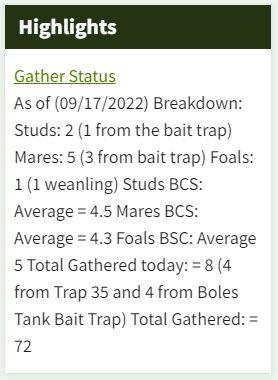
As of August 21, 65 burros have been trapped, 49 have been shipped and no deaths have occurred, according to the gather page.
The capture total includes 28 jacks, 28 jennies and nine foals.
Youngsters represented 13.8% of the animals gathered.
The herd can’t be growing at a rate of 20% per year with a birth rate of 14%.
Of the adults, 50% were male and 50% were female.
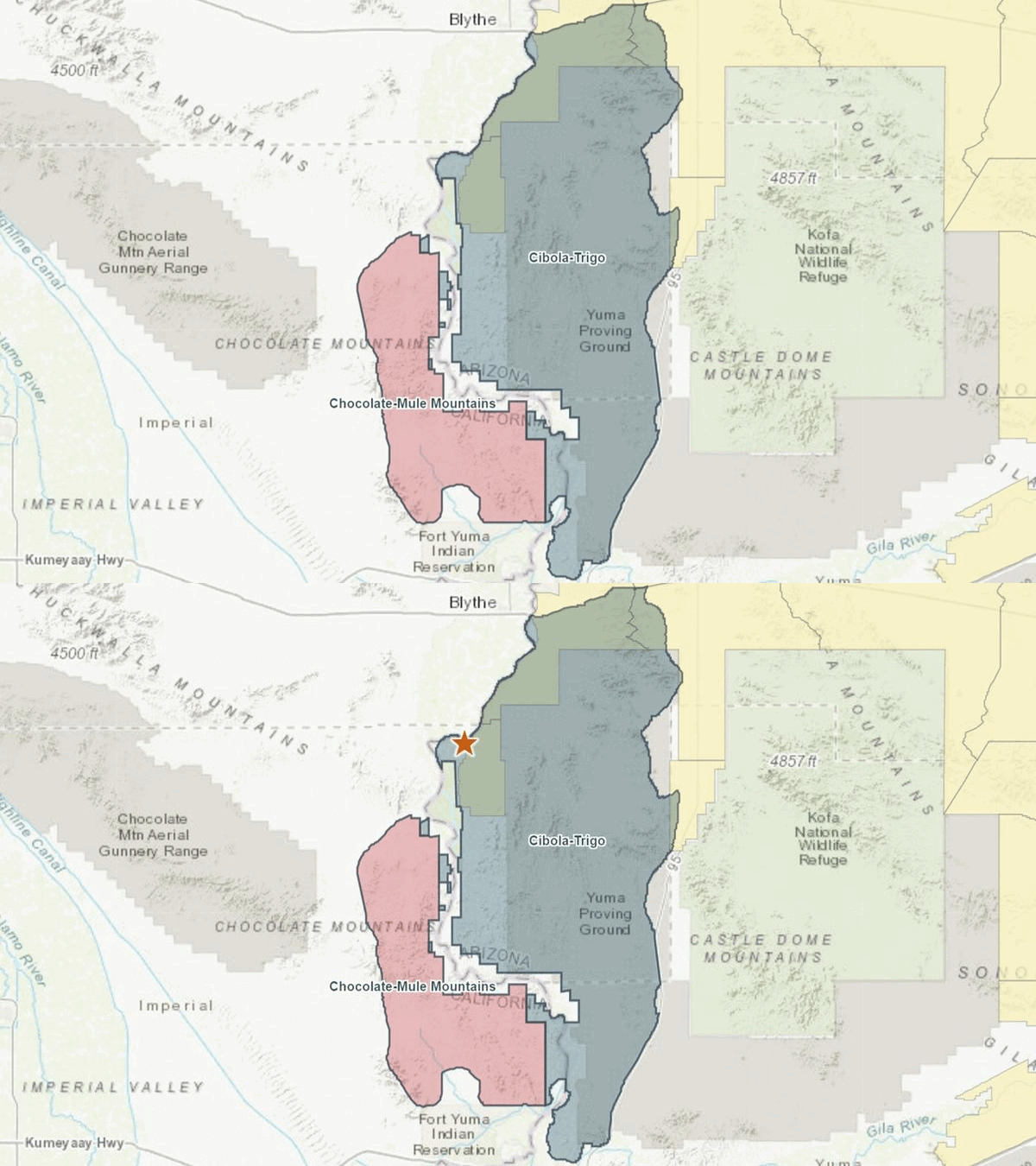
The location of the trap site is not known but the burros are associated with the Cibola-Trigo HMA, which overlaps the Yuma Proving Ground.
Day 16 ended with 16 unaccounted-for animals.
The capture and removal goals are 80 each according to the latest schedule.
The roundup was not announced at the BLM news site.
RELATED: YPG Roundup in Progress.
The incident began on July 17. Gather stats through August 23:
The figures above are based on the daily reports, not the totals posted by the BLM.
The death rate is 1.2%.
The capture total includes 638 stallions, 891 mares and 325 foals.
Youngsters represented 17.5% of the animals gathered.
Of the adults, 41.7% were male and 58.3% were female.
The herd can’t be growing at a rate of 20% per year with a birth rate of 18% per year.
A better estimate would be 13% per year, assuming a death rate of 5% per year.
The observed percentages of stallions and mares cannot be attributed to a simple random process centered at 50% males / 50% females.
Abnormal sex ratios are often found in herds subject to the Montana Solution but not double-digit birth rates.
Body condition scores were not provided.
The location of the trap was not disclosed.
The Complex and surrounding lands are subject to permitted grazing.
Day 38 ended with 215 unaccounted-for animals.
The capture goal is 98% complete. Operations will probably conclude this week.
Mares treated with fertility control may be returned to the area at a later date.
Other statistics:
RELATED: Triple B Roundup, Day 36.
A report posted yesterday by the White Mountain Independent suggests they were disposed at the Navajo County Fairgrounds in Holbrook on August 10.
Some of them may have been acquired by the Salt River Wild Horse Darting Group, a surrogate of the Campaign Against America’s Wild Horses, as explained in this story by ABC15 News of Phoenix.
Eighteen wild horses were removed from a protected area near Alpine earlier this year in what the Forest Service described as a law enforcement action.
RELATED: Judge Sides with Forest Service in ISPMB Complaint.
The incident will begin on September 12, according to a story posted today by the Lake County Examiner, with 500 wild horses slated for removal.
Helicopters will push the horses into the traps and the incident will be open to limited public observation.
The WHT covers 258,000 acres in northern California and has an AML of 402.
The current population is thought to be 1,205.
The destination of captured animals was not given.
A link to the gather stats and daily reports was not provided.
The WHT is subject to permitted grazing.
Horses were removed from the area in 2018, 2019, 2020 and 2021.
Table 15 in the Draft EA for resource enforcement actions provides data for the four allotments that intersect the Complex. Map 2 in the SIR shows the arrangement.
The Allotment Master Report provides acreage, management status and active AUMs, which may differ slightly from the AUMs in the table.

The condition of Lucky C is unknown. Western Horse Watchers is unable to explain how it qualifies for Custodial status.
The other three allotments, representing 73.5% of the public acres, do not meet one or more standards for rangeland health. Our stewards of the public lands may not be taking their responsibilities seriously.
Forage production across the four allotments averages 49.7 AUMs per year per thousand acres, enough to support 4.1 wild horses per thousand acres.
When public lands are designated for wild horses, they can only sustain one such animal per thousand acres (27,000 animals on 27 million acres).
Livestock receive an estimated 8,122 AUMs per year inside the Complex, which would support 676 wild horses, on top of the 184 allowed by plan.
The True AML would be 860, to be achieved by confining the ranchers to their base properties and expecting them to pay the going rate to feed their animals.
Meanwhile, the BLM will collect 8,122 × 1.35 = $10,965 per year in grazing fees from ranching activity inside the Complex while it spends 676 × 5 × 365 = $1,233,700 per year to care for the horses displaced thereby.
Would you say that permitted grazing is a wise use of the public lands?
The incident began on August 20, according to the gather page, with two burros captured, two shipped and no deaths.
On Day 2, four burros were trapped and shipped.
Up to 60 animals will be removed from the area due to lack of water.
RELATED: Piute Mountain Emergency Roundup Announced.
UPDATE: The incident started on August 19. The gather page has been corrected.
The incident will begin on August 29, according to a BLM news release.
The August 10 schedule indicates a capture goal of 97 and a removal goal of 67, with 30 horses returned to the HMA, including 15 mares treated with fertility control.
The announcement said 100 would be removed.
Helicopters will push the horses into the traps and operations will be open to public observation.
The HMA covers about 60,000 total acres, including 49,000 acres managed by the BLM, in western Utah near the Bible Springs Complex.
The AML is 60 and the current population is thought to be 137, including foals.
The news release refers to the difference as “excess horses,” meaning more horses than allowed by plan, not more horses than the land can support.
The stocking rate allowed by plan is one wild horse per thousand acres, in line with the target rate across all HMAs.
The HMA intersects five grazing allotments according to the Western Watersheds map.
A 2016 EA indicates four allotments, with an estimated 2,959 AUMs per year assigned to livestock inside the HMA, compared to 720 AUMs per year for the horses.
The BLM will collect $3,995 per year in grazing fees from ranching activity inside the HMA while it spends $450,775 per year to care for the 247 horses displaced thereby.
Would you say that permitted grazing is a wise use of the public lands?
Captured animals will be taken to the off-range corrals in Axtell.
Gather stats and daily reports will be posted to this page.
A roundup two years ago took 143 wild horses off the HMA.
The incident began on July 17. Gather stats through August 21:
The figures above are based on the daily reports, not the totals posted by the BLM.
A stallion died on Day 36 of a broken neck and a mare was put down because of a missing eye.
The death rate is 1.5%.
The capture total includes 549 stallions, 771 mares and 265 foals.
Youngsters represented 16.7% of the animals gathered.
Of the adults, 41.6% were male and 58.4% were female.
The herd can’t be growing at a rate of 20% per year with a birth rate of 17% per year.
A better estimate would be 12% per year, assuming a death rate of 5% per year.
The observed percentages of stallions and mares cannot be attributed to a simple random process centered at 50% males / 50% females.
Abnormal sex ratios are often found in herds subject to the Montana Solution but not double-digit birth rates.
Body condition scores were not provided.
The location of the trap was not disclosed.
The Complex and surrounding lands are subject to permitted grazing.
Day 36 ended with 67 unaccounted-for animals.
The capture goal is 83% complete.
Mares treated with fertility control may be returned to the area at a later date.
Other statistics:
RELATED: Triple B Roundup, Day 34.
The project folder populated overnight. The Draft Environmental Assessment and Supplemental Information Report are available for review and comment.
The project area is about three times larger than the HMAs. Refer to Map 2 in the SIR, page 124 in the pdf, which also shows the overlapping allotments.
The numbers in Table 3 of the EA are a bit confusing.
The curent population is thought to be 1,176. The initial roundup would target 1,000 wild horses and 809 would be removed.
That means 191 could be returned to the Complex, leaving a post-gather population of 367, but the table says 222.
The combined AML is 184.
The best way to protect them from removal is to get rid of them with the Montana Solution, according to the advocates.
Table 15 provides data for permitted grazing. An estimate of the forage assigned to livestock inside the HMAs, the number of horses displaced from their lawful home by permitted grazing and the True AML should be possible.
Comments can be submitted online through September 20.
RELATED: New Resource Enforcement Plan for Roberts Mountain Complex?
UPDATE: Comment period announced in BLM news release dated August 22.
Horses have the day off. Near Pahrump, NV with Triple777Seven Channel.