Back to the Fast-Disappearing Days

The following remarks were delivered at the October 2019 WHBAB meeting by a representative of the Society for Range Management, an organization that believes rangelands should be used for livestock grazing and not much else.

Although the group accepts wild horses and burros on those lands, they insist that their numbers be limited to those that existed when the WHB Act became law (0:23 to 0:36).

This is where they’re going with the ‘Path Forward.’

We know from President Nixon’s remarks that only 9,500 wild horses and 11,000 wild burros remained on western rangelands in 1971.  That’s equivalent to 15,000 wild horses today on 27 million acres, for a stocking rate of 0.6 horses per thousand acres.

A number that low means only one thing: Large amounts of forage diverted to privately owned livestock.

No new laws are required.  Just enforce the plans that are already on the books.

RELATED: ‘Path Forward’ Extinction Target.

Future of Wild Horses in Hands of U.S. Senate?

So says the writer of an opinion piece published this morning by the Las Vegas Sun.

Written by the director of field operations for AWHC, it’s just another attempt to push the PZP Amendment through Congress, an idea so good that even the Rolling Stones would support it.

This is the same guy who’s coordinating the Virginia Range darting program.  A former BLM employee, he’s 100% on board with the overpopulation narrative.

Never let the facts get in the way of a good story, especially if you’re a big-name ‘advocacy’ group with a hidden agenda.

Truth is, the helicopters are flying because most of the resources in wild horse areas have been diverted to privately owned livestock.  And, apparently, AWHC doesn’t give a damn about that.  Just keep the PZP supply chain moving.

Short End of Stick Recap 10-14-20-1Would you be surprised if they take money from ranching interests?  The organization needs a thorough house cleaning, starting at the top.

Handiwork of PZP Zealots

On the Red Desert Roundup

As the photos roll out, remember that you are watching an enforcement action.

Media coverage—if there is any—will focus on casualties and the treatment of the horses but the real injustice was done years ago, by those who wrote and approved the resource management plans.

On the Lost Creek HMA, for example, the horses receive an estimated four percent of the authorized forage, excluding wildlife.  They have been consuming more than their fair share, around 16%, so the herd needs to be cut down to size.

The same is true for the ‘Path Forward,’ a plan with the same goal but much broader scope: Enforce the resource allocations across all HMAs, manage them principally for cattle and sheep.

Path Forward Signatories

Notably absent from the signatories are drillers and miners, the supposed boogeymen of western rangelands.

But there are dozens of ‘advocacy’ groups that can be added to the list—always begging for your money—so they can make sure those forage allocations never go any higher.

They, like the public-lands ranchers, are enemies of America’s wild horses.

Confusion DR Setting New Precedent in WH Management?

The Decision Record issued yesterday states that “…sterilization is the minimum feasible level of management possible for the Confusion HMA.”

Section 2.2.4 in the Final EA for the Gather Plan indicates that the procedures would be carried out at a private facility and would not be open to public observation.

This is unacceptable.

In the future, writers of new gather plans will only need to point to this one to justify their ill-conceived ideas.  Each step in the process moves the program farther from its original charter, which is to manage the land principally for wild horses.

NOTE: The documents were combined into one file.  The Decision Record is not searchable but the Final EA is.

RELATED: Confusion Roundup Pending.

Cattle and Horses

South Steens Follow-Up

At the conclusion of the roundup, BLM reported that 62 studs had been captured along with 103 mares.  Do those numbers look like they came from a herd that’s 50% males, 50% females?

The question can be answered with the most rudimentary of statistical calculations, where n = 165 and p-bar = .5.

The observed values of 62 and 103 fall outside the calculated limits of 63.2 and 101.8.

Therefore, the answer is ‘No.’  An assignable cause should be sought.

One possibility is that mares prefer private property.  Another possibility is that the contractor targeted family bands.  That might explain the rather large percentage of foals captured (24.3% of the total).

Or perhaps the herd was not composed of 50% males and 50% females.  Do studs die off at an early age, leaving the mares and foals behind?

Would a sex ratio of 40% males and 60% females be considered normal?  If so, then attempts to skew it in the other direction would be considered malicious, interfering with a natural process, just like PZP darting.

But it makes sense in an age where ‘management at the minimum feasible level’ has been replaced with ‘management primarily for livestock,’ privately owned, of course.

RELATED: South Steens Roundup Ends.

Wild Horse Management

Axtell Tour Set for Mid Month

A public tour of the off-range corrals in Axtell, UT will occur on October 15, according to a BLM news release published today.

The facility currently houses animals from the Frisco, Shawave and Sulphur roundups.

The government removes wild horses from western rangelands and places them in facilities like this at a cost of roughly $5 per day per horse so it can collect about four and a half cents per day for each cow/calf pair that replaces them.

Taxpayers cover the difference and the ranchers get rich.

‘Path Forward’ Extinction Target

President Nixon noted that America’s wild horses and burros were 99% extinct when he signed the WHB Act into law in 1971.

Today, the current population of 95,000 puts those animals at 95% extinct.

The ‘Path Forward,’ a plan for achieving and maintaining an AML of 27,000, will leave them very close to 99% extinct.

Achieving and maintaining an AML of 27,000 will mean areas set aside for wild horses and burros are managed primarily for cattle and sheep.

Achieving a true AML of 135,000 would mean those same areas are managed primarily for wild horses and burros, as Congress and the President intended in 1971.

Restoring lands known as Herd Areas would mean the number could go even higher.

A population of 200,000 would mean the horses and burros are 90% extinct.

Here’s how to compute it:

Percent extinct = (1 − Current population ÷ Peak population) × 100

where the peak population is 2,000,000.

RELATED: Ninety Nine Percent Extinct.

Rationale for AMLs?

Several commenters at this week’s Wild Horse and Burro Advisory Board meeting claimed that the rationale for setting AMLs wasn’t clear.  These figures are specified in Resource Management Plans, which are usually cited in NEPA projects for wild horse and burro roundups.

If you look at the numbers, the rationale is obvious: Areas designated for wild horses and burros shall be managed primarily for cattle and sheep.

The typical AML works out to about one wild horse or burro per thousand acres, with seventy to ninety percent of the forage allocated to privately owned livestock.

One person—only one—mentioned this on Day 1.

Western Horse Watchers doesn’t see the value in creating Herd Management Area Plans, also mentioned by several commenters, when the RMPs are biased in favor of public-lands ranchers.  The government must first be compelled to manage these areas primarily for wild horses and burros and change the RMPs accordingly.

As for contraceptives, the subject of many comments on the first day of the meeting, the PZP zealots won’t look at the data because they’d have to admit they’re wrong.  Better to push the overpopulation narrative, it’s good for business.

Once you compute the true AMLs you realize most areas aren’t overpopulated and there’s no justification for fertility control.  These people are as much of a threat to America’s wild horses and burros as the public-lands ranchers.

Wild Horse Management

WHBAB Day 1: Get Rid of the Horses with PZP not Helicopters!

Accordingly,

  • Continue managing HMAs primarily for livestock
  • Keep AMLs low to keep excess horses high, fueling the overpopulation myth
  • Forget about Velma Johnston and the original WHB Act
  • Don’t talk about public-lands ranching
  • Don’t look at the numbers

In the public comments, a representative of AWHC violated the fourth and fifth bullet points by suggesting that tens of thousands of wild horses could be returned to the range by removing a small percentage of privately owned livestock from public lands.

She was right.  Western Horse Watchers estimates that 108,000 wild horses and burros could be returned to their home range by removing livestock from lands that can only support 27,000 of them, enough to empty all of the off-range corrals and pastures twice.

RELATED: WHBAB Meeting Tomorrow.

Marching Orders

From Section 2.5.3 in the Final Environmental Assessment for wild horse management actions in the Red Desert Complex:

[C]hanges to livestock grazing cannot be made through a wild horse gather decision, and are only possible if the BLM first revises the land-use plans to re-allocate livestock forage to wild horses and to reduce or eliminate livestock grazing.

Will a court order be required to achieve this?

Roundups don’t allocate resources, they enforce resource allocations, and those are determined upstream in the management process.

RELATED: Statutes and Regulations, Red Desert Gather, Part 2, Starts Next Month.

Pendley Still Targeting Wild Horses and Burros

There’s not enough seed or fertilizer or technology or time or water to fix the damage they caused, according to an interview posted this morning by The Salt Lake Tribune.

Curiously, the leading beneficiary of the plan to remove them from America’s public lands was not a part of the discussion.

When the interview turned to fertility control, Pendley suggested that GonaCon is actually a chemical sterilant.  “We’ve got a new product out there that we think will last [with] a one-time application.”

RELATED: Pendley Won’t Head BLM.

Tour of Long-Term Holding Facility Announced

BLM has scheduled an online tour of a private pasture for wild horses, starting at 9 AM on September 21, Mountain Time.  The facility is near Davis, OK.

Wild horses are not sent to these places for protection and preservation.  They are not backups in case something happens to the original herd.  They will never return to their home range.

Rather, they are removed from public lands in favor of privately owned livestock and, if not adopted, shipped to segregated pastures to live out their lives and die.  No family, no foals, no legacy.

The announcement did not indicate if the facility holds stallions or mares and if any of them have been sterilized.  The event will be carried by socialist media.

Forget About Darting, Castrate the Studs

So says the writer of a letter to the Las Vegas Review-Journal, published this evening.

The AML of 27,000 does not represent the carrying capacity of lands set aside for wild horses and burros.  The true AML is likely five times higher and the current population of 95,000 is not close to that.

So why does everybody have their panties in a knot?

Because the horses and burros are robbing forage from the most noble and deserving inhabitants of America’s public lands: Privately owned livestock.

RELATED: New WHB Off-Range Corrals in the News.

AMLs and True AMLs

What’s the difference?  On HMAs subject to permitted livestock grazing (which is most of them), the AML is the number of horses or burros the land can support after diverting most of the resources to privately owned cattle and sheep.

The true AML is the number of horses or burros the land can support after taking back those resources and managing the HMAs principally for wild horses and burros, per the statute.  Some resources would be assigned to wildlife, bringing the total to 100%, with special attention to endangered species, per the statute.

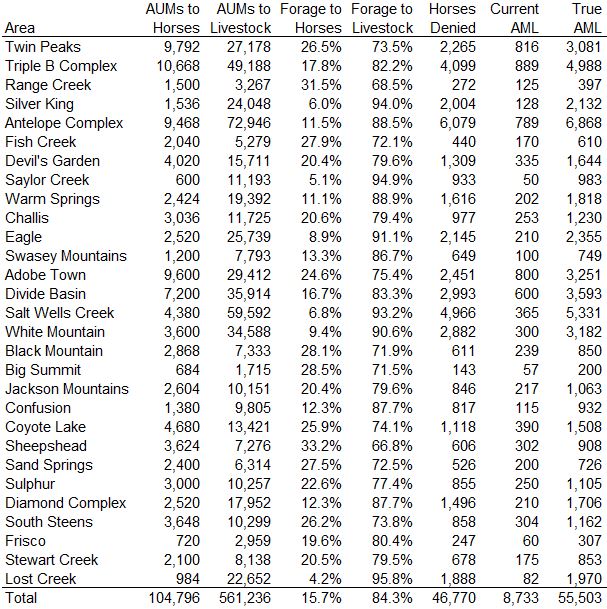
The column headed ‘New AML’ in this report could have been labeled ‘True AML,’ as it was computed according to the definition above.  You may be shocked by the magnitude of the numbers.

Program Trains Excess Horses for Forest Service Use

There are 95,114 wild horses and burros roaming on America’s public lands, according to a story published August 26 by the Jackson Hole News and Guide, compared to a recommended maximum of 26,770.

In Wyoming, the population exceeds the state’s goal by 4,900 animals and ranchers say the excess “robs rangeland from their cattle.”

Curiously, the article did not include any complaints by drillers, miners and loggers.

There is a problem, however.  There aren’t any excess horses and burros on America’s public lands, overall.

Yes, some areas are overpopulated in terms of their true AML—the number of animals the land can support if forage diverted to privately owned livestock was returned to the horses and burros.  For example, the pre-gather population in the Sulphur HMA, now in a roundup, included 88 excess horses.

But numbers like that are more than offset by shortfalls in other areas.  The 68,344 excess animals indicated above is fiction.

The story did not mention that according to the WHB Act, areas set aside for wild horses and burros are to be managed principally for them.  Instead, the government supplanted the statute with a regulation.  We’ll do that if we feel like it.

It did not mention that almost half of the land set aside for wild horses and burros is no longer managed for them, usually due to ‘inadequate resources.’  Roundups do occur in those areas and many are subject to permitted grazing.  The gather at Jakes Wash in Nevada provides an example.  The Caliente roundup of 2019 is another.

The article noted that wild horses have no natural predators but did not mention that in most cases they share their land with livestock.  The animals that would keep horse populations in check would also be interested in cattle and sheep, and the ranchers aren’t going to tolerate that.

They’ve never been able to tolerate the WHB Act either and have pushed for several amendments since it was signed into law almost 50 years ago.

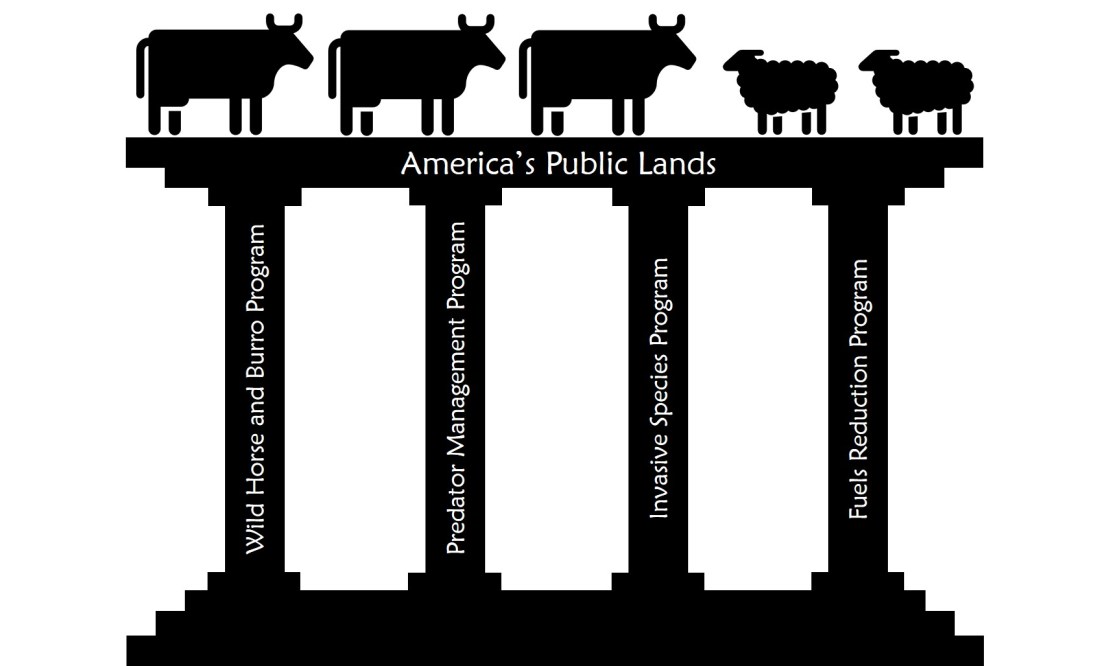
Today, the WHB program, like predator management programs, is nothing more than a grazing program ancillary, designed to give ranchers unfettered access to cheap feed on America’s public lands.

The enterprise, which has outlived its usefulness, should be shut down effective Monday morning, as the cost of those programs far exceeds the fees paid by the ranchers.


Cattle and Horses

Grazing Program Ancillaries

What do they have in common?  They work together to give ranchers unfettered access to cheap feed on America’s public lands.

You don’t have a horse problem on western rangelands, you have a ranching problem, and it is huge.

Grazing Program Ancillaries B-1