Family, Freedom Overrated

Roundups are not necessarily a bad thing for wild horses, according to the writer of the Sac Bee article, because humans will “find them loving homes and a life of fresh hay, warm barns and veterinary care.”

No more hooves stuck in cattle guards.

Instead, they’ll be locked in stalls and fed a steady diet of bits, spurs, tiedowns, blankets, braided tails and maybe even shoes, everything they dreamed of while on the range.

And, of course, everybody has a heated barn with running water, except the host of Western Horse Watchers.

RELATED: Sac Bee Publishes Hit Piece On Wild Horses.

Corral 12-21-20-1

Economic Benefit of Public-Lands Ranching in Wild Horse Areas?

The federal government sells about 12 million AUMs per year to public-lands ranchers, across 155 million acres, mostly in the western U.S.

That transaction generates about $16 million per year in revenue for the government, which manages those lands—supposedly—for the benefit of the American people.

How much of that income is produced in areas identified for wild horses and burros?

One way to answer the question is to scale the revenue according to acreage.

The management plans assign 27 million acres to horses and burros, approximately 17% of the land authorized for grazing.  The estimated revenue would be .17 × 16 = $2.7 million per year.

Another approach would be to consider the resource allocations in areas designated for wild horses and burros, where the plans allow 27,000 of them.  Data reviewed on these pages suggest that livestock receive eighty to eighty five percent of the forage, excluding wildlife.  That means they receive four to five times as much as the horses and burros.

If that’s true in other areas, the forage assigned to livestock in areas identified for horses and burros would be 27,000 × 12 × 5 = 1.6 million AUMs per year, worth $2.2 million per year at current prices.

Not much of an offset for the tens of millions of dollars spent every year—confiscated from American wage earners—to remove and warehouse the horses and burros, so the ranchers can enjoy more of what their allotments have to offer.

The major economic benefit accrues at harvest time.  Of course, those revenues stay with the ranchers and their overlords, not the American people.

It’s redistribution of wealth, classic socialism.  That’s what the farm bureaus, stockgrower’s associations and cattlemen’s groups are trying to defend.

What the CAWP Can’t Do

The program can’t change the resource allocations that leave America’s wild horses and burros with crumbs, necessitating their removal from public lands in favor of privately owned livestock.

So as the roundups accelerate and the ‘Path Forward‘ is put into practice, know that the animals are being treated humanely—even the ones that don’t survive—while cattle and sheep graze peacefully on land that belongs to them.

RELATED: BLM Reaffirms Commitment to CAWP.

Pancake Gather Plan

Heber Wild Horses: Setting Them Up for Failure?

A bachelor stallion chases a mare and foal as they leave a water hole in the following video by Friends of the Heber Wild Horses.  The fence is for livestock.

A management plan, drafted earlier this year, shows the WHT boundary relative to those of the allotments, page 10 in the pdf.  The proposed AML is discussed on page 21.

The AML for areas outside the WHT is zero, meaning the horses could be captured and removed from the forest if someone complains or they create a hazard.

When grazing season begins, gates are closed, and the horses are cut off from some of their food and water, perhaps a sizeable amount.

If they can’t access critical resources inside their designated area, they’ll move beyond it in search of new ones.  Gotcha!

This approach to wild horse management is not unique to the WHT.  It’s standard practice for most of the wild horse areas on western rangelands.  The new Desatoya resource enforcement plan, currently out for review, is another example.

The environmental assessment for the Heber management plan should be available for public review in early 2021, according to the project status.

RELATED: Heber EA in Progress.

Consumers Screaming for More Range-Fed Beef?

Wild horses should be relocated to remote wilderness areas, to satisfy growing demand for range-fed beef, according to a column published yesterday by the Mail Tribune of Medford, OR.  There, apex predators will keep their populations in check and cattle ranchers will be able to enjoy the full benefit of areas set aside for wild horses.

This is nuts.  If Equine Elite can buy an 80-acre parcel near Burns, WY to build a high-density animal feeding operation—for horses removed from public lands—why is it unreasonable to expect the ranchers to do that?  Many of them already have base properties of several thousand acres.

And why is it unreasonable to expect that lands identified for wild horses in 1971, about 50 million acres, should be managed principally for them, per the original statute?

Range Fed Beef

Castration Better Than Spaying?

The writer of a letter to the Las Vegas Review-Journal says it’s the easiest and cheapest way to curtail herd growth.

Why would you want to curtail herd growth?

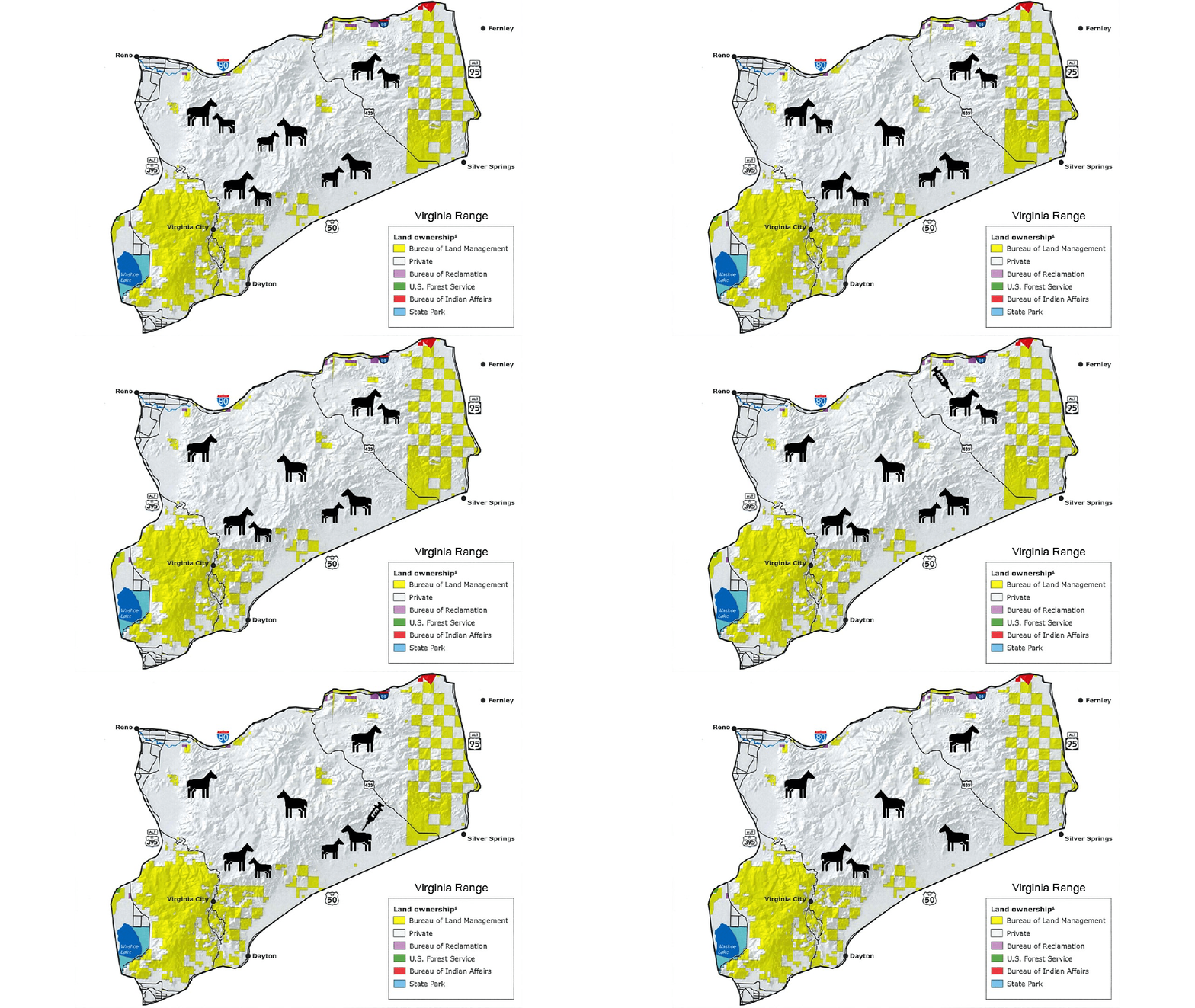
Look at the gather area for the new Desatoya resource enforcement plan, currently out for review.  The boundary, denoted in red, extends well beyond the HMA.

Desatoya Gather Plan Map

When you carve out over 80% of their food and sell it to public-lands ranchers, don’t you think the horses might outgrow the remaining resources fairly quickly and move off the reservation in search of new ones?

That puts them into areas managed exclusively for wildlife and the most noble and deserving inhabitants of America’s public lands: Privately owned livestock.

RTF Tries to Stop Sterilization of Confusion Wild Mares

Return to Freedom filed suit today in federal court to block the plan, according to a news release, arguing that contraceptives should be used to control herd sizes.

The resource allocations and management priorities that leave wild horses with crumbs on public lands in the western U.S., in favor of privately owned cattle and sheep, were not mentioned in the announcement.

The group is a signatory to the rancher-friendly ‘Path Forward,’ a plan to manage wild horse areas primarily for livestock.

RELATED: Why Should You Oppose Sterilization of Wild Mares?

Best Place to See Oregon Wild Horses Is In the BLM Corrals?

That’s what the writer of a letter to the Pagosa Daily Post was told.

As for the number of livestock allowed on America’s public lands, the figure offered by the writer is a fairly good estimate.

The BLM sells about 12 million AUMs per year to public-lands ranchers.  If you assume an average grazing season of six months per year, that’s two million cow/calf pairs.

That forage would support one million wild horses, enough to empty all of the off-range corrals and long-term pastures twenty times over.

Slaughter Debate Continues

Point: Column in the East Oregonian dated December 5.

Counterpoint: Reader response dated December 10.

Neither writer mentions the horses displaced from public lands by privately owned livestock.  Nearly 2,000 at the Pancake HMA and that’s just one of approximately 200 WHTs and HMAs.

Given that the ranchers pay about five cents on the dollar to feed their cattle, the product should be dirt cheap and good way to help the poor.

Range-fed beef.  Yum.

Pancake Comment Period Almost Over

A news release published yesterday by Friends of Animals urges you to tell the BLM that you oppose the removal of wild horses from the Complex.

Don’t do it.  BLM already knows that.

The problem is in the RMPs listed in Section 1.0 of the Draft EA and those documents are not up for review at this time.  Your comments will likely be dismissed as outside the scope of the project.

The draft enforcement plan, which is open for discussion, is designed to achieve and maintain AMLs in the four areas that make up the Complex.  Those targets are based on the resource allocations and management priorities of the RMPs.

FOA is on the right track, however.

Keep in mind that drilling and mining, mentioned in the statement, affect anywhere from a few acres to a few thousand acres, while public-lands ranching affects entire HMAs—hundreds of thousands of acres—so keep the focus where it belongs.

RELATED: Pancake Wild Horses Get Short End of Stick.

Pancake Gather Plan