Success on the Salt River

The PZP zealots got rid of 80 or more wild horses last year, according to a story by The Fountain Hills Times.  Only 16 foals were born in 2020, down from over 100 in 2019.

Beat that ExxonMobil!

This is great news because the horses are not allowed to outgrow their boundaries.

What’s on the other side of the fence?

In typical fashion, they tell you the ‘vaccine’ is safe and does not change herd behavior, but they never supply any data to allow you to make an assessment for yourself.

  • Herd size
  • Stocking rate
  • Percentage of males and females
  • Percentage of foals
  • Average lifespan
  • Number of deaths
  • Changes year over year

Same thing for the Virginia Range.  The darting program is a success but we’re not going to give you any demographics.

Like Assateague Island, the full effect of the programs may not be revealed for another twenty years.

RELATED: Oil and Mining Companies Can’t Match Impact of PZP Zealots.

WHB50 Gaining Momentum

The fiftieth anniversary page for the WHB Act now has a masthead, promoting the hardiness and versatility of America’s wild horses.

Why would anybody care about the versatility of wild horses?  Because the theme is going to be ‘off the range’ and the concept may correlate with greater interest in adoptions, training and private care.

RELATED: The Horses Are Still a Problem But the Statute Is Not.

Predators Can’t Match Impact of PZP Zealots

They’re getting rid of more wild horses than these guys ever could.

The management plans assign most of their food to privately owned livestock, forcing them into areas where they’re not welcomed, and their answer is to shoot the mares with contraceptive darts.

Next to the public-lands ranchers, the greatest threat to America’s wild horses is not the drilling companies, not the mining companies, but the so-called advocacy groups.

RELATED: No Natural Predators?

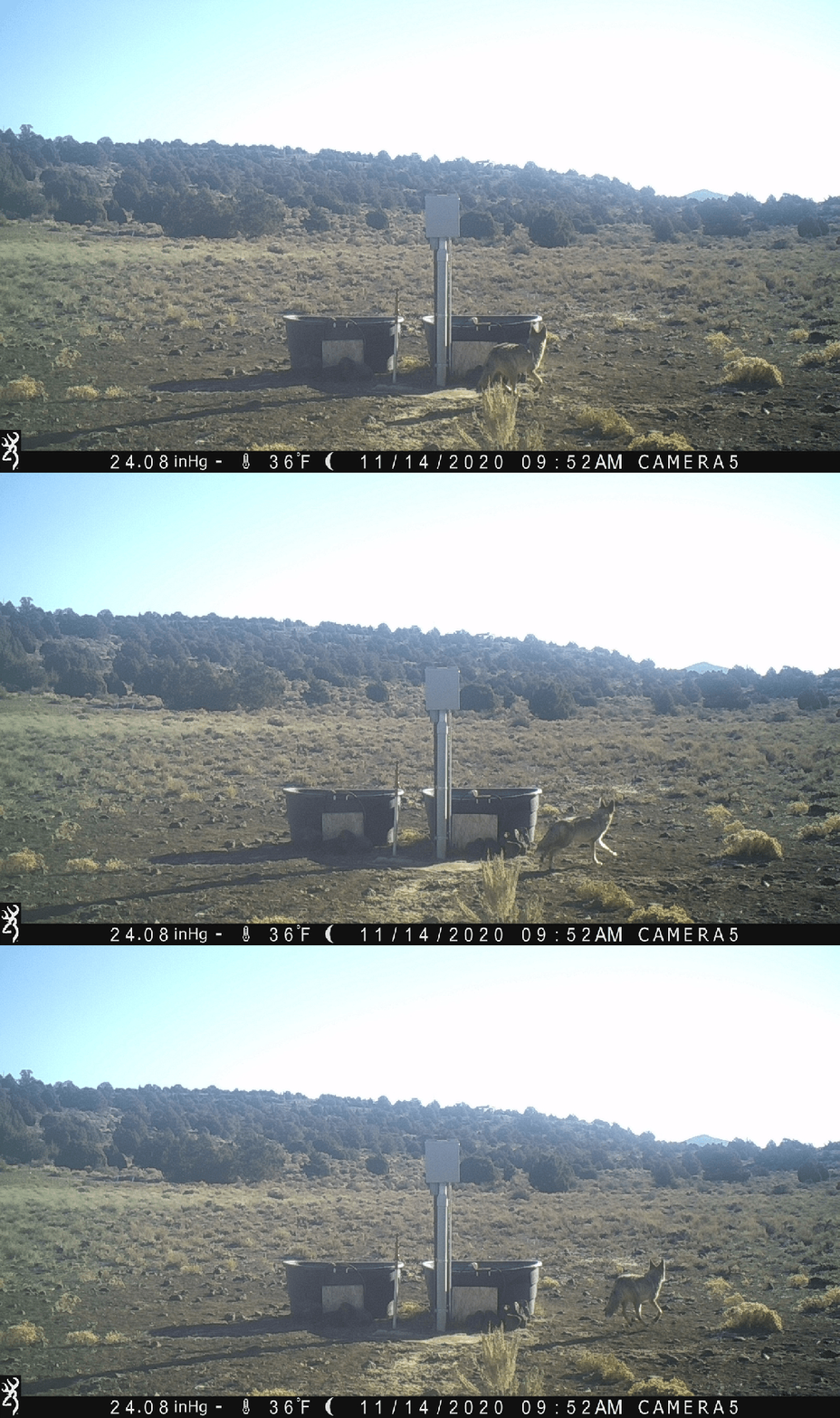
Coyote at Water Tanks 11-14-20

My, How Quickly Things Change at the BLM

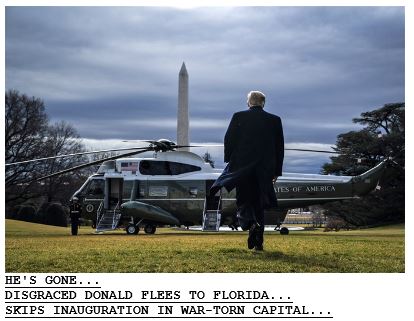
Two hours into the Biden administration.  If you go to the BLM home page and click on the Quick Facts tab, you’ll see four priorities, down from six priorities under Trump.

What changed?

  • Safety through Energy Independence – Gone
  • Supporting the American Worker – Gone
  • Securing America’s Borders – Gone
  • Greatness through Shared Conservation – Gone
  • Respecting the American Family – Gone
  • Preserving America’s Cultural Resources – Still there

New priorities may appear in the coming weeks.  The goal for today was to get rid of anything Trump.

RELATED: Haaland to Head Interior?

Modoc Horse Problem: Allowing Cattle Ranchers to Make a Living

“It’s not fair to cut out the small rural communities that rely on these places for their livelihoods,” according to a story posted today by KQED.

Nobody’s trying to shut them down.  We just want them confined to their own property, like everybody else.

Get your livestock off the public lands and pay the going rate to feed them.

RELATED: Fixing the Modoc Horse Problem.

Comments on Today’s News

BLM Fills WHBAB Vacancies

Western Horse Watchers believes all three appointees are hostile to America’s wild horses and burros.  Nobody from the drilling and mining sectors was selected.

Fence Sought for Fish Springs Mustangs

The Buckeye Allotment is in the ‘Improve’ category, probably because of the horses.

Managing Primarily for Livestock

BLM announced today in a news release that a decision record for the fuels reduction project had been signed but Western Horse Watchers is unable to find it in the project documents.  Eradication of those pinyon pines and juniper trees is inexcusable.

Managing Primarily for Livestock

Refer to this opinion piece on BLM’s “Programmatic EIS for Fuels Reduction and Rangeland Restoration in the Great Basin,” NEPA project DOI-BLM-ID-0000-2017-0003-EIS.  It’s not just about areas identified for wild horse and burros.

The views expressed in the article, hosted by CounterPunch, are those of its author and not necessarily those of Western Horse Watchers.

The government spends untold amounts on these projects, confiscated from American wage earners, while the ranchers pocket the benefits.  It’s redistribution of wealth.

RELATED: Sagebrush Restoration Project Inching Ahead.

BLM3

Contraceptives Extend Life of Wild Mares?

The annual report for the Shackleford herd in 2020 says “Contraception has been linked to increased longevity among treated females.”

One explanation, not invented here, is that treated mares don’t have to go through the stress of pregnancy, birth and caring for a new foal.

Stallions don’t go through any of that, yet they only represent about one third of the Shackleford population.

On the Maryland side of Assateague Island, females outnumber males 2.4 to 1.

Both herds are subject to ‘humane management practices.’

A difference is that the disparity at Shackleford can be attributed to chance, random noise in the process, while the imbalance at Assateague is so large that it must be attributed to an assignable cause, a signal of trouble in the herd.

That may explain why the fertility control program was shut off in 2016.

Are the Shackleford horses heading in the same direction?  Do contraceptives have other effects that would limit their use?  Is the cup half full or half empty?

RELATED: Shackleford Herd Grows In Latest Census.

Haaland to Head Interior?

Her nomination is subject to Senate confirmation, as reported last month by The Hill.

“Hey Western Horse Watchers, she’s native American.”

Hatred of God and country are learned behaviors.  They can be taught to anyone, even native Americans.

She would be responsible for a number of federal agencies, including the Bureau of Land Management.  What do you suppose the priorities will look like after January 20?

Drilling and Mining Companies In Same League as PL Ranchers?

If you’re talking about the impact on wild horses, the answer is yes, according to the writer of a story posted today by World Animal News.  It’s an interview with filmmaker James Kleinert.

Western Horse Watchers disagrees.  Drilling and mining affect anywhere from a few acres to a few thousand acres, while public-lands ranching affects entire HMAs and beyond—hundreds of thousands of acres.

The emergency roundup mentioned in the article is probably Delamar.

UNR Cattlemen’s Update to Include Session On WHB

The conference will be held virtually this year, according to an announcement dated January 4.

The WHB update will be presented by Barry Perryman, UNR professor and member of the Wild Horse and Burro Advisory Board, on the afternoon of January 13.

If it was a driller’s conference, would there be a session on wild horses and burros?

What if it was a miner’s conference?

Wild Horses Reduce Wildfires?

They can, according to a guest column appearing today in the Pagosa Daily Post, by consuming grass and brush that carry flames to other fuels, such as trees.

The writer is described as a naturalist, author and conservationist.

A related article posted today by the Ag Information Network of the West provides additional details.

The author of the guest column wants horses removed “from areas where they are not wanted,” such as HMAs, and placed “in the mountains in an effort to reduce wildfire fuel.”

You see, many of these “remote wilderness areas are poorly suited to commercial livestock grazing due to the extensive predation of calves and lambs, poor accessibility and very difficult terrain,” so horses should live there.

Does this sound familiar?

The author is the same guy who wrote a column last month about moving wild horses into remote areas so public-lands ranchers can have full access to their food.

He’s listed as a rancher/conservationist in the Ag Info article.

Virginia Range Darting Program Spreading to South Africa?

A report by Deseret News says that a researcher from the University of Pretoria will be collaborating with personnel from the American Wild Horse Campaign regarding the use of PZP to manage elephants in limited habitats.

Volunteers on the Virginia Range have treated 1,333 mares in a herd of 3,000 horses that roam on 300,000 acres, according to the story, with an expectation that 600 lives will be denied this year.

You can’t have healthy horses at a stocking rate of ten animals per thousand acres when you’re an ally of those who demand stocking rates of one wild horse per thousand acres or less on public lands in the western U.S.—to accommodate more privately owned cattle and sheep.

These people are preventing wild horses, not protecting them, an insult to Velma’s legacy.

The report confirmed that the ‘One-Horse Pony‘ Amendment was dropped from the FY 2021 spending bill.

RELATED: PZP Zealotry on a Global Scale, So Long, PZP Amendment?

Water Tanks 06-25-20

The Horses Are Still a Problem But the Statute Is Not

The WHB Act, formally known as 16 USC 30, turns 50 in December but no longer functions as Velma intended.  Most of the protections are gone.

How did we get to the point where almost half of the land identified for wild horses and burros has been taken away and most of the resources on the remaining land have been diverted to privately owned livestock?

  • Changes to the statute by Congress (amendments)
  • Rules promulgated by the unelected bureaucracy (regulations)

The regulations have probably had the greatest impact.

In the original Act, land where wild horses and burros were found was to be “devoted principally but not necessarily exclusively to their welfare.”  That was the only condition.

Today, land is managed principally for them if the bureaucracy says so.

And what has been the response of the ‘advocacy’ groups?  Bash oil and mining companies while pushing contraceptives.

Reform has to start on the advocacy side and that’s what this blog is all about.

RELATED: Coming Soon: WHB Act at 50, Statutes and Regulations.

Economic Viability of Wild Horse Roundups

The economic attractiveness of the scenario considered yesterday, which was based on data from Table 3-3 in the Draft EA for resource enforcement actions in the Desatoya HMA, was zilch.

  • Spend $954 to remove a wild horse from his home range
  • Spend $568 per year to keep him in long-term holding
  • Collect $16 per year from the rancher to whom his food is sold

So the question arises: By how much would the grazing fee have to increase to justify the endeavor from an economic viewpoint?

A crude approach to the problem would be to solve for x in the following expression, where 12 represents the forage that would have been consumed by the horse but is now available to livestock (AUMs per year), x is the grazing fee ($ per AUM) and 568 is the cost of long-term holding ($ per year).

12 × x = 568

The answer is x = $47.33 per AUM.  The fee would have to increase from $1.35 to $47.33 to pay for long-term holding.  But it doesn’t pay for the cost of capture and doesn’t reflect the time-value of money.

That’s why the BLM used present values in the EA.

Another way to answer the question is to model the situation in a Excel, using the built-in present value functions.  Most of the cells in this example have text and numbers except B13, B15, B17 and B19, which have formulas.
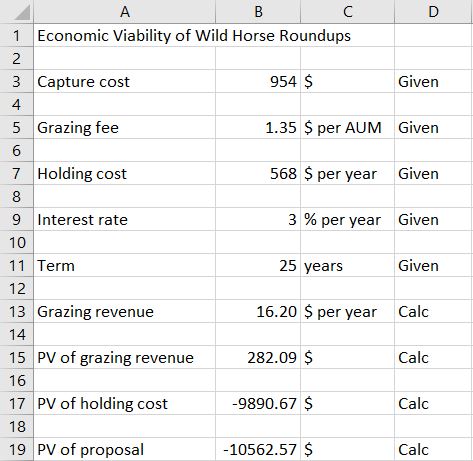
Economic Viability of Wild Horse Roundups-1

If you put the data in different cells the formulas won’t work.  The sign convention for cash flows is negative for expenditures, positive for revenues.

The present value function discounts a series of future payments (or receipts) back to the present, for a given interest rate and time period, which in this case were taken from the EA.

The model assumes that a captured horse is not adopted and is transferred immediately to long-term holding.  The analysis in the EA is a bit more complex, using both short-term and long-term holding, a topic for future discussion.

The present value of the capture cost is $954, as it occurs at the start of the process.

The other transactions are assumed to occur at the end of the year and are assumed to be constant over the life of the project.

  • Beginning of year 1: Spend $954 to capture a wild horse
  • End of year 1: Spend $568 for holding, receive $16 in grazing fees
  • End of year 2: Spend $568, receive $16
  • End of year 3: Spend $568, receive $16
  • ¦
  • End of year 25: Spend $568, receive $16

The present value of the proposal is the difference between the present value of the grazing revenues and the present value of the holding costs, minus the capture cost.

The formulas are as follows:

  • B13: =12*B5
  • B15: =PV(B9/100,B11,-B13)
  • B17: =PV(B9/100,B11,B7)
  • B19: =B15+B17-B3

The cell formats were changed to two decimals, getting rid of the accounting formats applied by Excel when entering financial functions.  You can download a copy of the spreadsheet here.

The present value of the proposal, in cell B19, is negative, meaning the present value of the costs exceeds the present value of the revenues.  It is a bad investment.

By how much would the grazing fee have to increase to make the present value of the proposal positive?

Try entering some larger values in cell B5, observing the effect in B19.  You may have to enable editing when the file opens, depending on the security settings of your computer.

The amount that flips the present value from negative to positive would be the smallest fee that makes wild horse roundups economically viable.  If the proposal involved a mix of short-term and long-term holding, as in the EA, the fee would be higher.

Of course, everything is off the table until areas identified for wild horses and burros are managed principally for wild horses and burros, as specified in the original statute.

Commenting On the Desatoya EA

The present-value analysis following Table 3-3 in the Draft EA, as noted yesterday, shows there is no economic justification for wild horse roundups.  That would be a substantive comment.

If the present value of the costs exceeds the present value of the benefits, the proposal should be rejected.  In this case, the proposal is to remove and warehouse wild horses.

Another comment involves the rationale for the benefit calculation: Money spent on removing and warehousing wild horses is offset by grazing fees, not the price of hay the ranchers would have to pay if (OMG) their livestock were confined to private property with imported feed.

  • Spend $954 to remove a wild horse from his home range
  • Spend $568 per year to keep him in long-term holding
  • Collect 12 × $1.35 = $16 per year from the rancher to whom his food is sold

There’s no way you could get that past your boss in the private sector.

Concerns about resource allocations and management priorities, although valid, should not be submitted as they are outside the scope of the project.

Comments on the EA can be submitted through January 9.

RELATED: New Desatoya Gather Plan Available for Review.