Horses and Cattle to Be Removed from TRNP?

The Park Service is working on a new livestock management plan that will protect native species and the natural prairie ecosystem at the expense of nonnative horses and cattle, according to a story posted this evening by The Bismarck Tribune.

Not mentioned in the report:

An advocate interviewed for the story said all the horses can’t stay but maybe the Park Service can keep some of them.

You have to give them credit: They think alike.

“If we get rid of them, they can stay.”

RELATED: Advocates Criticize Treatment of Horses at TRNP.

Leave Your Estate to the Wild Horse Advocates?

They could spend more time on the range pummeling the mares with their favorite pesticide and less time devising ways to separate you from your money.

New Pine Nut Calendar 11-19-22

Their mission is to help the bureaucrats enforce management plans that assign most of the resources to privately owned livestock in areas set aside for wild horses.

If you think they’re doing a good job and deserve a share of your estate, refer to this month’s episode of “Wild Horse Tales,” starting on page 13 in the December edition of Horse Tales.

Donations from ranchers and ranching sympathizers always accepted.

RELATED: The Trials and Tribulations of the Advocates

Advocates Say Currituck Herd Spends Most of Its Time Eating

That’s probably not a surprise to many in the wild horse world but a statement last week on socialist media, reported yesterday by The News & Observer of Raliegh, NC, might raise a few eyebrows:

“This time of year, the herd spends 89% of the day, or 16-plus hours, fattening up for winter.”

If 89% of the day corresponds to 16 hours, then a day spans just 18 hours, not 24.

Maybe it’s a typo—or an undocumented effect of global warming.

The story also indicated that the horses poop 1.5% of the time, with travel and rest occupying 10.5% and 12.5% of their day, respectively.

Western Horse Watchers thought they spent 98% of their time hiding from the advocates, who have been targeting the mares with their favorite pesticide.

RELATED: Praising the Currituck Advocates.

Guide to End-of-Year Giving

You want to help wild horses but don’t know who to support.

Western Horse Watchers doesn’t either.

Most of the 501(c)(3) nonprofits are fraudulent.

They tell you they’re saving wild horses while they’re actually getting rid of them, with benefits accruing to the public-lands ranchers.

If they talk about cruel and costly roundups, humane management and cherished wild horses, your donation may be used to dart the mares with PZP, a restricted-use pesticide and sterilant marketed as a safe, proven and reversible vaccine.

File under: Charlatans.

New Pine Nut Calendar 11-19-22

Forest Service Cedes Oversight of Allotments to Permittees?

A story dated December 2 by the Western Livestock Journal said the Public Lands Council and U.S. Forest Service have signed a memorandum of understanding to promote cooperative monitoring of grazing allotments on National Forest System lands.

The MOU will allow sharing of information about rangeland health between permittees and the Forest Service and will strengthen the partnership between them, according to the report.

A similar agreement with the Bureau of Land Management is expected by the end of the year.

An article dated December 9 by Wyoming Livestock Roundup indicates that range monitoring carried out by permittees will be accepted by the Forest Service as a legitimate source of data and the agency will treat that information as its own!

The writers did not indicate if the ranchers’ reports would be subject to audits or other administrative controls.

The Public Lands Council and its parent organization, the National Cattlemen’s Beef Association, have been pushing for changes to standards for rangeland health, temporary non-use and flexibility with on and off dates, according to WYLR.

The groups submitted an appropriations request of $153.1 million for the wild horse and burro program [in FY 2023?], which was about $20 million higher [than FY 2022?].

Like other government dependents, they want the federal government to confiscate more and more money from American wage earners and spend it on programs that benefit them.

This process, known as “redistribution of wealth,” is a hallmark of liberalism, socialism and communism.

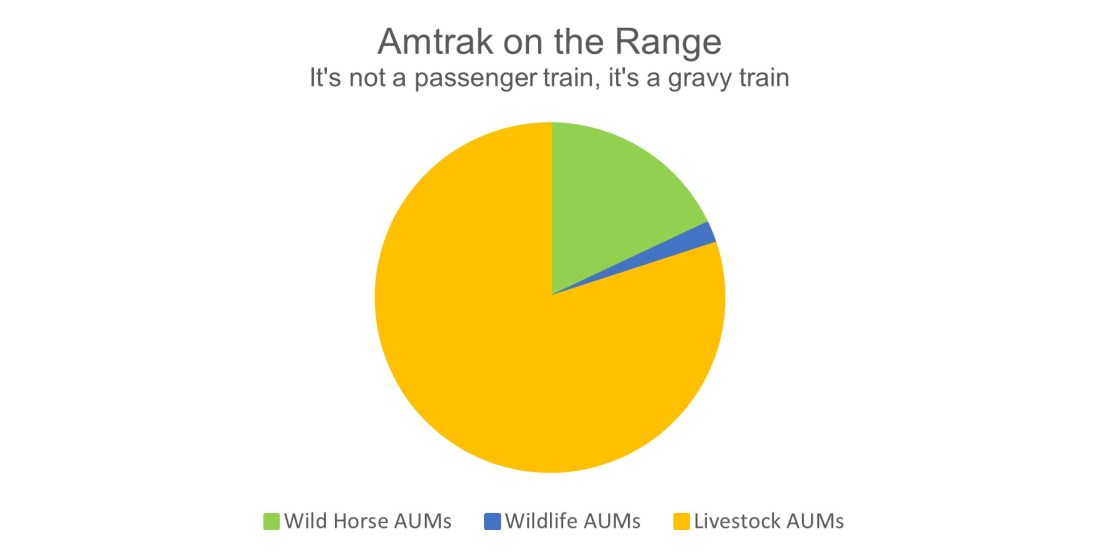
Amtrak on the Range 11-21-22

The Advocates Have No Role in Wild Horse Preservation

Defined by their unwavering support of the Montana Solution and management plans that assign most of the forage to public-lands ranchers, they are to be opposed at every opportunity.

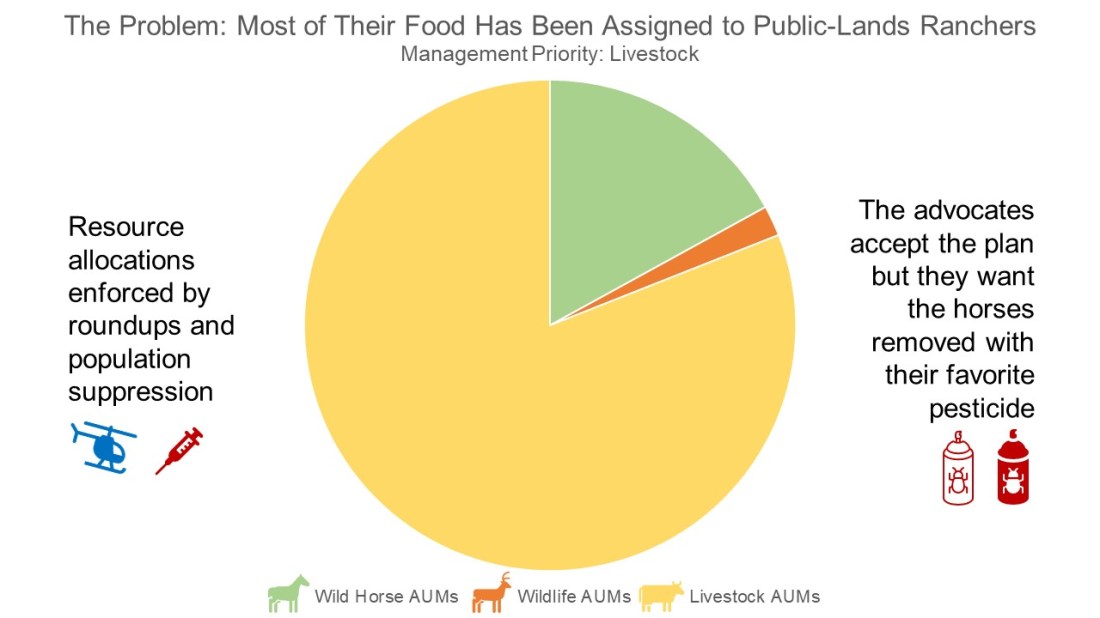
This chart shows you what they’re trying to protect.

The Problem 12-04-22

The cart also explains why you see capture, branding, harassment and death of wild horses, all prohibited in the original statute.

“You have to manage the numbers to fit what’s available for the horses.”

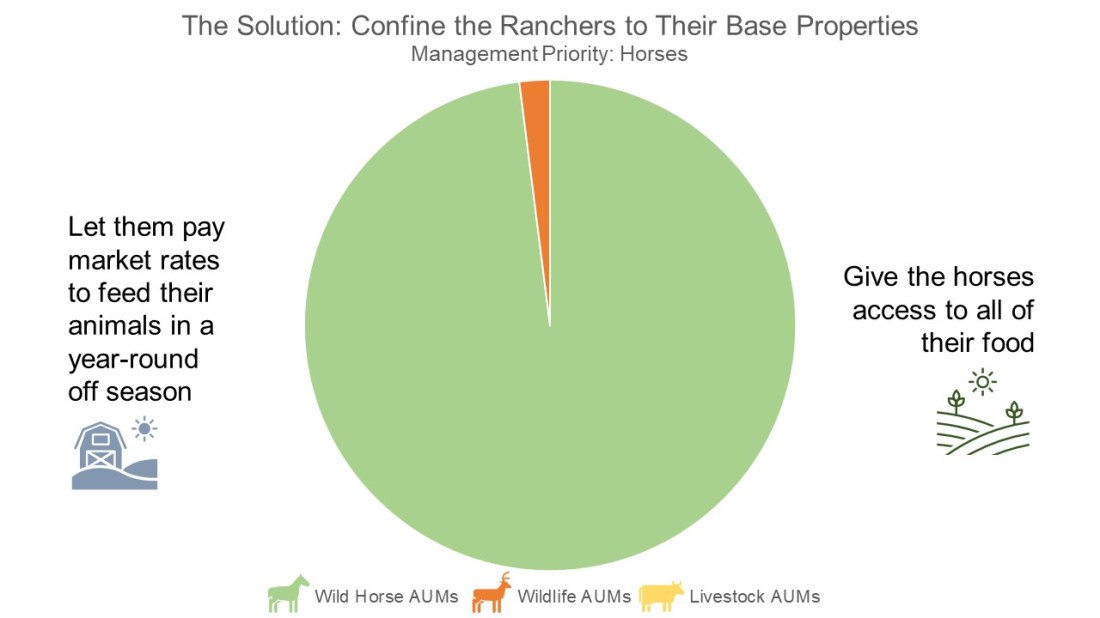
This chart shows you what Congress intended.

The Solution 12-04-22

There was only one requirement for lands to be managed in this manner: Horses were found there when the legislation was signed into law.

If you’re thinking about a year-end donation to a group that talks about cruel and costly roundups, humane management, keep them wild and free, or protect our cherished horses, think again.

RELATED: The Carrying Capacity Puzzle.

Dead-End Populations

The segment in the Saving America’s Horses trailer about surgical sterilization includes a remark about wild horses living out their lives as dead-end populations, destined for extinction.

Which of the following advocates warned that the herds will die off and the horses will be gone if there’s no reproduction?

a. Suzanne Roy

b. Neda Demayo

c. Simone Netherlands

d. Ginger Kathrens

e. Joanna Grossman

All are adherents of chemical sterilization via the Montana Solution, the centerpiece of HR 9154.

RELATED: New Documentary Looks at Horse Slaughter?

PZP Dangers 10-21-22

Managing the Herds to Keep the Herds?

The CBS reporter in this film from Day 4 of the Twin Peaks Roundup asks the BLM spokesman at 2:38 if his agency manages the herd to keep the herd and he says that’s exactly right.  The goal is healthy herds on healthy public lands, which means most of the resources consumed by privately owned livestock, as specified in the land-use plans.

Western Horse Watchers knows what you’re thinking: Do the bureaucrats sound like the advocates or do the advocates sound like the bureaucrats?

You decide.

“If we get rid of them they can stay.”

“We’re protecting them from removal by getting rid of them with PZP.”

“If we don’t get rid of them the BLM will.”

RELATED: CBS Mornings Looks at Twin Peaks Roundup.

The Trials and Tribulations of the Advocates

The November edition of Horse Tales has been published, including a column about the Montana Solution by the real estate agent and PZP darter in the Minden/Gardnerville area.

The listings are on the back page.

The front page has three photos of the Pine Nut horses.

The first thing you notice is not the backdrop, which is magnificent, but the absence of youngsters.  This is the handiwork of the advocates.

The theme of the article, starting on page four, is “If we get rid of them, the BLM won’t have to.”

The ad at the bottom of page nine shows how you can support their mission, which is to ensure the public-lands ranchers can access most of the forage in an area set aside for wild horses, as specified by the bureaucrats in the land-use plans.

New Pine Nut Calendar 11-19-22

“The birth control vaccine,” which is is actually a restricted-use pesticide, “is not available to the general public.”

“Every darter must be certified by the Science and Conservation Center,” the Billings School of PZP Darting.

“There will always be opposition to any program, so it is essential you understand the vaccine, how it is created, the costs and protocol.”  Yeah, some of us want the horses to succeed, not the ranchers.

“It is important you understand it well enough to be able to explain it to concerned people who believe we should leave nature alone,” which means you also need training in lying to the public, which the advocates will provide.

The remainder of the article considers the almost insurmountable difficulties facing the advocates in on-range management of wild horses: Stalking them in rough terrain, identifying the right mares and obtaining good shot placement.  Any errors and (OMG) they might get pregnant.

Crime in the Wild Horse World 05-26-22

Imagine hiking a quarter mile up a hill and aiming your trusted darting rifle, when an off-road vehicle or motorcycle zooms by, scaring the band off at a full gallop!

“But the public lands must be shared with everyone, and everyone has a right to be there,” including privately owned livestock, which she consistently fails to mention.

RELATED: How Many Wild Horses Can the Pine Nut HA Support?

Challenge Their Authority!

As noted previously, the BLM sells about 12 million AUMs per year to the public-lands ranchers on 155 million acres, which includes most of the land identified for wild horses.

That works out to 77.4 AUMs per year per thousand acres, enough to support 6.5 wild horses per thousand acres.

The BLM insists that public lands in the western U.S. can only support one wild horse per thousand acres (27,000 animals on 27 million acres).

The current population is about three wild horses per thousand acres.

Why are the advocates so eager to get rid of wild horses when the land can support many more than the BLM admits?

“Are you questioning our authority?”

Yes we are.

“Never mind, we know what’s best for the horses.”

No, you know what’s best for the public-lands ranchers.

RELATED: Their Words Never Match Their Deeds.

HMAs Freed from Grazing 05-23-21

Their Words Never Match Their Deeds

An advocate with the Campaign Against America’s Wild Horses told a reporter for Cowboy State Daily in a story posted today that wild horses “shouldn’t be considered scourges or something to get rid of.”

What is her group doing on the Virginia Range?  Getting rid of wild horses.

These people are so full of crap!

Every now and then they have a few harsh words for the public-lands ranchers, but no offense is taken.

It’s part of the charade that keeps the donations rolling in while maintaining the status quo—areas set aside for wild horses are managed primarily, if not principally, for privately owned cattle and sheep.

RELATED: Criticize Livestock, Dart Horses.

Turmoil at Currituck Wild Horse Advisory Board?

The group convenes on a quarterly basis, at least in theory, but the meetings for August and November were cancelled.

Minutes from the May meeting include a report by Meg Puckett of the Corolla Wild Horse Fund, starting on page six of the pdf.

The on-range population was 106 as of March, with 19 animals in off-range holding.

Six foals were born in 2022, for a birth rate 5.7%.

The Equus Survival Trust classified the herd as Critical/Nearly Extinct in their 2022 Equine Conservation List, yet the advocates have been pummeling the mares with their favorite pesticide for years.

Curiously, only two have been darted this year.

“Due to significant loss over the last several years, an aging population, and questions about the long-term effects of PZP on the mares’ reproductive systems, healthy mares are not being darted in 2022.”

Moreover, “The small roster of mares consistently producing foals has not changed significantly in six years.”

The Assateague herd shows no growth six years after the safe, proven and reversible darting program was shut off.

Will history repeat in Currituck County?

The Currituck advocates have been invited to present research at a conference hosted by the Science and Conservation Center in 2023 (the Billings School of PZP Darting), according to the report.

Truth will likely be in short supply.

The minutes also include a marked-up version of the Wild Horse Management Agreement, starting on page 11, which protects and maintains a thriving ecological balance, and preserves the free-roaming nature and habits of the horses!

RELATED: Advocates, Not Climate Change, to Destroy Currituck Herd.

Standing Up for Wild Horses on Virginia Range 06-18-22

Rationale for Roundups: Healthy Horses on Healthy Rangelands

The term is used in this video from the Piceance adoption at the Mesa County Fairgrounds in Grand Junction.

It’s similar to “If we get rid of them they can stay,” a favorite of the advocates.

If an area set aside for wild horses can support 1,500 animals, and the current population is 800, with an AML of 300, wouldn’t you expect to find healthy horses?

Of course you would.  So what’s the problem?

Eighty percent of the forage, corresponding to 1,200 animals, has been assigned to privately owned livestock.

At least 500 horses have to go.  Some may end up in pens like these.

You can have your wild horse and burro program as long as it doesn’t interfere with the grazing program.

RELATED: BLM Admits Piceance HMA Not Managed Primarily for Horses!