Foreground, on the left, and at the water tank on the right. Base color is definitely not black. Strawberry roans? Trailcam photos from the Virginia Range.


Western Horse Watchers Association
Exposing the Hypocrisy, Lies and Incompetence of the Wild Horse Advocates
Foreground, on the left, and at the water tank on the right. Base color is definitely not black. Strawberry roans? Trailcam photos from the Virginia Range.
The four year old was put down after a vet said his leg injury was beyond repair, according to a report by WFMY News of Greensboro, NC.
RELATED: Corolla Mare Hits Guy Wire.
For years we’ve heard that taxes and regulations are destroying businesses—weakening our competitive position—but now we’re learning that wild burros are the culprit, at least in Arizona.
They’re trampling the ground, reducing vegetation, invading farmland, breaking fences and releasing livestock, according to a story posted Thursday by the U.S. Small Business Administration Office of Advocacy.
They have no natural predators and compete with domestic cattle for resources.
While all of these things may be true, the author did not indicate if they were occurring on public lands set aside for the burros.
If not, were those lands designated as open range, where the owners are responsible for keeping the burros out (by constructing suitable fences)?
Whatever the answers, the ranchers want the burro populations reduced and are willing to look at all options.
Complaints about the burros from oil companies, mining companies, timber companies, hikers, campers and tourists appeared nowhere in the story.
BLM said today that the number of wild horses in the Fifteenmile HMA, northwest of Worland, WY, would be reduced from nearly 700 to around 100 this fall, the point at which the HMA can support the horses and other mandated uses of the land (privately owned sheep in this case).
Horses that have moved onto private and state lands will also be removed, according to the news release.
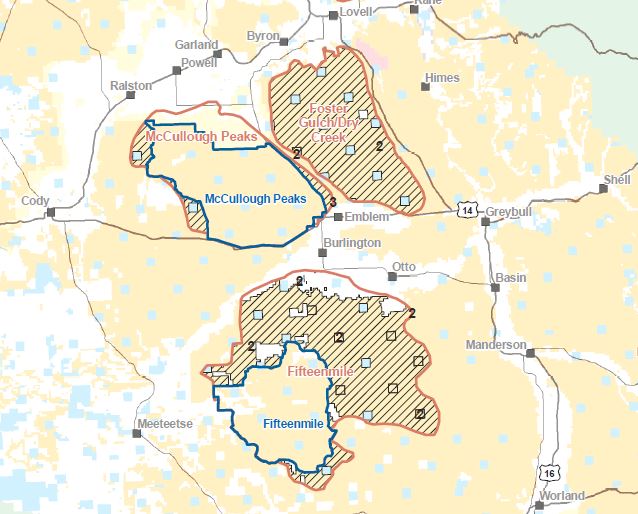
Supporting documentation, including the final environmental assessment and herd management plan, can be found on this page.
The HMA intersects five grazing allotments, according to the EA, with 3,370 AUMS per year allocated to sheep (60%) and 2,300 AUMs per year allocated to the horses (40%).
There isn’t one. See this report, posted today by The News & Observer of Raleigh, NC.
RELATED: Deputies Issuing Citations for Approaching Corolla Wild Horses.
There must be a mistake. A post from today appeared in Bing search results…today.

“We have spoken to the developers and it won’t happen again.”
Camping and hiking at Theodore Roosevelt National Park with Reel Diel Outdoors.
A report posted today by the Lexington Herald-Leader says they eat bugs stirred up by the horses. Observers are not sure if the horses actually like these birds or just tolerate them, according to the story.
A condition on some Herd Management Areas where a nominal amount of the available forage—at least 60%—is allocated to privately owned cattle and sheep, with the balance going to wildlife and free-roaming horses.

The Park Service will remove 14 wild horses from the south unit of Theodore Roosevelt National Park, to prevent overgrazing, according to a story by Inforum of Fargo, ND.
Captured animals will be offered for adoption later this month through an online auction by the General Services Administration.
RELATED: Horses of the Badlands.
On the Salt River with Pam Rutherford.
On-road adventure near Lockwood, NV with California Travel Videos.
A story by Taos News dated 08/01/19 confirms it’s in southern Colorado near the New Mexico border. A herd of 150 wild horses inhabits an area formally known as San Pedro Mesa, which includes the Sanchez Reservoir.
Judy Barnes of Spirit of the Wild Horse, a non-profit organization she started, cares for the animals, protecting them from mustangers.
The article did not indicate if the land was public or private and if it was subject to livestock grazing.
RELATED: Wild Horse Mesa.
UPDATE: Judy said WHM is on private land, part of a real estate development known as Melby Ranch, with some livestock grazing on the east side.
On Theodore Roosevelt National Park, South Unit, with Heather White.
If this is true, why aren’t they calling for an end to public-lands ranching? Instead of ‘Ten Years to AML,’ it’s ‘Cattle-Free by ’23.’
Off-road adventure to the PM Wild Horse Range, home of Cloud, the wild stallion.
Refer to this story in Drovers, posted yesterday. Those 237 horses were ‘relocated,’ not ’rounded up’ or ‘removed from their home range.’
Changing the vocabulary and redefining terms, to hide something evil or unpleasant, are sure signs that liberals are involved.
Abortion is not baby murder, it’s ‘women’s health’ or ‘family planning.’
Shooting wild mares in the ass with contraceptive darts is not harassment, it’s ‘humane management.’
RELATED: Red Rock Gather Complete.

Young colt crosses the river with his band, courtesy of SRWHMG.
Sixteen wild horses have been captured as of today. One death was reported.
The gather may remove as many as 100 wild horses from the Caliente Complex, which includes nine Herd Areas in eastern Nevada: Applewhite, Blue Nose Peak, Clover Creek, Clover Mountains, Delamar Mountains, Little Mountain, Meadow Valley Mountains, Miller Flat and Mormon Mountains. See Map 1 on page 5 of the Final EA.
All of them were HMAs but were zeroed out according to section 4.2.2 in the EA.
The news release from last week said they didn’t have enough forage and water to sustain wild horses.
Yet the horses are there, over 2,000 of them.
The Complex is overlapped by 26 grazing allotments, per Table 3.2 in the EA, which are permitted for 39,920 AUMs per year. That means they can support 5,617 cow/calf pairs over a weighted-average grazing period of 7.1 months per year.
Or 3,326 wild horses over a twelve month period.
But the goal is to achieve and maintain a thriving ecological balance and multiple-use relationship on these lands (section 1.1), which apparently means no wild horses.
RELATED: Mustangs to Be Removed from Eastern Nevada Starting Today.

